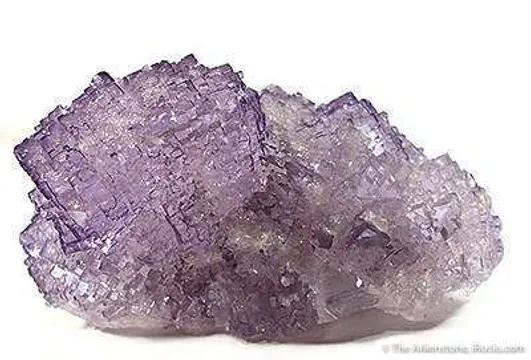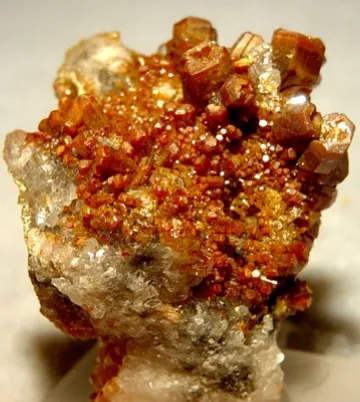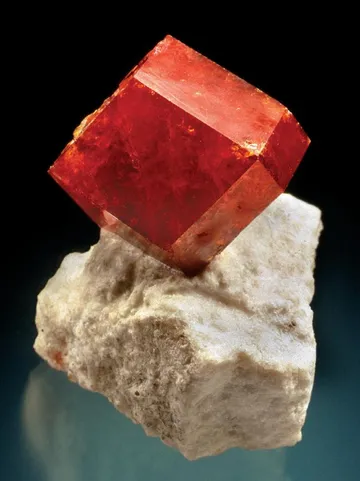
Melchor Múzquiz, Mexico — fluorite and celestine locality, famed for violet fluorite cubes on white blades; prized by collectors for architectural crystals.
Key facts
Melchor Múzquiz, in northern Coahuila, is one of the great Mexican names for collector fluorite because the name sits at the center of a broad Sabinas Basin family of low-temperature, carbonate-hosted deposits that produced unmistakable fluorite and celestine combinations. The best-known specimens, especially those sold for decades as “Muzquiz” or “Tule Mine,” show pale lilac to richer violet fluorite cubes perched on white to bluish-white bladed celestine, with many fluorite crystals carrying stepped, blocky, almost architectural growth faces. In good light, the fluorite can look deceptively simple from a distance and intricate up close: transparent cubes with darker violet edge zoning, tiny secondary cube growths, and a glassy-to-satiny luster over blades of SrSO4.
Geologically, this is not a classic igneous vein locality. The collector material belongs to the northeastern Mexico MVT-style province, where basin brines moved through Mesozoic carbonate-platform rocks and evaporitic horizons, replacing limestone and filling open spaces along bedding, joints, collapse breccias, and dissolution porosity. At El Tule, the mineral story is especially elegant: celestine formed first in opened sedimentary joints and replacement zones, and fluorite followed after a major change in fluid composition, trapping brines and hydrocarbons in the process. That history gives the specimens their look: elongated, serrated or tabular celestine crystals as pale structural “scaffolds,” then violet fluorite cubes set along edges, caps, and broken surfaces.
Historically, Múzquiz also matters because it is more than one mine name. Dealers and older collections often used “Muzquiz” for a cluster of small high-grade fluorite, celestine, barite, and Pb-Zn occurrences around the municipality and its larger mining region. Some specimens can be confidently placed at El Tule by habit and association; many others are safer to treat as regional Múzquiz pieces unless accompanied by old labels, mine-specific provenance, or distinctive paragenesis. That looseness is part of the locality’s collecting history and one reason serious collectors prize old labels from well-documented collections.
Regional View
Country View
The finest cabinet pieces balance three things that are hard to get together: undamaged celestine blades, sharply perched fluorite, and clean display geometry. Many examples are visually busy or contacted; the exceptional ones read almost like a sculpture, with a single broad blade or spear of celestine carrying a crown or garland of violet cubes.

Photo: Wikimedia Commons

Photo: Wikimedia Commons
Search for specimens: View all specimens from Melchor Múzquiz, Mexico
The collecting locality is best understood as a regional label rather than a single shaft. Ciudad Melchor Múzquiz lies in the Sabinas Basin of Coahuila, with the Sierra de Santa Rosa and other mineralized areas around the town and municipality. The district belongs to northeastern Mexico’s broad suite of stratabound, epigenetic carbonate-hosted deposits: fluorite, celestine, barite, and Pb-Zn mineralization formed from low-temperature basin brines moving through carbonate and evaporitic stratigraphy. In the regional model, fluorite and celestine occurrences tend to occupy relatively shallow stratigraphic levels along basin margins and structural corridors, while barite and Pb-Zn bodies occupy deeper or more basinward positions.
The ore bodies that concern specimen collectors are thin, elongate, high-grade replacement and open-space bodies in limestone. Regional accounts describe many small deposits, some only modest tonnage, developed beneath widespread shale units and controlled by bedding, joints, collapse breccias, and dissolution cavities. The mineralogy is simple but distinctive: fluorite, celestine, barite or Sr-rich barite, calcite, aragonite, strontianite, and locally oxidized Pb-Zn species in nearby metallic workings. At El Tule, the famous fluorite-celestine association is an F-Sr body: celestine formed as bladed to tabular crystals and replacement textures, while fluorite grew later as cubic crystals on or around the celestine.
The mining history of the Múzquiz area has two overlapping threads. Metallic mining in the Sierra de Santa Rosa-El Cedral area is old, with Spanish-period claims and later foreign-backed work on silver, lead, and zinc prospects. Official Mexican geological mapping records Jesuit-era claims from the 1760s and 1770s in the El Cedral canyon area, later nineteenth- and early twentieth-century work, and renewed descriptions in early private mining reports. Those oxidized Pb-Zn-Ag workings were not the direct source of the classic fluorite-celestine pieces, but they belong to the same carbonate-hosted mineralized province and explain why Múzquiz appears in both specimen and economic-mining literature.
The nonmetallic-mineral history is equally important. Fluorite discoveries in the Múzquiz municipality date to the 1940s, and by the 1950s beneficiation infrastructure had been established in the city. Fluorita de México operated a flotation plant in Melchor Múzquiz with a reported 500 ton-per-day capacity, while Minera Múzquiz operated another fluorite plant at Rancho El Saucito, southwest of the city, with a reported 700 ton-per-day capacity processing material from northern Coahuila mining zones such as Aguachile-La Linda-Cuatro Palmas. Nearby barite mining in the Sierra de Santa Rosa was substantial as well, with the Barita de Santa Rosa operation described as a long-running producer from stratabound mantos in the Lower Cretaceous carbonate sequence.
For specimen collectors, El Tule is the name to know. It is the source most consistently associated with the classic white to pale blue celestine blades studded with lilac or violet fluorite cubes. Other Múzquiz-labeled fluorites may come from Esperanza, Sierra Grande, or unnamed small workings, but much of the commercial material was historically lumped under the larger “Muzquiz” label. The region produced huge quantities of light fluorite-celestine combinations during the 1990s, with Tucson dealers prominently marketing the material, while older examples with “Musquiz” or “Muskiz” spellings appear in collections with labels going back decades earlier.
Collecting access today should be treated as private, industrial, and hazardous. Some old metallic workings are inactive, collapsed, flooded, or used for water supply; the El Socavón area, for example, is described in government mapping as guarded by municipal authorities because old mine workings provide potable water to Melchor Múzquiz. The realistic collector route is the specimen market, not field collecting. Mine-specific Múzquiz specimens deserve careful label preservation, because older locality information is often more valuable than a modern relabeling that overstates certainty.
Múzquiz fluorite is overwhelmingly a cube locality in collector terms, but its cubes are rarely plain: the best crystals are transparent to translucent lilac, smoky violet, or deep purple, commonly with darker edge zoning and stepped-growth faces made of smaller, aligned cubic subfaces. At El Tule, fluorite occurs on celestine as isolated cubes, clusters, caps, and garlands along bladed SrSO4 crystals; on some pieces, broken or detached celestine leaves casts or seating marks against the fluorite. Individual cubes on ordinary pieces may be a few millimeters to around 1 cm, while fine cabinet specimens can carry cubes around 2 cm, and exceptional reported examples reach several centimeters across. Strong pieces show sharpness, glassiness, attractive violet zoning, clean placement on celestine, and minimal bruising to cube edges; ordinary pieces are more massive, crowded, contacted, or dull, and may simply be labeled “Muzquiz” without a dependable mine name.
Celestine from the Melchor Múzquiz suite is most admired not as loose blue crystals but as the pale structural host for fluorite: broad blades, tabular crystals, lamellar aggregates, and spear-like forms in white, colorless, translucent, or pale blue-white tones. The Tule Mine material is the classic, with celestine crystals forming plates and chisel-edged blades that are crowned, rimmed, or studded by violet fluorite cubes. Large blades can reach cabinet scale, and documented specimens include celestine crystals over 10 cm long, with much larger display plates known from older collections; however, complete undamaged celestine is scarce because the blades are cleavable, serrated, brittle, and commonly contacted or broken at the edges. Top examples show an intact celestine form, pearly-to-vitreous luster, visible translucency, and fluorite placed aesthetically rather than smeared across a damaged surface.
Other documented minerals from the Melchor Múzquiz area include barite, calcite, aragonite, strontianite, gypsum, quartz, goethite, siderite, muscovite var. illite, cerussite, and anglesite. In the broader Santa Rosa-El Cedral setting, oxidized Pb-Zn mineralization adds cerussite, anglesite, iron oxides, and zinc-bearing alteration to the story, while barite mantos form a major economic part of the district. Strontianite is a noteworthy collector rarity at El Tule and has been reported with analytical confirmation; calcite is common as an associated species but is often damaged or removed from fluorite-celestine specimens. The area is not best known for type-mineral discoveries; its importance is instead paragenetic and aesthetic, defined by the F-Sr association and the instantly recognizable fluorite-on-celestine habit.
The main authenticity issue for Melchor Múzquiz specimens is not laboratory treatment but locality precision. “Muzquiz” has long functioned as a broad trade name for a cluster of small fluorite deposits in and around the municipality, and many old labels do not identify a mine. El Tule pieces are the easiest to recognize when they show pale celestine blades with lilac to violet fluorite cubes, but dark purple stepped fluorites without celestine can be harder to separate from nearby Coahuila workings unless the label history is strong. A specimen labeled “Tule Mine” should ideally show either the classic celestine association, old provenance, or a morphology consistent with documented Tule material.
Documented outright fakes or routine dyeing are not a prominent issue for this locality, but repairs and assembly should always be considered on high-value fluorite-on-celestine pieces. The association naturally breaks along weak celestine cleavage and contact surfaces, and collectors should inspect junctions between fluorite and celestine under magnification for glue, filled gaps, suspiciously glossy seams, or mismatched dust. Reattached fluorite groups can be difficult to spot if the repair follows a natural celestine break.
Condition is central to value. Fluorite cube corners bruise easily, and Múzquiz pieces often have many tiny stepped faces where a small chip can disappear into the architecture or, on a top piece, become painfully obvious. Celestine is the greater problem: edge cleaves, broken blade tips, and missing serrations are common. Many specimens that look dramatic in photographs reveal contacted backs, trimmed bases, or damaged celestine margins in hand. For display specimens, the key question is whether the best face is clean and whether any damage interrupts the principal celestine-fluorite composition.
Fluorescence should be tested specimen by specimen rather than assumed. Some celestine-bearing Tule specimens are reported to fluoresce under both longwave and shortwave ultraviolet light, while fluorite from individual pieces may be weak or nonresponsive despite the species’ famous relationship with fluorescence. Hydrocarbon-bearing inclusions are part of the geologic character of the region, and freshly broken or scratched material may release a fetid petroleum odor; this is interesting mineralogically but not a reason to abrade a specimen.
Market availability is steady at the small-cabinet and cabinet level, especially for purple stepped fluorite clusters and fluorite-on-celestine combinations. Fine, undamaged, well-composed examples are far scarcer than the number of “Muzquiz fluorite” listings suggests. Top-tier specimens with large intact celestine blades, gemmy fluorite, old labels, and balanced display geometry move from casual fluorite collecting into connoisseur territory.
One of the most memorable things about Múzquiz is that the collector name has always been a little larger than the map. In practice, “Muzquiz” became a label of convenience for a swarm of small fluorite occurrences, many of them too small, too short-lived, or too poorly recorded to survive as firm mine names in the specimen trade. That is why old labels matter here. A cabinet specimen might pass through several collections as “Musquiz,” “Muskiz,” “Muzquiz,” or “Tule Mine,” while the crystal itself carries the better evidence: a pale blade of celestine, a crown of violet cubes, and the peculiar stepped architecture that collectors recognize instantly.
The Tule Mine’s great signature is theatrical restraint. A classic piece may consist of little more than one white celestine blade and a few purple fluorite cubes, but when the proportions are right the effect is unforgettable. Collectors who handled large numbers of them in the trade have described the best examples as serrated, sword-like celestine crystals rimmed or crowned by rich fluorite. One long-time dealer recalled that the Tule Mine produced “huge numbers” of light fluorite in the 1990s, especially during the years when Top Gem Minerals of Tucson was marketing the big finds, but that later production became sporadic by comparison. That explains the odd market pattern today: the locality is common enough for most fluorite collectors to own one, yet genuinely elegant large pieces are not common at all.
The locality also has a geological drama hidden inside apparently quiet crystals. In the El Tule F-Sr deposit, fluid-inclusion work found celestine recording lower-temperature aqueous fluids and fluorite recording brines plus dark hydrocarbon-bearing inclusions. The shift from celestine to fluorite was interpreted as a real change in fluid regime: celestine formed in opened sedimentary joints and dissolution porosity, then fluorite arrived after the chemistry changed and hydrocarbons entered the system. That is the scientific version of what the collector sees on the shelf: an earlier white SrSO4 framework overprinted by later purple CaF2.
There is a second, less glamorous Múzquiz story in the old workings near town. Government mapping describes El Socavón as a tunnel roughly 950 meters long whose portal discharges water used by Melchor Múzquiz. The same report notes that the site is guarded to protect the town’s water supply and that renewed mining there would be highly restricted. It is a reminder that old mineral localities do not remain frozen for collectors; they become water sources, hazards, industrial ground, private ranches, or forgotten holes in limestone.
Jordi Tritlla, Gilles Levresse, Rodolfo Corona-Esquivel, David Banks, Hector Lamadrid and Julien Bourdet, “Depósitos de Pb-Zn-Cu-Ba-F-Sr epigenéticos estratoligados en series sedimentarias en relación con salmueras de cuenca: depósitos de tipo ‘Mississippi Valley’ (MVT) y similares en México,” Boletín de la Sociedad Geológica Mexicana 58(1), 103-139, 2006. A foundational Spanish-language review placing Mexico’s Pb-Zn-Ba-F-Sr carbonate-hosted deposits, including the Múzquiz-El Tule type of mineralization, in an MVT-style basin-brine framework.
Jordi Tritlla, Gilles Levresse, Héctor Lamadrid, Julien Bourdet and Rodolfo Corona-Esquivel, “Basinal brines as witnesses of fluid flow changes in a compressional- to extensional tectonic regime: the case of El Tule stratabound F-Sr deposit, NE México,” ECROFI-XIX Abstract Volume, p. 266, 2007. The most directly relevant fluid-inclusion account of the El Tule fluorite-celestine deposit, including temperatures, salinities, hydrocarbons, and the paragenetic change from celestine to fluorite.
Francisco González-Sánchez, Antoni Camprubí, Eduardo González-Partida, Rafael Puente-Solís, Carles Canet, Elena Centeno-García and Viorel Atudorei, “Regional stratigraphy and distribution of epigenetic stratabound celestine, fluorite, barite and Pb-Zn deposits in the MVT province of northeastern Mexico,” Mineralium Deposita 44, 343-361, 2009. A regional stratigraphic and metallogenic synthesis for the northeastern Mexico MVT province, useful for understanding why celestine, fluorite, barite, and Pb-Zn deposits are distributed at different structural and stratigraphic levels.
“Geological setting and genesis of stratabound barite deposits at Múzquiz, Coahuila in northeastern Mexico,” Ore Geology Reviews, 2016. A detailed study of the nearby Sierra de Santa Rosa barite mantos, including host formations, manto geometry, fluid inclusions, isotopes, and the role of evaporite replacement in the Múzquiz district.
Consejo de Recursos Minerales, “Carta Geológico-Minera Melchor Múzquiz G14-A12,” scale 1:50,000 technical report. The essential government mapping source for local geology, mining history, infrastructure, inactive workings, El Cedral-El Socavón mineralization, and the fluorite processing plants around Melchor Múzquiz.
Mindat, “Tule Mine, Melchor Múzquiz, Múzquiz Municipality, Coahuila, Mexico.” The principal locality database entry for the classic Tule Mine fluorite-celestine specimens, with species list, associations, and photo records.
Muséum national d’Histoire naturelle, “Tout savoir sur la collection Roger Caillois.” Documents a fluorite from Tule, Melchor Múzquiz, in the Paris MNHN mineral and gem collection as part of the Roger Caillois collection context.
Mindat: Melchor Múzquiz, Múzquiz Municipality, Coahuila, Mexico — Broad regional locality page listing minerals and sublocalities under the Melchor Múzquiz label.
Mindat: Tule Mine, Melchor Múzquiz, Coahuila — Best database starting point for the classic fluorite-on-celestine material.
Wikimedia Commons: Fluorite-186606.jpg — Openly licensed photograph of purple fluorite from the Tule Mine, with locality and specimen size information.
Wikimedia Commons: Celestine-Fluorite-142218.jpg — Openly licensed photograph of a large celestine-fluorite combination from the Tule Mine, useful for recognizing the classic habit.
Boletín de la Sociedad Geológica Mexicana: Tritlla et al. 2006 — Regional MVT-style interpretation of Mexican Pb-Zn-Ba-F-Sr deposits.
ResearchGate: El Tule stratabound F-Sr deposit abstract — Directly addresses El Tule fluid inclusions, hydrocarbon-bearing fluorite, and the celestine-to-fluorite paragenesis.
SGM / Consejo de Recursos Minerales: Carta Geológico-Minera Melchor Múzquiz G14-A12 — Detailed official mapping report for the town area, mining history, infrastructure, and resource context.
Friends of Minerals Forum: El Tule Mine, Melchor Musquiz, Coahuila, Mexico — Collector-oriented discussion of the locality, its MVT setting, petroleum inclusions, and the broad use of “Muzquiz” in the trade.
Mindat discussion: Fluorite Muzquiz — Useful collector discussion about distinguishing Tule material from other Múzquiz-area fluorites and the importance of celestine associations.
MineralAuctions: Fluorite on Celestine, Tule Mine, Melchor Múzquiz — Recent market example showing size, condition language, provenance, and price history for a Jack Halpern collection specimen.