






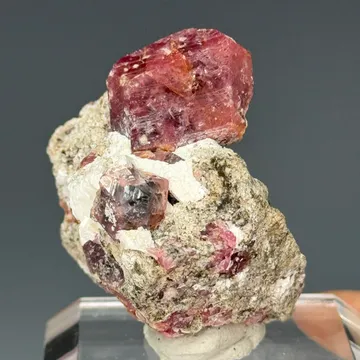
Sierra de Cruces, Mexico locality guide - famed for raspberry-red grossular (rosolite) and vesuvianite in skarn, with distinctive zoning and collector appeal.
Key facts
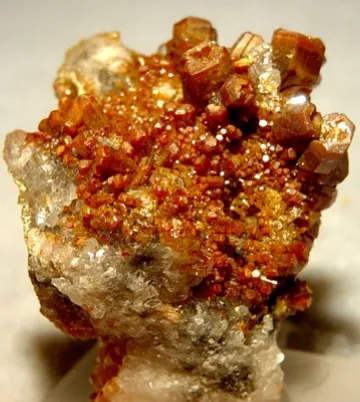
Sierra de Cruces is one of the defining Mexican skarn localities for collectors: a remote range in the Sierra Mojada Municipality of Coahuila where carbonate rocks were thermally and chemically overprinted by intrusive activity, producing a calcium-rich assemblage of grossular, vesuvianite, wollastonite, calcite, quartz, scapolite, and related garnet-group compositions. The locality’s fame rests above all on its raspberry-red grossular—often traded as rosolite—whose color, zoning, and association with yellow-brown vesuvianite give the best pieces an instantly recognizable look. In a cabinet, the classic specimen is a pale, granular skarn or carbonate matrix sprinkled with sharp rose to raspberry dodecahedra, sometimes joined by blocky mustard, honey, or olive-brown vesuvianite crystals.
The deposit matters beyond mere prettiness. Sierra de Cruces grossular has been repeatedly studied because its color is unusual in natural grossular and because many crystals are internally zoned: a pink to red outer zone may wrap a dark, iron- and titanium-rich mantle or core, and in some studied crystals a pale to white core is present as well. For a collector, that means a broken face, a sawn specimen, or a crystal with natural windows can be more than damage—it can reveal the growth history that makes the locality scientifically interesting.
Regional View
Country View
Sierra de Cruces specimens also carry a small but persistent historical complication: many older labels say “Lake Jaco,” “Laguna de Jaco,” “Sierra de la Cruz,” or even Chihuahua. Those names belong to the story of how the locality entered commerce, but the accepted collector and database locality for the garnet and vesuvianite is Sierra de Cruces, Sierra Mojada Municipality, Coahuila, Mexico, east of Laguna El Jaco and near the Hércules mining area.

Photo: Lech Darski / Wikimedia Commons
Search for specimens: View all specimens from Sierra de Cruces, Mexico
Sierra de Cruces lies in the arid northern Mexican basin-and-range country of western Coahuila, close to the Coahuila–Chihuahua border and the Hércules iron-mining district. Modern locality records place it in Sierra Mojada Municipality, with the familiar specimen locality east of Laguna El Jaco rather than in Chihuahua itself. The surrounding region is a dry, rugged landscape of ranges and enclosed basins, with intermittent drainage, rough roads, and sparse settlement—conditions that helped keep the exact collecting ground obscure during the early years of commercial specimen recovery.
Geologically, the specimen-producing ground is a contact-metamorphic, calcium-silicate skarn developed where intrusive rocks affected Cretaceous carbonate formations. Regional mapping by the Servicio Geológico Mexicano describes Sierra de Cruces as an area with intrusive rocks, including granite to granodioritic and rhyolitic bodies, cutting or affecting limestone and related carbonate units. The 1:50,000 Llano el Guaje sheet specifically records contact metamorphism producing garnet skarn, marbleized limestone, hornfels, and a skarn assemblage including grossular, andradite, vesuvianite, and wollastonite. That geological setting explains the physical character of the specimens: dodecahedral garnet and blocky vesuvianite embedded in, or perched on, a pale matrix of calcite, quartz, wollastonite, and scapolite-bearing skarn.
The broader Sierra Mojada district has a long mining history for lead, zinc, silver, copper, iron, and related industrial minerals, but the Sierra de Cruces collector locality is best understood as a specimen and skarn-mineral occurrence rather than a conventional gem mine. SGM mapping records hydrothermal mineralization and alteration along the Sierra de Cruces area, with regional structures, intrusive contacts, and carbonate host rocks controlling several styles of mineralization. Nearby and related mining areas include Santa Elena, Nuestra Señora de la Luz de Cruces, La Fe, Juan José, Picacho, and the large Hércules iron deposit. Hércules itself is a major iron-ore operation associated with the northwestern margin of the intrusive stock forming the Sierra de Cruces range, while the specimen locality is the skarn environment that yielded grossular and vesuvianite rather than the industrial iron ore for which Hércules is known.
For collectors, the productive mineralization is essentially pocketed and weathered skarn: crystals either grew in cavities and seams or weathered out of tougher calc-silicate rock into collectable float and matrix pieces. Older accounts describe the earliest specimen-quality material as known by the mid-twentieth century, but the classic red grossular story centers on a rancher’s 1974 discovery of pink-to-red crystals and the subsequent staking of claims with the help of dealer Benny Fenn. Improved access connected to the Hércules mining road made removal and marketing more practical, and large numbers of specimens reached the United States collector market in later decades.
The famous pieces came from several styles of occurrence. The most familiar are plates and chunks of white to off-white matrix with scattered raspberry-red dodecahedra, commonly from a few millimeters to around a centimeter across. Better crystals reach larger miniature scale, and exceptional old-time specimens include large, sharp grossular crystals several centimeters across associated with substantial vesuvianite. Some labels and dealer records name the Santo Domingo Claim; others use Hércules, Lake Jaco, Laguna de Jaco, Sierra de la Cruz, or Sierra de las Cruces. Those labels should be read as part of the locality’s collecting history rather than as necessarily distinct producing pockets unless accompanied by reliable old documentation.
Collecting access today should be treated as private-claim and mining-district access, not casual public collecting. The terrain is remote, hot, and rough, and older collecting notes repeatedly stress difficult field conditions. The market supply now consists mainly of older stock, recirculated collection specimens, and occasional small lots or modern dealer offerings. Fresh, high-quality matrix pieces with saturated red garnets and undamaged vesuvianite are not common.
Grossular is the signature mineral of Sierra de Cruces, occurring as sharp dodecahedra and modified dodecahedra in raspberry-red, rose-pink, mauve, peach, cream, gray, olive-green, golden-green, greenish-brown, and dark-zoned examples. The finest specimens show saturated pink to red crystals on contrasting white calcite-quartz-wollastonite-scapolite skarn, with individual crystals commonly in the millimeter-to-centimeter range and exceptional crystals documented several centimeters across. Scientific work has shown that the raspberry color is tied to manganese in grossular, while dark mantles and cores are richer in iron, titanium, and andradite-related components; this zoning is a major part of the locality’s identity. Top pieces are not merely colorful—they have crisp complete form, bright luster, strong contrast against pale matrix, and preferably an association with mustard-yellow or brown vesuvianite; ordinary pieces tend to be pale, crowded, granular, chipped, or embedded so deeply that the garnet habit is hard to read.
Vesuvianite from Sierra de Cruces is the great companion species to the grossular, typically appearing as yellow-brown, honey-brown, mustard-yellow, tan, olive, or greenish-brown crystals in the same skarn matrix. Good crystals are blocky to stout prismatic, lustrous, and sometimes complexly modified; older literature and market records document sharp tan crystals with grossular, blocky crystals around 3 cm, and exceptional old specimens with vesuvianite crystals in the 4–5 cm range. The most desirable examples show well-defined vesuvianite crystals rather than indistinct massive tan skarn, especially where smaller raspberry grossular crystals are attached or nestled in the faces and interstices. Collectors should look for intact terminations, clean glassy to resinous luster, and an old-label association with Lake Jaco or Sierra de la Cruz only when the piece visually matches the Sierra de Cruces grossular-vesuvianite assemblage.
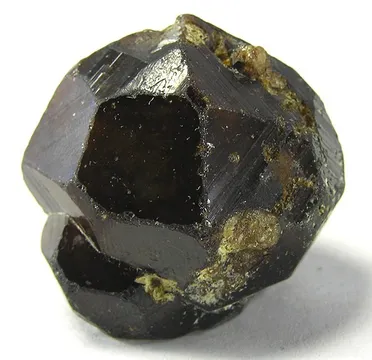
The garnet entry at Sierra de Cruces covers the broader grandite character of the locality, where grossular and andradite-related chemistry meet in strongly zoned crystals. In hand specimens this may appear as pink grossular rims around dark gray, brown, black, or titanium-rich internal zones, and some collector pieces show broken or sawn crystals where the concentric structure is visible. The habit is dominantly dodecahedral, sometimes modified, and the best garnet specimens from the locality are judged by crystal size, completeness, color saturation, zoning interest, and matrix contrast. Good “garnet” pieces here may not always be pure-looking red rosolite; green, gray, mauve, and dark-cored examples can be important when the form is sharp, the luster is lively, and the specimen preserves the locality’s distinctive skarn association with vesuvianite, calcite, quartz, wollastonite, and scapolite.
Beyond grossular and vesuvianite, the documented Sierra de Cruces species list is concise but revealing: andradite as gray to dark internal zones in some garnets, calcite and quartz as common pale matrix minerals, wollastonite and scapolite as important calc-silicate constituents, diopside, epidote, dolomite, strontianite, sphalerite, and reported wiluite in the vesuvianite group. The wiluite report is especially interesting for advanced collectors because it reflects boron-rich vesuvianite-group chemistry rather than a visually obvious field distinction. No separate type-locality mineral gives Sierra de Cruces its fame; the locality’s mineralogical importance instead comes from the unique combination of raspberry grossular color, internal zoning, large and attractive skarn crystals, and the grossular-vesuvianite association.
The first authenticity issue is locality, not treatment. “Lake Jaco,” “Laguna de Jaco,” “Sierra de la Cruz,” “Sierra de las Cruces,” “Sierra de Cruces,” “Hércules,” and “Santo Domingo Claim” all appear on labels. Lake Jaco-style labels are historically important, but they can be geographically misleading; most classic garnet and vesuvianite specimens so labeled are now assigned to Sierra de Cruces, Sierra Mojada Municipality, Coahuila. A fine old label is a plus, but a buyer should still evaluate whether the specimen matches the Coahuila skarn assemblage.
There is no well-established published problem of dyed, heated, or manufactured Sierra de Cruces grossular in the collector literature. Misidentification is much more common. Pink pieces may be casually called “rosolite,” “raspberry garnet,” “grossularite,” or simply “garnet,” and dark cores have been mistaken for separate black inclusions or unrelated minerals. The dark zones are commonly part of the garnet growth history and may be andradite-rich or titanium- and iron-rich areas within grandite-style zoning.
Condition is a serious grading factor. Many crystals are partly embedded, intergrown, weathered, or chipped on exposed edges. Pale matrix is often sawn or trimmed, and this is not automatically a defect if the display face is natural and the trimming was done cleanly; in fact, many matrix pieces need cutting to sit well. Broken crystals can reveal excellent zoning, but for display specimens complete dodecahedra with sharp edges command the premium. Large crystals deserve close inspection because impressive size can mask dull luster, bruising, or incomplete back sides.
Fluorescence can be present and is worth checking, especially in pink to raspberry grossular. Documented Sierra de Cruces grossular can show orange to red responses under longwave UV, violet/405 nm excitation, or midwave conditions, while the carbonate-rich matrix may also fluoresce. Fluorescence should be treated as an interesting secondary feature rather than a stand-alone proof of locality or quality.
Rarity is tiered. Small pink grossular-on-matrix specimens remain obtainable, and lower-grade granular pieces still circulate. Fine saturated raspberry-red crystals on bright white matrix are much scarcer. Exceptional large grossular crystals, complete vesuvianite crystals with attached grossular, and old-time Lake Jaco/Sierra de la Cruz pieces with reliable provenance are genuinely hard to replace. On the current market, the locality is represented more by recycled collection specimens and scattered dealer offerings than by abundant fresh production.
The most enduring Sierra de Cruces story begins with a deliberate misdirection. In the 1950s, dealer George Burnam was collecting in Mexico and came upon the garnets near the top of the mountain. From that vantage he could see the broad dry lake to the west—Laguna El Jaco, across the state line in Chihuahua. Rather than place a label that would lead competitors straight to the mountain, he used “Lake Jaco.” Buyers then looked up the lake on maps and repeated the Chihuahua attribution, and the false locality took on a life of its own. It was not merely a spelling error; it was a classic specimen-dealer shield, a way of giving a recognizable but imprecise location while keeping the productive ground protected.
The 1974 discovery account reads like the opening scene of a collector-locality article: a Mexican rancher found a small red crystal, showed it to someone who recognized it as grossular, and soon the material came to the attention of the Arizona dealer Benny Fenn. With Fenn’s help, the rancher staked a claim. What had been a remote curiosity became a working specimen source, and the locality began sending out quantities of pink-to-red grossular with mustard-yellow vesuvianite on snow-white calcite and quartz matrix. By the time collectors in the United States began seeing more of the material, the road network serving the Hércules iron mine had made the range less inaccessible than it had been in the old Burnam era.
The land itself adds another layer to the story. Collectors’ notes describe a hard, dry range reached by rough roads, with heat, steep ground, and desert animals part of the field reality. The attractive cabinet specimens—bright pink dodecahedra on pale matrix—come from a place that is not gentle: skarn knobs, weathered outcrops, and claim ground in an isolated mining district. That contrast is part of the appeal. Sierra de Cruces specimens look almost confectionary in a case, but they were born in intrusive heat and recovered from harsh desert rock.
The “Lake Jaco” label still creates small dramas in collections. A vesuvianite bought as “Laguna de Jaco, Chihuahua” may turn out to be exactly right mineralogically and wrong geographically. A pink garnet sold casually as rhodochrosite, tourmaline, or “raspberry garnet” without a precise species may resolve into Sierra de Cruces grossular once the hardness, habit, matrix, and locality style are recognized. For old collections, the label is often not a problem to erase but a clue to preserve: it records the route by which Sierra de Cruces entered the mineral trade.
_-_Sierra_de_Cruces,_Sierra_Mojada_Municipality,_Coahuila,_Mexico.jpg)