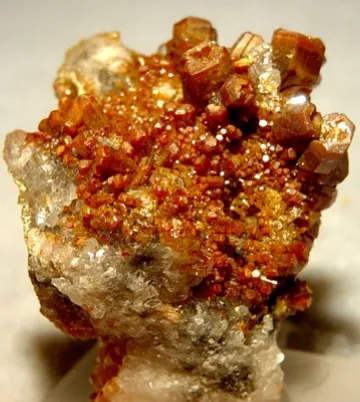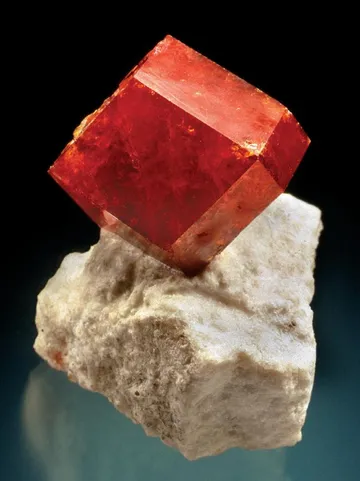
Coahuila, Mexico: a sulfate–fluorite belt famous for lilac fluorite on white celestine from Tule, plus blue celestine and rosolite; prized by collectors.
Key facts
Coahuila’s mineral reputation rests on one of the great sulfate–fluorite belts of northeastern Mexico: a province of stratabound, carbonate-hosted deposits formed as warm basinal brines moved through Jurassic–Cretaceous sedimentary rocks during and after Laramide deformation. For collectors, the state is not a single pocket or a single mine story, but a broad geological province in which the same basin-scale plumbing produced several distinct collecting personalities: pale to rich purple fluorite from the Múzquiz–El Tule area, white to blue celestine from the south-central celestite mantos, barite and Pb-Zn mineralization in related districts, and a separate but famous skarn suite that includes the raspberry-red grossular known as rosolite from Sierra de Cruces.
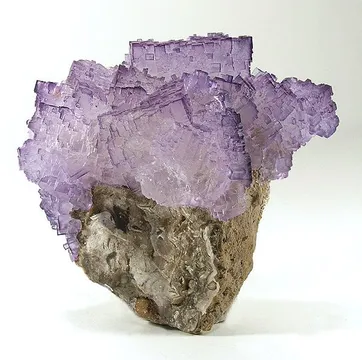
The classic Coahuila specimen, and the one most collectors immediately picture, is fluorite on celestine from the Tule Mine area near Melchor Múzquiz. The best pieces are elegant rather than massive: lilac to violet cubic fluorite, often with stepped or terraced faces and deeper purple edge-zoning, set on white to translucent celestine blades or spear-like crystals. The contrast is unmistakable—cool purple cubes on snowy, pearly strontium sulfate—and fine examples can have a delicacy that separates them from the more blocky fluorite plates of many other MVT districts. Coahuila celestine also appears as blue-gray lustrous crystals from mines such as San Agustín, and the state’s industrial celestite deposits are among the most important sources of strontium ore in Mexico.
Regional View
Country View
Geologically, the state’s specimen-producing districts owe much of their character to subtle stratigraphic traps: permeable limestones, evaporitic intervals, shale seals, low-angle slip surfaces, and breccias opened during deformation. That is why so many of the best specimens have a “grown in a narrow sheet” look—fluorite and celestine lining seams, mantos, and residual cavities rather than building open alpine-style crystal pockets. In the north, the La Encantada–Buenavista fluorite district and El Tule illustrate the fluorite-rich side of the system; farther south, the Coahuila Platform hosts the celestite-rich mantos of Sierra La Paila, Sierra de Los Alamitos, Rancho Cuates de Australia, Sierra San Lorenzo, and Sierra Tlahualilo.

Photo: Wikimedia Commons
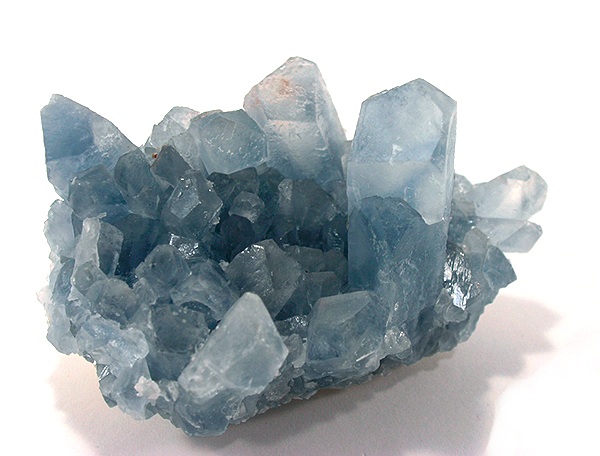
Photo: Wikimedia Commons
Search for specimens: View all specimens from Coahuila, Mexico
Coahuila lies across a key part of the northeastern Mexico MVT province, where more than two hundred stratabound occurrences of celestine, fluorite, barite, and Pb-Zn mineralization have been documented in Coahuila and adjacent areas. The deposits are hosted in Mesozoic sedimentary rocks of the Sabinas Basin and neighboring paleogeographic highs, including the Coahuila Block and the Burro–Peyotes area. Their mineralogy is usually simple: fluorite, celestine, barite, sphalerite, galena, calcite, gypsum, clays, and minor accessory phases rather than complex high-temperature assemblages. The contrast between the southern celestine-rich and northern fluorite-rich subprovinces is one of the state’s defining geological features.
The celestine deposits of south-central Coahuila are manto-style replacement bodies in carbonate rocks and gypsum-bearing beds, particularly of the Acatita Formation on the Coahuila Platform. Principal producing areas reported for the industrial celestite district include Sierra La Paila, Rancho Cuates de Australia, Sierra San Lorenzo, and Sierra Tlahualilo, in the broad region between Torreón and Saltillo. A typical example, the Mina La Ilusión deposit, was described as a nearly horizontal replacement manto averaging about 1.2 m thick, exposed for roughly 450 m along outcrop and mined at least 250 m down-dip without the limits of the manto being reached. The ore there was reported as roughly 85–95% coarse-grained celestite, with the remainder mostly dark limestone, coarse crystalline calcite, and less than 1% barite.
The mines are chiefly industrial workings rather than specimen mines. Coahuila celestite mantos have been worked by adit entry and underground room-and-pillar methods; some ore was shipped mine-run, while much was concentrated by jigs or shaking tables to remove limestone before shipment to sulfate-conversion plants in Mexico or export markets. Significant celestite mining in the region began during World War II, when demand for strontium compounds rose for flares and tracer ammunition. Production increased dramatically in the late twentieth century, and modern Mexican strontium production has continued to be strongly tied to Coahuila, with Minas de Celestita, S.A. de C.V. reported as a leading producer.
Specimen celestine is a different story from bulk celestite ore. In the Sierra de La Paila and Sierra de Los Alamitos deposits, pure zones in the mantos can contain cavities lined by idiomorphic celestine crystals. Geological descriptions from the Alamitos district record tabular to prismatic euhedral and subhedral crystals ranging from white and blue to dark or black where bitumen is abundant; crystals in some mantos may reach decimeter scale, though collector-quality undamaged examples are far less common than ore. Associated late minerals include selenitic gypsum, calcite, scarce native sulfur, and locally fluorite.
The Tule Mine, north of Múzquiz, is the collector’s bridge between the celestite and fluorite worlds. It is an unusual stratabound celestine-fluorite deposit hosted by carbonates of the Buda Formation in the Washita Group, developed along a low-angle, layer-parallel slip surface. The mineralized body is variable in thickness and has been described in places up to about 2 m thick. At Tule, the celestine is generally white and shows rhythmic banding like the southern celestine mantos, but the late-stage fluorite fills residual openings erratically as idiomorphic blue to pale violet zoned cubes. That late fluorite did not enclose celestine inclusions in the geological descriptions, suggesting an abrupt shift in the chemistry of the mineralizing fluid after the celestine stage.
Farther north, the La Encantada–Buenavista district represents the fluorite-dominant side of the province. Its fluorite bodies are manto-style, stratabound deposits in Cretaceous carbonates, especially reefal and platform limestones of the Aurora Formation and the overlying Washita Group succession. The main mantos are structurally controlled, commonly forming where low-permeability barriers intersect low-angle faults and slip surfaces. Industrially, this was one of Coahuila’s important fluorspar districts: major production began in the early 1950s after the discovery of high-grade deposits, though smaller production began earlier in the 1940s. Published USGS work estimated that nearly one million tons of ore from the Encantada–Buenavista district yielded about 500,000 tons of fluorspar concentrates over a ten-year period ending in the early 1960s.
Collectors should not confuse the La Encantada–Buenavista fluorite ore district with the famous La Encantada silver mine district, which is also in northern Coahuila and has produced a quite different suite of silver and manganese minerals. The La Encantada silver mine is a modern operating silver mine complex associated with steeply dipping vein and replacement systems, and its mineral list includes silver minerals such as acanthite, pyrargyrite, cerargyrite, embolite, and related manganese oxides. Specimens from this environment are uncommon in the general collector market compared with the abundant Tule-style fluorite-celestine combinations.
Collecting access today should be treated as essentially private and industrial. The productive celestite and fluorite areas are remote, with mine roads, locked gates, active claims, and operating or legacy underground workings. Published field accounts note that many of the celestite mines are well away from main roads and that even general information can be difficult to obtain because of restricted access and competition for reserves. Any collecting requires explicit permission from landowners, concession holders, or mine operators; old workings in carbonate mantos and gypsum-bearing ground are not casual collecting sites.
Coahuila fluorite is best known to collectors from the Múzquiz–Tule area, where lustrous cubic crystals in lilac, lavender, violet, and deeper purple occur alone or, most famously, perched on white to translucent celestine blades. Good Tule specimens show sharp, transparent to gemmy cubes with stepped faces, zoning or darker purple edge phantoms, and balanced placement on intact celestine; ordinary pieces tend to be cleaved, crowded, dull, or visually flat. Crystals commonly range from a few millimeters to several centimeters on edge, with documented collector pieces showing fluorite cubes around 1–3 cm and occasional larger cabinet combinations. Geologically, the fluorite is a late phase in the Tule celestine-fluorite system, occupying residual porosity after celestine, while the broader northern Coahuila fluorite mantos of La Encantada–Buenavista are dominantly white to colorless fluorite with late zoned purple cubic crystals in cavities.
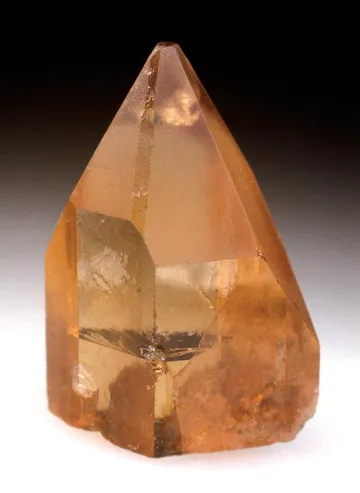
Coahuila celestine occurs both as an ore mineral in south-central manto deposits and as the sculptural white host for the famous Tule fluorite combinations. In the Sierra de La Paila and Sierra de Los Alamitos celestite deposits, crystals are described as tabular to prismatic, white, blue, or darkened by organic matter, growing in rhythmic bands from the walls of lens-like bodies toward their centers; in pure cavities, individual crystals may reach roughly 10–20 cm, though undamaged display specimens are much scarcer than ore. At the Tule Mine, celestine is typically white, translucent to pearly, bladed, spear-like, or serrated along the margins, and the most desirable examples carry well-positioned violet fluorite rather than isolated broken blades. Blue-gray lustrous celestine from San Agustín Mine is another prized Coahuila look, with crystals to several centimeters, but the white Tule material remains the classic collector association.
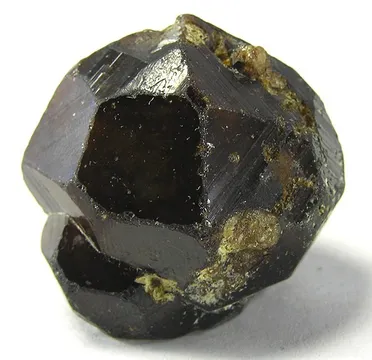
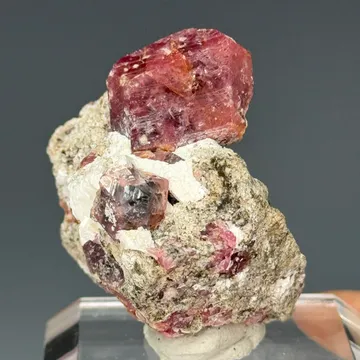
Beyond fluorite and celestine, Coahuila has an unusually broad mineralogical footprint. The Coahuila meteorite from Ocampo Municipality is the type locality for daubréelite, FeCr2S4, described from troilite-daubréelite nodules in the iron meteorite; the meteorite also contains kamacite, taenite, schreibersite, troilite, cohenite, graphite, and other meteoritic phases. Sierra de Cruces in Sierra Mojada Municipality is famous for raspberry-red grossular, commonly called rosolite, associated with quartz, calcite, and mustard-yellow vesuvianite; the intense pink to red color is tied to manganese in the garnet, and old labels may say “Lake Jaco” because that name was long used in the trade. Coahuila’s Pb-Zn and silver districts add sphalerite, galena, acanthite, pyrargyrite, cerargyrite, embolite, manganese oxides, barite, calcite, and gypsum, while the El Pilote occurrence in the La Encantada–Buenavista district is notable as a rare fluorite-bearing skarn related to an Oligocene rhyolitic intrusion.
Coahuila fluorite-celestine combinations are abundant enough that the locality is familiar, but fine examples are much less common than casual market listings suggest. Look first for locality precision: “Coahuila” alone is broad, “Múzquiz” is better, and “Tule Mine” or “El Tule Mine, Melchor Múzquiz Municipality” is the classic designation for the purple fluorite on white celestine combinations. Some labels may use “Musquiz,” “Muzquiz,” or “Melchor Múzquiz,” all referring to the same municipality/city area. Be cautious with any specimen labeled simply “Mexican fluorite on celestite” if the habit does not match the locality; Tule material usually shows purple cubic fluorite with stepped or complex faces on white bladed celestine, not the blue geode-like celestine habits familiar from Madagascar or Ohio.
Condition is the main value trap. Fluorite has perfect octahedral cleavage, and Coahuila fluorite commonly shows small cleaves, bruised edges, or contacts hidden among stepped faces. Celestine is softer and cleaves readily, so the white blades and spear-like crystals are often chipped, snapped, or repaired. The best pieces preserve an undamaged or minimally damaged celestine blade with fluorite positioned on the front edge, crest, or base in a way that looks natural and balanced. On lower-grade examples, purple fluorite may be attractive but scattered across broken celestine or a massive slab with little architecture.
Repairs and reconstructions should be considered possible on larger Tule combinations because the celestine host is fragile and the fluorite clusters make tempting aesthetic “perches.” Examine attachment zones under magnification for glue, unnatural gaps, or mismatched luster. A repaired celestine blade is not unusual and may be acceptable if disclosed, but a fluorite cluster reattached to a blade can materially change the desirability of the specimen. Also distinguish natural hydrocarbon or bitumen-related dark inclusions from dirt or staining; organic matter is part of the geological story of these MVT systems.
Color is usually natural. The desirable purple in Tule fluorite is a normal locality feature, often concentrated at edges or zones. Strong lighting can exaggerate the lavender-to-violet contrast, so ask for daylight photos when assessing expensive pieces. Fluorite from the broader Coahuila districts may fluoresce bluish under ultraviolet light, as many fluorites do, but fluorescence should be treated as a secondary curiosity rather than the primary basis for value. Celestine is relatively brittle and should be kept away from repeated washing, ultrasonic cleaning, or pressure cleaning; dust removal with a soft brush and minimal water is safer.
Market availability is steady for small to mid-sized Tule fluorite-celestine pieces, including old material from 1960s-style collections and later finds such as the 2013 material documented by collectors. Cabinet pieces with large, complete celestine blades and sharp, well-placed purple fluorite remain competitive. San Agustín blue-gray celestine is less commonly seen as an aesthetic specimen. Coahuila rosolite grossular is a separate specialty market and should not be evaluated by the same criteria; for those pieces, old “Lake Jaco” labels, raspberry color, complete dodecahedral form, and contrast with white matrix drive value.
The most repeated collector story from Coahuila does not begin in a mine office or a published geological map; it begins with a red crystal. In 1974, a Mexican rancher in the Sierra de Cruces area came across a small red crystal and had it identified as grossular. With help from mineral dealer Benny Fenn, the rancher staked a claim. The deposit went on to produce the raspberry-pink to red grossular crystals that collectors now know as rosolite, commonly set in white calcite and quartz with mustard-yellow vesuvianite. The color was so distinctive, and the locality so vulnerable to a collecting rush, that old trade labels often displaced the occurrence to “Lake Jaco.” Those labels still circulate, turning up in collections as a small historical misdirection attached to one of Mexico’s most recognizable garnet varieties.
The Tule Mine story is quieter but equally characteristic of serious collecting. Over decades, fluorite-studded celestine blades from the El Tule area entered collections in batches, often with incomplete locality data: Múzquiz, Musquiz, Melchor Múzquiz, Coahuila, or simply “Tule Mine.” A 2013 group of specimens documented by Peter Megaw showed just how sculptural the material could be: a shelf of roughly 30 by 30 cm filled with related pieces, one specimen measuring about 8 x 6 x 5 cm with 3 cm fluorite cubes enveloping an 8 cm celestine crystal, and another measuring about 14 x 8 x 5 cm with a 3 cm fluorite cube perched on the side of a 14 cm celestine blade. They were not huge by worldwide fluorite standards, but they had the combination collectors want from Tule: pale to violet cubes placed like accents on white blades, every good specimen a small lesson in the transition from strontium sulfate to calcium fluoride mineralization.
The industrial celestite story is a different scale altogether. South-central Coahuila’s celestite deposits were remote enough that government topographic and geologic maps published before the celestite boom did not show many of the mines or the access roads that later became important. Field descriptions emphasize locked gates, mines far from main roads, and operators understandably guarded about reserves and markets. That secrecy makes sense in a region where a typical manto such as Mina La Ilusión could average 1.2 m thick, run hundreds of meters along outcrop and down-dip, and consist largely of coarse celestite suitable for strontium production. To a collector, the ore may look plain beside a Tule combination; to an operator, it was the material that made Mexico a leading celestite producer.
Francisco González Sánchez, Rafael Puente Solís, Eduardo González Partida, and Antoni Camprubí, “Estratigrafía del Noreste de México y su relación con los yacimientos estratoligados de fluorita, barita, celestina y Zn-Pb,” Boletín de la Sociedad Geológica Mexicana, 59(1), 43–62, 2007 — Foundational regional paper defining the northeastern Mexico MVT province and its celestine, fluorite, barite, and Pb-Zn subprovinces.
Jordi Tritlla, Gilles Levresse, Rodolfo Corona-Esquivel, David Banks, Hector Lamadrid, and Julien Bourdet, “Depósitos de Pb-Zn-Cu-Ba-F-Sr epigenéticos estratoligados en series sedimentarias en relación con salmueras de cuenca: depósitos de tipo ‘Mississippi Valley’ (MVT) y similares en México,” Boletín de la Sociedad Geológica Mexicana, 58(1), 103–139, 2006 — Essential treatment of Mexican MVT-style deposits, including detailed descriptions of Coahuila celestine mantos, El Tule, and La Encantada–Buenavista fluorite.
Abelardo Rodríguez Garza and W. Noel McAnulty, Jr., “Overview of celestite deposits of south-central Coahuila, Mexico—Geology and exploitation,” in Geology of Industrial Minerals, 31st Forum, New Mexico Bureau of Mines and Mineral Resources Bulletin 154, 1996 — Important industrial-geology account of the south-central Coahuila celestite district, including Mina La Ilusión and mining methods.
A. K. Temple and R. M. Grogan, “Manto deposits of fluorspar, northern Coahuila, Mexico,” Economic Geology, 58, 1037–1053, 1963 — Classic paper on the northern Coahuila manto-style fluorspar deposits.
A. V. Heyl, “Investigations of the principal fluorspar districts of Mexico,” U.S. Geological Survey Open-File Report 63-124, 1963 — Early USGS summary with production and district-scale observations for Encantada–Buenavista and other Mexican fluorspar districts.
E. González-Partida, A. Carrillo-Chávez, J. O. W. Grimmer, J. Pironon, J. Mutterer, and G. Levresse, “Fluorite deposits at Encantada–Buenavista, Mexico: products of Mississippi Valley type processes,” Ore Geology Reviews, 23, 107–124, 2003 — Fluid-inclusion and genetic study of the Encantada–Buenavista fluorite district.
Gilles Levresse, Jordi Tritlla, Jose Gregorio Solorio-Munguía, Victor Valencia, and Porfirio Julio Pinto Linares, “Fluid inclusions and U/Pb dating of the El Pilote Fluorite skarn occurrence: Metallogenic implications,” Comptes Rendus Géoscience, 343(5), 342–350, 2011 — Documents the rare El Pilote fluorite-bearing skarn and its 28.4 ± 0.4 Ma U/Pb age.
Robert W. Jones and Virgil W. Lueth, “Red Grossular from the Sierra de Cruces, Coahuila, Mexico,” Mineralogical Record, 34(6), 73–79, 95, 2003 — The standard collector reference for Coahuila rosolite grossular.
Charles A. Geiger, Andreas Stahl, and George R. Rossman, “Raspberry-red grossular from Sierra de Cruces Range, Coahuila, Mexico,” European Journal of Mineralogy, 11(6), 1109–1113, 1999 — Spectroscopic and chemical study of the raspberry-red grossular color.
J. Lawrence Smith, “Aragonite on the surface of a meteoric iron, and a new mineral (Daubréelite) in the concretions of the interior of the same,” American Journal of Science and Arts, 112, 107–110, 1876 — Original-era literature tied to daubréelite and the Coahuila meteorite.
Mindat: Coahuila, Mexico — Broad locality index for documented minerals, mines, municipalities, and sublocalities in the state.
Mindat: Fluorite from Coahuila, Mexico — Useful photo-linked occurrence page for comparing Coahuila fluorite habits and associations.
Mindat: Coahuila meteorite, Ocampo Municipality — Reference page for the daubréelite type locality and associated meteoritic minerals.
Wikimedia Commons: Fluorite-Celestine from Tule Mine — Open-license image of a classic light purple fluorite on translucent celestine combination.
Wikimedia Commons: Celestine from San Agustín Mine — Open-license image showing the less common blue-gray Coahuila celestine style.
Wikimedia Commons: Minerals of Coahuila — Image category covering fluorite, grossular, meteorite material, and other Coahuila minerals.
USGS: Mexico mineral yearbook page — Current and recent government summaries of Mexican mineral production, including Coahuila celestite.
First Majestic: La Encantada Silver Mine — Operator overview for the modern La Encantada silver mine in northern Coahuila.
Mineral Auctions: Fluorite on Celestine, Tule Mine — Market example illustrating modern pricing, size, condition, and description standards for Tule combinations.
Mineral Auctions: Fluorite on Celestine, Tule Mine, old material — Good comparison for smaller old Tule material with stepped purple fluorite and celestine.
Friends of Minerals Forum: El Tule Mine, Melchor Múzquiz, Coahuila — Collector discussion documenting 2013 Tule fluorite-celestine specimens and useful habit observations.