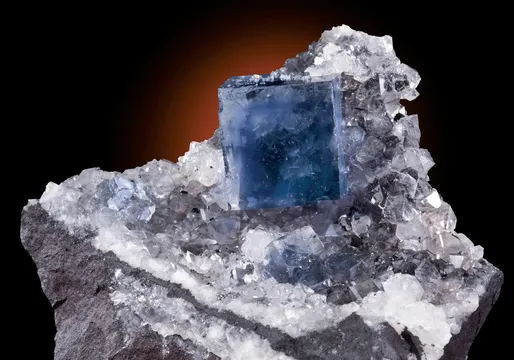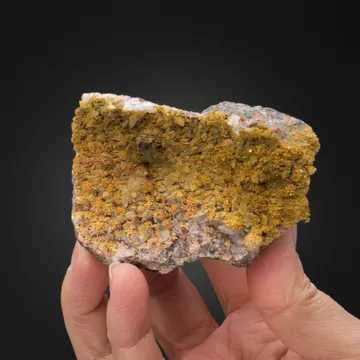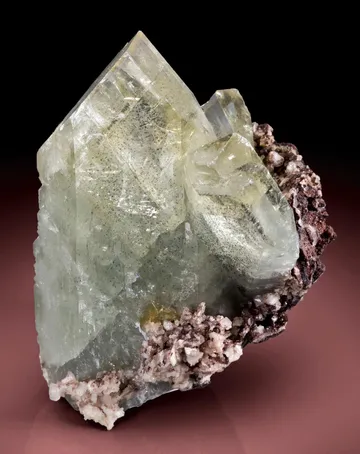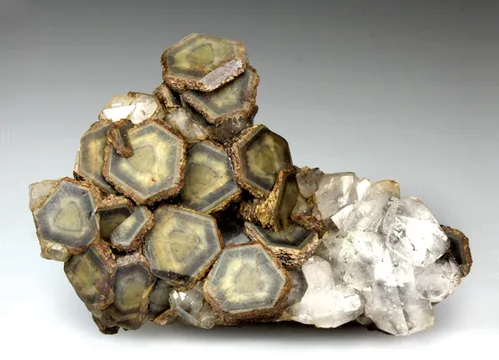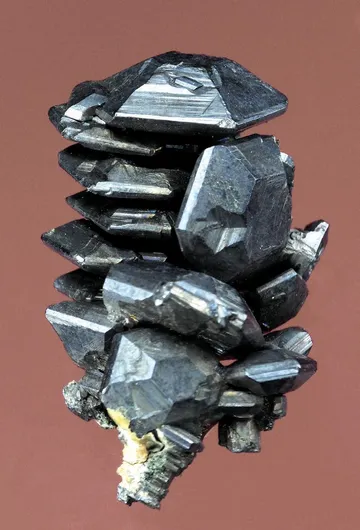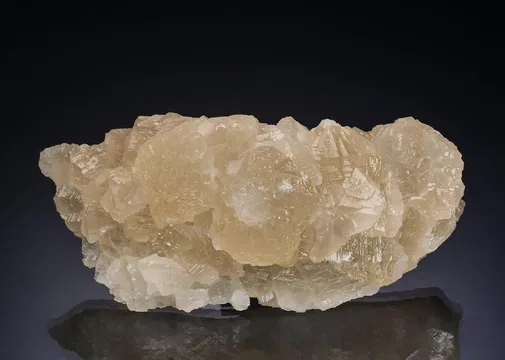
Settlingstones Mine, UK - renowned for witherite crusts and baryte crystals, twinned pseudohexagonal forms, a historic British locality prized by collectors.
Key facts
Settlingstones is one of the great British barium localities: a Northumberland mine whose collector fame rests not on lead ore, though it began as a lead mine, but on the extraordinary commercial and specimen output of witherite, BaCO3. The mine worked the Settlingstones Vein north of the Tyne Valley near Fourstones and Newbrough, in the Haydon Bridge portion of the Northern Pennine Orefield. Geologically it sits in Carboniferous strata of the Northumberland Trough, at the northern edge of the orefield’s barium-rich outer zone, where the vein cut limestones, sandstones, mudstones and the intruded Whin Sill dolerite. That interaction with the Whin Sill is central to the locality’s character: the richest witherite ground lay where the sill made one or both vein walls, and mineralizing fluids altered the dolerite to the pale clay-carbonate rock miners called “white whin.”
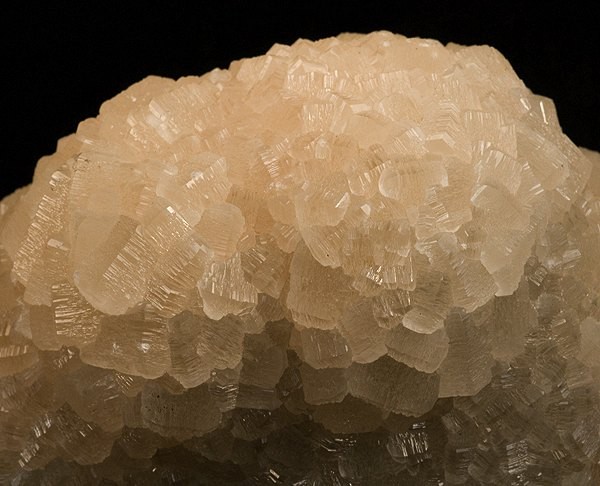
Collectors prize Settlingstones for dense, lustrous, cream to tan witherite crusts and mounded cabinet plates, commonly made of complex twinned pseudohexagonal crystals rather than isolated, textbook single crystals. In cavities the witherite may show terminated aggregates, rounded nodular surfaces, or more massive crystalline veinstone broken open to reveal sparkling vugs. Barite or baryte is the other signature species here, especially as transparent to translucent, colorless blades and sharp crystals lining cavities in witherite. The classic specimen aesthetic is understated but unmistakable: warm buff or fudge-brown witherite, glassy to waxy luster, heavy barium-carbonate heft, and cavities edged with pale baryte or specks of harmotome.
Historically, Settlingstones matters because it became the world’s leading, and for long periods sole, commercial source of witherite. Lead was raised first, but after the vein filling changed dramatically southwest of a cross-course, witherite became the mine’s reason for existence. From the 1870s until closure in 1969, the mine supplied the chemical industry while also releasing the finest English witherite specimens in quantity. Its surviving material is not merely attractive; it is central evidence for one of the most unusual barium-carbonate mineralizing systems known.
Regional View
Country View
The mine’s best specimens are old-time pieces from underground work rather than modern surface finds. The difference is immediately visible: mine-era witherites have complete crystal surfaces, deep vugs and comparatively fresh luster, while dump pieces are more often broken veinstone, oxidized, weathered, or partly converted at the surface. Even so, the remaining spoil has kept the locality scientifically alive, because pieces of witherite veinstone, distinctive baryte, harmotome-bearing “white whin,” and rare late-stage carbonate material can still document relationships once visible underground.

Search for specimens: View all specimens from Settlingstones Mine, UK
Settlingstones Mine lies in the Haydon Bridge mining field on the north side of the Tyne Valley, near Fourstones and Newbrough in Northumberland. The principal structure was the Settlingstones Vein, a roughly north-east–south-west vein cutting Lower Carboniferous sedimentary rocks and the Whin Sill. The enclosing sequence belongs to the alternating limestones, sandstones and shales of the district; locally the vein passed through the quartz-dolerite sill and associated thermally altered rocks. This setting placed Settlingstones in the northernmost worked expression of the Northern Pennine Orefield, but structurally outside the Alston Block proper, in the southern part of the Northumberland Trough. The deposit is generally treated as part of the orefield’s outer barium-rich zone, with a mineralogy dominated by witherite and baryte rather than the fluorite-rich assemblages more typical of more central districts.
The vein had two sharply different economic personalities. The earlier workings, near the crop of the vein in Settlingstones Burn, were lead workings, with galena accompanied by baryte and ankerite. Farther southwest, after the vein crossed a north-north-west to south-south-east cross-course, the filling changed abruptly: witherite became the dominant mineral, with only small amounts of sulphides and other gangue. The principal witherite orebody was broad for a Pennine vein, commonly around 2.5 to 3 m wide and locally far wider, with published accounts recording exceptional widths near 9 m. The productive witherite zone extended for about 1300 m, ending near the Grindon Hill Shaft area. Branches and loops of the vein were also sufficiently mineralized in places to be worked for witherite.
The best ore was associated with the Whin Sill. Where hard dolerite formed the vein walls, the ore shoot was competent and favorable for stoping; where mineralizing fluids reacted with the sill, the wall-rock was transformed into “white whin,” a pale altered rock that later became important to mineralogists because it can carry harmotome. The witherite was not merely a vein infill in the simplest sense. Thin-section and underground observations showed replacement relationships, especially with witherite replacing earlier tabular baryte. Bands of galena and sphalerite in baryte-rich crustified vein material continued into or hung across cavities later occupied by witherite, evidence for a complex paragenesis rather than a single pulse of crystallization.
Mining began as a lead enterprise, with records from the late seventeenth century and documentary accounts from 1687 to 1692. Notices of sale appeared in the eighteenth century, and in the nineteenth century the property came into the hands of Frederick Hall. The existing company form, the Owners of Settlingstones Mines Ltd., dates from 1907. Lead production records are best documented for 1849 to 1873, when 16,902 tons of lead concentrates were raised. Witherite production began in the early 1870s and became exclusive after 1873; from then until closure in 1969, Settlingstones was essentially a witherite mine. Published totals vary by source and accounting method, but the Geological Conservation Review gives around 630,000 tons of witherite product between 1873 and 1969, while contemporary regional accounts describe the Haydon field as producing just over half a million tons.
The working layout that collectors encounter in old labels often names Frederick Shaft and Ellen Shaft. Ore was raised at Frederick Shaft, beside the Fourstones to Grindon Hill road and the Stanegate, while treatment took place at the plant by Ellen pumping shaft on the south bank of Settlingstones Burn. Underground extraction used shrinkage stoping where the Whin Sill made strong walls. In the 1960s, miners broke the ore upward, left much of it in the stope as a working floor and underground store, and drew it off through timber chutes to maintain a steady feed to the surface dressing plant. F. Brook’s 1965 observations record ore going by tubs to Frederick Shaft, then by cable-drawn wagons to the Ellen plant, where crushing, washing and jigging produced saleable small pieces of barium carbonate.
On closure, the shafts were sealed, buildings were demolished or cleared, and most underground access disappeared permanently. No in situ mineralization is exposed today, and the underground workings should be regarded as inaccessible. The remaining collecting interest is in the spoil and coarse rock dumps, parts of which are protected as a Site of Special Scientific Interest. Much of the former spoil has been landscaped and is increasingly vegetated. Any visit therefore requires landowner permission and strict respect for protected features; removal or excavation from SSSI material can damage exactly the geological resource for which the site is designated. The responsible collector should think of Settlingstones primarily as a classic provenance for old specimens, not as a casual digging locality.
Specimen finds came chiefly from cavity-rich witherite ore in the working mine. Vugs in crystalline witherite produced twinned, pseudohexagonal witherite crystals, rounded nodular aggregates, baryte blades lining cavities, and small harmotome crystals encrusting witherite. The most unusual pocket recorded from the mine was the nickel occurrence on the 70-Fathom Level, a pipe-like body that yielded niccolite and ullmannite and later material identified as gersdorffite. That pocket is not representative of the mine’s usual output, but for specialists it is one of the locality’s most important mineralogical footnotes.
Witherite from Settlingstones is the locality’s defining species and typically appears as white, cream, pale buff, tan or yellow-brown crystalline masses with vugs of lustrous twinned crystals; the classic cabinet pieces are mounded crusts and dense aggregates of stacked pseudohexagonal forms rather than isolated single prisms. Published specimen photographs and old dealer descriptions show sizeable cabinet examples around 14.5 x 7.0 x 5.9 cm, while underground accounts describe vugs lined with shining twinned crystals and, more rarely, globular, tuberous and botryoidal material with columnar internal structure. The richest witherite ground lay southwest of the cross-course where the vein changed from lead-baryte-ankerite mineralization to a witherite-dominant filling, especially where Whin Sill wall-rock bounded the orebody. Associations include baryte, sparse galena and sphalerite, calcite, very rare barytocalcite, harmotome encrustations and local strontianite. The best specimens have fresh luster, intact rounded or pseudohexagonal crystal faces, open cavities, and a warm cream-to-fudge color; ordinary pieces are massive, broken veinstone or weathered dump fragments with little three-dimensional crystal development.
Barite from Settlingstones is intimately tied to the witherite orebody and is best known as sharply terminated crystals and blades lining cavities in witherite. The most desirable pieces show transparent to translucent, colorless baryte blades with bright glassy luster and crisp, sometimes saw-toothed edges; a photographed old-time example measures 8.7 x 5.5 x 3.8 cm with a largest crystal of 4.5 cm. In the mine’s paragenesis, baryte occurred both as the earlier barium sulphate phase that could be replaced by witherite and as cavity-lining crystals associated with the barium-carbonate stage, which makes good Settlingstones specimens especially instructive. Fine pieces are judged by transparency, termination quality, contrast against witherite, and freedom from bruising along the thin blade edges; many otherwise attractive examples have small chips that are easy to miss because the crystals are pale and glassy.
Baryte, the spelling most often used in British geological literature, is not a different mineral from barite but it is the name under which much of the classic Settlingstones material is recorded. At this locality it ranges from earlier vein baryte in the original lead workings to the distinctive sharp, cavity-lining crystals found with witherite in the southwest part of the vein. The habit singled out in geological descriptions is a characteristically sharp morphology dominated by prism and pinacoid faces, developed in cavities in witherite and considered typical of baryte associated with barium carbonate in the Northern Pennines. Collectors should look for old labels, glassy colorless blades, balanced coverage on witherite matrix, and undisturbed cavity architecture; the most satisfying examples preserve the geological story visually, with baryte visibly seated in or on the witherite rather than occurring as anonymous loose blades.
Other documented minerals from Settlingstones include galena, sphalerite, pyrite, calcite, ankerite, strontianite, harmotome, barytocalcite, niccolite, ullmannite, gersdorffite, bournonite, quartz and country-rock species such as dolerite and shale. Harmotome is especially characteristic in small, colorless cruciform twins coating witherite in vugs or filling veinlets in altered Whin Sill. Barytocalcite is a very rare late-stage carbonate here, reported as tiny colorless monoclinic prisms on pseudohexagonal witherite in small vugs. The nickel minerals are rarer still: Russell’s 1927 paper documented niccolite and ullmannite from a single pipe-like occurrence, and later work recognized gersdorffite in material from the same unusual association. Settlingstones is not generally cited as a type locality for an accepted mineral species, but it is one of the essential reference localities for witherite mineralization, harmotome in the northern Pennine barium assemblage, and nickel-bearing pockets in the Whin Sill-related vein environment.
Settlingstones witherite is widely represented in older British and international collections, but top pieces are not common on the market because the mine closed in 1969 and the best material was collected during active underground work. Today’s supply is mostly old collection material: cabinet plates, dense miniatures, fragments of vuggy witherite veinstone, baryte-on-witherite combinations and occasional micromounts of harmotome or barytocalcite. Provenance matters. Old labels naming Settlingstones, Fourstones, Newbrough, Haydon Bridge or sometimes simply “Hexham, Northumberland” are all worth preserving with the specimen.
The main authenticity issue is not deliberate fakery so much as locality drift. Northern England produced witherite from several famous localities, including Fallowfield, Nentsberry Haggs, Brownley Hill, Rampgill and Durham coalfield occurrences, and old dealer labels can be shortened or confused. Settlingstones material is commonly denser-looking, tan to cream, mounded and drusy, with complex stacked pseudohexagonal aggregates and baryte cavity linings; Fallowfield witherite more often evokes sharper pale pseudohexagonal pyramids or nodular radiating masses. That distinction is useful, but it is not a substitute for provenance or analysis when a specimen carries a vague old label.
Condition is a serious factor. Witherite is brittle, relatively soft, and heavy for its size; crystal edges and rounded high points bruise easily. Baryte blades from Settlingstones are even more vulnerable along thin terminations, and small edge chips can disappear visually against a pale background until the specimen is rotated under strong light. Many mine-era specimens have minor bruising, and modest contact damage is acceptable if the overall form, luster and cavity quality are strong. Cleaned specimens should not be aggressively acid-treated without expert knowledge: witherite is a carbonate and will react with acids, so careless cleaning can etch surfaces that once had the glassy-to-waxy luster collectors want.
Handling deserves respect. Witherite is barium carbonate and is toxic if ingested or inhaled as dust. Solid display specimens are safe to own with ordinary mineral-collection hygiene, but do not saw, grind, lick, soak in unknown chemicals, or leave broken powder where children or pets can reach it. Wash hands after handling friable material. Some witherite can fluoresce pale bluish under ultraviolet light, but fluorescence is not the principal reason to buy Settlingstones specimens; form, surface quality, association and provenance are far more important.
Rarity is tiered. Massive witherite fragments and small vuggy pieces are available with patience. Attractive miniatures and cabinet plates with good luster and little damage are much scarcer. Fine baryte-on-witherite combinations, harmotome-rich vugs, verified barytocalcite, and any specimen credibly tied to the nickel pocket are specialist material. The most desirable Settlingstones specimens are not necessarily the largest; a compact piece with sharp, undamaged pseudohexagonal witherite, open pockets, and an old label can outrank a bulky mass of dull ore.
On Friday, March 28, 1969, the last shift came out of Settlingstones. F. Brook called it the end of an era for the metalliferous mines of Tynedale and the Haydon Field, and the phrase was not sentimental exaggeration. The mine was then the only remaining commercial source of witherite in the world. A small Northumberland field that had once worked lead had become the keeper of a mineral commodity so specialized that its closure effectively ended a whole branch of British barium mining.
Brook’s 1965 visit gives the most vivid surviving picture of the mine still alive. The miners were not selectively chasing thin strings of ore as in a traditional lead mine; they were taking out the whole witherite vein. That meant the empty space had to be filled. In the hard Whin Sill ground, shrinkage stoping was possible. Miners broke ore from the roof, left the bulk of the broken witherite in place as a rising working floor, and drew off surplus ore through timber hoppers and “mills” at the base. In effect the stope became an underground storehouse: broken ore underfoot, working space above, and a controlled flow downward whenever the dressing plant needed feed.
The movement of ore had the slow rhythm of an older mining world. Tubs were hauled by ponies along the levels to the foot of Frederick Shaft. Brook noted that when he visited, management was experimenting with a battery locomotive adapted to the narrow levels, but the image that stays is still the pony road: heavy barium carbonate in small tubs, passing out of a vein that had fed industry for nearly a century. From Frederick Shaft the ore went by cable-drawn wagons along a mineral railway to the dressing plant at Ellen Shaft, about half a mile to the north-east. There, machinery nearly a century old, made by Davison’s ironworks at Hexham, crushed, washed and jigged the witherite into saleable pieces about three-eighths of an inch across.
Trestrail’s 1938 account shows the mine as a place of water, pumps and hard rock. Natural ventilation carried air through Ellen and the 80-fathom water level, while Frederick Shaft served as the upcast, fan-boosted when needed. Water inflow was constant, about 400 gallons per minute, and the mine’s sumps were small enough that a stoppage of only a few hours could flood the workings. The drainage system led water from Frederick Shaft to the 80-fathom level and onward to Ellen, where the flow peaked. The power plant belonged to a transitional age: grid electricity had arrived, but older steam-generating equipment remained, including Belliss and Morcom generating sets and boilers standing by.
There are wonderfully concrete human traces in the local photographic record. Around 1920, the mine was busy enough to leave images of Frederick Shaft headgear, tubs ready to descend, an endless-rope balance bogey by the power house, a Sentinel steam wagon being loaded with witherite from hoppers at Frederick Shaft, Hertz jigs in the dressing plant, and named miners at work. Tom Caukwell and his son Harold were photographed drilling in a fore end with power drills and a tub nearby; Alf Angus and Joe Hodgson were shown drilling in the vein near surface. These names matter because they return the specimens to the human scale: the witherite plates now in drawers and cabinets came from an industrial place of drills, hoppers, ponies, pumps and men working in hard Whin Sill ground.
Even after the mine stopped, Settlingstones did not vanish quietly. A later account records that plant was sold off and shafts were capped, but in 1971 ground near Ellen Shaft collapsed, destroying the old mine offices, then in use as kennels for the Haydon Hunt. It is a suitably unsettling postscript for a mine whose geology had always been tied to voids: vugs in witherite, cavities broken into during stoping, water-filled spaces underground, and finally a surface collapse at the old heart of the treatment works.