


Serra do Caldeirão, Brazil — notable gold locality producing crystallized native gold with vivid luster and sculptural forms, prized as a brief, iconic collect…
Key facts
Serra do Caldeirão entered the collector vocabulary almost overnight in 2015, when a short-lived rush in the hills near Pontes e Lacerda, southwestern Mato Grosso, yielded a small but spectacular suite of crystallized native gold. The claims lie in the Alto Guaporé gold province, on the southwestern Amazonian Craton, where Proterozoic metasedimentary rocks, basement granitoids and long-lived shear structures of the Aguapeí belt host orogenic gold mineralization. In broad deposit terms, this is not a simple placer locality: the collector specimens are tied to gold in altered, crumbly, detrital and bedrock material on the Serra do Caldeirão ridge, with the broader district’s gold systems related to quartz veins, pyrite-bearing alteration and structurally focused hydrothermal fluids.
The reason collectors care is simple: the best pieces look nothing like ordinary Brazilian nuggets. Fine Serra do Caldeirão gold is vivid yellow, exceptionally lustrous and sculptural, forming aerial floaters of flattened, skeletal, hoppered and dendritic crystals. Many show elongated octahedral to octahedral-rhombododecahedral forms, spinel-law twins, hooked edges and hollowed growth faces. The great specimens have the improbable combination that makes a gold locality famous: strong crystallography, three-dimensional architecture, fine surface texture and enough heft to feel like gold rather than foil. The find was brief, chaotic and quickly choked by legal control and mining-rights disputes, which is why the locality now has the aura of a one-season classic.
Regional View
Country View
The locality’s specimen reputation rests on a narrow window, chiefly late 2015 into the early 2016 market. Pieces shown by European dealers at Tucson 2016 immediately stood apart from typical rounded nugget gold: not water-worn, not sheet gold, and not merely “interesting for Brazil,” but competitive with world-class crystallized gold localities. The best miniatures and thumbnails are complete floaters, sharply crystallized all around, often with a lattice-like or branching outline. Cabinet-size examples are dramatically rarer; one very large crystallized specimen from the claims, weighing hundreds of grams, later became a six-figure auction lot.
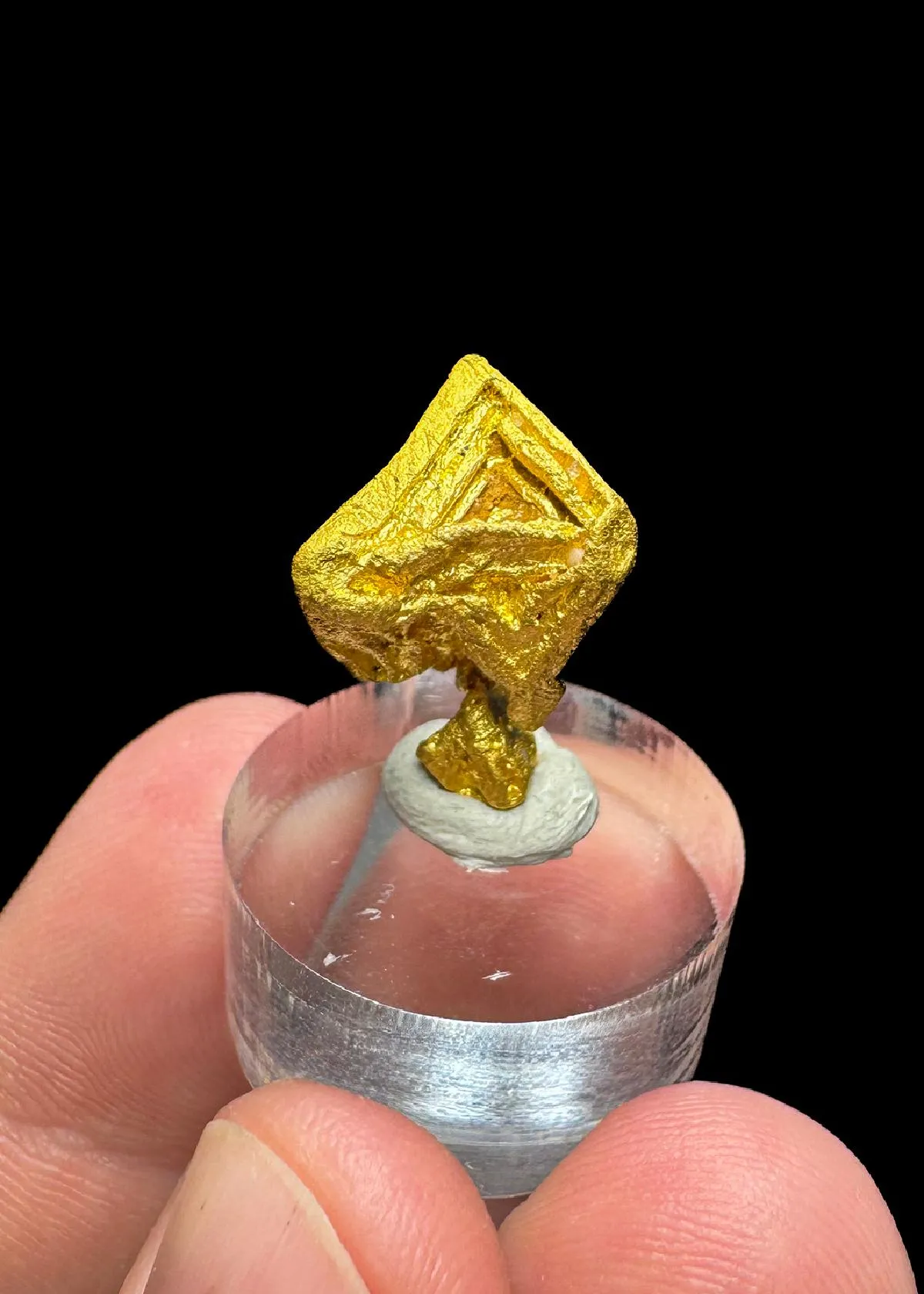
Photo: EarthWonders
Search for specimens: View all specimens from Serra do Caldeirão claims, Brazil
Serra do Caldeirão is a gold claim locality in the municipality of Pontes e Lacerda, Mato Grosso, in Brazil’s Alto Guaporé district. Field accounts place the 2015 rush area on the Serra do Caldeirão hills at roughly S 15°18', W 59°25', at about 400–500 m elevation, south to southwest of Pontes e Lacerda. News and legal accounts use slightly different distance figures for the rush area, commonly around 12–18 km from town, while older technical descriptions of the broader Serra do Caldeirão properties place them farther south in the Caldeirão Range. For collectors, the important point is that “Serra do Caldeirão claims” refers to the spectacular 2015 crystallized gold occurrence in this hill belt, not to an alluvial river locality.
Geologically, the claims sit within the Alto Guaporé gold province, a Proterozoic orogenic gold province along the Aguapeí belt on the southwestern Amazonian Craton. Regional work describes gold mineralization along a NNW-trending shear system developed in siliciclastic sequences of the Aguapeí Group and related basement rocks. In the better-studied Ernesto and Pau-a-Pique deposits of the same province, gold is associated with quartz vein systems, pyrite, muscovite-rich alteration, Fe-Ti oxides and minor base-metal sulfides; the Serra do Caldeirão material belongs to this same regional metallogenic architecture, though the specimen occurrence itself is best known from garimpo workings in altered, friable material on the ridge rather than from a carefully documented underground pocket.
The specimen gold appears to have been liberated from weathered and altered bedrock or colluvial material rather than transported far in streams. Contemporary field notes stressed that the material was not alluvial gold carried by rivers. Miners broke the relatively crumbly rock by hand tools and pneumatic drills, then searched debris with metal detectors or panned muddy water on the spot. That mode of recovery helps explain why many specimens are floaters and why matrix pieces are scarce: the collectible gold was removed directly from broken, altered material and cleaned for sale as discrete masses.
Mining history at Serra do Caldeirão is unusually tangled. The broader Pontes e Lacerda gold belt has been known for generations, and gold mining in the Alto Guaporé region reaches back to colonial-era activity in western Mato Grosso. The modern collector episode, however, was sudden. In 2015, images of alleged giant nuggets and bags of money circulated on social media and triggered a rush that Brazilian press compared with Serra Pelada. By mid-October 2015, thousands of people had reached the hills, including experienced garimpeiros, local workers, adventurers and people with no previous mining experience.
The legal situation closed in quickly. Federal authorities regarded the garimpo as illegal because extraction was occurring without the required mining and environmental authorizations. A Federal Court order in October 2015 directed that the area be vacated, tools destroyed, vehicles removed or seized, and extracted gold confiscated as a mineral resource of the Union. Police, federal agencies and state authorities remained involved through repeated evacuations and attempted reoccupations. A first major removal occurred in late 2015, and another in January 2016, with subsequent reports of renewed incursions in later years.
Corporate and title history is central to the locality. Contemporary legal and press accounts name Mineração Santa Elina, Mineração Tarauacá, Serra da Borda Mineração e Metalurgia, Mineração Silvana and later Mineração Apoena in connection with mineral-rights, research or licensing matters in and around the Serra do Caldeirão/Serra da Borda area. Santa Elina received a DNPM authorization in March 2016 to carry out mineral research in the Serra do Caldeirão area for a three-year period, while environmental licensing and research-related issues were still being discussed in 2017. These authorizations were for exploration and evaluation, not an open invitation for specimen collecting.
Collecting access today should be treated as closed unless a collector has explicit permission from the landholder, mineral-rights holder and any relevant authorities. The locality has a documented history of police action, court orders, armed confrontations, environmental fines and recurrent illegal mining. It is not a casual field-collecting destination, and specimens on the market should be approached as old material from the 2015–2016 supply, or from clearly documented later legal channels if such documentation exists.
The notable specimen “pockets” are not described in the classic mine-pocket sense. Instead, the collector record points to a concentrated late-2015 harvest of floaters from garimpo workings in the altered ridge material. Dealer and forum accounts repeatedly give the date range as 2015 or September–December 2015. Typical small specimens range from about 1 to 3.5 cm and a few grams to the mid-teens in grams, while very large crystallized pieces are exceptional. The best-known specimen styles include flattened skeletal crystals, arborescent masses of elongated octahedral crystals, spinel-law twins and sharply hoppered octahedral forms.
Gold from the Serra do Caldeirão claims is the locality’s defining mineral and, in strict specimen terms, essentially the entire story. The classic pieces are bright native gold floaters in flattened, dendritic to arborescent aggregates, commonly built from elongated octahedral, octahedral-rhombododecahedral or flattened cubic-looking crystals with skeletal and hoppered growth. Fine examples have crisp faces and edges, deep hollow growth features, spinel-law twinning, strong yellow colour and unusually lively luster; lesser pieces are more nugget-like, rounded, compact or poorly articulated. Most collectible specimens are thumbnail to small-miniature size, often around 1–3 cm and a few grams, while pieces exceeding 10 grams with sharp, three-dimensional crystallography are decidedly choice. The strongest Serra do Caldeirão pieces are not valued merely by weight but by architecture: complete floaters, balanced branching form, minimal bruising, and visible crystallography on multiple sides set the locality’s best gold apart from ordinary high-purity nuggets.
The exact locality record is remarkably narrow. Mindat lists native gold as the verified mineral species for the Serra do Caldeirão claims, and the collector literature likewise treats the locality as a native-gold occurrence rather than a multi-species specimen mine. Regional ore studies in the Pontes e Lacerda belt document quartz veins, pyrite, sericite/muscovite alteration, limonite after pyrite, magnetite altered to hematite, and minor sulfides in the broader district, but those should not be casually relabeled as Serra do Caldeirão collector minerals unless tied to a specific specimen or analysis. No type-locality mineral is verified from the claims; the often-mentioned rhodium content in some analyzed gold specimens is a trace-element peculiarity of the gold, not a separate mineral species.
Serra do Caldeirão gold is one of the modern localities where provenance matters intensely. The genuine classic material belongs to the 2015 rush and early 2016 dealer circulation, with some labels giving September–December 2015. Good labels from established dealers, auction records, or old collection cards are important because later Pontes e Lacerda-area finds, such as Serra Dourada, can resemble the Caldeirão material at a glance but have been described as morphologically distinct. A specimen simply labeled “Pontes e Lacerda gold” should not automatically be upgraded to Serra do Caldeirão without supporting provenance.
The main authenticity discussion concerns the very high fineness, bright luster and surface condition of some specimens. Forum participants reported EDS or XRF-type analyses showing very pure gold, with some specimens described around 98.5–99.7% Au and others reported by Fabre Minerals as about 99.1% Au with roughly 0.5% Rh. That high purity prompted discussion among collectors, including questions about whether some pieces might have been artificially enhanced. A rumor of galvanic gold-plating was raised publicly, but it was not demonstrated as a documented fake. Other collectors argued that natural surface enrichment and acid treatment can produce very yellow, clean surfaces, and one contributor suggested that nitric acid and water-jet cleaning may have removed matrix and brightened small voids. The practical advice is conservative: examine suspiciously uniform surfaces, unusually glossy recesses, solder-like textures, and any lack of normal micro-relief under magnification, but do not assume high-purity Serra do Caldeirão gold is inherently artificial.
A separate fake-related caution comes from the rush itself rather than from the mineral market: one widely circulated “giant nugget” image was identified in collector commentary as a painted rock. That episode belongs to the social-media frenzy that drew miners to the area, but it is a useful reminder that 2015 Serra do Caldeirão was surrounded by rumor, excitement and opportunism. Buy the specimen, not the story.
Condition is often the decisive factor. Gold is soft, and the best Serra do Caldeirão crystals depend on delicate edges, hollow faces and branching projections. Flattened dendritic pieces can be bent, compressed or bruised; hoppered crystals can have rubbed high points; and arborescent specimens may have broken branch tips. Because many specimens are floaters, check all sides. The reverse should be as convincing as the display face, even if less showy. Mounting damage is also worth checking on thumbnails that have been repeatedly handled or glued to acrylic bases.
There is no fluorescence consideration for native gold. Handling should be minimal and careful: avoid repeated touching, avoid ultrasonic cleaning, and do not try to “improve” a specimen by chemical cleaning unless you are prepared to risk changing its surfaces permanently. Fine gold specimens should be secured in a box or custom base so projections cannot flex during shipping.
Market availability is thin. Small pieces appear from time to time through dealers, auctions and collection dispersals, but the main supply seems to have been a single pulse rather than continuing production. The best examples entered advanced private collections quickly. Weight still affects price, but Serra do Caldeirão is primarily a crystallized-gold locality: a sharp, 2 cm skeletal floater can be more desirable than a heavier but rounded nugget. Superb large specimens are legitimately rare and have reached major-auction price levels.
The Serra do Caldeirão story began not with a formal discovery notice but with phones buzzing. In October 2015, photos of huge nuggets and quick fortunes flooded WhatsApp and Facebook, and Pontes e Lacerda suddenly had the rumor-energy of an old frontier camp. Folha de S.Paulo found Abiude Cerqueira, a 38-year-old body-shop owner from São Paulo, who had gone to Mato Grosso for a family party and wound up four days deep in mud, digging a hole that had reached six meters by Wednesday, October 14. He had found no gold, but the possibility was enough. Wesley Caetano, 19, left his job at a carwash in nearby Indiavaí after seeing phone images and hearing stories of people getting rich. His short explanation carried the whole rush in miniature: “My Whatsapp was full of images of gold.”
Within days the hillside became a noisy, improvised village of holes, tools, engines and parked vehicles. Folha reported almost 2,000 people by city-hall estimates in mid-October, while later accounts of the peak occupation reached 5,000 or more. A pasture along the access road became paid parking at R$ 50 per vehicle per day; by the afternoon of October 14, one reporter counted 340 cars. Tool sellers, equipment suppliers and landowners did well even when many diggers did not. The image is less of orderly mining than of a hillside suddenly perforated by hope.
The hazards appeared almost as quickly as the crowd. On October 19, 2015, five garimpeiros were injured when a bank collapsed at the illegal workings. Press reports described a shortage of water and food among the encamped miners and growing local concern about the disorder around the site. The court order to close the garimpo had already been issued, but getting thousands of people off a gold-bearing hill was not simply a matter of paper authority.
The legal machinery that followed was as dramatic as the rush. On October 16, 2015, Federal Judge Francisco Antônio de Moura Junior ordered the garimpo closed. The order called for people to be removed, tools destroyed, vehicles removed or seized, and gold confiscated. Police were to remain on site after the removal. The decision reflected the Brazilian constitutional principle that mineral resources belong to the Union, but in the dust of Serra do Caldeirão it meant something very direct: a prospector holding a fresh nugget could not simply claim it as private spoil.
Even after the first removals, the hill kept pulling people back. Public Ministry documents describe repeated reoccupations, cases involving weapons, drug traffic, extortion around profitable “holes,” and people lingering in Pontes e Lacerda for another chance. By January 2016, a second major desoccupation brought in federal security forces, including the National Force and the Brazilian Army. Later reports show that Serra do Caldeirão did not fade quietly: there were renewed incursions, security conflicts and, in 2018, a fatal exchange of gunfire between police and garimpeiros in the same broader area.
For mineral collectors, the human turmoil is inseparable from the specimens. The very features that make Serra do Caldeirão gold famous—sharp skeletal crystals, branching floaters, high luster—came out of a short-lived and poorly controlled rush rather than a specimen-conscious mining operation. The best pieces survived by chance: found in broken altered ground, recognized as something more than melt value, passed quickly into dealer networks, and then mostly locked away in collections. The locality’s legend is therefore double: a modern “Nova Serra Pelada” in the Brazilian press, and, for collectors, one sudden harvest of world-class crystallized native gold.