






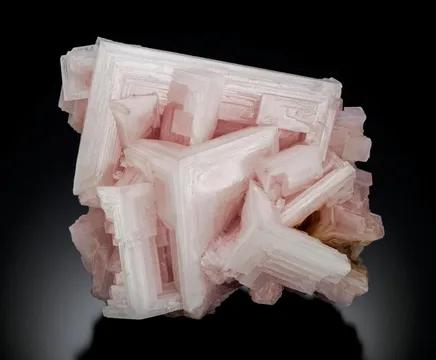
Searles Lake, USA — a dramatic Mojave evaporite locality famed for rose-pink halite, hanksite, borax and trona crystals, prized by collectors and researchers.
Key facts
Searles Lake is one of the defining evaporite localities for modern mineral collectors: a dry, chemically extravagant Mojave Desert basin whose best specimens look less like “salts” than like architecture grown in brine. The lake lies near Trona in northwestern San Bernardino County, between the Argus and Slate ranges, in the southwestern Basin and Range province. Its present playa is the exposed remnant of a much larger Pleistocene lake system fed episodically by the Owens River drainage. As glacial and interglacial climates alternated, Searles Lake rose, shrank, stratified, and repeatedly evaporated, leaving stacked mud and salt units packed with sodium, potassium, carbonate, bicarbonate, sulfate, chloride, fluoride, and borate minerals.
For collectors, Searles Lake matters because it combines three kinds of importance rarely found in one locality. It is a giant industrial brine deposit, long worked for borax, soda ash, salt cake, salt, boric acid, and related chemicals. It is a research locality where cores have been used to reconstruct late Quaternary climate, lake chemistry, and brine evolution. And it is a specimen locality famous for fragile, water-soluble crystals that once came to market through carefully controlled Gem-O-Rama collecting trips: rose-pink hopper halite from brine pools, large barrel and pyramidal hanksite from mud and “Blow Hole” material, borax and trona crystals, sulphohalite octahedra, and a supporting cast of unusual alkaline-lake minerals that reads like a systematic collector’s checklist.
The visual signature is unmistakable. Fine Searles halite shows transparent to translucent cubes, often hoppered and skeletal, in pale rose, raspberry, or cranberry-pink tones. Hanksite tends toward six-sided barrel-shaped prisms, tabular crystals, or pyramidal terminations in gray, tan, greenish, yellowish, or nearly colorless hues, sometimes as surprisingly large clusters. Nahcolite commonly appears as pale to white crystalline material associated with pink halite, and borax can occur as clear to whitish crystals that are far less stable in ordinary room conditions than their initial freshness suggests. Even modest pieces carry the atmosphere of the lake: brine, mud, salt crust, and rapid growth in an extreme closed-basin chemical system.
Regional View
Country View
Searles Lake is especially valuable to collectors because many of its most characteristic specimens are not products of ordinary hard-rock mining. They are ephemeral evaporite crystals produced, exposed, dissolved, re-grown, or damaged according to brine level, season, sunlight, temperature, mud conditions, and industrial access. A large, sharp, strongly colored Searles specimen is therefore not merely a mineral example; it is a preserved moment from a living salt system.


Photo: Wikimedia Commons / GeoDIL
Search for specimens: View all specimens from Searles Lake, USA
Searles Lake is a closed-basin saline-lake evaporite deposit. The broad playa covers a late Quaternary succession of muds and salts formed when pluvial lakes in the Owens–China–Searles drainage chain repeatedly filled and evaporated. In the classic USGS stratigraphy, the younger section is divided into Overburden Mud, Upper Salt, Parting Mud, Lower Salt, Bottom Mud, and an older Mixed Layer. The Upper Salt and Lower Salt are the units most immediately relevant to many collectible evaporite specimens, while the mud layers preserve the wetter intervals between major salt-forming episodes.
The deposit is not a single bed of ordinary rock salt. It is a chemically layered system in which halite, trona, hanksite, borax, burkeite, nahcolite, thenardite, aphthitalite, mirabilite, northupite, gaylussite, pirssonite, sulphohalite, teepleite, tincalconite, and other phases occur according to brine chemistry, temperature, water activity, carbon dioxide activity, and post-depositional brine movement. USGS core work documented an upper salt body and a lower salt body separated by clay or marl, with interstitial brines occupying pore spaces between the salts. In simple collecting terms, Searles is a layered chemical archive; in mineralogical terms, it is one of the great natural laboratories for alkaline evaporite paragenesis.
Modern brine evolution at Searles can be thought of as a progression from carbonate mud and calcium-magnesium carbonate phases through sodium carbonate and sulfate minerals, then ultimately to halite as evaporation advances. The Owens River system supplied water and dissolved solutes from a large catchment that included volcanic terranes of the Long Valley region and the eastern Sierra Nevada. The result was a nonmarine evaporite assemblage very different from a normal marine salt deposit: rich in sodium carbonate, sodium sulfate, borate, potassium-bearing salts, and rare fluoride-bearing phases.
Historically, the lake entered industry through borax. John W. Searles noticed borate salts on the playa in the 1860s while prospecting in the region; commercial work began in the 1870s when John and Dennis Searles organized the San Bernardino Borax Mining Company. Early production involved scraping surface borax and hauling it across the desert by mule team before rail connections transformed the economics of the field. Later operations shifted from surface salts to brine extraction and chemical processing. The 20th-century industrial lineage includes American Trona, American Potash & Chemical, Kerr-McGee, North American Chemical, IMC, and Searles Valley Minerals. The company town of Trona and the Trona Railway are inseparable from this industrial history.
Industrial extraction is solution mining and brine processing rather than conventional specimen mining. Brines are pumped from wells completed in selected salt-bearing horizons; injection, production wells, solar ponds, processing plants, and pipelines form the working landscape. Plant operations historically centered on Trona, Argus, and Westend. As of September 8, 2026, public regulatory records still identify Searles Valley Minerals Operations, Inc. with Searles Lake facilities, while the corporate parent, Searles Valley Minerals Inc., entered Chapter 11 proceedings in June 2026 and began a court-supervised sale process. For collectors this matters less as a financial detail than as a reminder that the lake is active industrial property, not open public ground.
Specimen collecting is permission-only. The classic public route was Gem-O-Rama, organized by the Searles Lake Gem & Mineral Society with cooperation from the operating company. For decades, the event gave collectors rare access to otherwise closed areas of Searles Dry Lake during the second weekend in October. The timing was practical: the brine level was low enough to expose Upper Salt material, mud was dry enough to support heavy equipment, and the pink halite had formed well but had not yet been extensively dissolved by winter conditions. The society later announced that the 2018 Gem-O-Rama was the last full show and that future Gem-O-Rama activities were permanently cancelled. Limited dealer-oriented pink halite trips were advertised for 2022 and 2023, but they required advance registration, payment, waivers, vehicle limits, and coordination with Searles Valley Minerals.
The named collecting experiences explain much of what appears in collections today. The Mud Trip involved digging through transported black mud containing hanksite, trona, borax, and associated saline crystals. The Blow Hole trip used prepared holes into the Upper Salt; Searles Valley Minerals personnel jetted crystal-bearing material from tens of feet below the playa surface and spread it over the salt pan for collection. The Pink Halite trip took collectors to brine pools where the best halite formed on the undersides of ledges, overhangs, and pressure-ridge voids beneath or near the brine surface. This is why many older Searles labels refer not only to “Searles Lake” but also to mud, blow-hole, brine-pool, or pink-halite field-trip material.
Notable pockets and finds at Searles are better understood as prepared collecting zones and seasonal brine-pool growths than as hard-rock vugs. Good pink halite plates came from ledges under brine, where crystals could remain shaded and saturated long enough to retain color. Hanksite clusters came from mud masses and Upper Salt material brought up during collecting events, with individual crystals ranging from small cabinet sizes to multi-inch barrels and clusters heavy enough to be display pieces rather than hand specimens. Occasional borax, trona, thenardite, sulphohalite, burkeite, and nahcolite associations give Searles specimens much of their locality character.
Searles Lake halite is the locality’s best-known collector mineral: cubic to hoppered NaCl crystals in colorless, pale pink, rose, raspberry, and red shades, commonly on salt or nahcolite-rich matrix and occasionally associated with burkeite or other saline phases. The finest pieces are brine-pool specimens, formed beneath hard salt ledges or along pressure-ridge voids where pigment-bearing halophilic microorganisms helped produce the pink to red coloration and where shade preserved it from bleaching. Individual collectible crystals are commonly millimeters to a few centimeters, while cabinet plates may reach well over 10 cm and exceptional clusters can be much larger. Quality is judged by natural color saturation, sharp cubic or skeletal morphology, translucency, intact growth surfaces, three-dimensional composition, and minimal bruising or dissolution; a broken salt slab with a few dull cubes is ordinary, but a bright, open, hoppered plate with even rose color is classic Searles Lake.
Searles Lake is the type locality and the world’s classic collector source for hanksite, the complex sodium-potassium sulfate-carbonate-chloride mineral Na22K(SO4)9(CO3)2Cl. It occurs here as large euhedral crystals, most characteristically hexagonal barrels, tabular forms, and pyramidal or double-terminated crystals in tan, gray, greenish, yellowish, colorless, or mud-stained tones. The best-known specimens came from Gem-O-Rama mud and Blow Hole material, where hanksite was dug from sticky black mud or recovered from Upper Salt material jetted from depth; crystals of several centimeters are routine in old collections, and clusters can be dramatically larger. Fine hanksite from Searles should show complete form, clean faces after careful brine washing, good translucency where the material permits, minimal leaching, and ideally the association or field-trip provenance that places it in the Searles salt sequence rather than as a loose, abraded mud crystal.
Nahcolite from Searles Lake, NaHCO3, is a characteristic bicarbonate mineral of the alkaline evaporite assemblage and is especially familiar to collectors as pale, whitish, grayish, granular, silky, or crystalline material associated with pink halite specimens. It occurs in the salt succession with trona, halite, burkeite, borax, hanksite, northupite, thenardite, and related saline minerals, and old descriptions note textures ranging from granular masses to reticulated or semi-fibrous prismatic aggregates. As a specimen mineral here it is usually valued less as a freestanding crystal species than as the matrix or association that makes Searles halite unmistakable; the best pieces show attractive contrast between lustrous pink halite cubes and a stable-looking nahcolite-rich ground, without powdering, damp alteration, or post-collection collapse.
Borax at Searles Lake is both historically central and mineralogically delicate. It occurs as surficial efflorescence and as crystals in the saline sequence, particularly in Lower Salt material but also in Upper Salt and mixed-layer settings, with reported crystal sizes from sub-millimeter grains to crystals on the order of 15 cm. Collectors encountered it in mud and Blow Hole material with hanksite, trona, halite, sulphohalite, thenardite, and other evaporites; fresh borax may be transparent to translucent and glassy, but exposure can turn it chalky or powdery as it dehydrates to tincalconite. Good Searles borax specimens therefore are those that preserve recognizable crystal form, freshness, and context, while ordinary or poorly kept pieces may become white, dull, friable masses that are more chemically interesting than visually satisfying.
Beyond the four featured species, Searles Lake is a type-locality powerhouse. Valid type-locality minerals documented from the lake include hanksite, northupite, pirssonite, schairerite, searlesite, sulphohalite, tincalconite, tychite, burkeite, and galeite. Trona is abundant and historically important enough to have given the town of Trona its name. Sulphohalite, as small pale yellowish to colorless octahedra or cubo-octahedra, is a special prize from Blow Hole material. Burkeite, aphthitalite, thenardite, mirabilite, gaylussite, pirssonite, northupite, teepleite, searlesite, calcite, aragonite, dolomite, zeolites, and even trace rarities such as realgar belong to the broader Searles mineral record. Few localities offer such a concentrated education in nonmarine evaporite mineralogy.
Searles Lake specimens are chemically honest but physically unforgiving. Halite dissolves in water, absorbs moisture in humid conditions, and can lose sharpness if stored in damp air. Pink halite adds the further problem of color: strong sunlight and prolonged exposure can fade the organic pigment responsible for the best rose-red tones. Store it dry, shaded, and protected from rapid humidity swings. Avoid display cases with condensation risk, damp basements, kitchens, bathrooms, or unsealed cabinets in humid climates.
Do not wash Searles evaporites in fresh water. The old local collecting guidance was blunt because it was correct: water can make these specimens disappear. Brine is safer than tap water for removing mud, but even brine is not universally benign, especially for hanksite and sodium-sulfate-rich assemblages. Deep-well brine saturated in sodium sulfate was preferred by experienced collectors for hanksite, and soaking was discouraged. Temperature matters: sodium sulfate solubility and hydration behavior change sharply around ordinary room-to-cool conditions, and careless washing can leave hanksite faces etched, dulled, or destabilized.
Borax and tincalconite deserve special attention. Fresh borax can dehydrate in dry air, turning partly or wholly into chalky white tincalconite. That alteration is common enough that older Searles borax specimens may be partly pseudomorphed or powdery. This is not necessarily fakery, but it is a condition issue. Collectors should distinguish fresh borax crystal surfaces from secondary white dehydration crust and should not assume that all white coating is dirt.
Hanksite is tougher than halite in handling but still a soluble evaporite. Good crystals may show bruised terminations, leached faces, adhering mud, or salt efflorescence. A thin coating of mineral oil has been used by some collectors and dealers on Searles salts to slow moisture exchange and improve appearance, but oiling should be disclosed because it affects surface luster and conservation choices. For high-end specimens, ask whether the piece has been oiled, rinsed, stabilized, repaired, or kept in a controlled dry environment.
Authenticity concerns are usually about preservation, locality, and enhancement rather than sophisticated forgery. Natural Searles pink halite has a recognizable combination of cubic or hoppered form, brine-growth texture, and saline matrix, but pink halite from other evaporite settings can be confused with it, and dyed or artificially colored salt can fool casual buyers. Strong color alone is not enough. Look for plausible morphology, old Gem-O-Rama or dealer-trip provenance, matrix associations such as nahcolite or burkeite where present, and honest disclosure of any oiling or cleaning. Hanksite is less commonly faked, but it is often misidentified by non-specialists as quartz, calcite, “salt crystal,” or generic “trona crystal.”
Rarity varies sharply by species and quality. Small Searles pink halite remains available, especially from older collections and dealer-trip stock, but top-quality saturated red hoppered plates with intact geometry are scarcer than the market sometimes implies. Hanksite crystals are available but fine, complete, large, well-preserved clusters are much less common. Sulphohalite, good borax, fresh nahcolite-rich associations, and type-locality rarities such as galeite, schairerite, tychite, searlesite, and northupite are specialized purchases and should be evaluated with labels, analytical confidence, and condition in mind.
For decades, the unlikely capital of public evaporite collecting was Trona on the second weekend in October. The Searles Lake Gem & Mineral Society’s Gem-O-Rama compressed a year of anticipation into about 36 hours: a show in town, plant tours, vehicles lined up before dawn, and convoys onto a private industrial lakebed that was normally closed. The setting was not romantic in the usual alpine-pocket sense. It was flat, glaring, chemical, and industrial, with brine ponds, salt crust, pipes, mud, and plant towers. Yet collectors came because the ground could yield minerals that most people had only seen in systematics drawers.
The Mud Trip was the spectacle of mass mess. Accounts describe nearly 1,000 tons of sticky black mud placed where collectors could attack it with three-tined cultivators, brushes, buckets, gloves, and kneeling pads. Hidden in that mud were thousands of hanksite crystals and clusters, along with trona and occasional borax. The cleaning stations were not freshwater troughs but brine troughs, because freshwater would damage the very prizes people had just dug. A good hanksite might emerge from the black muck as a six-sided barrel, tan or gray at first, then increasingly glassy as mud was teased from the faces.
The Blow Hole trip had more theater. Searles Valley Minerals crews prepared holes into the Upper Salt, and collectors gathered on the salt surface while crystal-bearing material from roughly 30 to 45 feet down was forced upward and spread across the playa. The official collecting notes warned that the trip was popular enough to draw up to 1,000 collectors and that those who stood too close, or rushed in too soon after the demonstration, might get their shoes wet with brine. Most people came away with hanksite, but the sharp-eyed hunted sulphohalite: small, pale octahedral crystals that could be easy to miss among salt, mud, and more abundant material.
The Sunday pink halite trip was the most sensory of all. Collectors worked in brine pools, not dry pits, and the best crystals were often on the undersides of overhanging salt ledges. That meant chopping into hard ledge material with a geologist’s pick, heavy steel bar, or sledge, sometimes in pools two or three feet deep, while a partner waited to catch the loosened specimen before it sank into the brine. The good pieces were not always obvious from above. The collector had to understand the hidden underside of the salt crust, where shaded growth could preserve the richest pink.
One observer at the 2010 Gem-O-Rama recorded about 300 vehicles being led onto the lake basin for the Sunday Pink Halite/Brine Pools field trip. From above, the scene looked almost ceremonial: a temporary city of cars on a white playa, people bent over red-brown brine pools, and long tools prying loose salt plates that would later sit in cabinets as delicate pink relics of that morning.
The place also made collectors talk in extremes. Reeve Peterson, a gem dealer quoted in a widely circulated account of the event, described the pink halite pools as “hot and acidic and salty, like a mixture of salt and lemon juice and sulfur.” Chemically, Searles is an alkaline evaporite world, but the quote captures the bodily memory of collecting there: heat, smell, sting, salt on clothing, salt on hands, salt crusting as soon as brine began to dry.
The end of the full public Gem-O-Rama changed the meaning of these specimens. A label reading “Gem-O-Rama, Searles Lake” is no longer just a casual field-trip note; it records access to a collecting culture that depended on local volunteers, company cooperation, heavy equipment, liability waivers, good timing, and a lake that was never truly public. The best Searles pieces now carry two histories at once: the Pleistocene chemistry that made the crystals possible, and the brief human window in which collectors were allowed to retrieve them.
George I. Smith and Minze Stuiver, “Subsurface stratigraphy and geochemistry of late Quaternary evaporites, Searles Lake, California, with a section on radiocarbon ages of stratigraphic units,” U.S. Geological Survey Professional Paper 1043, 1979. The foundational modern stratigraphic and geochemical treatment of the Searles Lake evaporite sequence.
David V. Haines, “Core logs from Searles Lake, San Bernardino County, California,” U.S. Geological Survey Bulletin 1045-E, 1959. Core-log documentation of the saline bodies, including halite, trona, hanksite, borax, burkeite, and associated minerals.
George I. Smith and David V. Haines, “Character and distribution of nonclastic minerals in the Searles Lake evaporite deposit, California,” U.S. Geological Survey Bulletin 1181-P, 1964. A key mineralogical reference for species distribution, habits, and assemblages in the Searles evaporites.
Hoyt S. Gale, “Salines in the Owens, Searles, and Panamint basins, southeastern California,” U.S. Geological Survey Bulletin 580-L, 1915. Early government study of the salines, including historical notes and mineralogical descriptions from Searles Lake.
H. P. Eugster and G. I. Smith, “Mineral equilibria in the Searles Lake evaporites, California,” Journal of Petrology, 6, 473–522, 1965. Classic equilibrium and brine-chemistry interpretation of the Searles assemblage.
A. R. C. Stroup and coauthors, “A >200 ka U-Th based chronology from lacustrine evaporites, Searles Lake, CA,” Geochemistry, Geophysics, Geosystems, 2023. Modern chronology work extending and refining age constraints on the Searles evaporite record.
“Application of Brillouin thermometry to latest Pleistocene and Holocene halite from Searles Lake, California, USA,” Earth and Planetary Science Letters, 2022. Uses halite fluid inclusions to estimate ancient lake-bottom brine temperatures.
William F. Foshag, “Burkeite, a new mineral species from Searles Lake, California,” American Mineralogist, 20, 50–56, 1935. Type-mineral publication for burkeite from Searles Lake.
William E. Hidden and J. B. Mackintosh, “Sulphohalite, a new sodium sulphato-chloride,” American Journal of Science, 36, 1888. Original sulphohalite reference as indexed for Searles Lake.
Warren M. Foote, “Preliminary note on a new alkali mineral,” American Journal of Science, 50, 1895. Early reference tied to northupite from the Searles Lake type locality.
Joseph H. Pratt, “On northupite; pirssonite, a new mineral; gaylussite and hanksite from Borax Lake, San Bernardino County, California,” American Journal of Science, 1896. Type-locality reference for pirssonite and important early work on the Searles assemblage.
Samuel L. Penfield and George S. Jamieson, “On tychite, a new mineral from Borax Lake, California, and on its artificial production and its relations to northupite,” American Journal of Science, 20, 217, 1905. Type-mineral reference for tychite.
Esper S. Larsen and William B. Hicks, “Searlesite, a new mineral,” American Journal of Science, 38, 437–440, 1914. Type description of searlesite, named for John W. Searles.
William F. Foshag, “Schairerite, a new mineral from Searles Lake, California,” American Mineralogist, 16, 133–139, 1931. Type-mineral publication for schairerite.
A. Pabst, D. L. Sawyer, and George Switzer, “Galeite and related phases in the system Na2SO4-NaF-NaCl,” American Mineralogist, 48, 485–510, 1963. Important reference for galeite and related Searles Lake fluoride-sulfate phases.
Smithsonian Institution, “A Catalog of the Type Specimens in the Mineral Collection of the National Museum of Natural History,” including Searles Lake type material. Useful for tracing type-specimen holdings, including burkeite from Searles Lake.
“Gem-O-Rama: Mojave Playa Interventions, Part II” — Kim Stringfellow, PBS SoCal Artbound. Photo-rich media essay on Gem-O-Rama, the Mud Run, Blow Hole, and Pink Halite collecting traditions.
“Gem-O-Rama” — Kim Stringfellow, The Mojave Project. Detailed visual dispatch documenting the cultural and industrial setting of the Searles Lake collecting event.
“The Allure of Searles Lake Salts” — NASA Earth Observatory. NASA media feature connecting Searles Lake evaporites with planetary-science interest in evaporated brines and asteroid-sample salts.
“Gem-O-Rama, Atolia, Grimes & Sexton Quarry October 2017” — Raymond Wu. Field-trip report with video and 360-degree material from a fluorescent-mineral collector’s visit to Gem-O-Rama.
“Searles Lake Gem-O-Rama” — KAP Cris, Flickr. Pole-aerial photo documentation of the 2010 Pink Halite/Brine Pools field trip.
Mindat: Searles Lake, San Bernardino County, California, USA — The central locality database entry for species list, type-locality status, photographs, and references.
Mindat photo gallery for Searles Lake — Useful visual survey of Searles specimens, including halite, hanksite, nahcolite associations, and rare evaporite species.
Searles Lake Gem & Mineral Society — Local society page with historical Gem-O-Rama material, cancellation notices, and dealer-trip information.
Searles Lake Gem & Mineral Society: Gem-O-Rama cancellation notice — Primary local notice explaining that the full public Gem-O-Rama was permanently cancelled.
Searles Lake Gem & Mineral Society: mineral collecting information — Essential historical collecting guidance for mud, Blow Hole, and brine-pool field trips, including handling warnings.
Searles Lake Gem & Mineral Society: 2023 Dealer Pink Halite Field Trip — Documents the later controlled, reservation-based access model for pink halite collecting.
USGS Professional Paper 1043: Subsurface stratigraphy and geochemistry of late Quaternary evaporites, Searles Lake — Best single scientific entry point for the stratigraphy and geochemistry of the deposit.
USGS Bulletin 1045-E: Core logs from Searles Lake — Core-log record of the saline bodies and their principal minerals.
USGS Bulletin 1181-P: Character and distribution of nonclastic minerals in the Searles Lake evaporite deposit — Specialized mineral-distribution reference for serious collectors and researchers.
USGS Professional Paper 1727: Late Cenozoic geology and lacustrine history of Searles Valley — Broader geologic and lake-history context for the basin.
NASA Earth Observatory: Searles Lake, California — Satellite-view introduction to the playa, mining operations, and evaporite setting.
Western Mining History: Searles Lake Deposit — Mining-database summary of the Searles Lake/Trona deposit and references.
California Historical Landmark context: Searles Lake borax discovery — Accessible historical overview of John Searles, borax discovery, and early mining.
EPA Underground Injection Control record: Searles Valley Minerals, Trona, California — Regulatory context for solution mining and injection operations at the lake.
Wikimedia Commons: Minerals of Searles Lake — Open image category with halite, hanksite, nahcolite associations, sulphohalite, and other Searles minerals.
_1.jpg)

.jpg)