San Bernardino County, USA — a varied locality with Searles Lake evaporites, Mountain Pass carbonatites, and Blue Bell micro-crystals that collectors seek.
Key facts
San Bernardino County is less a single mineral locality than a mineral continent. It stretches from the San Gabriel and San Bernardino Mountains across the Mojave Desert to the Nevada line, taking in young playa basins, Precambrian crystalline blocks, Miocene lacustrine borate deposits, carbonate replacement prospects, uranium-bearing skarns, rare-earth carbonatite, silver camps, and some of the most chemically eccentric micro-mineral ground in North America. For collectors, the county matters because it produced specimens in radically different styles: water-clear to pink saline crystals from Searles Lake, lead-copper-zinc secondary minerals from desert mines such as Blue Bell and Otto Mountain, rare-earth ore minerals from Mountain Pass, uranium silicates from the New Method Mine, and occasional gem pegmatite material from the San Bernardino Mountains.
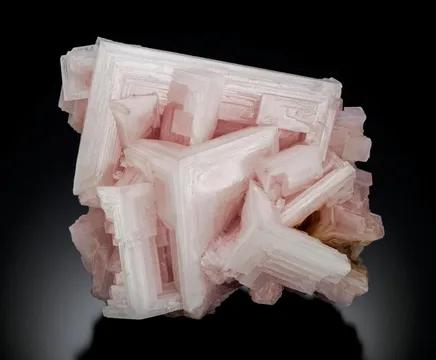
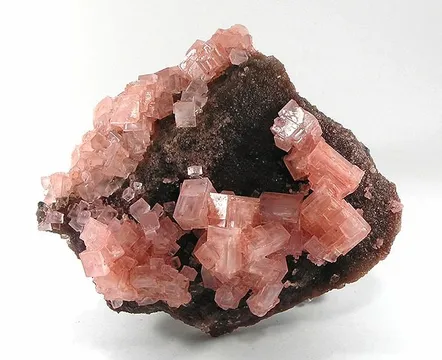
The locality’s great visual signatures are equally varied. Searles Lake gives lustrous hanksite barrels, pink halite, sulphohalite, northupite, borax, trona, and other evaporite minerals that look more like crystallized chemistry than ordinary rock. Mountain Pass is a collector’s ore locality: pale buff to brown carbonatite rich in bastnäsite, barite, calcite, dolomite, parisite, monazite, fluorite, and iron oxides. The Blue Bell Mine is a microscope collector’s playground of lead, copper, bismuth, tellurium, vanadium, zinc, and sulfate minerals; its best pieces are not large display specimens but sparkling crusts, rosettes, sprays, and microcrystals in astonishing colors. Otto Mountain near Baker belongs in the same modern rare-species league, famous for an extraordinary secondary tellurium assemblage and a cluster of type-locality minerals described in the twenty-first century.
Historically, the county links three different eras of western mineral collecting and mining. Calico represents the nineteenth-century silver and borate boom, when the colorful hills east of Barstow supported a bustling mining town. Searles Lake represents industrial evaporite chemistry and the vanished public collecting culture of Gem-O-Rama. Mountain Pass represents strategic rare-earth geology: the 1949 discovery of bastnäsite there led to one of the world’s most important rare-earth deposits. San Bernardino County therefore rewards the collector who thinks in districts rather than in a single “mine style.”
Regional View
Country View
The county’s strongest specimen reputation rests on two end-members: soluble evaporites and rare micros. Fine Searles Lake material is judged by form, freshness, and preservation: sharp pink halite cubes or hoppers; undamaged, translucent hanksite barrels; clean sulphohalite octahedra; and specimens that have not sweated, dulled, or crusted over from humidity. Fine Blue Bell and Otto Mountain material is judged by analytical confidence and locality precision. Many of those pieces are visually tiny but mineralogically large, and the label may be as important as the specimen.

Photo: Wikimedia Commons
Search for specimens: View all specimens from San Bernardino County, USA
San Bernardino County’s collector mineralogy is controlled by several unrelated geologic systems. In the northwest, Searles Lake is a closed-basin evaporite deposit in the Mojave Desert, built from repeated lake-level and desiccation cycles in the paleo-Owens drainage. Its salts and brines record a complex sodium-potassium-carbonate-sulfate-chloride-borate system. Collector specimens there came not from conventional hard-rock mining but from brine, mud, salt crust, drill cores, and controlled collecting events on industrial mineral property. The classic suite includes halite, hanksite, trona, borax, burkeite, northupite, pirssonite, searlesite, sulphohalite, tychite, tincalconite, galeite, and schairerite, with Searles Lake serving as the type locality for a remarkable number of those species.
The Calico district east of Barstow is another cornerstone. It is a Miocene lacustrine borate and silver district in the Barstow Basin, discovered in the early 1880s and active through the late nineteenth and early twentieth centuries. Silver ores made Calico famous, but colemanite and other borates also shaped the district’s history. For collectors, Calico is not a single pocket locality but a broad mining district with oxidized silver-lead minerals, sulfates, borates, clays, and weathering products spread among named mines and prospects such as Silver King, Odessa, Waterloo, Bismarck, and the Pacific borate workings. Much of the historic town is now Calico Ghost Town Regional Park, and collecting must be treated as a permission and land-status question, not an open invitation.
In the far northeastern county, Mountain Pass is a world-class rare-earth carbonatite district on the south side of the Clark Mountain Range. The main ore body, historically associated with the Sulphide Queen body and Birthday claims, is a carbonate-rich, barite-bearing rare-earth system hosted in a Precambrian metamorphic and alkaline intrusive complex. The ore is dominated by bastnäsite-group minerals with barite, calcite, dolomite, ankerite, siderite, parisite, monazite, fluorite, quartz, iron oxides, and accessory minerals. It is an active industrial rare-earth mine and processing facility, so collector access is not a casual matter; most specimens on the market are older material, study pieces, or pieces recovered from peripheral or historical sources rather than modern collector mining.
The Blue Bell Mine near Zzyzx, in the Soda Mountains portion of the Silver Lake Mining District, is one of the county’s most important micro-mineral localities. It is a polymetallic lead-copper-zinc-silver-bismuth-vanadium-tellurium occurrence with more than one hundred recorded valid species and several type-locality minerals. Its appeal lies in the oxidation-zone mineralogy: linarite, caledonite, cerussite, pyromorphite, mimetite, wulfenite, vanadinite, dioptase, aurichalcite, rosasite, atacamite, boleite-group material, lead-bismuth minerals, tellurium minerals, and an array of rare secondary species. The best Blue Bell specimens are usually small and locality-specific; labels such as B-Site, C-Site, Upper 2A-Site, or Lower D-Site can matter greatly.
Otto Mountain, near Baker, is a modern rare-species locality of exceptional importance. Mineralization occurs in oxidized quartz veins and related workings in the Soda Mountains/Silver Lake area, where primary sulfides and tellurides were altered during weathering and brecciation. The result is a suite of lead-tellurium oxysalts, tellurates, tellurites, vanadates, halides, and associated minerals including acanthite, cerussite, hessite, iodargyrite, khinite, wulfenite, mottramite, vanadinite, housleyite, markcooperite, ottoite, thorneite, timroseite, paratimroseite, telluroperite, and later-described species such as andychristyite, eckhardite, bairdite, chromschieffelinite, and related tellurates. Many are micromount-scale and require analytical confirmation.
The Hector area, west of Ludlow and east of Barstow, is significant for hectorite, the lithium-bearing smectite clay named from the Hector Bentonite Mine No. 1. The deposit is an industrial clay and bentonite locality in Cenozoic lacustrine and tuffaceous rocks. Collector value is modest in the display sense—hectorite is a pale, soft clay—but the locality has real species significance because it is the type locality of hectorite and one of the best-known economic occurrences of that mineral.
The New Method Mine in the Bristol Mountains near Amboy adds a different collecting niche: uranium and boron-fluorine mineralization in a contact-zone setting. It is best known among micromounters for yellow boltwoodite sprays and related uranium silicates on quartz, calcite, and fluorite, along with fluoborite in calcite, purple fluorite, uranophane, parauranophane, natroboltwoodite, and skarn or contact minerals such as diopside, forsterite, tremolite, brucite, and clinohumite. Specimens from this mine require both magnification and sensible radioactive-mineral handling.
The San Bernardino Mountains also contain pegmatites, marble quarries, tungsten and base-metal prospects, and unusual metamorphic occurrences. The California Blue Mine near Yucca Valley is the standout modern gem pegmatite locality in the county, discovered in 2006 and known for miarolitic pockets with aquamarine, colorless to pale blue topaz, quartz, smoky quartz, microcline, albite variety cleavelandite, fluorite, muscovite, and accessory rare minerals. It is important because San Bernardino County was not historically grouped with the classic San Diego–Riverside gem pegmatite belt; the California Blue discovery showed that the county could still surprise collectors with new gem pockets.
Spodumene is not the defining San Bernardino County mineral in the way it is for the great San Diego and Riverside County pegmatites, and that distinction matters when evaluating labels. County-level spodumene specimens on the market should be treated as uncommon pegmatite material rather than classic kunzite production: expect pale, whitish to colorless or weakly tinted bladed crystals or cleavages, typically associated with quartz, feldspar, mica, and other granitic-pegmatite minerals rather than the intensely lilac, gemmy kunzite habit of Pala-area material. The strongest San Bernardino County spodumene pieces are those with old, specific labels tying them to a named county occurrence or collection history; ordinary loose blades without a mine name are much less compelling, because southern California spodumene is easily and often confused across county lines.
Other documented San Bernardino County minerals give the county its real collector depth. Searles Lake alone accounts for type-locality evaporites such as burkeite, galeite, hanksite, northupite, pirssonite, schairerite, searlesite, sulphohalite, tincalconite, and tychite. Hector is the type locality for hectorite, the lithium-rich smectite clay. Mountain Pass is the type locality for sahamalite-(Ce), and remains one of the great reference localities for bastnäsite-group rare-earth mineralization. Blue Bell and Otto Mountain contribute a modern wave of rare lead-copper-bismuth-tellurium species and type minerals, including plumbophyllite, reynoldsite, telluroperite, thorneite, markcooperite, housleyite, ottoite, timroseite, paratimroseite, and related tellurates. The New Method Mine contributes high-interest uranium micros such as boltwoodite and uranophane-group material, while Calico and the broader Barstow-Baker desert districts provide the county’s classic oxidized silver, lead, borate, sulfate, and vanadate flavor.
San Bernardino County labels deserve careful reading. A label that says only “San Bernardino County” may represent anything from a Searles Lake salt to a Mountain Pass rare-earth ore fragment to a Blue Bell micromount. For serious collecting, a mine or district name is essential. “Searles Lake,” “Blue Bell Mine,” “Otto Mountain,” “Mountain Pass,” “New Method Mine,” “Hector Bentonite Mine No. 1,” “Calico district,” and “California Blue Mine” are far more useful than the county name alone.
The most common locality error involves southern California pegmatites. San Diego County’s Pala, Mesa Grande, and Ramona districts and Riverside County’s Cahuilla and related pegmatites are world-famous for spodumene, tourmaline, beryl, and quartz. Those localities are sometimes casually lumped as “southern California” or confused with “San Bernardino” because of the San Bernardino Meridian used in land descriptions. For spodumene in particular, do not accept a San Bernardino County attribution unless the label has a convincing named locality, collection history, or seller documentation.
Searles Lake specimens are chemically vulnerable. Halite, hanksite, borax, trona, and related evaporites can dull, sweat, effloresce, dehydrate, dissolve, or crust over if stored in humid conditions. Never wash them in fresh water. Keep them dry, avoid rapid humidity swings, and store the best pieces in sealed containers with appropriate desiccant or stable microclimate control. Pink halite should be kept out of strong sunlight, because the color can fade. Some older hanksite specimens were coated or stabilized by collectors; that may be acceptable if disclosed, but it should be reflected in value.
Blue Bell and Otto Mountain specimens are usually micromounts or small cabinet pieces where identification may require XRD, Raman, SEM-EDS, or a reliable chain of prior analysis. Many rare tellurium and lead-copper minerals are visually similar as yellow, green, orange, blue, or brown crusts and sprays. A beautiful “green rare mineral” from Otto Mountain or Blue Bell is not automatically a species-level identification. Analytical data, a collector’s label from a known specialist, or a published-photo match with caution is important.
New Method Mine uranium specimens require normal radioactive-mineral discipline. Small boltwoodite and uranophane micros are generally manageable in a collection, but they should be stored labeled, contained, and away from prolonged handling, inhalable dust, food areas, and children. Do not grind, trim, or acid-clean uranium-bearing pieces casually. Fluorite associated with uranium minerals may show radiation-related darkening, and boltwoodite is valued for tiny yellow acicular sprays, often best appreciated under magnification and ultraviolet light.
Market availability varies sharply by sublocality. Searles Lake pink halite and hanksite still appear from old field-trip material, dealer stock, and estate collections, but top pieces with strong color, sharp form, and minimal alteration are increasingly selective buys. Mountain Pass bastnäsite ore is available as study material, but fine crystallized specimens are not common. Blue Bell and Otto Mountain rarities circulate mostly through micromount specialists and old collections. California Blue aquamarine and topaz specimens are scarce, especially on matrix. San Bernardino County spodumene is best approached as a label-sensitive specialty rather than a readily available classic.
At Searles Lake, collecting once became a kind of annual desert ritual. Gem-O-Rama brought rockhounds to Trona for controlled collecting on Searles Valley Minerals property, and the field trips were unlike anything at a normal mine dump. The specimens were not waiting on a hillside. They were in black mud, brine pools, and salt crust, brought to the surface by industrial preparation and attacked by collectors wearing old clothes, rubber boots, gloves, hats, and the resigned expression of people about to be coated in alkali brine.
The Mud Run was exactly what the name promised. Mineral-rich black mud was hauled out and spread for collectors, who dug through it for hanksite and associated salts. Fresh hanksite might emerge as a sharp six-sided barrel, but only after the collector had worked through sticky mud and rinsed the prize in brine. Fresh water was the enemy: it could damage or dissolve soluble minerals. The field trip inverted normal collecting habits—water was not a cleaner, salt water was.
The Blow Hole was the theatrical event. Prepared holes in the lakebed were used to bring crystal-bearing material up from depth with compressed air, throwing mud, brine, and crystals to the surface. Collectors waited for the eruption and then moved in. Hanksite was the expected prize, but sulphohalite and other small evaporite crystals were the quiet treasures for those willing to sort patiently. In the best years, Searles Lake collecting felt like a temporary mineral factory: geology, industrial brine handling, and public collecting all meeting in one improbable place.
The Pink Halite trip was the one that entered collecting folklore. The crystals grew in shallow brine pools beneath a salt crust, and the finest pieces had to be freed wet, fragile, and fully saturated. Collectors broke through crust, reached into brine, and lifted plates of pink to cranberry halite that could look spectacular for a few minutes in the sun—and then demanded immediate care if they were to survive for years. The color came from the peculiar biology and chemistry of the saline pools, and the best specimens retained their intensity only when shielded from heat, light, and humidity.
Calico tells a different story. The hills east of Barstow were named for their patchwork colors, and the town grew around silver in the early 1880s. For a short, noisy period it was one of California’s great desert mining camps, with famous mines including Silver King, Odessa, Waterloo, Oriental, Bismarck, and others. When silver prices weakened in the 1890s, the town faded, but the borate story kept the district in mining memory. The later restoration by Walter Knott turned Calico into a ghost town park, preserving the outline of a mining boom that once tied silver ore, borate minerals, mills, rail haulage, and desert camp life into one landscape.
The California Blue Mine is the county’s modern pocket story. In 2006, local prospector Dave Schmidt found an aquamarine-bearing pegmatite north of Yucca Valley, in a county not previously famous for gem pegmatites. He worked a roughly meter-thick dike by hand, recovering loose aquamarine and topaz crystals. In November 2011, a one-week excavator dig with collector Paul Geffner exposed four aquamarine-bearing cavities and produced matrix specimens and loose crystals of bluish green to greenish blue aquamarine, colorless to pale blue topaz, quartz, smoky quartz, fluorite, albite, microcline, and spessartine. One museum blog recorded mineral dealer Rick Kennedy working through pocket mud with his preferred tool: chopsticks. That small image—chopsticks in a desert pegmatite pocket—captures the collector’s side of San Bernardino County perfectly: large geology, small tools, and surprises where the old literature said there should be few.