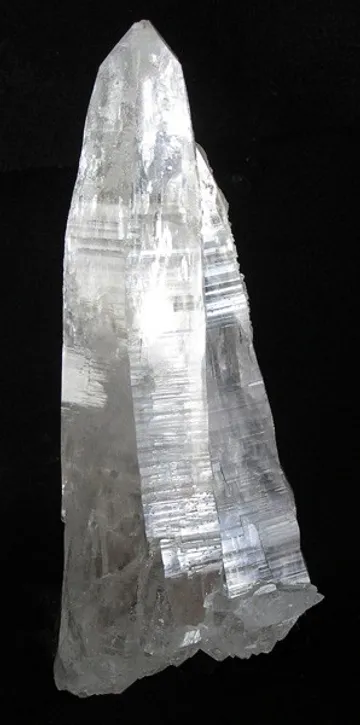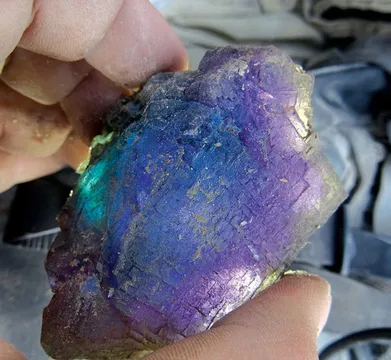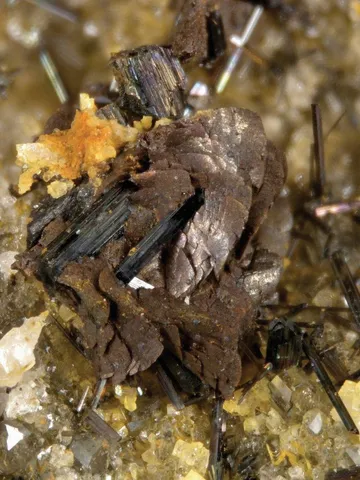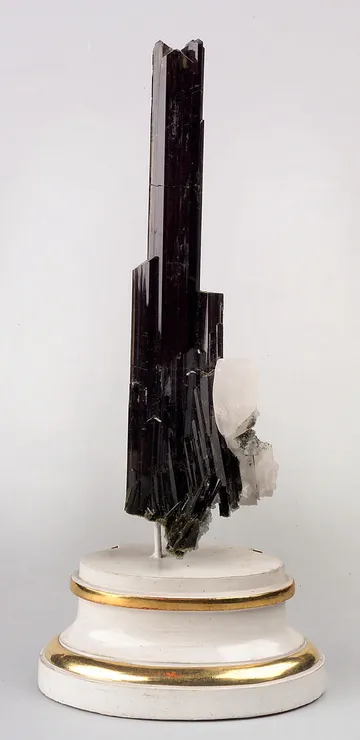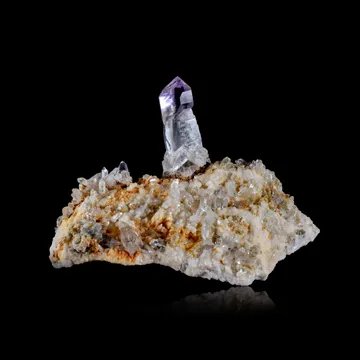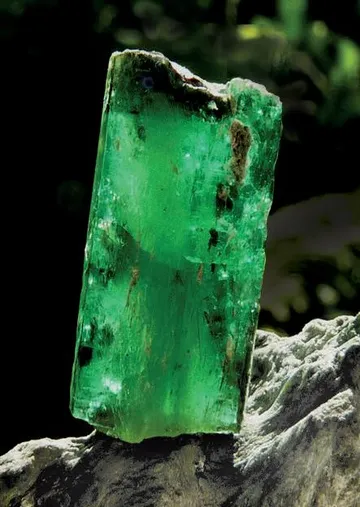
Habach valley, Austria — historic emerald locality in metamorphic schists, yielding emeralds in dark mica-rich matrices, prized for history and color.
Key facts
Habach valley—Habachtal to collectors and local Salzburgers—is the classic European emerald locality: a steep Hohe Tauern valley above Bramberg am Wildkogel where green beryl is not a pegmatite curiosity but the signature mineral of a metamorphic, schist-hosted deposit. The famous workings lie high on the eastern side of the valley in the Leckbachgraben, also called the Leckbachrinne or Sedl, below the Leckbachscharte and Nasenkopf area. There, emerald-bearing talc, biotite, chlorite, actinolite, and tremolite schists occur in a strongly deformed “blackwall” reaction zone developed among serpentinites, garnet-mica schists, amphibolites, and biotite-plagioclase gneisses of the Habach Formation and neighboring Tauern Window rocks.
For collectors, Habach valley matters for two reasons at once. It is a historically worked emerald deposit whose documentation begins in the late eighteenth century and whose small-scale mining history runs through Samuel Goldschmidt’s nineteenth-century enterprise, the London-backed Emerald Mines Limited period, and later private operations. It is also a specimen locality in the strictest sense: the best pieces are not usually clean facetable crystals, but sharply prismatic emeralds sitting in dark micaceous or talc-rich schist, often with biotite, actinolite-tremolite needles, chlorite, talc, quartz, feldspar, rutile, phenakite, chrysoberyl, and rare accessory phases in the same geological theater. Fine Habachtal emeralds have a velvety, saturated green that can be startling against the black to bronze schist; ordinary pieces are paler, fractured, included, or partly hidden by mica. The locality’s best crystals are small by Colombian or Zambian standards but immense in historical and regional weight.
Regional View
Country View
The visual identity of Habachtal specimens is unusually consistent: hexagonal beryl prisms, from sea-green beryl through gray-blue aquamarine to true emerald-green crystals, are locked into foliated schist rather than perched in open pegmatite cavities. Many show interrupted growth, internal veils, mica plates, and amphibole needles. Even a modest 1–2 cm emerald on original Habachtal matrix carries a pedigree that collectors recognize immediately: alpine, historic, scarce, and unmistakably Austrian.

Photo: Wikimedia Commons
Search for specimens: View all specimens from Habach valley, Austria
The emerald occurrence is in the upper Leckbachgraben on the eastern flank of Habach valley, in the Bramberg am Wildkogel municipality of Salzburg. The workings are high alpine workings, with historic galleries around roughly 2,100–2,200 m elevation. The broader valley runs north–south through the Hohe Tauern National Park; the Habach stream drains toward the Salzach near Bramberg, while the emerald ground lies below the Leckbachscharte, close to the divide with the neighboring Hollersbach valley.
Geologically, Habachtal is a model locality for schist-hosted emerald mineralization. The deposit sits in the central Tauern Window, in the contact region between the Habach Formation of the Lower Schieferhülle and the Augen- and Flasergneiss series of the Habach tongue. Detailed mapping by Günter Grundmann and Giulio Morteani separated the local Habach rocks into banded gneiss, serpentinite-talc schist, garnet-mica schist, and amphibolite series. The emerald-bearing rocks are chiefly talc, actinolite, tremolite, biotite, and chlorite schists produced by metasomatic reaction between serpentinites and adjoining garnet-mica schists, amphibolites, and biotite-plagioclase gneisses. In practical collecting terms, that means the emeralds are sought in schistose, foliated, often slippery and friable host rock—not in open pegmatite pockets.
The ore zone is not a single clean vein. Historical mining followed the contact zone between talc schists and garnet-bearing mica schists, biotite-plagioclase gneisses, and amphibolites on the southeast side of the Leckbachrinne. Earlier descriptions focused on the Smaragdpalfen, the emerald-bearing cliff of biotite schist, but nineteenth-century work showed that emerald-bearing rock extended into broader areas of mica schist. The best specimen material comes from those emerald-bearing schists and from the large secondary boulder and scree field below the primary outcrops, where erosion, rockfall, landslides, and mudflows have delivered emerald-bearing debris down the gully toward the valley floor.
The mineralization is beryllium-rich and chromium-bearing. Beryl is the dominant Be mineral; true emerald is accompanied locally by gray to blue beryl or aquamarine, rare phenakite, rare chrysoberyl, and accessory minerals such as rutile, aeschynite-(Ce), aeschynite-(Y), scheelite, molybdenite, chalcopyrite, magnetite, pyrite, pyrrhotite, graphite, phlogopite, chlorite, talc, quartz, feldspar, apatite, epidote, and titanite. The chromium needed for emerald color is tied to the ultramafic/serpentinite component and its reaction products, while the beryllium source has been interpreted through the Be-enriched metavolcanic and metasedimentary assemblage of the Habach rocks, with later work debating the role of supercritical, pegmatite-like melt/fluid processes superimposed on the regional metamorphic system.
Historically, the first reliable published record is Kaspar Melchior Schroll’s 1797 notice of a prismatic emerald crystal in mica schist from the old “Heubachtal.” In the early nineteenth century, the occurrence was mainly a secondary collecting locality; material was gathered from the Leckbachrinne and sold into the mineral trade before the primary source was understood. Jakob Frischholz, a Munich mineral dealer, described the material in 1821 after visiting the locality in the 1810s, and by the 1820s and 1830s the uphill primary source had entered the literature and collecting lore.
Systematic mining began with Samuel Goldschmidt, a Vienna jeweler. After geological interest in the occurrence increased, Goldschmidt explored the valley in 1861 with assistance from Markus Vincenz Lipold of the Austrian geological survey. In February 1862 he purchased a parcel of about one square kilometer from the Austrian government for 1,000 Gulden. His firm displayed emerald crystals in host rock at the 1862 Agricultural, Industrial and Art Exhibition in London, and mining began that year, first by surface/open-pit methods and then by tunneling. Goldschmidt also built the stone miners’ house known historically as the Smaragdhaus and still remembered as the Goldschmidthütte.
The most intensive mining period came under British ownership. Emerald Mines Limited, backed initially by the London diamond merchants Leverson, Forster & Co., worked the deposit from the mid-1890s into the early twentieth century, using four galleries and seasonal crews that reached 20–30 men. Ore was sorted and washed at the workings; some cleaner emerald was sent to India for cutting and entered commerce as “Indian emerald.” Reported early twentieth-century production figures include tens of thousands of carats in some years, but the high proportion of cloudy, fractured, included emerald made long-term profitability elusive. The deposit was also physically difficult: access was dangerous, rockfalls could involve hundreds of cubic meters, and the legal status of gemstone mining versus ordinary mining law created repeated regulatory trouble.
After the British period, ownership and operation became a succession of short ventures. Anton Hager acquired the property in 1916, worked to reopen it, and explored both emerald and industrial talc possibilities with Peter Staudt under the name Talk- und Edelsteinbergwerk Habachthal. The Swiss Aktiengesellschaft für modernen Bergbau owned the property in the late 1920s. In 1932 Angelo De Marchi leased the mine through a court-appointed receiver and invested heavily for a short season, employing 15–20 miners and shipping 16 boxes totaling about 500 kg of rough material over the Alps to Italy. Smaragd Aktiengesellschaft, formed in Schaffhausen in 1934, pursued limited production from 1935 to 1939 before dissolving. Later ownership consolidated in the Gaab family, and since the modern period the mine has remained private, with the Steiner family of Bramberg associated with maintaining and working the deposit on a small scale.
Collectors today must distinguish three different “Habachtal” experiences. The historic underground emerald mine itself is private and not open to the public. The upper Leckbachrinne is also dangerous because of rockfall and unstable ground. In the lower gully and valley area, guided tourist and educational emerald-searching has long been part of the local culture, and erosional material can still yield small crystals or crystal fragments. The valley lies within Hohe Tauern National Park, so legal regulations govern collecting; serious collectors should treat access, tools, and removal of material as regulated activities rather than as an open free-for-all.
The most celebrated modern specimen is the “Madonna emerald,” an approximately 30 cm tall matrix specimen found in 1970 and displayed at the Museum Bramberg. Published examples also record a 12 mm, 15 ct emerald found in 1972 with exceptional quality, a 4.5 cm, 128 ct gem-quality crystal found in the mid-1970s, and a 22 mm emerald on talc schist mined in 2019. These exceptional pieces set the standard: sharp crystal form, vivid green color, visible but not destructive inclusions, and original matrix. Outside the emerald mine proper, the valley has produced classic alpine fissure minerals, including smoky quartz from the Wiesbachrinne, rock crystal from the Teufelsmühle area, prehnite from the valley head, and a broad suite of sulfides, oxides, silicates, and secondary species from Nasenkopf, Greinerrinne, Windbach, and other sublocalities.
Habachtal emeralds are typically hexagonal prisms in schist, ranging from millimetric grains and stream-worn fragments to crystals around 1–2 cm on collector specimens, with exceptional historical crystals reaching several centimeters; their color ranges from pale green and bluish green to the saturated “velvety” green that makes the locality famous, and their most diagnostic associations are dark biotite or talc schist, actinolite-tremolite needles, phlogopite or biotite sheets, chlorite, quartz, feldspar, rutile, and occasional phenakite or chrysoberyl. The finest pieces come from the emerald-bearing schist zones of the upper Leckbachgraben or from boulders derived from them; they show a crisp prismatic crystal, convincing emerald color, and attractive contrast with the mica-rich matrix. Lesser specimens are abundant in comparison: pale green beryl, fractured crystals, mica-coated prisms, and loose alluvial fragments are much more common than bright, well-presented emeralds on matrix.
Non-emerald beryl from Habach valley is the quieter but scientifically important companion to the famous green variety: gray, pale bluish, blue-green, sea-green, and occasional aquamarine-toned crystals occur in the same Leckbachgraben emerald-bearing system, commonly as euhedral prisms in micaceous schist or talc-rich matrix and sometimes in association with true emerald on the same specimen. Color-zoned crystals with gray or bluish aquamarine grading into emerald are especially rare and desirable, because they show the chemical and fluid evolution of the deposit in a single crystal. Good Habachtal beryl specimens are judged less by gem transparency than by crystal completeness, sharp habit, natural matrix, and clear distinction between pale beryl and true emerald color; a clean, well-formed blue or gray-blue crystal from the Leckbachscharte area can be more interesting to a locality specialist than a damaged green fragment.
Beyond emerald and beryl, Habach valley is a compact but deep mineral district. The emerald deposit is known for rare Be minerals such as phenakite and chrysoberyl, for aeschynite-(Ce) and aeschynite-(Y) studied in Be-mineral parageneses, and for metamorphic and ore minerals including actinolite, tremolite, talc, chlorite, phlogopite, biotite, rutile, magnetite, pyrite, pyrrhotite, chalcopyrite, molybdenite, scheelite, apatite, epidote, quartz, feldspar, tourmaline, titanite, and graphite. The broader Habach valley also includes alpine fissure occurrences with smoky quartz, rock crystal, adularia, pericline, prehnite, anatase, rutile, titanite, and tourmaline. Its most important type-locality mineral is friedrichite, Cu5Pb5Bi7S18, described from Sedl on Nasenkopf as a member of the aikinite-bismuthinite series; the Nasenkopf–Leckbachgraben area also records rare sulfosalts such as aschamalmite and krupkaite, though those are micromount and ore-mineral interests rather than the emerald specimens for which the valley is famous.
Habachtal emerald collecting is fundamentally a provenance game. The same physical qualities that give the locality character—small crystals, mica-coated faces, internal fractures, amphibole needles, and dark schist matrix—also make overcalling easy. Pale green or gray-green beryl is often sold or labeled as emerald, and loose green fragments from the scree can be difficult to separate from actinolite-rich schist splinters or other green minerals without crystal form, refractive behavior, or analytical confirmation. The best labels specify Habach valley, Leckbachgraben or Leckbachrinne, Nasenkopf, Bramberg am Wildkogel, Salzburg, Austria; older labels may use Habachtal, Heubachtal, Heubachthal, Sedl, Söllgraben, or Leckbachscharte.
Documented historical mislabelling is part of the locality’s commercial history. Cleaner Habachtal emerald rough was reportedly sent to India for cutting in the early twentieth century and marketed as “Indian emerald,” so old cut stones with vague trade provenance should not be accepted as Habachtal merely on appearance. Conversely, recent analytical work shows that Austrian and Egyptian emeralds can overlap in broad color and spectral character, while Austrian material is distinguished especially by frequent actinolite needles and biotite or phlogopite inclusions. For a cut emerald, origin determination requires gemological evidence; for specimens, original matrix and a credible locality chain remain far more persuasive than color alone.
Condition is usually the limiting factor. Habachtal emeralds are commonly fractured, heavily included, partly turbid, or penetrated by mica and amphibole inclusions. Sharp, lustrous, undamaged terminations are much scarcer than broken cross sections and abraded scree pieces. Matrix is often schistose and fragile; talc-rich pieces can be soft, greasy, and prone to flaking, while mica-rich specimens shed small plates if handled roughly. Avoid aggressive cleaning, ultrasonic cleaning, acid treatment, and heavy brushing. Stabilization or trimming of schist matrix can materially affect value if it changes the natural presentation, and oiled or resin-filled faceted emeralds should be disclosed as with emerald from any locality.
Fluorescence is not a useful shortcut for Habachtal emeralds. A modern study of reliable Austrian samples found them inert under both shortwave and longwave ultraviolet light. Their internal features are much more diagnostic: amphibole needles, biotite or phlogopite sheets, angular two-phase fluid inclusions, and dense inclusion scenes are normal rather than defects in the locality sense. In specimens, those inclusions help authenticate the geological setting, although they usually reduce gem value.
Market availability is steady but thin. Small loose crystals, chips, and modest schist pieces from Habachtal appear with some regularity in European shows and online offerings; fine, vivid, well-terminated emeralds on original matrix are genuinely scarce. Historic specimens with old European labels, pieces from documented mine work, color-zoned beryl/emerald crystals, and unusually large crystals command a strong locality premium. Buyers should be cautious with bright green fragments sold without matrix or label history, “museum quality” claims attached to sub-centimeter damaged pieces, and any specimen presented as coming from the active mine without a believable ownership or collector trail.
The first great Habachtal story is not Roman, not medieval, and not as old as collectors once liked to imagine. For generations, writers repeated tales of ancient mining, lost emerald workings, and even Roman exploitation in the Salzburg Alps. Karl Schmetzer’s archival work stripped much of that romance back to evidence. A 1593 landslide once invoked as proof of destroyed emerald mines actually concerned silver workings on the opposite side of the valley. Another much-repeated thread confused Bavarian fluorite from Bach near Donaustauf with emeralds from Habachtal. What remains is still remarkable: a 1669 letter from Anna de’ Medici mentioning Niels Stensen’s journey to the region, suggestive of curiosity about green stones in the Alps, but not proof of mining. In this locality, the real story is better than the legend because it shows how easily a mountain, a gemstone, and a few ambiguous words can gather centuries of myth.
The first secure printed notice came in 1797, when Kaspar Melchior Schroll reported a prismatic emerald crystal in mica schist from the old “Heubachthale.” That brief observation landed with more force than a modern reader might expect. At the time, Colombia was the only active, celebrated emerald source in the European mineralogical imagination. The Ural emerald deposits had not yet been discovered, and the Egyptian emerald mines known from antiquity had not yet been rediscovered in the Eastern Desert. A green beryl in alpine mica schist from Salzburg was therefore not a local curiosity but a European mineralogical surprise.
In the early 1800s, the emeralds were not yet mined from galleries. They were hunted from below. The secondary deposit in the Leckbachrinne—the boulder field beneath the primary schists—was the first practical source, and Munich dealer Jakob Frischholz visited repeatedly in the 1810s to search for material. Later accounts describe the discovery of the uphill primary source and the peril of the Smaragdpalfen, a steep biotite-schist cliff where emeralds could be broken from the rock only with real danger. Collectors were said to hang on ropes at the cliff face, prying off limited pieces of emerald-bearing matrix. That image—men suspended against dark schist high above the valley, trying to free a few green crystals—belongs at the center of Habachtal’s collecting history.
Samuel Goldschmidt brought the first sustained commercial ambition. A Vienna jeweler from a family already embedded in the gem and jewelry trade, he explored the valley in 1861 with Markus Vincenz Lipold of the Austrian geological survey. In February 1862 he purchased about a square kilometer of mountain ground from the state for 1,000 Gulden. By late spring his firm was already showing emerald crystals in host rock at the Agricultural, Industrial and Art Exhibition in London. At first the work was open-pit; by 1863 tunnels followed. Goldschmidt built a stone residence for miners, the Smaragdhaus, later known as the Goldschmidthütte. Even today, the name preserves the moment when Habachtal shifted from a collector’s boulder field to an emerald mine.
The English period gave the mountain its most industrial scene. Under Emerald Mines Limited, crews worked seasonally in four galleries, with 20–30 miners at the busier moments, aided by English and Austrian mining engineers. Photographs from that era show the Leckbachgraben boulder field, men at the C gallery, washing and sorting near the workings, the D gallery, wood being moved for tunnel stabilization, and the Goldschmidthütte in autumn snow. The logistical imagination grew large enough that a cable railway was considered for moving emerald-bearing rock down to the valley. Production numbers quoted for the period were equally dramatic: 68,000 carats in one reported year, and another tally of 32,000 carats of milky cloudy stones plus 7,000 carats of greener emeralds. Yet the mountain did not become Muzo in the Alps. Much of the material was fractured, cloudy, and included, and very few stones combined size, clarity, and value.
The most telling episode from the English years is financial rather than mineralogical. In 1908, promotional language offered potential investors a bright future: the Austrian mine was described as almost the only other important emerald mine in operation after Muzo, just “50 hours from London,” with 600 acres of ground and more than 200,000 carats supposedly produced over ten working seasons. The pitch even claimed that the quality, color, and size improved with depth and that the geological setting was analogous to Muzo. Then comes the cold counterweight: the company’s own financial statement for the period ending December 31, 1908, recorded cash in hand and emeralds in stock of only £100, and no dividend was ever paid. Habachtal could produce emeralds, but it punished exaggeration.
Between the wars, the mine became a revolving door of schemes, surveys, debts, and short seasons. Anton Hager bought the property in 1916 and soon had mining engineer Heinrich Stuchlik evaluating not only emeralds but talc—an industrial resource thought potentially useful for cosmetics, pharmaceuticals, glass, paper, leather, textiles, and soap. Stuchlik speculated about 200 wagons per year for 100 years, and Hager tried to find partners for the huge investment needed to move rough talc downhill. The name Talk- und Edelsteinbergwerk Habachthal says everything about the era: talc and gemstones, practicality and romance, business plan and alpine uncertainty all crowded into the same mountain gully.
The Italian season of 1932 was brief but vivid. Angelo De Marchi, a farmer and landowner from Milan with wider business connections, leased the mine after a court-appointed receiver became involved in the troubled property. The workings were in bad condition—unmaintained, obstructed, and damaged by illegal mining and uncontrolled blasting. De Marchi invested 25,000 Austrian shillings, employed 15–20 miners, and put Gottfried Förster in charge as mine manager. By October, 16 boxes of rough material weighing a total of 500 kg had been transported over the Alps to Italy. It sounds like the opening chapter of a revival; instead, it was another short flash in a long record of starts and stops.
The modern emblem of the locality is not a faceted stone but a specimen: the Madonna emerald, found in 1970 and displayed at the Museum Bramberg. At about 30 cm tall, it represents Habachtal at its most sculptural—emerald as alpine object, not just gem rough. Other twentieth-century pieces sharpen the scale of rarity: a 12 mm, 15 ct crystal found in 1972 with extraordinary quality, and a 4.5 cm, 128 ct gem-quality crystal found in the mid-1970s, one of the largest fine crystals recorded from the locality in that century. Against the countless small, fractured, mica-coated bits recovered from schist and scree, those pieces explain why collectors keep returning to the valley.
Karl Schmetzer, “History of Emerald Mining in the Habachtal Deposit of Austria, Part I,” Gems & Gemology, Winter 2021, 57, 338–371. Essential archival treatment of early records, nineteenth-century collecting, Goldschmidt’s purchase, and the British Emerald Mines Limited era to World War I.
Karl Schmetzer, “History of Emerald Mining in the Habachtal Deposit of Austria, Part II,” Gems & Gemology, Spring 2022. The continuation through the interwar ownership maze, De Marchi, Smaragd Aktiengesellschaft, postwar ownership, modern stewardship, and the “Madonna emerald.”
Günter Grundmann and Giulio Morteani, “Die Geologie des Smaragdvorkommens im Habachtal (Land Salzburg, Österreich),” Archiv für Lagerstättenforschung der Geologischen Bundesanstalt, 2, 71–107, 1982. The foundational geological mapping study of the emerald occurrence, its schist host rocks, metamorphic setting, and Be-bearing paragenesis.
G. Grundmann and G. Morteani, “Emerald mineralization during regional metamorphism: the Habachtal (Austria) and Leydsdorp (Transvaal, South Africa) deposits,” Economic Geology, 84, 1835–1849, 1989. Classic paper placing Habachtal in the schist-hosted emerald model and emphasizing blackwall metasomatism during regional metamorphism.
Maria Nikopoulou, Stefanos Karampelas, Ugo Hennebois, Pierre Gruss, Eloïse Gaillou, Emmanuel Fritsch, Annabelle Herreweghe, Lambrini Papadopoulou, Vasilios Melfos, Nikolaos Kantiranis, and Aurélien Delaunay, “Microscopic, Spectroscopic and Chemical Analysis of Emeralds from Habachtal, Austria,” Minerals, 15(1), 22, 2025. Modern gemological and analytical study of reliable Habachtal emeralds, including inclusions, spectroscopy, trace elements, and comparison with Egyptian emeralds.
R. Thomas, P. Davidson, and A. Rericha, “Emerald from the Habachtal: New Observations,” 2020. Reassessment of Habachtal emerald genesis using melt inclusions, ordered graphite, and supercritical melt/fluid arguments.
T. T. Chen, E. Kirchner, and W. H. Paar, “Friedrichite, Cu5Pb5Bi7S18, a new member of the aikinite-bismuthinite series,” The Canadian Mineralogist, 16, 127–130, 1978. Type-mineral paper for friedrichite from Sedl, Nasenkopf, in the Habach valley mineral district.
Günter Grundmann, “Die Mineralien des Smaragdvorkommens im Habachtal,” Lapis, 10(2), 13–33, 1985. Important locality-mineral paper documenting the emerald deposit’s mineral assemblage and specimen context.
Günter Grundmann, “Die Einschlüsse der Berylle und Phenakite des Smaragdvorkommens im Habachtal (Land Salzburg, Österreich),” Der Karinthin, 84, 227–237, 1981. Inclusion-focused study of Habachtal beryl and phenakite.
Günter Grundmann and Friedrich Koller, “Exkursion: Das Smaragdbergwerk im Habachtal, Land Salzburg, Österreich,” Mitteilungen der Österreichischen Mineralogischen Gesellschaft, 148, 317–343, 2003. Field-excursion style treatment of the emerald mine, geology, and literature.
“Smaragdsuche beim Smaragdbergwerk im Habachtal,” Mineralien Steiner. Short video with impressions of work at the active Habachtal emerald mine and the Steiner family’s modern mine context.
“Smaragdweg im Habachtal,” Heimatlexikon / ServusTV via Austria-Forum. Cultural and landscape video on the Habachtal Emerald Trail.
“Habachtal · Smaragdsuche in Österreich,” BR Retro, 28 September 1964. Historic Bavarian television segment on emerald searching in Habachtal.
“Bramberg: das Smaragd-Dorf der Hohen Tauern,” RTS Regional TV Salzburg. Regional feature on Bramberg’s identity as the “emerald village” and the cultural legacy of Habachtal emeralds.
Mindat: Habach valley, Bramberg am Wildkogel, Salzburg, Austria. Broad locality database page for the valley, sublocalities, mineral list, photos, historical names, and regional hierarchy.
Mindat: Emerald deposit, Leckbachgraben, Nasenkopf mountain, Bramberg am Wildkogel, Salzburg, Austria. Principal database page for the emerald mine locality and its documented mineral assemblage.
Mindat: Leckbachgraben, Nasenkopf mountain, Bramberg am Wildkogel, Salzburg, Austria. Useful sublocality page for the Leckbachgraben area surrounding the emerald occurrence.
Hohe Tauern National Park: Habachtal. Current visitor-oriented information on the valley, Emerald Trail, mineral wealth, access cautions, and national-park collecting regulation.
Wildkogel-Arena: Hiking in the Habach Valley. Practical access, trail, shuttle, and visitor information for the Habachtal and its emerald-searching tradition.
Wikimedia Commons: Minerals of Habach valley. Open image category with Habachtal emerald, beryl, aschamalmite, prehnite, and titanite photographs.
Wikimedia Commons: Smaragdbergwerk Habachtal. Image category focused on the emerald mine and associated material.
BGR Object of the Quarter: Das Habachtaler Smaragdvorkommen. German geological-survey museum note on Habachtal emeralds and their European significance.
RRUFF: Aquamarine R060944 from Habachtal, Salzburg, Austria. Analytical mineral entry with chemistry and Raman/X-ray/infrared data for Habachtal beryl/emerald material.
Mindat: Friedrichite from Sedl, Nasenkopf mountain, Habach valley, Austria. Type-locality occurrence page for friedrichite, a rare Cu-Pb-Bi sulfosalt from the Habach valley district.