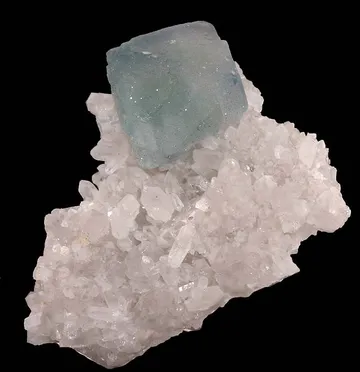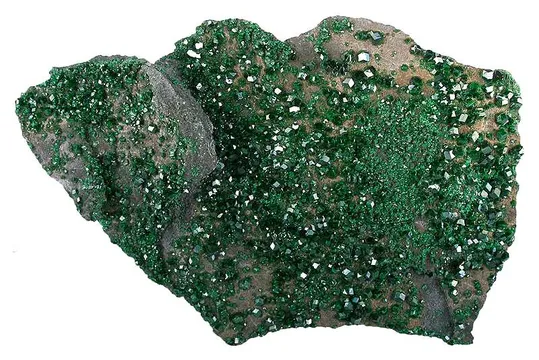
Saranovskii Mine, Russia — classic Urals chromium locality and the type locality for uvarovite; green crystals on dark chromite, prized for sparkle and rarity.
Key facts
Saranovskii Mine, at Sarany in the Gornozavodskii District of Perm Krai, is one of the classic chromium-mineral localities of the Urals and the type locality for uvarovite, the calcium-chromium garnet whose best specimens look like crushed emeralds spread across black chromitite. The mine works the Glavnoe Saranovskoe chromite deposit, also known in collector labels as Saranovskoe, Sarany, Sarani, or the “Rudnaya” underground chromite mine. Its importance is larger than uvarovite alone: the deposit is a compact, intensely metamorphosed ultrabasic massif of dunite and harzburgite cut by gabbroic and doleritic rocks, and its low-grade metamorphic overprint remobilized chromium into an unusually rich suite of Cr-bearing silicates and oxides.
Regional View
Country View
For collectors, Saranovskii is above all a locality of surface, sparkle, and contrast. The defining pieces are thin chromite slabs or dark serpentinized matrix carrying brilliant, saturated green rhombic-dodecahedral uvarovite crystals. Many crystals are tiny, but they are sharply faced and intensely lustrous; the best plates are uninterrupted druses with clean, evenly distributed crystals and enough relief that the individual dodecahedra catch the light rather than merging into a granular green crust. Associations with white or colorless calcite, pale to silvery Cr-clinochlore, purple chrome-bearing amesite or diaspore, and rare pumpellyite-group minerals add both mineralogical and visual interest.

Photo: Géry Parent, Wikimedia Commons
The locality has also become a research touchstone for chromium mineralogy. Modern work on the Saranovskoye deposit has documented successive replacement of magnesiochromite by chromite, ferrian chromite, chromian magnetite, and finally Cr-rich gem minerals. That sequence explains why Saranovskii specimens so often preserve the mine’s story in miniature: dark ore matrix, green garnet crusts, white carbonate, and late-stage alteration minerals occupying seams, pockets, and glide planes in a strongly deformed chromitite body.
Search for specimens: View all specimens from Saranovskii Mine, Russia
Saranovskii Mine is the working mine on the Glavnoe, or Main, Saranovskoe chromite deposit near Sarany, in the Middle Urals of Perm Krai. Older labels may place it in Permskaya Oblast or simply “Urals, Russia,” and the locality is also encountered as Saranovskaya, Saranovskoe, Sarany, Sarani, or “Rudnaya” mine. The mine lies near the settlement of Sarany, roughly northwest of Perm, and published mineralogical descriptions place the Rudnaya underground mine at the Glavnoe Saranovskoe deposit within the Saranovskaya group of chromite deposits. It is important not to merge it casually with nearby Biserskoe or Yuzhno-Saranovskoe, the Southern Saranovskoe deposit; they belong to the same regional chromite group but are distinct localities and have separate type-mineral histories.
Geologically, the ore belongs to a very small chromite-bearing gabbro-peridotite or ultrabasic massif. The principal host rocks are Precambrian dunites and harzburgites, with associated orthopyroxenites and troctolites, intruded by gabbro, gabbro-norite, anorthosite, melanogabbro, gabbro-dolerite, dolerite, and picrite dykes. The country rocks include metamorphosed clays, silts, sands, and schists at the edge of the Russian Platform. Later folding, thrusting, fracturing, and low-grade metamorphism left many units steeply oriented and locally converted the ore-bearing rocks into a mosaic of metachromitite, serpentinite, rodingite, metagabbro, and metasedimentary rocks.
The ore bodies are unusually well defined for such a compact massif. Older Soviet descriptions give three principal, nearly parallel commercial ore bodies: the Central, Western, and Eastern bodies. The Central body is the largest, reaching roughly 1,200 m in strike length and averaging about 10 to 11 m thick, though its thickness varies substantially. The Western body is about 910 m long and roughly 4 to 5 m thick, and the Eastern body is roughly 1,100 to 1,150 m long and about 3 to 3.5 m thick. Published gemological work describes as many as 30 chromitite horizons, from about 0.5 to 14 m thick, within the dunite-harzburgite massif. The chromite ore itself is dominantly chromium-spinel with subordinate silicates; in places, massive chromitite, spotted “ocellar” chromite, disseminated ore, carbonate veins, and sheared contact zones occur close together.
Saranovskii’s specimen minerals are products of low-grade metamorphism and hydrothermal activity superimposed on the chromite bodies. Mineralogical work divides the alteration into multiple stages from zeolite facies through prehnite-pumpellyite facies and back to lower-temperature zeolite-facies conditions. During the key “green” stage, chromium became mobile enough to enter garnet, pumpellyite-group minerals, chlorite-group minerals, titanite, diaspore, and related species. Alpine-type veins developed in the deformed rocks, carrying quartz, albite, ankerite, calcite, dolomite, epidote-clinozoisite, chlorite, titanite, sulphides, and Cr-bearing minerals. The most collectible uvarovite formed as Cr-garnet crusts on chromitite surfaces, along glide planes, and near contacts between chromitites and basic dykes, especially in crushed and mylonitized zones.
The deposit has been known since at least the nineteenth century. Mining is recorded from 1889; early extraction was by open pit, while modern mining has been mainly underground. Russian and Soviet sources describe Saranovskii as a major domestic chromite producer, historically important for refractory and chemical chromite raw material. The mine has been operated as Saranovskaya Mine “Rudnaya,” associated in recent sources with the Serov Ferroalloy Plant structure, and official local and industry sources describe it as a key Russian enterprise for mining and processing chromite ore. Because this is an active industrial mine, collecting access should be assumed closed unless arranged with the operator and all legal, safety, and mineral-rights permissions are in place.
Specimen production has largely come as a by-product of chromite mining rather than organized collector digging. The classic pockets and seams yielded uvarovite crusts on chromitite, uvarovite partly embedded in or etched from calcite, sprays of shuiskite-group needles with amesite and uvarovite, chromium-bearing titanite twins on Cr-clinochlore with calcite, and late calcite crystal groups. Some museum-scale pieces are substantial plates, but the individual garnet crystals are usually small. Pieces with clean, open crystal faces, strong emerald color, and minimal abrasion from mining are the ones that separate themselves immediately from the more common dull green crusts.
Saranovskii is the type locality and modern collector stronghold for uvarovite, and its characteristic specimens are brilliant emerald-green rhombic dodecahedra coating dark chromitite, commonly with calcite, chromite, magnesiochromite, amesite, Cr-clinochlore, shuiskite-group minerals, and locally pale Cr-titanite. Scientific descriptions give Saranovskoye uvarovite and Cr-grossular as predominantly rhombic-dodecahedral crystals, commonly intergrown into crusts on chromitite surfaces, with individual crystals typically only millimetric but reported up to about 8–12 mm in the broader gem-mineral study; many collector pieces show crystals around 1–2 mm, and those are already respectable when they are sharp, transparent, glassy, and evenly distributed. The best Saranovskii uvarovites have an intense “pure” green rather than yellowish or pale green, crisp dodecahedral faces rather than sugary aggregate texture, and enough exposed black or white matrix to frame the garnets without smothering them; ordinary pieces are darker, granular, calcite-stained, etched too aggressively, or rubbed along high points from ore handling.
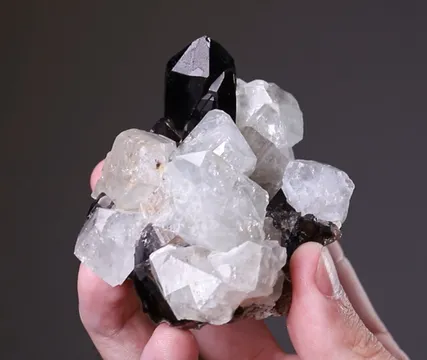
Calcite at Saranovskii is not merely a background carbonate: it is part of the vein system that made the chromium minerals collectible, occurring in alpine-type carbonate veins, as late white to colorless crystals with uvarovite and Cr-clinochlore, and as larger low-temperature crystals developed after granular calcite aggregates were dissolved and recrystallized. Published descriptions report late calcite crystals up to 40 cm long, singly or in groups, locally associated with sulphides, clay minerals, and pale-green titanite, while specimen-scale material more often appears as white, colorless, or translucent crystals and etched remnants among uvarovite on chromite matrix. Good collector examples from Saranovskii are judged less by calcite perfection alone than by the relationship between calcite and chromium minerals: bright white or glassy calcite gives superb contrast to emerald uvarovite, preserves the vein setting, and can show how garnet plates were partly freed from carbonate; poor pieces tend to have bruised calcite, iron-stained carbonate, or calcite that obscures rather than enhances the uvarovite.
Beyond uvarovite and calcite, Saranovskii is a remarkable locality for chromium species. Mindat records 42 valid minerals from the mine and four type-locality species: uvarovite, shuiskite-(Cr), saranovskite, and vakhrushevaite. Shuiskite-(Cr), a chromium-dominant pumpellyite-group mineral, was recognized from the Rudnaya underground mine and forms slender prismatic to acicular crystals. Saranovskite is a black crichtonite-group oxide, ideally SrCaFe2+(Cr4Ti2)Ti12O38, described from the Glavnoe Saranovskoe deposit with chromite, Cr-bearing clinochlore, and calcite. Vakhrushevaite, approved in 2025 pending full publication, is the chromium analogue of clinochlore and another sign of the locality’s exceptional Cr-rich phyllosilicate chemistry. Other notable Saranovskii minerals include chromoamesite, chromium-bearing titanite, chrome diaspore with alexandrite-like color behavior, Cr-clinochlore, stichtite, redledgeite, kassite, anatase, hydrotalcite, grossular to Cr-grossular, quartz, albite, epidote-clinozoisite, magnetite, and sulphides.
Saranovskii uvarovite is abundant enough in small specimens to be familiar on the market, but truly fine pieces are much less common than the name recognition suggests. Most commercial pieces are thumbnails to miniatures: green drusy garnet on black chromite, sometimes with white calcite. Larger cabinet plates exist, especially from older production and museum-associated dispersals, but they are increasingly difficult to find in undamaged condition. On EarthWonders, uvarovite is the principal collectible species from the locality, with calcite-associated pieces appearing far less often.
The main authenticity issue is not artificial treatment but locality precision. Saranovskii, Biserskoye, and Yuzhno-Saranovskoe/Southern Saranovskoe have all appeared on labels, and older labels may use broad names such as “Sarany,” “Saranovskaya,” or “Urals.” Because several nearby chromite deposits share chromium mineralization, collectors should preserve the original label but also note whether the specimen style is the classic Saranovskii Mine habit: emerald-green dodecahedral garnets on dark chromitite, often with calcite and Cr-chlorite. At least one well-documented commercial specimen was labeled Biserskoye but identified by style and matrix as Saranovskii; that kind of mix-up is far more plausible than outright fakery.
Condition is critical. The individual uvarovite crystals are hard enough as garnet, but they are tiny, exposed, and perched on a brittle ore matrix, so high points are easily dulled by bagging, shipment, or contact with other specimens. Look under magnification for flat broken crystal tops, smeared green granular patches, loose chromitite crumbs, and calcite bruising. Some pieces have been acid-etched or mechanically cleaned to expose garnet from calcite; etching is part of the normal preparation history for many chromite-matrix specimens, but over-etched pieces can look chalky, undercut, or unnaturally cavernous. Calcite-bearing specimens should not be cleaned with acids unless the goal is deliberately to remove carbonate, because the calcite association is often part of the specimen’s value and locality character.
Fluorescence is not a selling point for classic uvarovite from Saranovskii; gemological testing reported no ultraviolet reaction for the studied garnets. Chrome diaspore from the mine has been recorded in fluorescent-mineral contexts, and Cr-bearing species can have complex optical behavior, but ordinary uvarovite plates should be bought for color, luster, and morphology rather than UV response. Handling is straightforward: keep specimens dry, avoid acids around calcite, support thin chromitite plates from below, and store the sparkly druses in a covered box so their exposed microcrystals do not abrade against harder neighbors.
One of the most evocative Saranovskii specimens is not the largest green plate but an old museum piece with a human name attached. In 1914, Alexander E. Fersman collected a uvarovite specimen from the Saranovskii Mine near Biserskii Zavod. The piece later entered the Fersman Mineralogical Museum as FMM No. 9677, a 5 x 4.5 x 3.5 cm uvarovite with its original label. In a locality now traded globally in small thumbnails and glittering miniatures, that early labelled specimen is a reminder that Saranovskii’s collector history is tied not only to mining but to the formative years of Russian mineralogy.
Another small, consequential specimen came from far underground. The holotype material for shuiskite-(Cr) was found in 1979 by V.A. Kuznetsov, a local geologist, at the Rudnaya underground chromite mine on the 280 m level. The mineral itself is not visually flamboyant in the way uvarovite is: it forms long prismatic to acicular crystals only up to 0.1 x 0.5 x 7 mm. Yet that little spray of chromium pumpellyite-group crystals was important enough to clarify the chromium end of the shuiskite nomenclature decades later. Saranovskii’s ore bodies were mined for chromite, but in the narrow mineralogical world between chromite, calcite, and Cr-rich silicates, a few millimeters of needle crystals could still define a species.
There is also a practical mining story behind nearly every Saranovskii cabinet specimen. The deposit began as an open-cast operation in 1889 and later became mainly underground. Published Russian mining work on the deep horizons of the Rudnaya mine addresses the problem of extracting chromite while reducing ore losses left in protective pillars, a reminder that specimen-bearing seams are embedded in an active industrial system, not a recreational collecting ground. The same fractures, glide planes, and carbonate veins that make bright uvarovite plates are part of a strongly deformed ore body whose first purpose has always been chromite production.