A collector's guide to Sapat Gali, Pakistan: its geology, mining history and notable minerals, illustrated with the 149 specimens documented from this locality on EarthWonders.
Key facts
Sapat Gali is the locality that made peridot a serious cabinet-specimen mineral. High in the western Himalaya, northeast of Naran in the Kaghan Valley, the deposit lies in the Sapat mafic-ultramafic complex at the tectonic base of the Kohistan arc, immediately above the Indus suture zone and Main Mantle Thrust system. Its great specimens are not the granular olivine nodules familiar from basalt fields; they are discrete forsterite crystals, commonly gemmy, yellow-green to lime-green, and naturally terminated, formed in veins and pockets within sheared, partially serpentinized dunite.
The mineral assemblage is tight and distinctive: forsterite variety peridot, magnetite, ludwigite-vonsenite needles, serpentine-group minerals, talc, magnesite, clinochlore, chromite, and related spinel-group phases. The collector’s eye is drawn to the contrast: sharp green orthorhombic crystals against black magnetite or pale altered ultramafic matrix, and in many pieces black acicular ludwigite-vonsenite inclusions that look like fine ink strokes suspended in green glass. The best crystals combine color, luster, completeness, and real three-dimensional form—qualities that are rarely found together in peridot.
Historically, Sapat Gali entered the international gem and mineral conversation in the early 1990s. By 1994, unusually large and clean Pakistani peridot was appearing in the market in enough quantity to alter expectations for the species. Gem cutters suddenly had material large and uniform enough for important jewelry suites, while mineral collectors were seeing sharp, displayable forsterite crystals that could stand beside the classic green minerals of any modern collection.
Regional View
Country View
The locality is also important because its specimens preserve a readable geological story. The Sapat complex is a layered mafic-ultramafic body, with basal ultramafic cumulates and overlying dunite-pyroxenite-gabbroic sequences. In the gem zones, later fluids exploited fractures and shear zones in the dunite, producing new forsterite crystals along with serpentine, talc, magnesite, magnetite, and boron-bearing inclusions. That combination of deep arc-related ultramafic rock, Himalayan deformation, and late hydrothermal overprint is exactly why Sapat Gali peridot looks different from most commercial peridot sources.
Search for specimens: View all specimens from Sapat Gali, Pakistan
The modern label should read: Sapat Gali, Naran, Kaghan Valley, Mansehra District, Khyber Pakhtunkhwa Province, Pakistan. Older labels and literature may use Sapat Valley, Sapat Nala, Parla Sapat, Sappat, Soppat, Suppat, North West Frontier Province, Kohistan, or Naran-Kaghan. These are not all equally precise, but they reflect the history of how the material moved from a remote mountain occurrence into gem and specimen markets.
The deposit is a hydrothermal gem-forsterite occurrence hosted by dunite in the Sapat mafic-ultramafic complex. The complex has been described as a layered body at the base of the Cretaceous Kohistan island arc, directly associated with the Indus suture zone. In the central part of the complex, published mapping describes a stratigraphy that includes a thick basal zone of homogeneous serpentinized dunite, a dunite zone with thin chromite layers, thinly layered dunite-pyroxenite, layered dunite-pyroxenite-gabbro, and gabbroic rocks above. The gem-bearing peridot belongs to the ultramafic part of this package, especially the cumulate dunite and related fractured, serpentinized zones.
The ore body, in a collector’s sense, is not a single broad vein of gemstone but a system of pockets, joints, veins, and shear-related openings in altered dunite. The key mineralization occurs in partially serpentinized dunitic host rock, where peridot forms euhedral to subhedral forsterite crystals in fractures and cavities. Associated minerals include chrysotile and other serpentine minerals, talc, magnesite, magnetite, clinochlore, chromite and ferrichromite, with ludwigite-vonsenite as the classic black acicular inclusion in some crystals. Government geological descriptions place peridot in the cumulate dunite southeast of West Sapat Gali, north of Rah Wali Sapat in the Parla Sapat area, and west of Ratti Gatti on the Kohistan side. The host dunite is described as brownish on weathered surfaces and gray with a greenish cast on fresh surfaces, cut by cross-cutting joints and veins that contain serpentine minerals, talc, and magnetite.
Mining has been small-scale, difficult, and specimen/gem-oriented rather than an industrial operation run by a single widely documented company. Published accounts describe the mine area at roughly 4,500 m, or about 15,000 feet, in the western Himalaya. One access description gives a seven-hour horseback approach followed by a two-day hike from the nearest populated area, with the Jalkot Valley route noted as dangerous and unsuitable for nonlocals. A Pakistani geological survey account describes access from Sohch village on the Kunhar River by a roughly 20 km mule track to the mine area. The practical result for collectors is simple: Sapat Gali material reaches the market through local miners, Pakistani gem-trading networks, and international dealers, not through casual recreational collecting.
The principal production that made the locality famous began reaching international attention in the early to mid-1990s. By 1996, the deposit had already produced substantial quantities of crystals, including material suitable for fine faceting. The strongest market wave for classic loose crystals and gem rough appears to have been concentrated from the 1990s into the first decade of the 2000s, with later availability shifting toward smaller singles, older-stock specimens, and occasional newly surfaced pieces. Fine matrix pieces and large undamaged crystals have always been much scarcer than loose broken or contacted crystals.
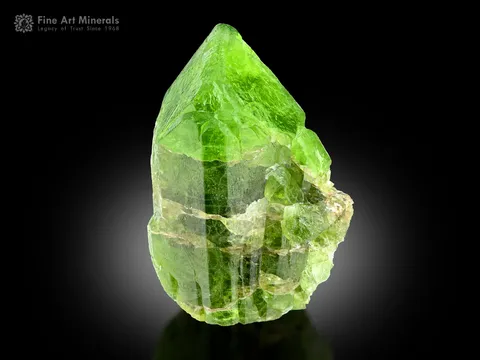
The notable finds are the ones that show why the locality became a modern classic: chunky, naturally terminated forsterite crystals several centimeters across; gem rough large enough to cut important stones; peridot crystals carrying black ludwigite-vonsenite needles; and rarer combinations with magnetite. Published accounts report crystals mostly under 3 cm, but with exceptional crystals to 15 cm and specimens weighing up to 2 kg. GIA has illustrated a 7.9 cm tall Pakistani crystal beside a 64.57 ct cut peridot, a pairing that neatly captures the dual identity of the locality: mineral specimen on one side, important gemstone source on the other.
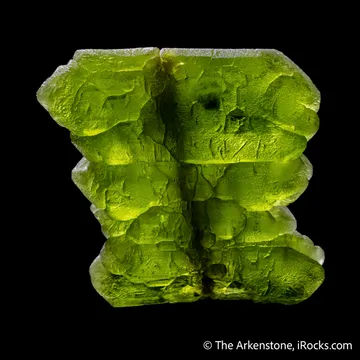
Forsterite is the species name behind the Sapat Gali legend, and the best examples are stout, sharp to slightly rounded orthorhombic crystals with yellow-green, lime-green, or grassy green color, generally transparent to translucent and commonly displaying strong prism and wedge-like terminal faces. Individual crystals in collections are commonly thumbnails to miniatures, with fine 3–5 cm crystals already significant and exceptional material reported much larger; many crystals show contact areas, bruised ridges, or internal veils because recovery from hard serpentinized dunite was rough. The classic associations are magnetite, talc, magnesite, serpentine, clinochlore, and black acicular ludwigite-vonsenite inclusions; superior pieces have undamaged natural terminations, lively color in ordinary light, clean form, and either attractive matrix contrast or a floater-like completeness that separates them from cuttable but specimen-poor rough.
Peridot from Sapat Gali is the gem variety of forsterite, prized here as both facetable rough and crystallized specimens; its finest crystals show saturated yellow-green to lime-green color, vitreous luster, real transparency, and a compact chisel-terminated habit rather than mere broken gem fragments. Most collector crystals are small, but the locality is famous for unusually large pieces of rough and crystals, with published reports of crystals to 15 cm and a largest reported faceted stone of about 310 ct; typical fine specimens are far smaller and valued more for completeness than bulk. The best peridot pieces from Sapat Gali show clean natural faces, minimal edge bruising, strong glow when backlit, and, when present, distinctive black ludwigite-vonsenite needles that give the crystal a locality signature without destroying its transparency.
Magnetite is the most desirable dark association for Sapat Gali peridot specimens, occurring as black metallic crystals, masses, and inclusions in the altered ultramafic vein assemblage; sharp crystals are much less common than the green forsterite and are prized when they form an aesthetic contrast with attached or adjacent peridot. Fine examples include euhedral crystals around the 2 cm scale, sometimes described as dodecahedral or sharply formed, with peridot crystals perched on or near them; many magnetites from the locality are striated, rounded, distorted, or partly embedded, so a smooth, sharp, undamaged crystal with bright green peridot is a notable specimen rather than a routine association. The strongest pieces show coherent geological contact, not an artificially placed crystal, and the black-green contrast is one of the few matrix styles from Sapat Gali that can rival the best loose peridot crystals for display impact.
Other documented minerals from Sapat Gali include serpentine-group minerals, chrysotile, talc, magnesite, clinochlore, chlorite-group minerals, chromite, ferrichromite, brucite, calcite, epidote, garnet-group minerals, muscovite, plagioclase, clinopyroxene- and orthopyroxene-group minerals, spinel, staurolite, and accessory PGE minerals such as laurite and erlichmanite recorded from the broader chromitite-bearing ultramafic system. No accepted type-locality mineral is securely tied to Sapat Gali in the verified mineralogical records consulted; the locality’s rare-mineral interest lies instead in its boron-bearing ludwigite-vonsenite inclusions and its accessory chromitite/PGE assemblage, while its collector fame remains overwhelmingly centered on world-class crystallized forsterite-peridot.
The first authentication issue is locality precision. “Pakistan peridot” is too broad for a serious specimen label, and “Kashmir peridot” is a trade expression that should not be treated as a locality. For specimen purposes, the useful label is Sapat Gali or Sapat Valley with the Kaghan Valley/Mansehra/Khyber Pakhtunkhwa hierarchy. Older labels using Soppat, Suppat, Sapat Nala, or Kohistan may be legitimate, but they should be reconciled with modern locality wording.
The second issue is reconstruction. Loose Sapat Gali peridot crystals are normal; matrix specimens are much less common and therefore attract a premium. That premium creates risk. Recent gemological reporting on Pakistani mineral markets documents artificially assembled specimens, glued crystals, resin-like adhesives, camouflaged joins, oiled surfaces, and undisclosed repairs in the broader Pakistan trade. The report was not written specifically about Sapat Gali peridot, but the warning is directly relevant whenever a valuable green crystal is presented on black magnetite or pale ultramafic matrix.
Inspect any peridot-on-matrix specimen under magnification. Natural contacts should show believable intergrowth or pocket relationships, compatible matrix, and no glossy meniscus, crushed-rock filler, trapped dust in adhesive, suspiciously fresh break surfaces, or a crystal that seems perched in a drilled-looking socket. Black magnetite, pale talc-magnesite-serpentine matrix, and altered ultramafic material make geological sense for Sapat Gali; a matrix that looks unrelated should raise questions. A disclosed repair is a condition and value issue. An undisclosed construction is a different matter entirely.
Condition is the most important quality variable. Forsterite-peridot is hard enough to be durable in jewelry, but it has only fair to good toughness, and specimen crystals chip along exposed ridges and terminations. Many Sapat pieces show small white edge bruises, contacted backs, shallow pits, internal feathers, or broken lower attachment points. A smaller crystal with a complete termination, strong color, and clean faces is usually more desirable than a larger rounded or bruised crystal. On fine pieces, judge color in normal daylight or good display lighting, not only under strong backlighting.
Ludwigite-vonsenite needles are a locality feature, not automatically a flaw. In faceted stones, dense needles or veils can lower clarity, but in mineral specimens they often increase character and confidence of origin. They should be described correctly: many sellers casually call black needles in peridot “rutile,” but the classic Sapat inclusions are ludwigite-vonsenite, with magnetite also possible as tiny inclusions.
Peridot from Sapat Gali is not rare in the absolute sense; small crystals and ordinary pieces remain available. Fine specimens are a different category. Large sharp singles, clean gem crystals over several centimeters, attractive clusters, true floaters, and natural magnetite-matrix combinations are scarce and increasingly competitive. The best pieces are modern classics, and they should be evaluated with the same discipline collectors apply to famous pegmatite and alpine localities: crystal form, color, damage, repair status, provenance, and matrix authenticity all matter.
Cleaning should be conservative. Avoid acids, harsh chemical cleaners, steam, ultrasonic cleaning, and sudden temperature changes, especially for fractured crystals, matrix pieces, and any specimen with possible repair. Dust with a soft brush; if needed, use only lukewarm water and mild soap, then dry carefully. Store specimens away from harder minerals that can abrade faces or chip terminations.
The Sapat Gali story begins with the geography. The deposit sits high enough in the western Himalaya that even reaching the workings was an event. Published gemological accounts place the mine at about 4,500 m, roughly 15,000 feet above sea level. One route required a seven-hour horseback ride and then a two-day hike from the nearest populated area, Basham Village. Another Pakistani geological description gives a route from Sohch village on the Kunhar River, followed by a 20 km mule track to the mine area. Those are not romantic flourishes; they explain the locality’s production character. Short seasons, hard access, and small-scale recovery shaped both the availability and the condition of the crystals.
The market impact was abrupt. In the early 1990s, Arizona supplied the overwhelming share of commercial peridot, mostly in small sizes. Then Pakistani material appeared with a different scale and clarity. Robert E. Kane recorded that one international manufacturer had faceted nearly half a million carats of Arizona peridot over fifteen years and produced only a handful of nearly flawless stones over 10 ct, while the average relatively clean stone was about 2 ct. In only three years, the same operation faceted more than 30,000 carats of Pakistani peridot; 35 percent of that production was over 5 ct, and nearly a third of the over-5 ct material fell in the 10–20 ct range. Kane had seen occasional faceted Pakistani peridots exceeding 100 ct. For a species that many jewelers associated with modest green accent stones, Sapat Valley changed the scale.
The most detailed published journey of Sapat peridot follows an 8 kg parcel bought in February 2004. Eight kilograms is 40,000 carats of rough. The parcel contained large pieces up to 35 g, but the big crystals were not simply turned into giant gems; inclusions and fractures meant they had to be studied, sawn, and reduced with care. The initial expected recovery was 20 percent, or 8,000 carats of faceted stones. The final yield was about 6,500 carats, or 16.2 percent. That figure is a useful reminder for specimen collectors too: what looks like abundant green crystal at the mine face becomes far less abundant once damage, veils, fractures, color orientation, and useful shape are taken seriously.
From that parcel came one of the great modern peridot jewelry projects. The cutting plan favored a matched suite rather than maximum weight retention. The Asscher cut was chosen because its broad, architectural facets could emphasize both color and brilliance, but it demanded very clean material. Rough was sorted, examined on light boxes, checked with intense incandescent and fiber-optic light, marked with ink, sawn with 0.2 mm diamond blades, preformed, and finally faceted on a modified Swiss jam-peg system by a master cutter with thirty years of experience. The completed suite contained 54 Asscher-cut peridots, from 3.57 to 18.30 ct, totaling 350.40 ct.
The final act took the stones to Van Cleef & Arpels. Paris designed the suite; the New York atelier made it. Five master jewelers spent more than 900 hours on the necklace, bracelet, earrings, and ring. The platinum alloy was 95 percent platinum and 5 percent ruthenium. More than 90 diamonds, totaling about 21 carats, were incorporated with the peridots. Even at the setting stage, the Sapat material demanded special handling: peridot’s hardness and only fair to good toughness meant the setters had to avoid the kind of pressure and tool slips that sapphire would tolerate more readily. It is a remarkable end point for crystals born in fractured dunite beside Himalayan shear zones: from a remote mule-track locality to a Fifth Avenue jewelry suite.