San Piero in Campo, Italy Elba’s classic tourmaline locality, famed for elbaite-bearing pegmatites and historic diggings, producing sought-after color varietie…
Key facts
San Piero in Campo is one of the great European names in pegmatite mineralogy: a small Tuscan village on the southern flank of Monte Capanne, but to collectors a shorthand for the classic elbaite-bearing miarolitic pegmatites of western Elba. The locality is not a single mine in the modern sense; it is a compact district of pegmatitic veins, quarries, boulders, and small historical diggings around Fonte del Prete, Grotta d’Oggi, La Speranza, Facciatoia, Rosina, Il Prado, and related occurrences between San Piero and Sant’Ilario. These bodies belong to the rare-element LCT pegmatite suite genetically tied to the Monte Capanne monzogranite, and their cavities produced the specimens that made Elba a textbook locality for colored lithium tourmaline.
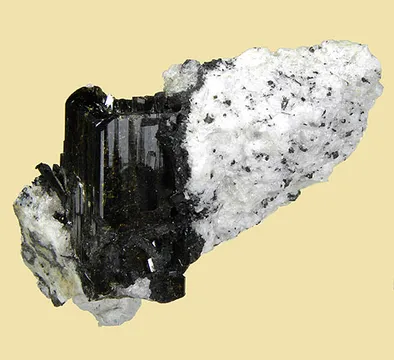
Collectors come to San Piero first for tourmaline: black schorl passing into elbaite, pale green and colorless crystals, rose and pink rubellite-like crystals, yellow to brownish manganese-rich crystals, “Moor’s head” crystals with dark caps, and tight polychrome groups on quartz, albite, and orthoclase. But the district’s importance is broader than beauty. Elbaite itself takes its name from the island; neotype elbaite material has now been defined from the Rosina pegmatite. Grotta d’Oggi is the type locality for tsilaisite and fluor-tsilaisite, Rosina is the type locality for celleriite, Facciatoia supplied the holotype of uvite, and San Piero also figures in the type record of rubicline, ramanite-(Cs), ramanite-(Rb), and uranopolycrase. Few localities compress so much mineralogical history into such a small walking landscape.
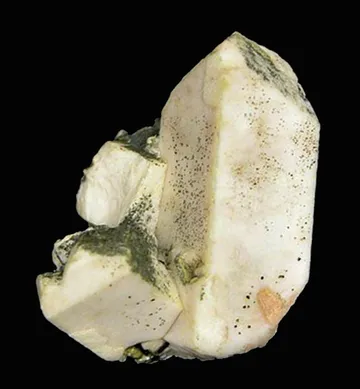
The finest old San Piero specimens have a very recognizable look. Tourmaline crystals are usually modest by Brazilian or Afghan standards, but they have an architectural elegance that is unmistakably Elban: lustrous, striated prisms rising from sugary albite or blocky orthoclase, often with smoky or glassy quartz and sometimes with beryl, lepidolite, pollucite, spessartine, zeolites, or rare oxides. The best pieces are not judged only by size. Color zoning, sharp undamaged terminations, intact matrix, and credible old provenance matter enormously here, because so much of the district’s best material left the island in the nineteenth and early twentieth centuries for university museums and aristocratic collections.
Regional View
Country View
San Piero is also unusual because its collecting history is so deeply human. Names that often appear only as labels—Raffaello Foresi, Luigi Celleri, Giuseppe Pisani, Giorgio Roster, Bista Toscanelli, Federico Pezzotta—belong to a two-century chain of diggers, scholars, curators, and collectors who treated these small pegmatites as both scientific objects and cultural patrimony. Today that tradition is visible at the MUM, the Luigi Celleri Mineralogical Museum in San Piero, where specimens from local and historical collections are displayed close to the very slopes that produced them.

Photo: Wikimedia Commons

Photo: Wikimedia Commons
Search for specimens: View all specimens from San Piero in Campo, Italy
San Piero in Campo lies on the western part of Elba Island, in the Campo nell’Elba municipality of Livorno Province, Tuscany. Mineralogically, the name covers a cluster of pegmatitic and contact-zone occurrences rather than one continuous mine. The classic tourmaline localities are arranged around the village and its neighboring valleys and slopes: Grotta d’Oggi, Fonte del Prete, La Speranza or Pisani’s Quarry, Masso Foresi, Facciatoia, Il Prado, Rosina, and several smaller veins and quarry areas. The veins are hosted in and around the Monte Capanne intrusive complex, especially along the eastern and southeastern part of the pluton where evolved granitic melts and late fluids produced rare-element, miarolitic pegmatites.
The deposit type is best understood as a swarm of evolved granitic LCT pegmatites—lithium, cesium, tantalum enriched—related to the Monte Capanne monzogranite. At Rosina, one of the best modern-described bodies, the pegmatite is an aplite-pegmatite dyke hosted in porphyritic monzogranite a few hundred meters south of the village. It is complexly and asymmetrically zoned, roughly north–south in trend, steeply to moderately dipping, and in its most productive part about 14 meters long and roughly 0.6 to 2.1 meters wide. The upper and lower parts differ strongly: one side is more sodic and albite-rich, the other more potassic and coarse-grained. The central miarolitic zone contains petalite and pollucite, with local lepidolite, and the pockets yielded tourmaline-bearing assemblages that record changing late-stage fluids.
The San Piero pegmatites are not ore bodies in the industrial sense, though they are rare-element mineralized bodies rich in Li, Cs, Rb, B, Mn, Be, Nb, Ta, and related elements. Their collector value came from pockets. These miarolitic cavities range from small vugs only a few centimeters across to larger chambers capable of producing cabinet-scale matrix specimens. At shallow levels in Rosina, darker tourmalines with pale-blue aquamarine and spessartine are recorded; deeper pockets produced more abundant polychrome and rose tourmalines with low iron and variable manganese, accompanied by morganite, petalite, pollucite, and spessartine. Other San Piero pockets and veins produced quartz, orthoclase, albite, beryl, lepidolite, cassiterite, columbite-(Mn), tantalite-(Mn), microlite-group minerals, topaz, zeolites, and a long list of rarities.
Historically, Grotta d’Oggi was the first great stage of the San Piero story. The famous granite mass there was purchased and opened in 1825, and the locality quickly entered the literature of Italian mineralogy. Fonte del Prete and La Speranza followed as major nineteenth-century sources; La Speranza, named around 1850 by Giuseppe Pisani, became especially noted for pollucite and associated rare-element assemblages. Masso Foresi, at Fonte del Prete, yielded the monumental geode fragments later nicknamed the “Four Evangelists,” probably the most famous individual specimens ever taken from the district. By the later nineteenth century Luigi Celleri was the indispensable local field man, preparing and discovering specimens for the Foresi and Roster circles and for museum collections that eventually carried San Piero minerals across Europe.
The modern Rosina pegmatite added a second life to the district. Discovered by mineral collectors around 1990–1991 near La Speranza, Rosina became a scientifically important source of fresh, well-localized material. Its pockets supplied excellent tourmaline specimens and research material for studies of elbaite, fluor-elbaite, rossmanite, celleriite, foititic and schorlitic overgrowths, and late-stage pocket-fracture processes. Rosina is especially valuable because its geology and paragenesis are much better documented than many nineteenth-century San Piero finds, whose precise sublocality may be uncertain or known only from old labels.
Collecting access today is not comparable to the free-for-all of the nineteenth century. The classic workings are historic, heavily collected, partly exhausted, and in places tied to museum, guided-excursion, private-property, quarry, or protected-land considerations. Visitors should treat San Piero as a heritage mineral district rather than an open dig site. The responsible modern route is through the MUM and organized excursions, which have included visits to Grotta d’Oggi and other geosites with observation and limited collecting of small samples where permitted. Serious collectors seeking specimens will usually obtain them through old collections, Italian dealers, or carefully documented modern material rather than by field collecting.
Elbaite from San Piero in Campo is the locality’s signature mineral and the reason the village is written into the history of tourmaline. The crystals are typically slender to stout trigonal prisms, deeply striated, glassy, and strongly zoned, with colors ranging from nearly colorless and pale green through pink and rose to yellow, brownish, blue-green, purple-blue, and black-capped combinations; many classic specimens show elbaite in continuity with schorl, fluor-elbaite, rossmanite, tsilaisite, or late fibrous tourmaline overgrowths. Most fine crystals are thumbnail to small-cabinet scale rather than giant, commonly from a few millimeters to a few centimeters, but Rosina pockets have yielded sharply formed elongated crystals up to about 1.5 cm in the neotype-style assemblage, while Grotta d’Oggi and Fonte del Prete historical pieces may carry richer crystal groups on quartz, albite, orthoclase, or beryl-bearing matrix. The best San Piero elbaites combine strong luster, intact terminations, crisp color zoning, and undisturbed matrix; ordinary examples are loose, repaired, opaque, bruised, or vaguely labeled “Elba” without a reliable sublocality.
Other documented minerals from San Piero in Campo make the district one of the densest type-locality clusters in pegmatite mineralogy. Type-locality or type-related species include elbaite, tsilaisite, fluor-tsilaisite, celleriite, uvite, rubicline, ramanite-(Cs), ramanite-(Rb), and uranopolycrase. The pegmatite assemblage also includes beryl varieties such as aquamarine, goshenite, and morganite; petalite and pollucite in evolved zones; orthoclase, microcline, albite, quartz, muscovite, lepidolite, and spessartine as common companions; and accessory or rare species such as cassiterite, columbite-(Mn), tantalite-(Mn), microlite-group minerals, pyrophanite, topaz, zircon, sekaninaite, rossmanite, fluor-elbaite, foitite, schorl, magnesio-lucchesiite, and zeolites including heulandite, stilbite, chabazite, natrolite, laumontite, and mordenite. San Piero is a place where a pretty tourmaline specimen and a scientifically consequential micro-mineral record may come from the same family of cavities.
Provenance is everything with San Piero material. A label that says only “Elba” may refer to San Piero, Sant’Ilario, another western Elban pegmatite, or even a broad historic trade name. Better labels specify Grotta d’Oggi, Fonte del Prete, La Speranza, Rosina, Facciatoia, Masso Foresi, or another recognized sublocality. Old museum or dealer labels from Italian, German, French, British, Scandinavian, or American collections can add real value, especially where the specimen style matches the label and the matrix is consistent with San Piero pegmatite.
Species names require caution. Many attractive specimens sold as elbaite may be fluor-elbaite, schorl-to-elbaite zoned tourmaline, rossmanite-bearing tourmaline, tsilaisite-bearing tourmaline, or simply “tourmaline” without analytical confirmation. For display specimens this may not matter much, but for species collectors it matters enormously. Celleriite, fluor-tsilaisite, tsilaisite, uvite, magnesio-lucchesiite, ramanite, rubicline, and uranopolycrase should not be accepted on appearance alone; they require either a reputable analytical history or a research-grade provenance.
Condition problems are common. Elban tourmalines are often perched in small cavities on feldspar and quartz, and crystals may be broken at the base, detached and reattached, restored onto matrix, or chipped along terminations and prism edges. Repairs are not inherently disqualifying in old San Piero specimens—many historic pieces have been stabilized—but they should be disclosed. Carefully inspect black-capped and polychrome crystals for glue at the base, mismatched contact surfaces, and matrix disturbances. Some otherwise desirable examples are composed of loose crystals with excellent color but no matrix; these can be attractive thumbnails, though they carry less geological information.
The matrix minerals need their own care. Albite and zeolite coatings can be friable; pollucite, petalite, and altered feldspar zones may show bruising or cleaving; and delicate acicular or fibrous tourmaline overgrowths should be handled as microscopy-grade surfaces, not cleaned aggressively. Avoid acids or harsh ultrasonic cleaning on matrix specimens. Even when the main tourmaline is hard and durable, the specimen as a whole may not be.
Market availability is uneven. Small San Piero elbaites appear periodically, but top matrix specimens with rich crystal coverage, old labels, or named sublocalities are scarce and strongly competed for. Rosina material is better represented among modern specimens, while nineteenth-century Grotta d’Oggi, Fonte del Prete, La Speranza, and Masso Foresi pieces are often locked in museums or long-held private collections. True type-mineral specimens from San Piero are usually micro or analytical material rather than showy cabinet pieces.
In 1825 the story begins almost like a folktale: a lieutenant stationed at Portoferraio, Giovanni Ammannati, notices the mineral promise of a granite mass at Grotta d’Oggi. The rock stood in scrubland at San Pietro a Campo on property belonging to the priest Raffaello Pisani. Ammannati bought the mass on 6 May 1825. Contemporary accounts give the boulder a circumference of 44 braccia and a northern height of 20 braccia—a huge block by any collector’s measure, and one that would soon make the obscure slope between San Piero and Sant’Ilario a destination for mineralogists. The place later became, in local memory, a “temple” for lovers of minerals: not a cavern of fantasy, but a scar in granite where feldspar, beryl, and polychrome tourmaline had crystallized with extraordinary grace.
The nineteenth-century San Piero diggers had a habit of naming hope directly. Around 1850, Commander Giuseppe Pisani opened work at Fonte del Prete and called one vein La Speranza—“The Hope”—because, after poor luck elsewhere, he expected better fortune there. The name proved apt. The La Speranza and Fonte del Prete area became a source of pollucite-bearing rare-element pegmatite material and tourmaline specimens, and it remains one of the names collectors most want to see on an old Elban label.
The most dramatic find was Masso Foresi. Work at the Masso di Fonte del Prete began on 25 January 1872 and continued until mid-April. From that excavation came heulandite, chabazite, natrolite, the material once called foresite, and above all enormous geode fragments lined with crystals. These blocks, about 60 by 70 cm, carried pink tourmaline, aquamarine beryl, pollucite, heulandite, orthoclase, and other pegmatite minerals. In the Foresi Museum at Portoferraio, a monk reportedly saw them, fell to his knees in astonishment, and proclaimed them “I Quattro Evangelisti”—the Four Evangelists. The name stuck. They are not merely large specimens; they are relics of the age when San Piero specimens were treated with almost devotional awe.
Luigi Celleri stands at the center of the human story. A son of San Piero, he helped build the Foresi collection and prepared the famous Four Evangelists for exhibition. After breaking with Foresi around 1874–1875, he worked with Giorgio Roster and Bista Toscanelli, who had acquired rights in western Elba’s pegmatitic veins. In those years Celleri found a remarkable number of specimens at Grotta d’Oggi, Fonte del Prete, Facciatoia, Forcioni, and Prado: tourmalines, beryls, pollucite, petalite, garnets, zeolites, and other species that went into museums and private collections far beyond the island. At Facciatoia, close to the fortified church of San Niccolò and today’s MUM, he is credited with a celebrated vein that produced beautiful pink tourmalines.
Celleri’s end is inseparable from the locality. On 19 April 1900, while working at Grotta d’Oggi, he was struck by illness. Local accounts say workers from the nearby magnesite quarry lifted him and carried him home, accompanied by the women of the sorting work; as they moved toward the village, more townspeople joined the sad procession. He died two days later. More than a century later, the mineral celleriite—first recognized from the Rosina pegmatite—honors not an armchair mineralogist, but the local field man whose eye and labor helped make San Piero famous.
The Rosina pegmatite gave modern science one of the district’s best second acts. Discovered by mineral collectors around 1990–1991 near La Speranza, it was mined not only for attractive specimens but also for carefully documented research material. Its cavities preserve a remarkably detailed record of late-stage pegmatite evolution: pale prismatic tourmaline, dark manganese-rich overgrowths, fibrous caps, acicular late tourmaline, and evidence of pocket rupture followed by reactive fluid circulation. In one studied sample, a millimeter-scale pale-green prismatic crystal carried a dark fibrous “fur-hat-like” termination and microscopic colorless acicular crystals. In San Piero terms, that is a perfect modern story: a specimen tiny enough to fit under a microscope, yet rich enough to rewrite the paragenesis of Elban tourmaline.
Bosi, F., Pezzotta, F., Skogby, H., Luppi, R., Ballirano, P., Hålenius, U., Tempesta, G., Agrosì, G., and Sejkora, J. “Elbaite, the neotype material from the Rosina pegmatite, San Piero in Campo, Elba island, Italy.” European Journal of Mineralogy 37, 505–516, 2025. Formal neotype description for elbaite from the Rosina pegmatite, with occurrence, zoning, and museum deposition details.
Andreozzi, G. B., Di Giuseppe, D., Gualtieri, A. F., Scognamiglio, V., Fornasini, L., Bersani, D., Giovanardi, T., Lugli, F., and Pezzotta, F. “Fibrous tourmaline from San Piero in Campo (Elba, Italy).” European Journal of Mineralogy 37, 437–453, 2025. Detailed multi-analytical study of fibrous and acicular tourmaline from a Rosina miarolitic cavity.
Bosi, F., Biagioni, C., Pezzotta, F., Skogby, H., Hålenius, U., Cempírek, J., Hawthorne, F. C., Lussier, A. J., Abdu, Y. A., Day, M. C., Fayek, M., Clark, C. M., Grice, J. D., and Henry, D. J. “Uvite, CaMg3(Al5Mg)(Si6O18)(BO3)3(OH)3(OH), a new, but long-anticipated mineral species of the tourmaline supergroup from San Piero in Campo, Elba Island, Italy.” Mineralogical Magazine 86, 2022. Description of uvite from the abandoned Facciatoia quarry, including occurrence in a narrow tourmaline vein cutting altered metaserpentinite.
Bosi, F., Pezzotta, F., Altieri, A., Andreozzi, G. B., Ballirano, P., Tempesta, G., Cempírek, J., Škoda, R., Filip, J., Čopjaková, R., Novák, M., Kampf, A. R., Scribner, E. D., Groat, L. A., and Evans, R. J. “Celleriite, □(Mn2+2Al)Al6(Si6O18)(BO3)3(OH)3(OH), a new mineral species of the tourmaline supergroup.” American Mineralogist 107, 31–42, 2022. Original description of celleriite, with the Rosina pegmatite as holotype locality and Pikárec in Moravia as co-type locality.
Bosi, F., Skogby, H., Agrosì, G., and Scandale, E. “Tsilaisite, NaMn3Al6(Si6O18)(BO3)3(OH)3OH, a new mineral species of the tourmaline supergroup from Grotta d’Oggi, San Pietro in Campo, island of Elba, Italy.” American Mineralogist 97, 989–994, 2012. Type-locality record for tsilaisite from Grotta d’Oggi.
Bosi, F., Andreozzi, G. B., Agrosì, G., and Scandale, E. “Fluor-tsilaisite, NaMn3Al6(Si6O18)(BO3)3(OH)3F, a new tourmaline from San Piero in Campo (Elba, Italy) and new data on tsilaisitic tourmaline from the holotype specimen locality.” Mineralogical Magazine 79, 89–101, 2015. Description of the fluorine-dominant manganese tourmaline end-member from San Piero material.
Teertstra, D. K., Černý, P., Hawthorne, F. C., Pier, J., Wang, L.-M., and Ewing, R. C. “Rubicline, a new feldspar from San Piero in Campo, Elba, Italy.” American Mineralogist 83, 1335–1339, 1998. Description of rubicline, the rubidium analogue of microcline, from a pollucite-bearing rare-element pegmatite at San Piero.
Thomas, R., Davidson, P., and Hahn, A. “Ramanite-(Cs) and ramanite-(Rb): New cesium and rubidium pentaborate tetrahydrate minerals identified with Raman spectroscopy.” American Mineralogist 93, 1034–1042, 2008. Type record for ramanite-(Cs) and related ramanite-(Rb) from San Piero material.
Altieri, A., Pezzotta, F., Skogby, H., Hålenius, U., and Bosi, F. “Dark-coloured Mn-rich overgrowths in an elbaitic tourmaline crystal from the Rosina pegmatite, San Piero in Campo, Elba Island, Italy: witness of late-stage opening of the geochemical system.” Mineralogical Magazine 87, 130–142, 2023. Study of manganese-rich overgrowths on Rosina tourmaline and their interpretation as evidence of late-stage system opening.
Orlandi, P., and Scortecci, P. B. “Minerals of the Elba Pegmatites.” The Mineralogical Record 16(5), 353–363, 1985. Classic collector-oriented article summarizing the mineralogy of the Elban pegmatites, including San Piero occurrences.
Orlandi, P., and Pezzotta, F. Minerali dell’Isola d’Elba: i minerali dei giacimenti metalliferi dell’Elba orientale e delle pegmatiti del Monte Capanne. Edizioni Novecento Grafico, 1996/1997. Major Italian monograph on Elba minerals, including the Monte Capanne pegmatites.
Moggi Cecchi, V., Pezzotta, F., Dominici, S., and Savorelli, A. “The ‘Quattro Evangelisti’ pegmatitic blocks of the Museo La Specola: a restoration and re-exhibition project.” Congresso congiunto SIMP-SGI 2025 abstract. Recent museum-focused account of the Four Evangelists blocks from Masso di Fonte del Prete/Masso Foresi.
“I minerali delle pegmatiti elbane” — YouTube / linked by Virtual Elba — A video listed by Virtual Elba under the Luigi Celleri Museum media section, focused on the pegmatite minerals of Elba.
“La collezione elbana di minerali” — YouTube / linked by Virtual Elba — A video listed with the Natural History Museum of the University of Florence’s Elban mineral collection.
“La miniera del Vallone - Linea Blu 13/07/2019” — Rai 1 / YouTube link listed by Virtual Elba — A television segment linked in the San Piero museum media section and described there as including the famous tourmalines found at San Piero.
Virtual Elba 360° view of an internal room of the Luigi Celleri Mineralogical Museum — Interactive museum-room media on the MUM page, useful for seeing the local display context.
Mindat: San Piero in Campo, Campo nell’Elba, Livorno Province, Tuscany, Italy — The most useful consolidated mineral list for the San Piero district, with sublocalities, photos, and type-locality records.
Mindat: Rosina vein (Rosina pegmatite) — Key modern sublocality page for the Rosina aplite-pegmatite dyke and its scientifically important tourmalines.
Mindat: Grotta d’Oggi — Classic San Piero sublocality and type locality for tsilaisite and fluor-tsilaisite.
Mindat photo gallery: San Piero in Campo — Broad visual reference for San Piero specimens across species and sublocalities.
MUM – Museo Mineralogico Luigi Celleri — Official site for the San Piero mineralogical museum named for Luigi Celleri.
MUM history page — Strong source for the local collecting history of Celleri, Foresi, the Four Evangelists, and the museum’s formation.
Musei Arcipelago: MUM – Museo mineralogico Luigi Celleri — Practical visitor-oriented overview of the museum and its role as a base for local geosite activities.
Virtual Elba: Luigi Celleri Museum – Tourmalines and minerals of San Piero — Accessible English-language overview of the museum, principal deposits, stories, videos, and excursion context.
San Piero in Campo: “Il paese dei cristalli” — Local historical account of the village as “the town of crystals,” with notes on Grotta d’Oggi, La Speranza, Masso Foresi, and the Four Evangelists.
Escursione a Grotta d’Oggi — Musei dell’Arcipelago Toscano SMART — Example of a guided Grotta d’Oggi excursion including observation and limited small-sample collecting.
Museo di Storia Naturale dell’Università di Pisa: Minerals — Notes the importance of San Piero pegmatites in the Pisa museum mineral collections, including a large tourmaline specimen.
Wikimedia Commons: Elbaite Elbe.jpg — Open-license photograph of San Piero elbaite, useful as a visual reference for the locality’s classic tourmaline style.
Wikimedia Commons: Elbaite, quartz, orthoclase from San Piero — Open-license image showing elbaite with quartz and orthoclase from the San Piero district.