A collector's guide to Elba Island, Italy: its geology, mining history and notable minerals, illustrated with the 49 specimens documented from this locality on EarthWonders.
Key facts
Elba is one of the rare European localities where a single island can carry two quite different collector legends without either one feeling secondary. On the eastern side, the “land of iron” is a chain of hematite-, pyrite-, limonite-, and magnetite-bearing deposits running roughly north–south from Rio Albano and Rio Marina down toward Ortano, Terranera, Ginevro, Sassi Neri, and the Calamita promontory. These are ancient and historically immense iron workings, exploited from Etruscan and Roman times through the industrial age, and they gave collectors the black mirror hematites, brassy pyrites on hematite, iridescent specularites, and ilvaite-bearing skarns that made Elba a cabinet name long before most modern classic localities were fashionable.
The western and central part of the island tells a different story. Around San Piero in Campo and Sant’Ilario, the Monte Capanne granitic system produced LCT pegmatites—lithium-cesium-tantalum bodies—whose pockets supplied elbaite, beryl, orthoclase, albite, quartz, lepidolite, petalite, pollucite, spessartine, and rare niobium-tantalum oxides. Elbaite itself takes its name from Elba; the island is its type locality, and recent formal work has fixed neotype material from the Rosina pegmatite near San Piero in Campo. For collectors, that means Elba is not just a place that produced attractive tourmaline—it is part of the nomenclatural foundation of the tourmaline group.
Regional View
Country View
The best iron-mining specimens from Elba have an unmistakable Mediterranean severity: jet-black hematite with metallic faces, bladed or rhombohedral crystals catching blue, bronze, and oil-slick iridescence, and pyrite crystals rising from dark hematitic matrix with a contrast that is hard to confuse with Spanish, Peruvian, or Romanian pyrite. The best pegmatite specimens are smaller in scale but historically powerful—delicate polychrome tourmalines, pale or smoky quartz, feldspar masses, albite, and old labels from San Piero, Grotta d’Oggi, Fonte del Prete, Facciatoia, La Speranza, or Rosina.

Photo: Wikimedia Commons

Photo: Wikimedia Commons

Photo: Wikimedia Commons
Search for specimens: View all specimens from Elba Island, Italy
Elba sits in the Tuscan Archipelago off the western coast of Italy, and its mineral localities divide naturally into two collector districts. Eastern Elba is the iron district: Rio Albano, Rio Marina, Ortano, Terranera, Ginevro, Sassi Neri, and Calamita. Western Elba is the pegmatite district: San Piero in Campo, Sant’Ilario in Campo, the Monte Capanne granitic area, and the classic dyke and quarry names—Grotta d’Oggi, Fonte del Prete, La Speranza or Cava Pisani, Facciatoia, Il Prado, Masso Foresi, Forcioni, Catri, and Rosina.
The iron deposits form a relatively narrow belt along the eastern side of the island. In the Rio Marina and Rio Albano sector, hematite-rich ore bodies occur as stratiform, massive, pod-like, and vein-like mineralization hosted in older metasiliciclastic and carbonate units, especially around contacts between the Rio Marina Formation or Verrucano rocks and overlying calcareous levels such as Calcare Cavernoso. The main ore assemblage is hematite with pyrite and limonite, locally with magnetite, quartz, adularia, chlorite, calcite, epidote, ilvaite, and base-metal or bismuth minerals such as sphalerite, galena, bismuthinite, chalcopyrite, and secondary lead or bismuth phases. In deeper parts of Rio Marina, the “Rio Marina profondo” ore is associated with skarn silicates including hedenbergite, ilvaite, epidote, calcite, quartz, chlorite, and adularia.
Rio Marina is the classic collecting name. The mining area covers roughly two square kilometers and includes the Bacino, Valle Giove, Falcacci, Vigneria, Zuccoletto, and related workings. Bacino is especially important for crystallized hematite: compact microcrystalline masses, flaky and lamellar specularite, groups of black crystals, and iridescent pieces whose surface colors are produced by thin films of iron hydroxides. Valle Giove, worked beginning in 1950 and active until the final closure of Elba’s iron mines in 1981, is the great Elban pyrite-on-hematite locality; its open amphitheater and stepped benches produced some of the island’s most admired pyrite specimens. Falcacci, cultivated from the early nineteenth century until 1960, is noted for cubic pyrite and for riomarinaite, the bismuth sulfate hydroxide hydrate named for Rio Marina. Conche, part of the Rio Albano field and worked from 1940 to 1970, yielded limonite and hematite with pyrite and siderite and now contains the red-brown, iron-rich mine lake known as Laghetto delle Conche.
Farther south, Calamita and the Capoliveri mines are more strongly tied to magnetite and skarn. Calamita’s northern workings—Civetta, Albaroccia, Macei, Polveraio, and Coti Nere—are developed in thermometamorphosed carbonate rocks where andradite skarn and ilvaite-hedenbergite skarn occur near contacts between metacarbonates and underlying formations. Calamita’s exploited ores were mostly magnetite with goethite, hematite, pyrite, chalcopyrite, pyrrhotite, bornite, sphalerite, and copper secondaries. At Ginevro and Sassi Neri, magnetite-dominant ores and skarn assemblages add a different texture to the district’s mineralogy, and Ginevro is notable among Elba’s mines for its underground workings.
Mining history here is deep enough that the earliest production cannot be reconstructed simply from modern tonnage figures. Iron from Elba was a major Mediterranean resource by the first millennium BC, and ancient smelting sites on and near the Tuscan coast preserve slag and furnace debris tied to Elban ore. Industrial production continued into the twentieth century, with the post-1860 to late-1970s period especially important in the Rio Marina records; the island’s iron mines closed around 1981 after the IRI decision to end operations. Modern scholarship has shown that Elban hematite-rich ores have a distinctive tungsten-tin signature, with tiny ferberite, scheelite, and cassiterite grains dispersed through the hematite matrix. That trace-element fingerprint now matters to archaeometallurgists because it can help recognize Elban iron in ancient slags and metalworking debris.
The San Piero pegmatite field is geologically and aesthetically distinct. It lies in the influence of the Monte Capanne pluton, in and around granitic rocks, hornfels, and older units cut by LCT pegmatite dykes of variable thickness, orientation, and pocket development. The cavities are generally small compared with Brazilian or Afghan pegmatites, but their mineralogical complexity is extraordinary. Pocket assemblages include elbaite, schorl, quartz, orthoclase or microcline, albite, beryl, lepidolite, petalite, pollucite, spessartine, columbite-group minerals, microlite-group minerals, tantalite, uranopolycrase, euxenite-(Y), ilmenorutile, and rarer tourmaline species. San Piero’s most famous dyke and quarry names—Grotta d’Oggi, Fonte del Prete, La Speranza, Facciatoia, Masso Foresi, and Rosina—belong on old labels because those names preserve real differences in history, paragenesis, and specimen style.
Access today is structured, not free-for-all mining. The Rio Marina mining area is preserved and interpreted by the Parco Minerario dell’Isola d’Elba, with museum displays in the Palazzo del Burò and guided tours by train, on foot, and by off-road vehicle. Visitors on organized tours are commonly allowed to collect small pyrite and hematite samples at designated stops, especially in the Valle Giove area; that should not be confused with permission to dig independently in closed workings, unstable benches, or protected ground. San Piero’s pegmatite localities are likewise best approached through local museums, guided excursions, and current permissions, because many classic quarries and dykes are closed, on private land, historically sensitive, or scientifically important.
Elba hematite is most closely associated with Rio Marina and Rio Albano, where specularite occurs as lamellar and micaceous aggregates, flattened rhombohedral crystals, and glossy black crystal groups on hematite-rich matrix, often with white to clear quartz and locally with pyrite or adularia; Bacino is especially prized for sharp, mirror-bright hematites and for iridescent surfaces caused by thin goethitic alteration films, while Valle Giove and other Rio workings supplied darker hematite matrices for the classic pyrite combinations. Good Elba hematite is not merely shiny ore: the better pieces show discrete crystal form, undamaged reflective faces, color play that does not obscure the crystal, and an aesthetic contrast with quartz or pyrite; ordinary pieces tend to be massive specular ore, rubbed dump material, or heavily bruised crystals from old iron workings.
Pyrite from Elba is most celebrated from Rio Marina, particularly Valle Giove and Falcacci, where crystals occur on dark hematitic matrix as brassy pyritohedra, cubes, octahedra, and intergrown “poker-chip” aggregates; Valle Giove produced the island’s finest pyrite-on-hematite specimens, including large pyritohedral crystals in old pockets from the early twentieth century and again from important finds in the early 1970s, while Falcacci is remembered for cubic pyrite and later for riomarinaite. The elite pieces are sharply isolated, lustrous, and fresh-looking, with the golden pyrite standing proudly against black hematite; lesser examples are massive, dulled by oxidation, contacted on the rear or base, or composed of small pyrite crusts without the sculptural contrast that made Elba famous.
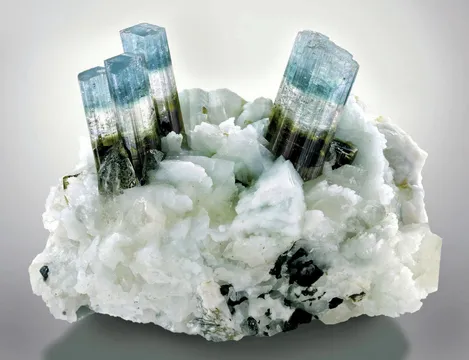
Elbaite is the namesake tourmaline of the island and belongs to the San Piero in Campo pegmatite field rather than the eastern iron mines; it occurs in LCT pegmatite pockets at and around Fonte del Prete, Grotta d’Oggi, Facciatoia, La Speranza, Forcioni, Catri, and Rosina, typically as slender to stout prismatic crystals in colorless, green, pink, red, yellow, violet, blue, and polychrome zones, often with quartz, albite, orthoclase or microcline, schorl, lepidolite, beryl, petalite, and pollucite. The most desirable Elba elbaites are matrix specimens with clean terminations, transparent color zoning, and a credible old or locality-specific label; large matrix crystals are genuinely rare here, and even well-formed crystals of only a few centimeters can be important if they are undamaged, well placed, and tied to a classic San Piero occurrence.
Quartz appears in both faces of Elba’s mineralogy: in the iron district it is the bright white or clear companion to black hematite and brassy pyrite from Rio Marina, sometimes forming small prismatic sprays in hematite cavities, while in the San Piero pegmatites it occurs as colorless to smoky crystals associated with orthoclase, albite, elbaite, schorl, beryl, lepidolite, and other pocket minerals. The most collectible quartz from Elba is not usually judged as a standalone quartz locality but as part of a locality-specific association—sharp milky quartz against iridescent hematite from Bacino, clear quartz accenting pyrite on hematite from Rio Marina, or smoky quartz perched with feldspar and tourmaline from San Piero; broken points, etched fragments, and loose pegmatite quartz without context are much less compelling.
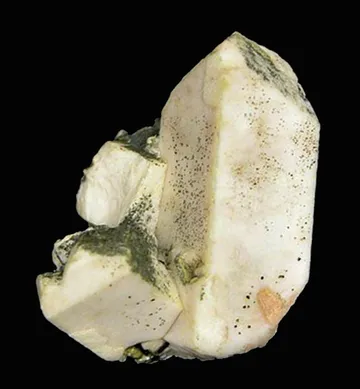
Orthoclase is a classic feldspar label in the San Piero pegmatites, especially at Grotta d’Oggi, Fonte del Prete, Facciatoia, Rosina, and related dykes, where pale cream to pinkish feldspar crystals and cleavages are found with albite, quartz, schorl, elbaite, beryl, and lithium minerals; some old Elba feldspar specimens carry historical “orthose” or orthoclase terminology even where modern work may distinguish microcline or other K-feldspar more carefully. Strong specimens are matrix pieces in which feldspar forms the architecture of the pocket—blocky crystals, clean cleavages, or aesthetic platforms for smoky quartz, elbaite, and albite—rather than anonymous feldspar chunks from weathered pegmatite rubble.
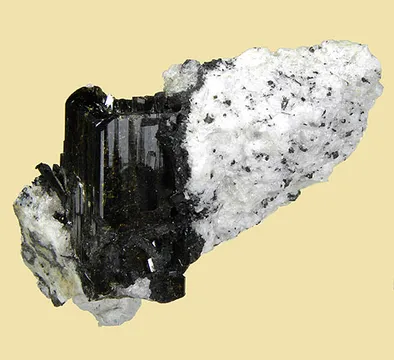
Elba’s supporting cast is unusually deep. Ilvaite, named from Ilva, the Latin name of Elba, is tied to the Torre di Rio–Santa Filomena skarns and occurs there as black prismatic crystals with vertical striations and submetallic luster. Pollucite was first described from the San Piero pegmatites, and La Speranza or Cava Pisani remains one of the crucial historic names for cesium-rich pegmatite mineralogy. The island has also yielded riomarinaite from Falcacci, rubicline from San Piero, and an important suite of tourmaline-supergroup species from the San Piero area, including tsilaisite, fluor-tsilaisite, celleriite, uvite, and magnesio-lucchesiite. Add beryl in colorless, aquamarine, and morganitic shades, petalite, lepidolite, spessartine, columbite-tantalite minerals, microlite-group species, euxenite-(Y), uranopolycrase, and the occasional bismuth mineral, and the island becomes less a single locality than a compact mineralogical province.
Elba specimens reward precise labels. “Elba Island” alone is acceptable only for inherited older material when no better information survives; serious Rio specimens should be narrowed where possible to Rio Marina, Rio Mine, Bacino, Valle Giove, Falcacci, Vigneria, Rio Albano, Conche, Calamita, or another working. Serious pegmatite labels should preserve San Piero in Campo, Grotta d’Oggi, Fonte del Prete, La Speranza, Facciatoia, Rosina, Forcioni, Catri, or Sant’Ilario information. Overbroad labeling is the commonest authenticity problem: a pyrite-on-hematite from Rio Marina is a different collecting object from a generic “Elba pyrite,” and a small polychrome tourmaline from Rosina or Fonte del Prete is more meaningful than a vague “Italian elbaite.”
For hematite, inspect luster and edges carefully. The best Rio Marina pieces have hard, reflective faces, but the same mirror surfaces show bruising, edge chatter, and rubs instantly. Iridescent hematite is desirable when the film is natural, thin, and localized; heavy artificial-looking oiliness, thick coatings, or cleaned surfaces with dull patches should be viewed cautiously. Quartz on hematite can be brittle, and older cabinet pieces may have repaired quartz sprays or reglued hematite groups.
Pyrite from Rio Marina is generally stable when stored dry, but it is still pyrite from an iron-sulfide environment and should not be kept in damp cabinets, foam-lined boxes that trap humidity, or enclosed cases with acidic paper. Watch for granular breakdown, white sulfate efflorescence, or rust-colored staining on matrix. Large isolated pyrite crystals are often contacted on the underside or rear because of how they grew on hematite; that is normal, but prominent repairs, filled cracks, and reattached crystals materially affect value.
Elbaite and associated pegmatite minerals bring a different set of concerns. Many crystals are small, delicate, and historically old; terminations, color zones, and matrix attachment points need magnification. Matrix elbaites from Elba are much rarer than loose fragments, and transparent, well-terminated crystals over a centimeter or two can be disproportionately important when the label is strong. Because “elbaite” is also a species name used worldwide, dealers and collectors sometimes confuse the species with the locality; a specimen described as “elbaite” is not automatically from Elba. Conversely, many older Elba tourmalines may have labels that say simply “tourmaline,” “rubellite,” “achroite,” “verdelite,” or “San Piero,” and those labels can be historically valuable.
Fluorescence is not usually the reason to buy Elba specimens. The appeal lies in morphology, association, locality precision, and history. Store hematite and pyrite away from abrasion, store pyrite dry, keep tourmalines protected from knocks and pressure on the termination, and do not over-clean old pegmatite specimens: clay, albite, mica, and pocket coatings can carry useful evidence of origin and may be part of the specimen’s historical character.
The story of Elba’s pegmatites begins with men who were not yet modern mineral dealers in the current sense, but who already understood that crystals could move minds as well as markets. In the early nineteenth century, Giovanni Ammannati, a lieutenant stationed at Portoferraio, had the curiosity and the means to investigate the “singular beauties” hidden in the granitic countryside around San Piero. The place name Grotta d’Oggi entered mineral history through this kind of directed searching: not a large industrial mine, but a granite locality where pockets could reveal tourmaline, quartz, feldspar, and the new visual language of Elban pegmatites.
By the 1830s the San Piero area was attracting official attention. Giuseppe Giulj was asked by the Grand Duke of Tuscany to assess Elba’s potential for gem and ornamental stones, and his 1835 report named Grotta d’Oggi and Fonte del Prete as gem-rich localities. Local guides and diggers learned to read the granite, and two of them, Giuseppe Lazzerini and Pietro Pinotti, became known by the same nickname: “Cervellofine,” the smart-brain. It is a perfect Elban detail. The island’s pegmatite history was not made only by professors; it was made by guides, masons, quarrymen, military men, collectors, and ambitious local naturalists who recognized that a vein only a short walk from a village could contain minerals destined for European museums.
Giuseppe Pisani gave one of the great San Piero localities its most hopeful name. Around 1850 he worked the site at Fonte del Prete, later known as Filone della Speranza and Cava Pisani. The “Hope Vein” was not just a poetic label. It preserved a miner’s wager that this ground might succeed where other digging had not. That hope proved justified: Fonte del Prete and its Masso Foresi area would produce some of Elba’s most famous pegmatite blocks and become central to the history of elbaite, pollucite, beryl, orthoclase, zeolites, and lithium minerals.
The most memorable museum story is the episode of the “Four Evangelists.” In 1872, Luigi Celleri extracted the Masso Foresi, the boulder that yielded four extraordinary pegmatite blocks. Raffaello Foresi, the self-taught Elban naturalist and collector, displayed them in his Portoferraio museum, which opened to the public in February 1873. Visitors saw blocks roughly cabinet-to-furniture scale, surfaces carrying tourmaline, beryl, pollucite, orthoclase, and zeolitic minerals. One monk, seeing the four largest and finest blocks, was so overwhelmed that he threw himself to his knees and proclaimed them “the Four Evangelists.” After Foresi died prematurely in 1876 at the age of 56, his museum closed, and in 1877 the heirs sold the collection—including the Four Evangelists—to the Institute of Higher Studies in Florence, today part of the University of Florence collections.
Luigi Celleri’s life belongs at the center of Elba collecting. Born in San Piero in Campo in 1828, he began as a bricklayer and became one of the island’s defining mineral diggers. Around 1860 he started working with Raffaello Foresi, and for about a decade their collaboration linked local field skill with scientific ambition. Celleri was not merely strong with a hammer; sources remember him as observant, energetic, and eager to learn from visiting mineralogists. He was proud of discovering the Facciatoia tourmaline locality. Later he worked with Giorgio Roster, and then his efforts fed Pilade del Buono’s plan for a mineralogical museum at Villa San Martino. His death is starkly tied to the place he made famous: in July 1900, while mining at Grotta d’Oggi, Celleri suffered a sudden illness and died soon after.
Modern San Piero did not stop with the nineteenth century. In the 1980s, collectors again worked Facciatoia and recovered a new series of fine pink tourmalines. In 1991, Federico Pezzotta and Klaus Wirth discovered a new important pegmatite, naming it the Rosina pegmatite; Rosina later supplied major scientific material, including the neotype elbaite described in 2025. In 1994, careful exploration north of Sant’Ilario found a pegmatite vein in the Forcioni Valley that had escaped Celleri and generations of earlier collectors. Its polychrome elbaites were good enough to be compared with the classic San Piero material, proof that even on a heavily collected island, the granite still had secrets.
The iron district has a different drama: scale, color, heat, and industry. Rio Marina’s open workings cut the red and black hillside above the sea, and Valle Giove became a stepped amphitheater of ore benches rising roughly from 100 to 200 meters above sea level. The landscape is so strongly stained by hematite and limonite that the town, roads, beaches, and mine terraces read as part of the mineral deposit. After closure, the same ground that fed furnaces and ships became a place where visitors could ride into the old mining sites and collect small pyrite and hematite pieces under guidance. It is one of the few classic European iron districts where the public can still feel the specimen locality underfoot without pretending the mines are still active.
Ferdinando Bosi, Federico Pezzotta, Henrik Skobgy, Riccardo Luppi, Paolo Ballirano, Ulf Hålenius, Gioacchino Tempesta, Giovanna Agrosì, and Jiří Sejkora, “Elbaite, the neotype material from the Rosina pegmatite, San Piero in Campo, Elba island, Italy,” European Journal of Mineralogy, 37, 505–516, 2025 — formal neotype work for elbaite from the Rosina pegmatite near San Piero in Campo.
Andreas Ertl, “About the nomenclature and the type locality of elbaite: a historical review,” Mitteilungen der Österreichischen Mineralogischen Gesellschaft, 154, 35–44, 2008 — historical and nomenclatural review of elbaite, including the likely connection of the type material with Fonte del Prete.
Federico Pezzotta, “MUM, a Mineralogical Museum Dedicated to Luigi Celleri,” TUR2021 Abstract Volume, Natura 111(1), 2021 — concise account of San Piero’s tourmaline history, Celleri, Foresi, the Four Evangelists, Rosina, and modern Elba tourmaline research.
David K. Teertstra, Petr Černý, Frank C. Hawthorne, Julie Pier, Lu-Min Wang, and Rodney C. Ewing, “Rubicline, a new feldspar from San Piero in Campo, Elba, Italy,” American Mineralogist, 83, 1335–1339, 1998 — description of rubicline, an important rare feldspar species from the San Piero pegmatites.
Paolo Orlandi and Federico Pezzotta, Minerali dell’Isola d’Elba, Edizioni Novecento Grafico, 1997 — the standard locality-level reference repeatedly cited for Elba minerals and historical occurrences.
Federico Pezzotta, The Italian Island of Elba, ExtraLapis English No. 8, 2005 — richly illustrated collector reference covering the island’s pegmatites, iron mines, mineral history, and specimens.
Marco Benvenuti, “Skarn deposits in Southern Tuscany and Elba Island, Central Italy,” field-trip guide, 2004 — field-based geological treatment of Torre di Rio, Rio Marina, Rio Albano, Calamita, and skarn-related mineralization.
Giuseppe Tanelli, Marco Benvenuti, Paolo Costagliola, Paolo Dini, and colleagues, “The iron mineral deposits of Elba Island: state of the art,” Ofioliti, 2001 — overview of eastern Elba’s iron deposits, ore bodies, and unresolved genetic questions.
Marco Benvenuti and coauthors, “The tungsten and tin signature of iron ores from Elba Island (Italy): a tool for provenance studies of iron production in the Mediterranean region,” 2013 — study of the distinctive W-Sn geochemical signature of hematite-rich Elban ores and its archaeometallurgical importance.
“Riomarinaite,” Athena Mineralogy database — concise mineral-data entry giving formula, IMA number, and Falcacci mine type locality for riomarinaite.
“The Quattro Evangelisti pegmatitic blocks of the Museo La Specola: a restoration and re-exhibition project,” University of Florence abstract, 2025 — recent museum note on the famous Masso Foresi blocks and their restoration context.
Mindat: Elba Island, Livorno Province, Tuscany, Italy — the broad locality database page, useful for species lists, subordinate localities, and type-locality connections.
Mindat: Rio Mine, Rio Marina — key database entry for the Rio Marina iron-mining area and its hematite-pyrite associations.
Mindat: Fonte del Prete, San Piero in Campo — essential page for the Fonte del Prete LCT pegmatite and its elbaite, beryl, lithium minerals, and rare species.
Mindat: San Piero in Campo — overview of the San Piero pegmatite field, pocket assemblages, and classic dyke names.
Mindat: Grotta d’Oggi — locality page for one of the most historic San Piero pegmatite sites, with feldspar, quartz, tourmaline, and rare-mineral context.
Parco Minerario dell’Isola d’Elba: Mining Areas — official Mining Park summary of Bacino, Valle Giove, Falcacci, Conche, and Rio Marina history.
Parco Minerario dell’Isola d’Elba: Guided Tours — current visitor-access information for guided mine tours and permitted small-sample collecting experiences.
MUM Museo Mineralogico Luigi Celleri — museum in San Piero in Campo devoted to Elba’s pegmatites, elbaite, San Piero collecting history, and guided excursions.
MUM History — background on Luigi Celleri, San Piero pegmatites, the museum’s founding, and the collections behind the displays.
Visit Elba: Mineralogy and Mines — practical tourism-oriented overview of the island’s mining parks, museums, and mineral districts.
Visit Elba: Mines, Granites and Minerals — readable field itinerary connecting the iron mines of eastern Elba with the granite and pegmatite heritage of western Elba.
Virtual Elba: Elba Mineral Museum in Rio Marina — visitor-oriented page on the Rio Marina museum, displays, and mine-train access to Valle Giove.
Wikimedia Commons: Minerals of Rio Marina — open image category with photographs of Rio Marina pyrite, hematite, and hematite-quartz specimens.
Wikimedia Commons: Elbaite, quartz, orthoclase, albite, schorl from San Piero in Campo — useful image record of a San Piero pegmatite association.