San Juan County, USA — famed for azurite and malachite from Lisbon Valley, plus notable uranium minerals; a rare copper and uranium collecting destination.
Key facts
San Juan County, as represented by the azurite and malachite specimens most familiar to collectors, is the sandstone-copper country of southeastern Utah: a dry Colorado Plateau landscape where blue and green copper carbonates formed in bleached, permeable sandstones along the Lisbon Valley anticline. The county’s best-known collector material comes from the historic Big Indian–Blue Crystal mine area in the Lisbon Valley Mining District near La Sal, where oxidized copper ore produced lustrous azurite rosettes, nodules, “blueberries,” geodes, and richly colored azurite–malachite combinations unlike the vein and replacement specimens of the great Arizona copper camps. Here the best pieces have a very particular look: dark royal-blue azurite in sparkling blades or rounded crystalline aggregates, often perched on pale kaolinized sandstone or set against soft, velvety malachite.
Regional View
Country View
The county is much more than a single azurite locality. Lisbon Valley and White Canyon were also major uranium districts, and the old uranium mines of Red Canyon, White Canyon, and Browns Rim have become famous in modern descriptive mineralogy. Their damp, post-mining oxidation environments have yielded an extraordinary suite of secondary uranyl sulfates, carbonates, and related minerals, including numerous type-locality species from the Blue Lizard, Markey, and Jomac mines. For specimen collectors, that gives San Juan County a rare double identity: showy cabinet-scale copper minerals from Lisbon Valley, and microscope-scale, scientifically important uranium minerals from nearby Colorado Plateau paleochannel deposits.

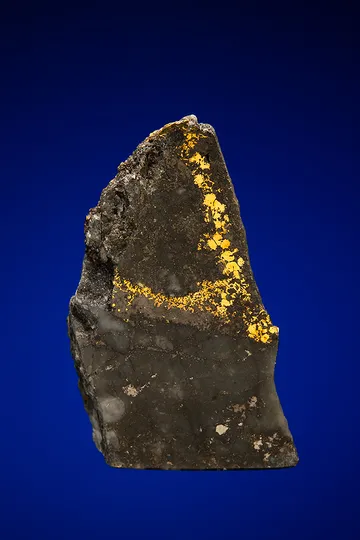
Photo: JSS / Mindat.org
The historical thread running through the county is equally strong. Copper mining at Big Indian began in the early twentieth century; uranium transformed Lisbon Valley and the wider Moab–San Juan region in the 1950s; and the 1978 recognition of attractive azurite specimen material near the Big Indian mine opened a collecting chapter that continues, in controlled form, at the private Blue Crystal Mines. Good old pieces with Blue Jay, Blue Grotto, Nevada Lode, Big Indian, La Sal, or Blue Crystal labels all belong to this same closely related Lisbon Valley specimen tradition, though precise sublocality labels matter greatly to specialists.
Search for specimens: View all specimens from San Juan County, USA
The important collector azurite and malachite are tied to the Lisbon Valley copper system of northeastern San Juan County, Utah, southeast of Moab and near La Sal. The district is controlled by a northwest-trending, doubly plunging anticline. A major normal fault on the northeast flank of the fold provided a pathway for copper-bearing fluids, and the main copper ores occupy bleached, medium- to coarse-grained Cretaceous sandstones, especially the Burro Canyon Formation, with subsidiary mineralization in the overlying Dakota Sandstone. Copper minerals occur in pore spaces in the sandstone rather than in classic open-vein cavities, which helps explain the distinctive rounded, nodule-like, and rosette habits of many specimens. The oxidized zone contains malachite, azurite, and tenorite; below it are sulfide-zone minerals including chalcocite, bornite, chalcopyrite, and cuprite.
The historic Big Indian mine area, now commonly represented in collections by Blue Crystal Mines and its sublocalities, is the classic specimen producer. Older labels may read Big Indian Copper Mine, Big Indian mine near La Sal, Blue Jay claim or pit, Blue Grotto Prospect, Nevada Lode, Nevada claim, Blue Crystal Mine, or simply La Sal, Utah. These names reflect both the mining history and later attempts to organize a cluster of workings and claims into more precise locality usage. The Blue Jay material is especially noted by collectors for lustrous azurite; the Blue Grotto material is associated with large rosettes and clayy sandstone matrix; and the Nevada Lode has produced the attractive “rose” groups and some of the finest azurite-on-malachite combinations.
Mining in the Lisbon Valley district began as an oxidized copper venture. The district was organized in the late nineteenth century under the Big Indian name, and copper mining at Big Indian began in 1903. Production was sporadic until a 300-ton-per-day acid-leach mill was completed in 1918. During World War II, the Big Indian operation changed from underground mining to open-pit work and produced about 150,000 tons of ore averaging roughly 1.5 percent copper. The Blackbird copper mine, at the southeast end of the anticline, shipped ore in the 1950s and returned to production in the 1960s with another acid-leach plant. Copper production then became intermittent and ceased in the early 1970s.
The collector chapter began in 1978, when attractive azurite mineral specimens were recognized near the Big Indian mine. Commercial collection of azurite crystal clusters continued into the late 1980s, and old specimens from that era are still among the most desirable San Juan County copper pieces. Later, the Blue Crystal Mines became a controlled fee-collecting locality and a source of newly collected azurite “blueberries,” rosettes, geodes, and malachite-associated material. The mine is private property; current collecting is by advance permission, arranged fee collecting, or guided tour, not by casual entry. The broader Lisbon Valley also includes active copper operations, and active mine areas are not collecting sites.
Modern industrial copper mining has continued in Lisbon Valley under Lisbon Valley Mining Company. The modern operation is an open-pit, heap-leach and SX-EW copper operation on a large mining area in San Juan County. Constellation Copper’s Lisbon Valley plans were permitted in 2004, construction began in 2005, and production was anticipated for 2006; later ownership and operating history passed through Lisbon Valley Mining Company. In October 2025, the Bureau of Land Management approved an expansion of Lisbon Valley Copper Mine operations, including plans connected with expanded extraction. This modern operation is important economically and geologically, but specimen collectors should treat it separately from the controlled collecting access at Blue Crystal.
The other major San Juan County mineral story lies west and southwest in the White Canyon and Red Canyon uranium districts. There, ore bodies formed in paleostream channels cut into the Moenkopi Formation and filled by the Shinarump Member of the Upper Triassic Chinle Formation. The mineralized channel sandstones contain fossil wood, organic debris, asphaltum, uranium minerals, copper sulfides, and oxidation products. Mines such as Happy Jack, Jomac, Blue Lizard, Markey, Green Lizard, and related Red Canyon workings belong to this broader Colorado Plateau uranium environment. Their showiest material is generally not cabinet-sized copper carbonate, but micromount-scale secondary uranium minerals—many water-soluble, delicate, and intensely colored under the microscope.
The Markey mine is a good example of this uranium side of the county. Claims were staked in Red Canyon in 1949 by Jim Rigg and others; the Markey group was acquired by Anaconda Copper Mining Company in 1951; the mine closed in 1955 after limited exploration and production; and it was later acquired by Calvin Black of Blanding, under whose ownership it operated from 1960 to 1982 and became an important district producer. The mineralization is hosted in Shinarump sandstone and conglomeratic sandstone, with ore replacing wood and organic matter and disseminated in the enclosing sandstone. After closure, humid underground conditions produced abundant efflorescent crusts of secondary uranyl carbonates and sulfates on mine walls.
Collecting access today is therefore sharply divided. Blue Crystal Mines may be legally visited only under the mine owner’s current rules and fee arrangements. Many uranium mines in White Canyon, Red Canyon, and nearby districts are reclaimed, gated, private, on active claims, within protected areas, or otherwise unsuitable for collecting; several also present significant abandoned-mine, radon, radioactive dust, and unstable-ground hazards. Utah collectors must determine land status before collecting: BLM land, Trust Lands, National Park Service land, private property, mining claims, and active mine permits all carry different rules. The Jomac mine, for example, lies within Glen Canyon National Recreation Area boundaries, was reclaimed in 1992, and is not a collecting locality today.
San Juan County azurite is best known from the Big Indian–Blue Crystal mine group in the Lisbon Valley Mining District, where it occurs as dark-blue rosettes, balls, nodules, geodes, sparkling crusts, and lustrous bladed crystal aggregates in oxidized copper-bearing sandstone. The classic pieces are the rounded “blueberries,” often only a few millimeters but locally forming larger spherical aggregates; more displayable specimens include centimeter-scale rosettes, 3-cm blooms, lustrous bladed aggregates, and rare rosettes preserved on friable kaolinized sandstone matrix. Nevada Lode material is especially prized for dark-blue “rose” groups, sometimes with malachite; Blue Jay pieces are sought for sharper, more lustrous crystals; and Blue Grotto specimens are valued when the azurite remains perched on natural matrix rather than as a detached floater. Fine examples show saturated blue color, bright luster, intact chisel-edged or rosette morphology, and a clean contrast with green malachite or pale sandstone; ordinary pieces are duller, abraded nodules or broken crystal clusters without strong form.
Malachite from San Juan County’s Lisbon Valley copper localities is chiefly a companion and alteration mineral to azurite, appearing as velvety botryoidal coatings, green balls and crusts, rims on azurite nodules, thin layers in sandstone seams, and pseudomorphic or replacement textures in the oxidized copper zone. At Blue Crystal and its associated workings, it is less often the dominant display mineral than azurite, which is why strong malachite-rich specimens with sharp blue azurite groups on plush green botryoidal surfaces are notably attractive. The best pieces have fresh, saturated green color, soft velvety texture, undamaged botryoidal surfaces, and distinct blue azurite rosettes or blueberries for contrast; lesser specimens are earthy, dusty, fibrous-looking, or simply green-stained sandstone without sculptural form.
Other minerals documented from San Juan County reflect both Lisbon Valley copper mineralization and the county’s uranium deposits. The Big Indian–Blue Crystal suite includes copper, cuprite, tenorite, chrysocolla, chalcocite, chalcopyrite, covellite, djurleite, diginite, enargite, tennantite, sphalerite, pyrite, quartz, calcite, kaolinite, goethite, conichalcite, clinoclase, olivenite, cornwallite, chalcophyllite, tyrolite, and wulfenite. The Red Canyon and White Canyon uranium mines add a remarkable micromineral dimension: the Blue Lizard mine alone has become a prolific type locality for rare secondary uranyl species such as bluelizardite, meisserite, redcanyonite, alwilkinsite-(Y), chinleite-(Y), uranoclite, and many others; the Markey mine is the type locality for markeyite and additional rare uranyl carbonate and sulfate species; and the Jomac mine is tied to blatonite, oswaldpeetersite, and rare occurrences of minerals such as swamboite and mbobomkulite.
The main authenticity issue for San Juan County azurite and malachite is locality precision rather than outright fakery. Older labels may say “La Sal,” “Big Indian,” “Big Indian Mine,” “Blue Crystal,” “Blue Jay,” “Blue Grotto,” “Nevada Lode,” or “San Juan Co., Utah,” and those names are not always used consistently. Serious collectors should preserve old labels but, when possible, record the most specific sublocality known. A vague “La Sal azurite” label is acceptable for a legacy piece but less desirable than a specimen tied to Blue Jay, Blue Grotto, Nevada Lode, or Blue Crystal Mines.
Condition matters greatly. The azurite rosettes and balls are commonly made of small, lustrous blades with exposed edges, so bruising, rubbed high points, broken rosette petals, and dull surface abrasion are common. The pale clayey or kaolinized sandstone matrix on some classic pieces is friable; documented specimens from the locality have been stabilized with light glue solutions, and such stabilization is not automatically a defect if disclosed, because it may be the difference between a preserved pedestal specimen and a pile of blue fragments. Undisclosed heavy glue, dyed cracks, artificial reattachment, or reconstructed rosettes should be viewed critically.
Malachite is generally more forgiving visually but can be fragile where it forms velvety botryoidal coatings or fine fibrous surfaces. Avoid aggressive washing, ultrasonic cleaning, acid cleaning, or brushing that can flatten the nap of the malachite or loosen azurite blades. If cutting or polishing low-grade azurite–malachite material, avoid inhaling dust: copper carbonates are not lapidary materials to dry-grind casually. Display specimens should be kept dry and handled by the matrix, not by the rosettes or blueberry clusters.
For uranium minerals from San Juan County, the collecting considerations are very different. Many of the Red Canyon and White Canyon secondary minerals are radioactive, fragile, water-soluble or humidity-sensitive efflorescences. Micromounts and analytical specimens should be stored in closed boxes with stable humidity, clearly labeled as radioactive when appropriate, and handled with basic contamination discipline: no grinding, no loose dust, no food at the workbench, and careful disposal of contaminated packing or debris. These are specialist specimens, not casual display minerals.
San Juan County azurite remains available because Blue Crystal Mines has continued controlled fee collecting and sells material, and because older Lisbon Valley pieces circulate through western U.S. collections and dealers. Small “blueberries,” mixed azurite–malachite fragments, and modest rosettes are not rare. Fine, lustrous, undamaged old Blue Jay or Nevada Lode pieces; large rosettes on natural matrix; and balanced azurite-on-malachite combinations are much scarcer and bring noticeably stronger prices. Type-locality uranium minerals from Blue Lizard, Markey, and Jomac are a separate micromount market: many are rare, locality-sensitive, and valued more for scientific significance than cabinet display.
The most famous San Juan County mining story begins not with azurite, but with black uranium ore in the Lisbon Valley. Charles A. Steen, a Texas-trained geologist, came to the Moab region convinced that the accepted uranium-prospecting wisdom was missing something. He did not have the standard tool of the uranium boom—a Geiger counter—and worked instead from geologic reasoning, oil-field instincts, a battered drill rig, and a belief that deep drilling on the Lisbon Valley structure could find what surface prospectors had missed.
By July 1952, Steen was nearly finished. Money was gone, equipment was failing, and the drill had reached almost 200 feet when a bit broke short of its intended target. The core included dark material, but its significance was not immediately obvious. The now-famous moment came later at Cisco, when a piece of that core was tested with a Geiger counter. The instrument’s needle reacted violently. Steen realized he had drilled into high-grade uranium ore at what became the Mi Vida mine—“My Life”—in Big Indian Wash, San Juan County.
The discovery reshaped the region. Moab, then a small agricultural town, became a uranium boomtown almost overnight. Lisbon Valley, already known for copper, became one of the great uranium districts of the Colorado Plateau, and Steen became the emblematic “Uranium King.” The story gathered all the ingredients of western mineral legend: a tarpaper shack, a secondhand rig, doubting officials, a last-chance hole, a wild Geiger-counter reading, instant wealth, and a rush of prospectors into the red-rock country. For collectors, the afterimage of that boom survives in the labels from Mi Vida, Happy Jack, Jomac, Markey, Blue Lizard, and the other uranium mines whose specimens still appear in micromount collections.
The Blue Crystal–Big Indian azurite story has a quieter but equally collectible arc. The workings began as copper mines, not specimen mines. Ore, not cabinet pieces, paid the bills. Then, in 1978, the discovery of beautiful azurite clusters near the Big Indian mine changed how collectors viewed the locality. Through the late 1980s, crystal clusters were commercially collected, and the old material from that period has become the reference standard: deep blue, lustrous, sometimes nearly matrix-free rose forms, and occasionally rosettes posed against malachite in combinations far more sculptural than ordinary oxidized copper ore.
Modern visits to Blue Crystal Mines preserve a bit of that field-collecting energy, but under a different regime. The mine is private, controlled, and fee-based. Collectors hunt tailings, washes, and selected areas for blueberries, rosettes, geodes, and malachite-bearing pieces, often finding the rounded azurite nodules that have become the locality’s signature. It is one of the unusual cases where a classic American mineral locality is still accessible to collectors, but only because access has been formalized. The old romance of “just wandering in” is gone; the reward is that fresh material can still enter collections with a legitimate modern provenance.
A different kind of story belongs to the Jomac mine. Located on Browns Rim in the White Canyon district, Jomac produced uranium ore mainly in the 1950s and held an active claim until 1985. It later became a scientifically important mineral locality, recognized as the type locality for blatonite and tied to additional rare uranium minerals. Then the portals were sealed, backfilled, and the access road blocked as part of reclamation in 1992. The irony is sharp: after the mine was physically closed to collectors, previously recovered specimens continued to yield new mineralogical information. For San Juan County’s uranium mines, the field collecting chapter may be over in many places, but the mineralogical work continues in drawers, vials, and micromount boxes.
Arnold G. Hampson, “Minerals of the Big Indian Copper Mine,” Rocks & Minerals, 68(6), 372–380, 1993 — The key collector-oriented article on the Big Indian copper mine and its azurite, malachite, and associated copper minerals.
Ken Krahulec, “Lisbon Valley Copper Project: Utah’s Newest Copper Mine,” Utah Geological Survey, Survey Notes, v. 38 no. 1, January 2006 — Concise overview of Lisbon Valley copper geology, mining history, oxide and sulfide ore mineralogy, and the modern SX-EW operation.
W. L. Chenoweth, The Geology and Production History of the Uranium Deposits in the White Canyon Mining District, San Juan County, Utah, Utah Geological Survey Miscellaneous Publication 93-3, 1993 — Essential historical and geologic account of White Canyon uranium mining, including Shinarump channel-hosted ore geology.
Albert F. Trites Jr. and Garland A. Hadd, Geology of the Jomac Mine, White Canyon Area, San Juan County, Utah, U.S. Geological Survey Bulletin 1046-H, 1958 — Classic USGS treatment of the Jomac uranium deposit and its geological setting.
Patrick E. Haynes, “Mineralogy of the Jomac Mine, San Juan County, Utah,” Rocks & Minerals, 75(4), 240–248, 2000 — Specialist mineralogical account of Jomac, including its role as a type locality and source of rare uranium minerals.
Patrick E. Haynes, “Mineralogy of the Jomac mine, San Juan County, Utah,” New Mexico Mineral Symposium abstract, 2000 — Useful short summary noting Jomac’s Browns Rim setting, 1950s production, rare minerals, and 1992 reclamation.
Anthony R. Kampf, Jakub Plášil, Jiří Čejka, Joe Marty, Radek Škoda, and Ladislav Lapčák, “Alwilkinsite-(Y), a new rare-earth uranyl sulfate mineral from the Blue Lizard mine, San Juan County, Utah, USA,” Mineralogical Magazine, 81(4), 895–907, 2017 — One of the important Blue Lizard new-mineral descriptions, documenting the mine’s unusual rare-earth uranyl sulfate chemistry.
Anthony R. Kampf, Jakub Plášil, Travis A. Olds, Barbara P. Nash, and Joe Marty, “Uranoclite, a new uranyl chloride mineral from the Blue Lizard mine, San Juan County, Utah, USA,” Mineralogical Magazine, 85, 438–443, 2021 — Description of uranoclite and discussion of the Blue Lizard mine as a prolific source of new uranyl minerals.
Jakub Plášil, Anthony R. Kampf, Anatoly V. Kasatkin, and Joe Marty, “Bluelizardite, Na7(UO2)(SO4)4Cl(H2O)2, a new uranyl sulfate mineral from the Blue Lizard mine, San Juan County, Utah, USA,” Journal of Geosciences, 59, 145–158, 2014 — Type-mineral paper for the namesake Blue Lizard species.
Anthony R. Kampf, Jakub Plášil, Anatoly V. Kasatkin, Joe Marty, and Jiří Čejka, “Markeyite, a new calcium uranyl carbonate mineral from the Markey mine, San Juan County, Utah, USA,” Mineralogical Magazine, 82(5), 1089–1100, 2018 — Type description for markeyite, with valuable Markey mine history, geology, and secondary-mineral assemblage information.
Utah Geological Survey, “New Utah Minerals: Utahite, Juabite, and Blatonite,” Survey Notes, January 2000 — Short Utah Geological Survey note identifying blatonite from the Jomac mine in San Juan County.
Utah Geological Survey, “New Utah Minerals: Orthominasragrite & Oswaldpeetersite,” Survey Notes — Includes oswaldpeetersite, a basic uranyl carbonate described from the Jomac uranium mine.
Mindat — San Juan County, Utah, USA — Broad county-level mineral list and locality index for San Juan County, Utah.
Mindat — Lisbon Valley Mining District, San Juan County, Utah — District-level page useful for Big Indian, Blue Crystal, and related Lisbon Valley copper localities.
Mindat — Blue Crystal Mine, Lisbon Valley Mining District — Principal collector locality page for the classic Blue Crystal–Big Indian azurite and malachite suite.
Mindat — Azurite from Blue Grotto Prospect, Blue Crystal Mine — Occurrence page documenting azurite from the Blue Grotto sublocality and its association with malachite.
Mindat — Azurite from Nevada Lode, Blue Crystal Mine — Occurrence page for the Nevada Lode azurite, one of the important sublocalities for rosette specimens.
Utah Geological Survey — Lisbon Valley Copper Project — Best concise public summary of Lisbon Valley copper geology, mining history, and ore mineralogy.
Blue Crystal Mines — Mineral Collecting — Current access, fee-collecting, appointment, and private-property information from the mine.
Deep Desert Expeditions — Azurite Mine Tours — Guided-tour information for collectors visiting Blue Crystal Mines from Moab.
Utah Geological Survey — Rock, Mineral, and Fossil Collecting Rules — Essential statewide collecting rules for BLM land, Trust Lands, private land, and protected areas.
Bureau of Land Management — Lisbon Valley Copper Mine expansion approval — Current regulatory context for the modern Lisbon Valley copper operation.
EPA — Final approval for Lisbon Valley copper mining project — Federal approval information for the expanded Lisbon Valley copper project and aquifer exemption.
Utah Geological Survey — Geologic Resources of San Juan County, Utah — County-level geologic and mineral-resource overview, including copper, uranium, and Lisbon Valley history.
Utah Geological Survey — White Canyon uranium district production history — Detailed White Canyon mining history and Shinarump-hosted uranium geology.
USGS — Geology of the Happy Jack Mine, White Canyon Area — USGS bulletin record for one of the county’s important uranium mines.
USGS — Geology of the Jomac Mine, White Canyon Area — Full USGS report on the Jomac mine geology.
New Mexico Mineral Symposium — Mineralogy of the Jomac mine — Compact summary of Jomac’s rare minerals, production period, and reclamation status.
Science History Institute — “Uranium Mania” — Readable historical account of Charlie Steen, the Mi Vida discovery, and the uranium boom.
Utah Historical Society — Charles Augustus Steen Papers, 1952–1966 — Archival finding aid for Steen’s papers, useful for historical research on the Mi Vida mine and Moab uranium boom.