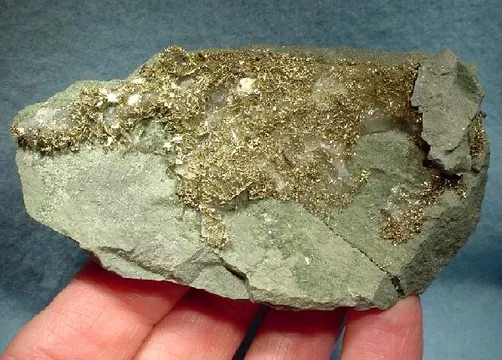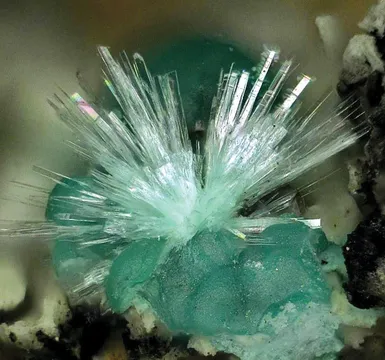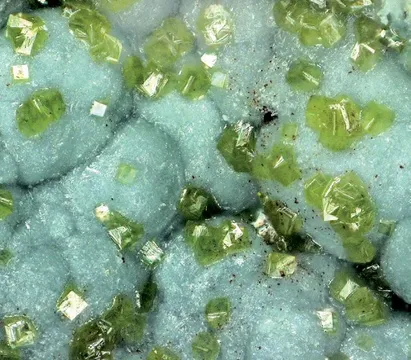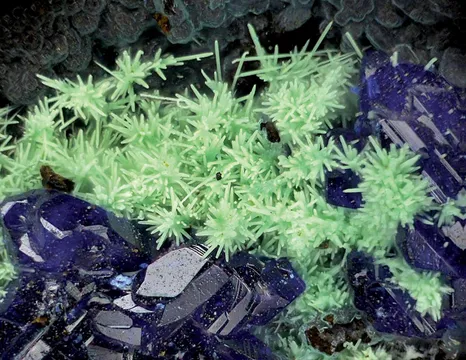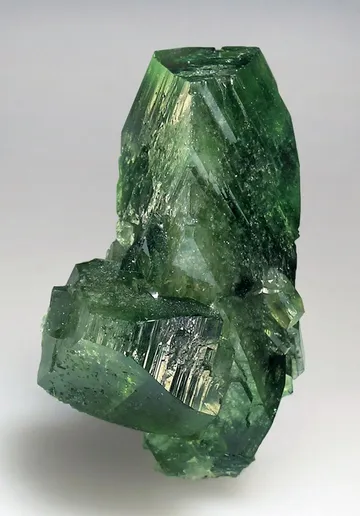
Sacramento mine, USA - Bisbee copper-carbonate locale: azurite blades with malachite on goethite matrix; open-pit and shaft workings prized by collectors.
Key facts
Sacramento mine, as used by collectors today, points to the Sacramento Pit and associated Sacramento Hill workings at Bisbee in Cochise County, Arizona: one of the classic copper-carbonate names in the American collecting canon. It sits in the Warren mining district of the Mule Mountains, where Jurassic intrusive rocks of the Sacramento Stock complex cut a thick Paleozoic carbonate pile and helped drive the replacement, breccia, and porphyry-style copper mineralization that made Bisbee famous. For specimen people, the name matters because it belongs to the old Bisbee blue-and-green suite: lustrous azurite, vivid malachite, malachite pseudomorphs after azurite, goethite-rich gossan matrix, and a small but important supporting cast of copper oxides, sulfides, aluminum copper sulfates, chrysocolla, descloizite, and turquoise.
The historical Sacramento story has two overlapping but not identical parts. The Sacramento Shaft was an important underground hoisting and development shaft of the Copper Queen/Phelps Dodge system in the early twentieth century. The Sacramento Pit, developed on Sacramento Hill beginning in 1917, was the district’s pioneering large open-pit operation and one of the early examples of open-pit copper mining in Arizona. Old labels and dealer descriptions often use “Sacramento Mine,” “Sacramento Pit,” “Sacramento Hill,” or simply “Sacramento” in ways that blur the distinction, but the best labels try to preserve whether a specimen came from the underground shaft workings or the pit.
Regional View
Country View
The best Sacramento pieces have the unmistakable Bisbee look: midnight to royal-blue azurite blades or flattened crystals, commonly with partial velvety green malachite alteration, set on dark brown to black goethitic matrix. Fine malachite may occur as acicular sprays, silky bundles, botryoidal coatings, or complete green pseudomorphs after bladed azurite. These are not simply “Arizona copper minerals”; they are products of one of the most intensely collected oxidation zones in North America, where supergene chemistry transformed copper sulfide ore into saturated, sculptural, highly recognizable cabinet specimens.

Photo: Library of Congress
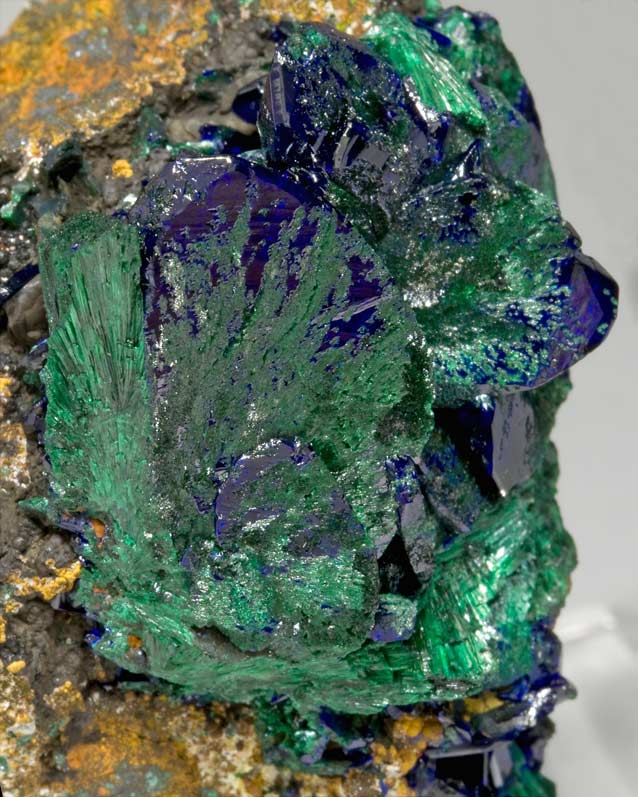
Photo: Fabre Minerals
Search for specimens: View all specimens from Sacramento mine, USA
Sacramento mine is in the Bisbee area of the Warren mining district, Cochise County, Arizona, approximately half a mile northwest of Lowell. The locality generally corresponds to the Sacramento Pit on Sacramento Hill, with the historical name Sacramento Mine also applied in mineral databases and on old specimen labels. The recorded position for the pit is about 31° 26′ 7″ N, 109° 54′ 27″ W. The ground is private, and the old Sacramento Pit area was later swallowed and largely obliterated by the expansion of the Lavender Pit; modern collecting access should be regarded as closed unless one has explicit permission from the landowner or responsible operator.
Geologically, Sacramento is part of the broader Bisbee copper system centered on the Sacramento Stock complex. The mineralization is tied to altered and brecciated granite porphyry, intrusive breccia, porphyry dikes and sills, and carbonate wall rocks, especially Mississippian Escabrosa Limestone, with nearby Devonian Martin Limestone playing a major role elsewhere in the district. The Warren district orebodies are best understood as a hybrid of porphyry-related and limestone-replacement mineralization: pyrite-rich intrusive and sediment-hosted bodies, copper replacement masses, breccia ores, supergene enrichment, and later oxidation. Around Sacramento Hill, copper sulfides, enriched chalcocite, oxides, and carbonates occurred in irregular masses controlled by dikes, sills, faulting, brecciation, and the contact environment of the Sacramento Stock.
The ore was not a single neat vein. It was a set of replacement and breccia-related bodies, many of them in direct relation to the Sacramento Dike or stock margin. Mindat’s locality record emphasizes irregular masses in brecciated and altered granite porphyry, contact breccia, and relatively unaltered Escabrosa Limestone cut by porphyry. Ore control included faulting, pre-mineral structures, dikes, sills, and brecciation. In mining terms, this mattered because the Sacramento ores could be worked at scale: lower-grade material that would not have suited earlier hand-sorted underground mining became viable once steam shovels, rail haulage, and open-pit methods were applied.
The Sacramento Shaft was planned in the first years of the twentieth century by the Copper Queen Consolidated Mining Company and became a crucial hoisting shaft. Reports in 1903 and 1904 describe plans for a new shaft on the Stars and Stripes claim, originally with three compartments and ultimately developed into a large multi-compartment installation. Drifts from the Lowell and Gardner mines were driven toward it, and a crosscut under Sacramento Hill was planned to reach ores discovered by the Holbrook Mine. After the Holbrook No. 1 shaft collapsed in July 1906, Sacramento’s importance increased, and by 1910 all ore formerly hoisted through Lowell was being hoisted through Sacramento.
The open-pit phase began in 1917, when Phelps Dodge brought large-scale surface methods to Sacramento Hill. Rail-mounted Bucyrus steam shovels and 20- to 25-ton rail cars worked the benches. The top of Sacramento Hill was blasted away on June 6, 1918. The pit eventually cut down from the 5,665-foot elevation to about 4,925 feet, with spiral rail grades descending into the excavation. When the lower pit became too narrow for shovel work, ore was recovered by glory-hole methods: raises driven up from underground levels into the pit bottom allowed blasted ore to fall to grizzlies and storage chutes, then to haulage on lower levels. This final phase continued until 1931, when the West Orebody was exhausted.
Published figures differ depending on whether they describe pit ore alone, waste and leach material, or the entire 1917–1931 operation. The Library of Congress caption and period postcard accounts give the classic figure of just over 20.8 million tons of ore removed between 1917 and 1931 over an area of roughly 35 acres. Doug Graeme’s Sacramento Pit history gives a more detailed operating breakdown: about 11.2 million tons of waste rock, 12.6 million tons of low-grade leach material, 7,957,370 tons of ore, 358,144,662 pounds of copper, 1,365,191 ounces of silver, and 54,234 ounces of gold directly produced, with later leaching adding more copper. For collectors, the key point is that Sacramento was not a little prospect; it was a major engineered copper operation that intersected extensive oxidized and supergene material.
Specimens attributed to Sacramento are mainly from old mining-era recoveries, old Bisbee collections, and dealer circulation. The best mineral finds were not a continuous modern supply but pockets, ore zones, and gossanous cavities encountered during underground development, open-pit stripping, and pit-to-underground transitions. In the marketplace, the strongest labels are those with old collection history, specific wording such as Sacramento Pit or Sacramento Shaft, and associations consistent with Bisbee oxidation-zone material: azurite and malachite on goethite or limonite, chrysocolla, cuprite, chalcoalumite, or less commonly turquoise and vanadate species.
Sacramento azurite is valued for the classic Bisbee combination of dark saturated blue color, sharp to flattened crystals, and intimate association with malachite on oxidized iron-rich matrix. Documented specimens from the Sacramento Pit include lustrous, very flat azurite crystals with individual crystals reaching about 2.2 × 1.5 cm on a 5 × 3.7 × 3.7 cm miniature, and another small-cabinet specimen showing midnight-blue azurite partly altering to velvety forest-green malachite with white cerussite. Dealer and collection records also describe fist-sized old pieces, bladed groups, and azurite with acicular malachite sprays. The best Sacramento azurites are those with glassy faces, deep but not blackened color, visible crystal form, and undamaged edges; ordinary pieces tend to be massive, bruised, heavily limonitic, or so altered to malachite that the original azurite habit is only partly readable.
Sacramento malachite is most distinctive when it records the replacement of earlier azurite: thin green blades, sprays, and pseudomorphs preserving the azurite form, commonly on brown goethite or limonitic matrix. The Bisbee Mining & Minerals gallery documents a 9 cm Sacramento Mine specimen of malachite pseudomorphs after azurite on goethite, and market examples from the Sacramento Pit show green replacement of bladed azurite clusters, acicular malachite bundles beside azurite, and velvety coatings creeping over blue crystals. Good Sacramento malachite is judged less by size alone than by texture and story: sharp pseudomorphic blades, silky acicular luster, pleasing contrast with remnant azurite, and an undisturbed gossan matrix are far more desirable than massive green carbonate with no crystal habit.
Other minerals documented from Sacramento include native copper, chalcocite, bornite, chalcopyrite, pyrrhotite, cuprite, quartz, goethite, gibbsite, chalcoalumite, probable carbonatecyanotrichite, descloizite including copper-bearing descloizite, turquoise, tremolite, chrysocolla, biotite-group material, and limonite. Chalcoalumite is especially worth noting because Bisbee is the type region for the species and Sacramento Pit material was significant in later crystallographic work by S. A. Williams and BaSaw Khin; a blue crystalline mineral brought in by local collector Terry D. Mayberry in February 1971 was identified as chalcoalumite from the Sacramento Pit, and additional material was later found in company storage bins. Sacramento is not the type locality for Bisbee’s other celebrated type minerals, but it belongs to the same district-scale mineralogical environment that produced spangolite, paramelaconite, shattuckite, bisbeeite, chalcoalumite, graemite, and henryite.
The chief authenticity issue for Sacramento specimens is not elaborate fakery but locality precision. “Sacramento Mine” may refer loosely to the Sacramento Pit, Sacramento Hill, the underground Sacramento Shaft, or old material from nearby Bisbee workings that passed through collections with shortened labels. The distinction matters: the underground Sacramento Shaft and the open Sacramento Pit had different histories, and some collector literature treats the shaft as a separate source from the pit. A specimen labeled simply “Bisbee” cannot be safely upgraded to Sacramento without old documentation, and a specimen labeled “Sacramento” should not automatically be assumed to be from the pit unless the label or provenance says so.
Condition is a major value separator. Azurite has perfect cleavage and can show edge bruising, dull broken terminations, and rubbed high points, especially on older pieces that spent decades in drawers. Malachite sprays and pseudomorphs can be fragile; acicular bundles may lose fibers, while velvety coatings can look scuffed if handled. Goethitic matrix may be friable, and old limonitic material can shed powder. Avoid washing delicate specimens aggressively; a dry air bulb and soft brush are safer than water, especially where fine malachite needles, friable gossan, or clay are present.
Be alert for confusing Bisbee-wide attributions. Czar, Holbrook, Copper Queen, Southwest, Shattuck, Lavender Pit, Cole, and Sacramento material may all share blue azurite, green malachite, and brown iron-oxide matrix. Sacramento pieces tend to be sold as old Bisbee classics rather than as abundant modern material, and strong examples are scarcer than generic Bisbee azurite-malachite. EarthWonders currently has enough Sacramento-labeled azurite and malachite to show that the locality is obtainable, but fine miniature and cabinet pieces with sharp blue crystals, pseudomorphic malachite, and old collection history remain competitive.
Turquoise needs special caution. Bisbee turquoise is famous, but much of the best-known gem material came from the Lavender Pit, and older Sacramento Pit or underground attributions can be difficult to prove. In lapidary material, stabilization, polishing, and recutting are part of the normal market; for mineral specimens, matrix, old labels, and collection history are critical. A turquoise cabochon or polished “Bisbee Blue” stone should not be marketed as Sacramento without unusually strong provenance.
In 1917, Sacramento Hill became a public spectacle and a public hazard. The new pit was exciting enough that townspeople wanted to watch the steam shovels work, but the blasting quickly made sightseeing dangerous. Phelps Dodge warned residents to stay off roads and trails from the west end of Sacramento Hill to the Gardner Shaft, and to keep clear of the area between the Copper Queen machine shop and the Sacramento Shaft unless they were employees or had urgent business. Shovel whistles, locomotive whistles, and blasting signals were part of the new soundscape. On May 31, 1917, residents along the Naco road were asked to evacuate temporarily before a 6,000- to 7,000-pound explosive charge was fired. The next year, the Copper Queen Safety Building itself had to be abandoned because it stood too close to the pit.
The great visual moment came on June 6, 1918, when the peak of Sacramento Hill was dynamited off. This was not a symbolic scrape at the skyline but the beginning of a wholesale re-engineering of the mountain. Rails descended into the pit on a gentle 2½ percent grade. Steam shovels loaded rail cars. Waste, leach material, and ore moved by the millions of tons. When the bottom became too cramped for the big machines, the operation turned downward into the old underground logic of Bisbee: eleven 10-by-10-foot raises were driven up from the 400 level into the pit bottom, and miners drilled 60-foot holes around the glory holes, firing 400- to 500-pound charges so that broken ore would fall through grizzlies to haulage below. The last Sacramento ore was not so much dug out of a pit as dropped through the bottom of it.
The Sacramento Shaft has its own underground legend, and it belongs not to azurite or copper but to a black cat named Felix. Around 1912, Felix took up residence on the 1500 level near one of the winzes, more than a quarter mile below the surface and far along dark, twisting workings. He lived among electric bulbs, side crosscuts, mine rats, men, timber, moving cages, and open holes. When curious miners approached, he would leap from wall plates and guides around the winze—dangerous timberwork beside drops that could exceed 100 feet and, in the major winze from the 1500 to the 1800 level, about 300 feet. At first he survived largely on rats; later the miners left him milk and snacks.
Felix’s underground life lasted fifteen years. At one point a locomotive crushed part of his tail, and a powderman amputated the injured portion with an axe. In June 1927, Felix died near a mule barn on the 1400 level. The miners brought him to the surface and buried him near the Sacramento Shaft in a wooden dynamite box. For collectors, the story is a reminder that “Sacramento” is not only a locality name on blue-and-green labels; it was a lived industrial maze with hoists, winzes, trolley cars, mules, shovels, powdermen, and odd survivals in the dark.
There is also a quieter, very Bisbee kind of glamour in the Sacramento Shaft story. On January 7, 1915, after a dinner party, Mrs. Gerald Sherman, wife of the mine superintendent, took a party of sixteen men and women on a tour of the Sacramento Mine. That same year, experiments on the 300 level tested whether a shaft could be concreted while still operating. The method worked. Sand and gravel storage bins were erected near the Sacramento Adit, concrete was mixed at the “Subway” station, and the mix was dropped through a 4-inch pipe and blown into forms with compressed air. The shaft was concreted in sections while operations continued around the work. By August 1916 the job was finished—an engineering achievement as much a part of Sacramento’s identity as the copper carbonates that later collectors prize.