Roughton Gill, UK - Caldbeck Fells locality famed for a rich supergene system producing pyromorphite, plumbogummite and blue hemimorphite, highly prized by col…
Key facts
Roughton Gill is one of the classic names in British mineral collecting: a high, austere Caldbeck Fells locality where old lead-copper-zinc veins cut Ordovician volcanic and intrusive rocks at the head of the Dale Beck valley. The collecting importance of the place rests not on one attractive species but on an unusually deep and rich supergene system. Primary galena, chalcopyrite and sphalerite in a quartz-carbonate gangue were oxidised on a scale exceptional for northern England, producing great quantities of pyromorphite, cerussite and malachite, together with the specimens for which Roughton Gill is internationally known: pyromorphite, blue plumbogummite and sky-blue botryoidal hemimorphite.
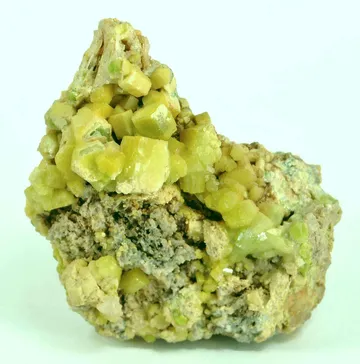
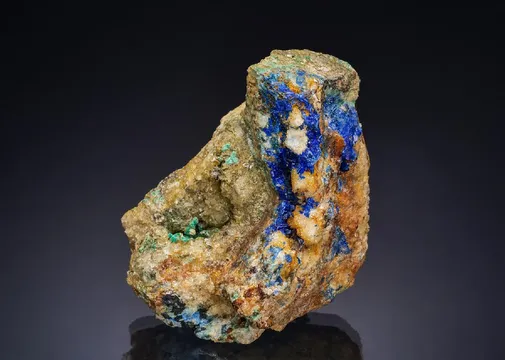
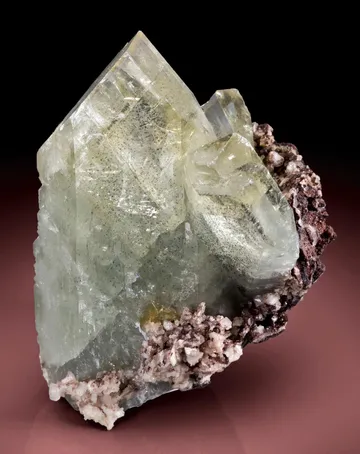
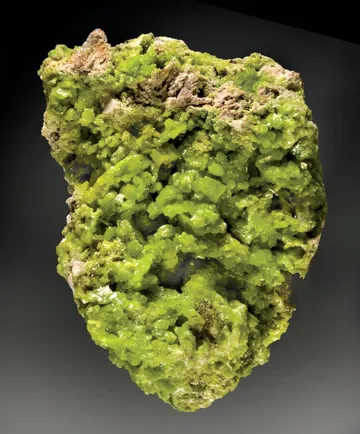
The best Roughton Gill specimens have a look all their own. Old pyromorphites range from yellow-green and oil-green to bright emerald, orange-yellow and bicoloured habits, often as lustrous prismatic sprays, botryoidal crusts, stalactitic aggregates or compact heavy masses on iron-stained quartz. The plumbogummites are the locality’s most aristocratic pieces: smooth to drusy cobalt-blue crusts on quartz, commonly overgrowing or replacing pyromorphite, then dusted or studded again by fresh pyromorphite crystals. The hemimorphites, when fine, are rounded masses of blue glassy “grapes,” sometimes several centimetres thick, that can be mistaken at a glance for the best blue smithsonite from other districts but are unmistakably Caldbeck in association and texture.
Regional View
Country View
Historically, “Roughton Gill” is also a locality-label problem. In older collections the name may cover the principal Roughton Gill Mine under Iron Crag, Higher Roughton Gill or Balliway Rigg, Mexico Mine, Barstow’s Trench, Silver Gill, Red Gill and other workings around the head of the valley. That imprecision matters: the valley contains several closely related but mineralogically distinct workings, and some of the most desirable old labels pre-date modern locality discipline. A serious collector should therefore read a Roughton Gill label as an invitation to examine the specimen’s habit, matrix, associations and provenance history, not as a final word.

Photo: Wikimedia Commons

Photo: Wikimedia Commons
Search for specimens: View all specimens from Roughton Gill, UK
Roughton Gill lies south of Caldbeck, in the northern Lake District, at the head of the Dale Beck valley. The principal mine workings sit below Iron Crag, with associated workings extending into Silver Gill, Higher Roughton Gill on Balliway Rigg, Mexico Mine and smaller trials. The grid reference commonly given for the Roughtongill Mine GCR site is NY 304 344, and field guides approach the area from Fellside by the old mine road into the valley.
Geologically, the mines worked mineralised faults and veins near the junction of the Ordovician Eycott Volcanic Group and the Carrock Fell Intrusive Complex, with Skiddaw Group rocks involved toward the western side of the system. The Eycott rocks in this district are mainly mafic to intermediate lavas with volcaniclastics and pyroclastics; the Carrock Fell Complex includes gabbroic and microgranitic intrusions, including the Iron Crag Microgranite and apatite-rich ferrodioritic rocks that are important when considering the phosphate-rich supergene suite. The main veins are commonly described as NE-SW or roughly east-west to northeast-trending structures, with the Roughton Gill South Vein the most productive and mineralogically consequential.
The deposit is a hydrothermal lead-copper-zinc vein system with an exceptionally developed oxidation zone. Primary ore consisted chiefly of galena, chalcopyrite and sphalerite in quartz, chalcedony, calcite, dolomite and locally baryte. Later alteration produced the great supergene assemblage: lead phosphates and arsenates, copper carbonates and sulphates, zinc silicates and carbonates, manganese oxides and a long tail of rarities. The great abundance of carbonate gangue moderated the chemistry of the oxidising zone; as a result, cerussite and malachite are especially important, while low-pH lead sulphates and sulphato-carbonates such as anglesite, leadhillite and caledonite are much less typical of true Roughton Gill Mine material than they are of nearby Red Gill and Higher Roughton Gill.
The major orebody in the mine was the celebrated “Great Bunch,” developed between the 60 and 90 fathom levels. Historical accounts describe a vein width reaching about 9 metres and a length of about 70 fathoms, extending downward from the 60 fathom to the 90 fathom level. It was a gossanous, friable quartz-calcite mass, with pyromorphite and cerussite along the fringes and silver-bearing galena deeper in the orebody. The scale of oxidation is one reason Roughton Gill is so important: pyromorphite occurred not merely as a cabinet curiosity but in ore quantities, while the specimen pockets yielded museum-grade material.
Mining history here is long and layered. Silver Gill has documentary evidence of working by the early fourteenth century, and the Roughton Gill-Silver Gill area may include some of the earliest mining ground in the Caldbeck Fells. The district was worked by Elizabethan miners connected with the Company of Mines Royal in the sixteenth century, and Roughtongill has often been discussed as a candidate for one of the principal German-worked Caldbeck mines. There were intermittent eighteenth-century workings, followed by major nineteenth-century production. The 30 fathom crosscut onto the South Vein is generally regarded as an eighteenth-century working; by 1832 it was nearly exhausted and the 60 fathom level became important. From 1832 to 1845 recorded production from Roughton Gill Mine amounted to 3,229 tons of lead ore and 150 tons of copper ore.
After a brief abandonment in 1845 when leases expired, the Roughtongill Silver Lead and Copper Mining Company took up the lease in 1849. The 90 fathom level, begun in 1849, became the principal ore source by 1852. Later operators included the Caldbeck Fells Mining Company in the 1860s, and Lainton’s Shaft was sunk in 1866 in an attempt to reach ore below the 90 fathom level. Water ingress, financial difficulty and poor management dogged the final years. The mine went bankrupt in 1878 and did not resume as a producing mine. In 1913 Carlisle Urban District Council bought the mine to pump water from the 90 fathom level for public supply.
Specimen production is bound to the old levels and dumps. The 60 fathom level was especially prolific for nineteenth-century pyromorphite, while the 90 fathom dumps have remained the most important surface source for later study specimens of many supergene species. Classic plumbogummite and hemimorphite largely belong to the old mining period; later dump finds exist, but they rarely match the size, colour or aesthetic completeness of the best nineteenth-century pieces. In the 1990s Barstow’s Trench, an excavation on the Roughton Gill South Vein above Mexico Mine, exposed a rich pocket of well-crystallised pyromorphite; that occurrence helped refresh the market with late twentieth-century material but did not replace the status of the old-time classics.
Collecting access today is controlled. The Roughton Gill-Silver Gill area is within the protected Caldbeck Fells/Skiddaw Group SSSI framework and the Lake District National Park Authority’s Caldbeck and Uldale Commons mineral-collecting policy. The area is zoned for management, and collecting requires permission or licence under the relevant current scheme. Unauthorised digging, removing specimens, forcing levels, trenching dumps or disturbing archaeological remains is not acceptable and may be illegal. For collectors, that means modern Roughton Gill specimens should come with a clear collecting history: old collection labels, documented pre-policy material, licensed collecting, or legitimate dispersal from institutional or private collections.
Pyromorphite is the defining Roughton Gill species: Pb5(PO4)3Cl formed here in ore-scale quantities from oxidising galena in phosphate-bearing groundwater, and the nineteenth-century mine produced world-class specimens, especially from the 60 fathom level and from the oxidised fringes of the Great Bunch. The best pieces show lustrous prismatic crystals, sprays, tabular crystals, botryoidal crusts, acicular aggregates, stalactitic forms and occasional epimorphs or pseudomorphs after cerussite, with colours ranging through yellow, oil-green, emerald-green, grey-white, brown, orange and green-yellow bicolour combinations. Fine Roughton Gill pyromorphite is judged by lustre, crystal definition, richness of coverage, colour contrast against iron-stained quartz or baryte, and association with blue plumbogummite; ordinary pieces are usually thin crusts or dull microcrystalline coatings, while the strongest specimens have heavy, wet-looking crystal coverage and an unmistakable old Caldbeck character.
Roughton Gill plumbogummite is one of the great British supergene collector minerals and for generations set the standard by which the species was judged: smooth to drusy blue, grey-blue or cobalt-blue crusts on quartz, commonly overcoating or pseudomorphing pyromorphite and then, in the most coveted pieces, carrying scattered later pyromorphite crystals across the blue surface. The best examples are old-time specimens, including substantial museum pieces, and the combination of saturated blue plumbogummite with yellow-green pyromorphite is the locality’s signature association. Later finds from the 90 fathom dumps are documented but rare and generally smaller or less visually commanding; top pieces separate themselves by continuous colour, intact botryoidal or drusy surface, visible pyromorphite relationship and old provenance.
Hemimorphite from Roughton Gill is prized chiefly as lustrous sky-blue botryoidal crusts, historically found in the nineteenth century and sometimes reaching several centimetres in thickness; classic specimens have smooth rounded surfaces, a soft porcelain-to-glassy glow and enough three-dimensional relief to stand as sculptural miniatures rather than simple coatings. White and colourless hemimorphite is also common in later material, especially as drusy crusts, open cellular masses and radiating bladed crystals, with individual blades to about 5 mm but usually smaller. Rosasite is a common associate on the more open, bladed hemimorphite, while the finest blue botryoidal pieces are typically clean, bold and only lightly associated with other minerals, aside from occasional pyromorphite.
Quartz is the principal surviving gangue on the Roughton Gill dumps and the matrix that carries many of the collectible supergene species. It occurs as large blocks, brecciated masses cemented by later silica and ore minerals, hackly-looking veinstone, common small pyramidal crystals and white chalcedony bands grading into crystalline quartz; individual quartz crystals are common but rarely exceed about 10 mm across. As a collector species in its own right, Roughton Gill quartz is secondary to the minerals it hosts, but good pieces matter because clean cavities, white chalcedonic bands, iron-stained contrast and open breccia textures make pyromorphite, malachite, goethite, hemimorphite, brochantite and other supergene species far more legible and aesthetic.
Beyond the four headline species, Roughton Gill has yielded a large and carefully studied supergene assemblage. Cerussite was abundant enough to be considered an ore and occurs as jackstraw and bladed crystals, commonly with malachite and pyromorphite. Malachite is common and historically important, occurring as coatings, breccia cement and radiating needles. Brochantite forms emerald-green crystals on quartz and is a notable Caldbeck species here. Rosasite is common on hemimorphite and was important in the first British reporting of the mineral. Rarities include tsumebite, arsentsumebite, schulenbergite, ramsbeckite, cinnabar, covellite, cuprite, baryte of both primary and supergene aspect, smithsonite, native silver, wulfenite and wooldridgeite. Wooldridgeite is the standout rarity for the mine itself, occurring as pale ice-blue tapering crystals, exceptionally to about 1.8 mm, on porous quartz with “chrysocolla”-like copper-rich silica; Roughton Gill is one of the key British localities for the species. Some older or nearby records require caution: excellent linarite, leadhillite and caledonite historically labelled Roughton Gill are now often considered more likely from Red Gill or Higher Roughton Gill, and visually pyromorphite, arsenate-rich pyromorphite and mimetite may require analysis to separate with confidence.
Roughton Gill material deserves close provenance scrutiny. The name was used broadly in the nineteenth and early twentieth centuries, and specimens from Mexico Mine, Barstow’s Trench, Iron Crag slopes, Higher Roughton Gill, Silver Gill and even Red Gill may appear under a simple “Roughton Gill” label. That does not automatically make them undesirable; it means the label should be interpreted with the specimen. Pyromorphite with the right Caldbeck colour and matrix may be perfectly collectible under the broader Roughton Gill umbrella, but a serious catalogue should record the most precise source that can be defended.
The most important documented authenticity issue concerns A.W.G. Kingsbury, whose locality falsifications affected many British mineral records. For Roughton Gill Mine, modern review considers gold and parahopeite claims fraudulent, and azurite highly doubtful. The broader lesson is to distrust unsupported rare-species claims, especially if the specimen cannot be reconciled with Roughton Gill matrix, associations or later collecting. Conversely, common and well-repeated Roughton Gill species such as pyromorphite, plumbogummite, hemimorphite, cerussite, malachite, brochantite and rosasite are much more secure when they match known habits and provenance.
Misidentification is a practical concern. Some globular or unusual “pyromorphite” from the upper gill area has proved to be mimetite or arsenate-rich pyromorphite, and visual distinction can be impossible without modern analytical work. Blue-green “chrysocolla” from the mine has also been treated cautiously in recent studies because much material is better understood as copper-rich hydrous silica gel rather than well-crystallised chrysocolla sensu stricto. Plumbogummite from Dry Gill can be mislabelled as Roughton Gill, but the best Roughton material is typically distinguished by its deep blue crusts and characteristic pyromorphite-over-plumbogummite association.
Condition is central to value. Pyromorphite crystals may be bruised, edge-chipped or dulled by historic cleaning; iron-stained quartz matrix can hide small broken areas. Plumbogummite crusts can be abraded on high spots, and once the blue surface is rubbed, the specimen loses much of its visual power. Hemimorphite botryoids show fractures, bruising and surface dulling readily; strong blue colour, uninterrupted botryoidal skin and three-dimensional form command a premium. Many Roughton Gill specimens are old and may carry glued repairs, trimmed matrix or old museum/dealer mounting residues; these are not necessarily fatal, but they should be disclosed.
Market availability is uneven. Modest Roughton Gill pyromorphite still appears, including small old pieces, ex-collection material and occasional specimens attributed to the wider Roughton Gill-Mexico-Barstow’s Trench area. Fine nineteenth-century pyromorphite, top blue plumbogummite and saturated blue hemimorphite are much scarcer and often remain in long-held British collections or museums. For high-end pieces, provenance can be nearly as important as aesthetics: old labels from respected collections, Natural History Museum comparisons, Lindsay Greenbank-associated material, or early dealer histories can sharply strengthen desirability.
The valley is quiet now, but the ground reads like a palimpsest of seven centuries of mineral hunger. Silver Gill, the older ravine, was already being worked by the early fourteenth century; by Elizabethan times the Caldbeck Fells were busy enough with German miners and Company of Mines Royal enterprise that later writers could still argue over which gill held the main early working. Roughton Gill, Silver Gill and Red Gill sit close together, and that closeness has always blurred the human story as much as the mineral labels. Old hand-cut coffin levels, smelting hearth traces, mine roads, spoil heaps and collapsed dressing floors are the visible remains of a valley that once justified the famous Caldbeck boast that the fells were “worth all England else.”
The nineteenth-century mine was a hard industrial place, but one episode dominates the mineralogical imagination: the Great Bunch between the 60 and 90 fathom levels. Imagine a vein body widening to about 9 metres, running for roughly 70 fathoms, filled with gossan, friable quartz and calcite, its outer parts alive with cerussite and pyromorphite and its deeper core carrying silver-bearing galena. This was not a collector’s pocket in the modern sense; it was an orebody. Yet from such ore came the specimens that still sit in major museums: pyromorphite rich enough to mine, but crystallised well enough to become one of the classic aesthetic minerals of Britain.
The end came not in a single dramatic collapse but through the familiar mining enemies: water, expense and bad management. The 90 fathom level had become the mine’s central artery by the early 1850s, and in 1866 Lainton’s Shaft was sunk to chase ore still deeper. It was an ambitious move, but the mine could not overcome the water and financial strain. Bankruptcy followed in 1878. Decades later, the old workings found an unexpected second life when Carlisle Urban District Council bought the mine in 1913 to pump water from the 90 fathom level into the public supply. A mine once worked for lead, copper and specimens became part of a civic water system.
Modern field accounts have a different mood: no clatter of dressing floors, just the long walk from Fellside and the sense of entering a famous locality that is no longer free to exploit. In August 2010 Jolyon Ralph visited with Tom and Asia from Spirifer Minerals. They reached the old workings as the cloud cleared, looked over the extensive mine tips, saw copper secondaries in the waste and resisted the temptation to collect. Ralph’s account captures the contemporary collector’s paradox perfectly: plenty of mineral signs underfoot, but a protected site where even micromount material was not worth risking a fine. Later, from the Mexico Mine dump, the party looked back and saw people collecting on the Roughton Gill dumps—an awkward little scene that says much about why the Caldbeck Fells now require firm management.