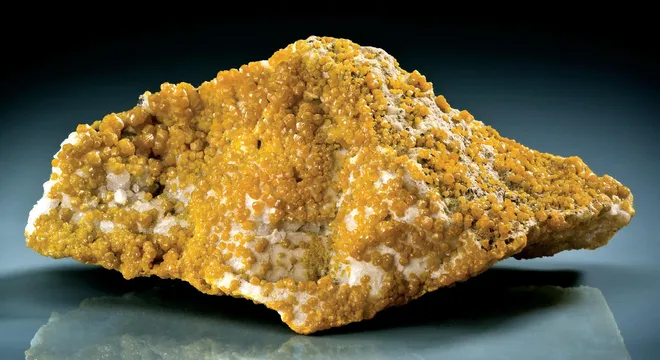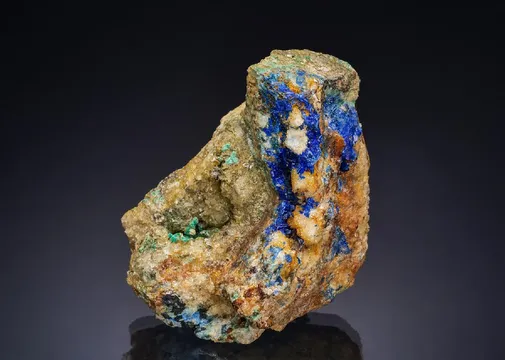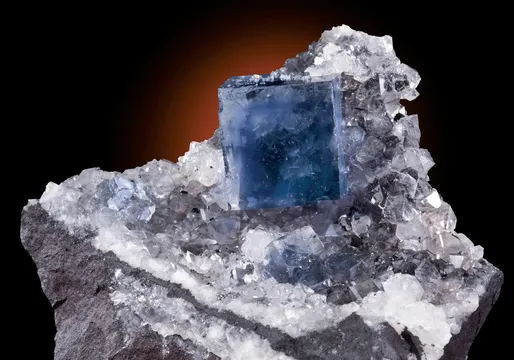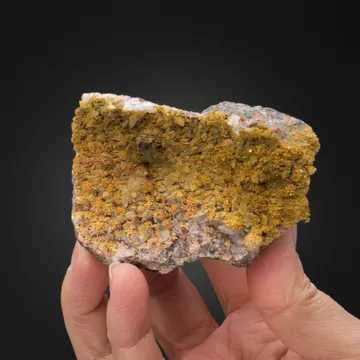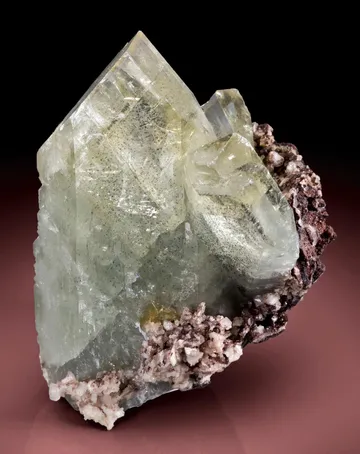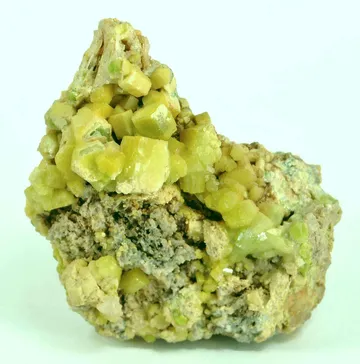
Roughton Gill Mine, UK — locality famed for pyromorphite crystals and blue plumbogummite; world-class specimens from its oxidized zone attract collectors.
Key facts
Roughton Gill Mine is one of the great classic British secondary-lead localities: a high, weather-bitten Caldbeck Fells mine whose reputation rests not on tonnage alone, but on the astonishing quality and scale of its supergene mineralization. The mine lies at the head of the Dale Beck valley, where Roughton Gill and Silver Gill cut into the northern Lake District fells south of Caldbeck. Its veins occupy a geologically complicated boundary zone between the Ordovician Eycott Volcanic Group and the Carrock Fell Complex, with the Roughton Gill South Vein especially important as a long, east-west to near east-west mineralized fracture system.
For collectors, the name means pyromorphite first: green, yellow, orange-yellow and bicoloured lead-phosphate crystals, often barrel-shaped, globular, tabular, acicular, or encrusting hackly quartz. But the mine’s fame is broader than pyromorphite. Nineteenth-century Roughton Gill yielded world-class blue plumbogummite and sky-blue botryoidal hemimorphite, and the best old pieces have the unmistakable look of true British classics: compact cabinet specimens with intensely coloured secondary minerals on quartz, gossan, altered wallrock, and remnants of galena, chalcopyrite, sphalerite, calcite and dolomite gangue. The mine also has a serious mineralogical literature because its vast oxidized zone, its unusual abundance of pyromorphite, and its long record of confused or over-broad labelling make it both rewarding and treacherous for attribution.
Historically, Roughton Gill stands at the meeting point of medieval mining, Elizabethan enterprise, nineteenth-century lead-copper production, Victorian mineral dealing, and modern conservation. Silver Gill was worked earlier, but by the late eighteenth century the principal activity had shifted into the larger Roughton Gill system. The classic Roughton Gill specimens entered museums and private cabinets when the mine was still a working or recently abandoned industrial site; today the locality is a protected, finite mineral and archaeological resource, and unauthorised collecting is not acceptable.
Regional View
Country View
The strongest specimens from Roughton Gill are rarely “flashy” in the modern commercial sense; their appeal is density, history, and locality character. A small hand specimen with fresh yellow-green pyromorphite scattered over iron-stained quartz, or a tight mound of blue hemimorphite with old collection provenance, can be far more significant than a larger but vague “Caldbeck” piece. The collector’s eye must learn the mine’s textures: brecciated quartz recemented by later silica, gossanous cavities, pale chalcedony bands grading into quartz crystals, green or honey pyromorphite over altered veinstone, and, at the top tier, the rare and coveted blue plumbogummite-pyromorphite associations.

Photo: Wikimedia Commons
Search for specimens: View all specimens from Roughton Gill Mine, UK
Roughton Gill Mine is best understood as the principal historic mine at the head of the Dale Beck valley, within the Caldbeck Fells mining region of Cumbria. The workings most specifically treated as Roughton Gill Mine in modern mineralogical reviews are the 30-, 60- and 90-fathom levels beneath and west of Iron Crag, though older labels and dealer usage often blur the name with neighbouring or related workings such as Mexico Mine, Silver Gill, Higher Roughton Gill, Iron Crag, Todd Gill and Barstow’s Trench. For mineral collectors, that distinction is not pedantry: some of the best-known “Roughton Gill” habits, especially certain linarite, leadhillite and caledonite associations, have been re-examined and in some cases reassigned or questioned.
The deposit is a hydrothermal Pb-Cu-Zn vein system with a very large supergene overprint. Primary mineralization consisted chiefly of galena, chalcopyrite and sphalerite in quartz-dominant gangue with significant calcite and dolomite. The Roughton Gill South Vein was the major productive structure; it can be traced for kilometres and is especially mineralized where it passes through the complex contact zone involving Eycott Volcanic Group rocks and intrusive members of the Carrock Fell Complex. In the Roughton Gill Mine area, the wall rocks include microgranite, microgabbro, ferrodioritic rocks and volcanic rocks, and the phosphate supply that helped generate abundant pyromorphite is plausibly tied to weathering of apatite-rich ferrodiorite in and around the system.
The most famous orebody was the “Great Bunch,” developed between the 60- and 90-fathom levels. It was described as a very large mass in which the vein reached roughly 9 metres wide and extended for about 70 fathoms along strike, with gossan, friable quartz and calcite, pyromorphite and cerussite on the fringes, and richer galena deeper into the body. That geological geometry explains much of the specimen story: extensive oxidation, open and brecciated quartz, abundant lead, enough phosphate, and a deep supergene environment combined to make pyromorphite not merely a collectible accessory but an ore mineral in its own right.
The mining history is long. Silver Gill has documentary evidence of operation by the early fourteenth century, and the wider Caldbeck Fells were worked by Elizabethan miners connected with the Company of Mines Royal in the sixteenth century. Roughton Gill itself became the dominant mine in the valley. The 30-fathom crosscut is considered to have been driven in the eighteenth century and was nearly worked out by 1832, after which work turned to the 60-fathom level. Between 1832 and 1845, recorded output from Roughton Gill Mine amounted to 3,229 tons of lead ore and 150 tons of copper ore. The mine was briefly abandoned in 1845 when leases expired, but the Roughtongill Silver Lead and Copper Mining Company took a lease in 1849; by 1852 the 90-fathom level, begun in 1849, had become the principal source of ore. Later ownership changes and attempts to reach deeper ore below the 90-fathom level through Lainton’s Shaft were defeated by water ingress and poor management, and bankruptcy in 1878 effectively ended mining. In 1913, Carlisle Urban District Council bought the mine for water supply purposes, pumping from the 90-fathom level.
The specimen-producing zones most often discussed are the 60-fathom level, historically prolific for pyromorphite, and the 90-fathom dumps, which became especially important to twentieth-century collectors and researchers. The 90-fathom dumps yielded small but significant modern specimens of pyromorphite, hemimorphite, plumbogummite and many rarer supergene species. In the late twentieth century, careful collectors could still find small material on the dumps, but the site’s finite mineral resource and its archaeological remains suffered from collecting pressure. The Caldbeck and Uldale Commons are now managed under a mineral collecting policy using red, amber and green zones, with permission procedures and a code of conduct. Anyone considering field activity must treat Roughton Gill as a protected site: do not collect, dig, hammer or disturb mine remains unless you have explicit current permission under the applicable scheme.
Pyromorphite is the signature Roughton Gill mineral, both as ore and as classic cabinet material: nineteenth-century finds from the mine, especially the 60-fathom level, placed yellow, grass-green, oil-green, orange-yellow and rarer colourless crystals into museums worldwide, while later study of dump material showed globular to barrel-shaped crystals commonly up to about 10 mm, hexagonal crystals up to about 5 mm, and fine crusts of minute crystals on hackly quartz and metasomatized rock. The richest specimens balance colour, luster, coverage and matrix character; ordinary pieces may be merely thin greenish crusts, while good ones show discrete, lustrous barrel or globular crystals on iron-stained quartz, and the elite old examples combine pyromorphite with blue plumbogummite or show the bicoloured and arsenate-rich habits that long caused confusion with mimetite. Associations at Roughton Gill include cerussite, malachite, quartz, altered galena, “chrysocolla”-type copper-rich silica, and plumbogummite, and analytical work has shown that pyromorphite and arsenate-rich pyromorphite are much more common here than true mimetite, making visual species calls on yellow-green “campylite-like” material unreliable without analysis.
Roughton Gill hemimorphite is one of the mine’s three great classic minerals, with the most desirable old specimens showing lustrous sky-blue botryoidal crusts that may reach substantial thickness, in exceptional nineteenth-century material up to about 3 cm, over matrix; later and smaller pieces from the 90-fathom dumps include white, colourless and blue botryoidal crusts, drusy botryoidal surfaces, radiating bladed crystal aggregates, and open cellular masses of colourless blades with individual crystals reported to about 5 mm but usually smaller. The blue botryoidal pieces are the prize: smooth, rounded, three-dimensional surfaces with saturated colour and minimal bruising stand well above flatter, chalkier or more broken white material. Rosasite is a notable associate, especially on cellular hemimorphite, while the classic blue botryoidal form is generally less heavily coated by later minerals, apart from occasional small pyromorphite.
Quartz is the dominant surviving gangue at Roughton Gill and is therefore central to the look and authenticity of the mine’s specimens: large dump blocks, brecciated veinstone cemented by later quartz, hackly quartz masses, small pyramidal crystals rarely exceeding about 10 mm, and bands of white chalcedony grading into crystalline quartz all occur. As a specimen species in its own right, Roughton Gill quartz is usually modest, but as a matrix it is diagnostic and essential; the best pieces carry pyromorphite, malachite, goethite, hemimorphite, cerussite, rosasite or rare phosphates and sulphates in cavities or across fractured surfaces. Collectors should value quartz pieces here for texture, association and provenance rather than isolated crystal perfection: a brecciated, iron-stained quartz miniature with bright secondary minerals is far more characteristic of the mine than a clean single quartz crystal.
Linarite from Roughton Gill Mine proper is real but must be treated with caution, because some historically excellent specimens once attributed to Roughton Gill have been argued on mineralogical and geochemical grounds to have come instead from nearby Red Gill Mine. Verified Roughton Gill linarite is fairly rare and usually occurs as thin blue crusts that are likely dump alteration products of galena and chalcopyrite; where crystals are present they form royal-blue blades up to about 3 mm long, with associations including malachite, quartz, cerussite, and in rare assemblages caledonite and leadhillite. A good Roughton Gill linarite is therefore not judged by large, showy crystals, but by confirmed provenance, fresh royal-blue colour, visible bladed habit, and honest association on the characteristic quartz-galena-chalcopyrite matrix.
Plumbogummite is one of Roughton Gill’s truly world-class claims, with nineteenth-century blue material from the mine long regarded among the finest known; it occurs chiefly as smooth to drusy crusts on quartz and commonly overcoats or pseudomorphs pyromorphite, while the most desirable specimens show later pyromorphite crystals sprinkled over or rising from the blue plumbogummite. Old specimens can be dramatic for a British locality, including large cabinet pieces in major institutional collections, whereas twentieth-century finds from the 90-fathom dumps are rare and generally smaller or less impressive. The collector’s hierarchy is clear: saturated blue colour, rounded or drusy plumbogummite texture, visible pyromorphite relationship, three-dimensional coverage, and old provenance separate major pieces from ordinary pale crusts.
Beyond these headline species, Roughton Gill Mine has produced a large and analytically demanding secondary assemblage. Confirmed or carefully discussed minerals include cerussite, malachite, goethite, anglesite, calcite, dolomite, galena, chalcopyrite, sphalerite, hydrocerussite, smithsonite, rosasite, brochantite, langite, schulenbergite, ramsbeckite, tsumebite, arsentsumebite, wulfenite, coronadite, cesàrolite, kintoreite, segnitite, acanthite and extremely rare native silver. Wooldridgeite is a special rarity here: before formal description from Judkins Quarry, an identical mineral had been noted from Roughton Gill as an unknown aquamarine bladed phase, and confirmed Roughton Gill examples came from a few small specimens collected on the 90-fathom dumps. In the broader Roughton Gill valley, Silver Gill is the type locality for redgillite, but that should not be confused with Roughton Gill Mine proper. Rosasite also deserves mention because early Roughton Gill material was historically important as a first British Isles report. Conversely, several attractive or tempting labels require restraint: mattheddleite and susannite material from the 90-fathom dumps has been treated as doubtful because it resembles Higher Roughton Gill material, while gold and parahopeite claims associated with Arthur Kingsbury are regarded as fraudulent and azurite is highly doubtful for the mine.
Roughton Gill is a locality where provenance is as important as species. The mine’s dominance in the Caldbeck Fells led generations of collectors, dealers and curators to use “Roughton Gill” loosely, and old labels may cover material from Roughton Gill Mine proper, Mexico Mine, Barstow’s Trench, Iron Crag, Silver Gill, Higher Roughton Gill or Red Gill. That matters most for linarite, leadhillite and caledonite, because several splendid old “Roughton Gill” specimens are now considered more likely to be Red Gill material. It also matters for pyromorphite: Barstow’s Trench and Mexico Mine material can be superb and fully collectible, but it is not the same as a confirmed 30-, 60- or 90-fathom Roughton Gill Mine specimen.
The Kingsbury problem is real here. Arthur W. G. Kingsbury’s British mineral labels have been re-examined in the literature, and for Roughton Gill the clearest fraudulent claims are gold and parahopeite; azurite is very doubtful. Collectors should be wary of rare-species labels from old British collections when the specimen lacks analytical work, a credible chain of ownership, or matrix and association consistent with confirmed Roughton Gill material. Mimetite is another common trap: much yellow to green “mimetite” from the Roughton Gill system is arsenate-rich pyromorphite or pyromorphite-mimetite series material, and visual identification alone is not enough.
Condition issues are typical of old British secondary lead and zinc specimens. Pyromorphite crystals may be bruised on high points, dulled by iron staining, or detached from crumbly gossan; hemimorphite botryoids may show edge wear, rubbed surfaces, or a chalkier appearance where the lustrous skin is damaged; plumbogummite crusts can be thin, powdery-looking, or broken where they overcoat earlier pyromorphite. Quartz matrix is tough, but the secondary minerals are not. Avoid ultrasonic cleaning, acids, and aggressive water cleaning on mixed secondary assemblages. Malachite, rosasite, linarite, brochantite and related copper secondaries should be kept dry and stable; pyromorphite contains lead, so normal toxic-mineral hygiene applies: wash hands after handling, do not cut or grind without proper controls, and keep fragments and dust away from children and pets.
Market availability is uneven. Small pyromorphite specimens from the wider Roughton Gill area appear with some regularity, but fine confirmed Roughton Gill Mine examples with old provenance are much scarcer. Blue hemimorphite and blue plumbogummite of classic quality are genuinely old-time prizes, often long held in British and European collections, and should command a premium when the label trail is convincing. Modern collecting restrictions also mean that new legitimate supply is limited; today’s best pieces are usually recycled from older collections rather than freshly recovered.
The landscape itself tells the first story. Walk south from Fellside beside Dale Beck and the modern fells feel quiet, but at the head of the valley the ground becomes a palimpsest of industry: levels, dumps, dressing-floor remains, gill-side workings and steep scree. Silver Gill was already a working mine by the early fourteenth century, and by the sixteenth century the Caldbeck Fells drew Elizabethan miners of the Company of Mines Royal. The old northern boast that the district was “worth all England else” makes sense here: lead, copper and silver were not abstractions, but veins cut into the fells, waterfalls beside adits, and ore brought down from high ground in a landscape now valued as much for its archaeology as for its minerals.
The nineteenth-century mine story has a sharper industrial rhythm. The older 30-fathom workings were nearly exhausted by 1832, the 60-fathom level followed, and from 1832 to 1845 the mine produced more than three thousand tons of lead ore and 150 tons of copper ore. When the leases expired in 1845 the operation paused, but the Roughtongill Silver Lead and Copper Mining Company revived it in 1849 and began the 90-fathom level. By 1852 the deeper level was replacing the older workings as the principal source of ore. Then came the usual mining drama: deeper ambitions, Lainton’s Shaft sunk in 1866 to chase ore below the 90-fathom level, water ingress, bad management, bankruptcy in 1878, and silence. A mine that had fed metal markets became, in time, a source of blue and green cabinet treasures.
The “Great Bunch” is the collector’s legend with a geological body behind it. It was no little vug. The orebody between the 60- and 90-fathom levels was described as a mass where the vein reached about 9 metres wide and extended for roughly 70 fathoms. In its oxidized fringes, pyromorphite and cerussite formed in gossan, friable quartz and calcite; deeper in, silver-rich galena lay toward the heart of the deposit. That arrangement is exactly what a collector wants to imagine when looking at a Roughton Gill pyromorphite: the specimen is a surviving coloured edge of a far larger ore machine.
A later field story belongs to the 90-fathom dumps and to the collectors who did careful work before modern restrictions tightened. In the twentieth century, small specimens of many secondary species could still be found on the dumps, and researchers examined hundreds of pieces with good provenance to separate Roughton Gill Mine proper from the confusing halo of neighbouring workings. Their work turned the dumps into a mineralogical archive: blue hemimorphite, rare plumbogummite, small linarite blades, rosasite on cellular hemimorphite, microscopic wulfenite plates, native silver plates only fractions of a millimetre across, and the pale ice-blue wooldridgeite known from a few specimens collected by Peter Braithwaite and John Dickinson. The field collecting may have been modest in scale compared with the nineteenth-century pockets, but the scientific value was high.
There is also a cautionary story, and it is one every serious British collector should know. Because Roughton Gill was the dominant name in the valley, doubtful pieces gravitated toward it. Some old labels almost certainly preserve genuine history; others flatten a complicated group of mines into one marketable phrase. The Kingsbury legacy sharpened the issue. Gold and parahopeite claims from Roughton Gill are now treated as fraudulent, and azurite is very doubtful. Even more subtly, some magnificent linarite, leadhillite and caledonite once admired as Roughton Gill are now considered more consistent with Red Gill. In this locality, the romance of the old label must be balanced by the discipline of modern mineralogy.
Trevor F. Bridges, David I. Green, Michael S. Rumsey and C. Michael Leppington, “A review of the mineralisation of the Roughton Gill mines, Caldbeck Fells, Cumbria: Part 3 Roughton Gill Mine,” Journal of the Russell Society, 14, 3–23, 2011 — The essential modern review for Roughton Gill Mine proper, with history, geology, mineral descriptions, provenance cautions and discussion of the 30-, 60- and 90-fathom workings.
Journal of the Russell Society, Volume 14 PDF — Includes the Roughton Gill Mine review in its original journal context, with figures and bibliography.
Marcus Jecock, Christopher Dunn and Amy Lax, “Roughton Gill Mine and Silver Gill Mine, Cumbria. Survey Report,” English Heritage Archaeological Investigation Report Series, AI/8/2001 — The major archaeological survey of the mine landscape, documenting the surface remains at Roughton Gill and Silver Gill.
Green, D.I., Bridges, T.F., Rumsey, M.S., Leppington, C.M. and Tindle, A.G., “A review of the mineralogy of the Roughton Gill Mines, Caldbeck Fells, Cumbria: Part 2 The Roughton Gill South Vein on Balliway Rigg,” Journal of the Russell Society, 11, 3–28, 2008 — Important for separating Higher Roughton Gill and South Vein material from Roughton Gill Mine proper, and for understanding the broader valley mineralogy.
Bridges, T.F., Green, D.I., Rumsey, M.S. and Leppington, M., “A review of the mineralisation at Red Gill Mine, Caldbeck Fells, Cumbria, England,” Journal of the Russell Society, 11, 29–47, 2008 — Key comparative paper for the Red Gill reassignment problem affecting old linarite, leadhillite and caledonite labels.
Förtsch, E.B., “‘Plumbogummite’ from Roughten Gill, Cumberland,” Mineralogical Magazine, 36, 530–538, 1967 — Classic analytical study of Roughton Gill plumbogummite-group material and its complex composition.
Tindle, A.G., Bridges, T.F. and Green, D.I., “The composition of tsumebite from Roughton Gill Mine, Caldbeck Fells, Cumbria,” UK Journal of Mines & Minerals, 27, 48–50, 2006 — Cited in the Roughton Gill review for analytical work showing arsenic enrichment in tsumebite aggregates, including material entering the arsentsumebite field.
Ryback, G., Hart, A.D. and Stanley, C.J., “A.W.G. Kingsbury’s specimens of British minerals. Part 1: some examples of falsified localities,” Journal of the Russell Society, 7(2), 51–69, 2001 — Essential background for evaluating questionable Kingsbury-linked British mineral localities, including Roughton Gill claims discussed in later reviews.
Cooper, M.P. and Stanley, C.J., Minerals of the English Lake District: Caldbeck Fells, Natural History Museum Publications, London, 1990 — The foundational modern book on Caldbeck Fells mineralogy, repeatedly cited in later work for Roughton Gill specimens, history and classic illustrated material.
Mindat: Roughton Gill Mine, Roughton Gill, Caldbeck, Cumbria, England, UK — The main online locality index for the mine, with species list, references and photo links.
Mindat occurrence record: Pyromorphite from Roughton Gill Mine — Useful for pyromorphite habits, colours, associations and specimen-photo cross-checking.
Lake District National Park: Caldbeck minerals — Current collecting-policy context for the Caldbeck and Uldale Commons, including permissions, zones and code-of-conduct resources.
Natural England: Managing geological specimen collecting — Caldbeck Fells case study — Conservation and management background for why collecting pressure at Caldbeck Fells is tightly controlled.
Historic England: Roughton Gill Mine and Silver Gill Mine, Cumbria. Survey Report — Archaeological overview and download page for the detailed survey of the mine remains.
GeoGuide: Roughton Gill and Silver Gill — Concise visitor-facing geological and mining summary for the Dale Beck headwaters.
Wikimedia Commons: Hemimorphite from Roughton Gill Mine — Freely licensed photograph of a classic blue Roughton Gill hemimorphite specimen.
Wikimedia Commons: Hemimorphite from Roughton Gill Mine — Additional freely licensed photograph of an old-time sky-blue botryoidal hemimorphite.