






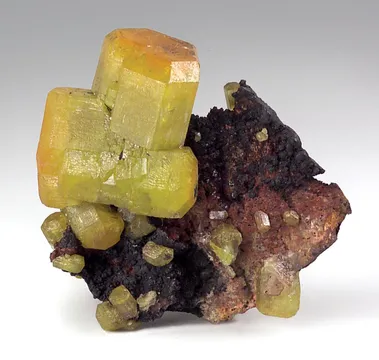
Rosenberg Mine, Germany — a historic locality famed for pyromorphite crystals in brown to green hues; prized for dense druses, barrel-like forms, and provenanc…
Key facts
The Rosenberg Mine above Braubach is one of the great old names of the lower Lahn–Middle Rhine lead district, a locality whose reputation rests on classic German pyromorphite rather than on sheer species count. It worked the southwestern end of the Emser Gangzug, a long hydrothermal vein system followed by the historic mines of Bad Ems, Friedrichssegen, Königstiel and Braubach. The ore was a Pb-Zn-Cu-Ag vein assemblage in the Rhenish Massif, with quartz and siderite as characteristic gangue and galena, sphalerite and chalcopyrite as the principal ore minerals. In the oxidized portions of those veins, galena supplied the lead for the pyromorphite that made Rosenberg famous.
For collectors, Rosenberg is a locality of color and texture: not the electric apple-green of modern Chinese material, but old European browns, honey-tan, orange-brown, cream-brown and occasional greenish tones with a resinous, “wet” luster. The best pieces show dense druses of short to medium prismatic pyromorphite on quartz-rich matrix, isolated barrel-like crystals perched on quartz ridges, doubly terminated crystals, cauliflower-like globular growths, and vugs lined with brown crystals against pale quartz and darker ore minerals. It is a locality where a miniature with undamaged, lustrous crystal architecture can outrank a larger but bruised plate.
Historically, Rosenberg matters because it was both an ore mine and one of the final industrial expressions of the Emser mining district. The mine is recorded from the early 18th century and closed in the 20th century, after a long and uneven life marked by periods of production, dormancy, consolidation with neighboring workings, and modernization. Old labels reading “Grube Rosenberg,” “Braubach,” “Bad Ems,” “Ems-Nassau,” or simply “Bad Ems” may all intersect with this collecting tradition, so provenance and habit are part of the specimen’s story.
Regional View
Country View
Rosenberg pyromorphite sits within the broader Bad Ems pyromorphite canon, but it has its own personality. Friedrichssegen is widely associated with the classic “Emser Tönnchen,” or little cask-like barrels; Mercur and Pfingstwiese with strong olive-green to brownish-green material; Rosenberg with brown to tan crystals, quartz-rich matrices, and distinctive globular or botryoidal aggregates in addition to normal prismatic habits. The mine also supplied attractive quartz specimens and ore-matrix pieces with galena and chalcopyrite, but pyromorphite is the reason Rosenberg appears on want lists.

Photo: Wikimedia Commons
Search for specimens: View all specimens from Rosenberg Mine, Germany
Rosenberg lies about 500 m north of Braubach in Rhineland-Palatinate, on the right-bank side of the Middle Rhine. Mineralogically and historically it belongs to the Ems–Braubach part of the Emser Gangzug, the vein trend that can be followed from the Bad Ems area toward Braubach. This was a hydrothermal vein deposit carrying lead, zinc, copper and silver ores. The vein system is classically described with quartz and siderite gangue and with galena, sphalerite, chalcopyrite and pyrite among the essential ore minerals; the oxidation zone produced pyromorphite, anglesite, cerussite, copper carbonates and sulphates, and a suite of rarer secondary phases.
The mine worked several vein branches, including the Victor vein area noted in mineral records. Documented mine openings and workings include the Victorstollen, Gustavstollen, Moritzstollen, Segengottesstollen, Albertschacht and Schacht Philipp. The broader Braubach mining landscape also included the Königstiel workings, which are often discussed with Rosenberg and the other final operations of the district. In specimen terms, the important environment was the oxidized lead-bearing vein material, especially quartz-rich cavities and altered ore matrix where pyromorphite formed as druses, prismatic crystals, rounded aggregates and small vug linings.
The Braubach mining story reaches back before Rosenberg as a named mine. A medieval grant for silver mining around Braubach was issued to Count Eberhard von Katzenelnbogen on November 12, 1301, though the direct evidence for actual work from that episode is uncertain. A request for mining permission in the Braubach office is recorded in 1681, and Rosenberg itself appears in 1723, with early workings at the Icklerstiel near St. Eckardsberg. Production figures from 1725 to 1732 record smelted metal and products including 77 Mark of silver, 521 Zentner of copper, 1903 Zentner of lead and 15 Zentner of litharge, with a stated total value of 35,299 Florin and 29 Kreuzer. That early phase ended before mid-century; the operation was stopped by 1738 and the mining rights lapsed in 1744.
Modern mining resumed in the 19th century. Rosenberg was re-granted in 1833, and the neighboring Philipp mine was later consolidated with Rosenberg. The Gewerkschaft Remy controlled the Braubach mines before selling them in 1877 to the Emser Blei- und Silberwerke. Production appears to have been intermittent in the late 19th century, with probable stoppages around 1867 and from 1869 to 1896. In 1891 a machine shaft was sunk about 175 m from the portal of the Moritz adit, and in 1909 the property passed to Stolberger Zink AG. The mine’s ore dressing plant was built in 1910 and began operation in 1912; the large concentrating facility became one of the defining industrial structures of the Braubach site.
The early 20th century was Rosenberg’s industrial high point. Ore was transported underground by mine horses, and the raw ore was dressed at the Braubach plant before further processing at Silberau near Ems. In 1909 the former Waldburg inn was rented to house mine horses and miners’ families, and an additional residence followed in 1916. The Kerkertserweg operating point was closed in 1928. After renewed need for lead following the Second World War, the mine was reactivated on a reduced scale; more than 40 miners were employed there in 1958. Rosenberg worked on eight deep levels, the lowest reported to have reached 267 m below sea level. The mine closed in 1963, marking the end of the Rosenberg operation as a working mine.
Today Rosenberg is an abandoned historic mining locality, not a collecting mine in the modern production sense. Remnants of the mine and processing plant survive, and the locality is represented in photographs by masonry buildings, a boiler-house chimney, covered remains and dumps. Underground access should be regarded as closed and hazardous unless explicit legal permission and professional safety provisions are in place. For collectors, the realistic source of Rosenberg material is the old-specimen market: estate collections, European dealer stock, auction lots, and classic pieces with labels from earlier hands.
The finest finds are not known from a single modern pocket story but from the mine’s long oxidation-zone output and the circulation of old specimens. Representative documented pieces include brown pyromorphite crystals to 6–8 mm in vugs and on quartz, larger individual crystals around 1 cm on quartz-rich matrix, small-cabinet specimens with light brown “wet-look” druses, and rarer larger clusters. One old-market specimen has been recorded with an 1894 “Grube Rosenberg, Bad Ems” label; another Mindat-documented pyromorphite on quartz was purchased in 1963 from Jordi Figueras in Barcelona and reportedly confirmed at the time by Joaquim Folch i Girona. Such provenance is especially valuable because Rosenberg material has long circulated under both precise Braubach labels and broader Bad Ems district labels.

Photo: Wikimedia Commons
Rosenberg pyromorphite is the mine’s signature mineral and one of the classic German expressions of the species: brown, tan, cream-brown, orange-brown to medium-brown crystals on quartz-rich and ore-bearing matrix, typically as lustrous short to elongated hexagonal prisms, barrel-like individuals, parallel-growth groups, doubly terminated crystals, and in some pieces botryoidal or cauliflower-like aggregates that resolve under magnification into packed crystals. Documented specimen sizes range from thumbnails and miniatures to small-cabinet pieces around 5–8 cm, with individual crystals commonly 4–8 mm and occasional crystals near 1 cm or larger; associated minerals include quartz, galena, chalcopyrite, sphalerite, limonitic/goethitic matrix and, less commonly, other secondary lead and copper species. The best Rosenberg pieces are sharply distinguished from ordinary drusy fragments by strong luster, undamaged terminations, open spacing that lets individual crystals read clearly, attractive contrast against pale quartz or dark ore, and old provenance that supports a precise Rosenberg rather than generic “Bad Ems” attribution.
Quartz at Rosenberg is both a collectible species and the essential stage on which the pyromorphite performs. It occurs as the principal gangue of the hydrothermal vein system, as quartz-rich matrix, pale ribs and ridges, drusy cavity linings, small microcrystals in vugs, and sprays or crystalline patches associated with pyromorphite, galena and corroded chalcopyrite. Local collecting accounts specifically note quartz crystals from the former mine, and dealer descriptions of Rosenberg pyromorphite repeatedly emphasize quartz matrix rather than massive siderite alone. As stand-alone specimens, Rosenberg quartz is a historic district accessory rather than a world-class quartz locality; the most desirable pieces are those with clean, bright crystallization, open vugs, sharp contrast with sulphides or secondary lead minerals, and especially quartz plates that carry well-formed brown pyromorphite without crowding or damage.
Other minerals documented from Rosenberg include the primary and hypogene ore suite galena, sphalerite, chalcopyrite, pyrite, arsenopyrite, gersdorffite, antimony-bearing gersdorffite and stibnite; oxidation-zone and supergene minerals such as anglesite, cerussite, malachite, azurite, aurichalcite, brochantite, cuprite, covellite, hydrocerussite and limonite/goethite; and smaller or rarer records including calcite, aragonite, chalconatronite, dypingite, fairchildite, litharge, native copper, nyerereite, spertiniite and zincite. Mineralienatlas records a broader Braubach/Rosenberg suite that includes additional microminerals such as elyite, ktenasite, langite, laurionite, linarite, namuwite, natrojarosite, olivenite, plumbonacrite, posnjakite, serpierite, siderite and strashimirite; many of these are micromount or specialized secondary-mineral records rather than the cabinet-level species that built Rosenberg’s collector fame. The important practical point is that Rosenberg is a pyromorphite locality first, an old Pb-Zn-Cu-Ag ore locality second, and a rarity locality chiefly for careful micromounters.
The central authenticity issue with Rosenberg specimens is locality attribution. “Bad Ems” has long functioned as both a precise town name and a wider collector shorthand for the Ems–Lahn mining district; old labels may say Bad Ems, Ems-Nassau, Braubach, Rosenberg, Friedrichssegen or only Germany. A Rosenberg attribution is strongest when the specimen is supported by an old label, collection history, or a style consistent with documented Rosenberg material: brown to tan pyromorphite on quartz-rich matrix, vuggy quartz-goethite boxwork, occasional globular or botryoidal aggregates, and associations with galena, chalcopyrite or sphalerite.
Specific large-scale faking or systematic treatment of Rosenberg pyromorphite is not a recurring theme in the literature or dealer records. The more realistic risks are over-precise relabeling of generic Bad Ems material as Rosenberg, confusion with Friedrichssegen or Mercur material, repaired crystals, glued fragments, and undisclosed trimming. The strongest warning example is the documented kind of label conflict where a piece may carry “Rosenberg Mine, Braubach, Bad Ems” while later comparison suggests another Ems district source. That does not make the specimen false as Bad Ems material, but it does affect value if it is priced as a precise Rosenberg piece.
Condition matters greatly. Pyromorphite is dense, brittle and easily bruised on exposed terminations; Rosenberg specimens are often old, and many have passed through several collections. Inspect the high points of the crystals, especially the terminal faces of isolated prisms and the outermost knobs of botryoidal aggregates. Small edge bruises are common on historical pieces and may be acceptable, but broken display crystals or dulled luster should be reflected in price. Quartz-rich matrix can be rugged, but vuggy goethitic or limonitic matrix may shed grains, and old trims may expose sawn or broken backs.
Rosenberg pyromorphite can fluoresce. Documented specimens show fluorescence under long-wave ultraviolet and sometimes weaker short-wave response; one dealer record describes creamy yellow long-wave fluorescence. Fluorescence is an interesting bonus rather than the principal value driver, but it is worth checking because UV response can help reveal repairs, glue, or later coatings. As with all lead minerals, handle pyromorphite sensibly: avoid dust, do not clean aggressively, wash hands after handling, and store away from children.
Availability is limited but not impossible. Modest Rosenberg miniatures and small cabinets appear periodically from old collections and dealers, while large, undamaged, aesthetic specimens with old labels are notably scarce. Prices rise sharply for strong luster, crystal size near or above 1 cm, attractive quartz matrix, precise old provenance, and old labels dated to the active mining era. In today’s market, a fine Rosenberg pyromorphite is bought as a historic European classic, not as a modern bulk locality.
The human story behind Rosenberg’s polished cabinet specimens is far rougher than the crystals suggest. Oral and local-history accounts of the Braubach mines describe raw ore being hauled underground by mine horses; one remembered detail is that people said the horses were all blind. Above ground and below, the working day could consume nearly the whole waking life of a miner. Many men came on foot from distant villages, worked shifts up to 12 hours, and when the 20–30 km walk was counted, could be away about 16 hours. Around 1890, an above-ground ore dresser earned 4 Pfennig per hour, while a hewer underground earned 21 Pfennig; a pound of bread cost 12 Pfennig. Those numbers give the best Rosenberg pyromorphites a hard edge: the crystals survived from an economy in which a specimen’s matrix was also a wage, a ration, and a family’s precarious living.
The Waldburg episode gives Rosenberg a particularly vivid industrial scene. By the beginning of the 20th century, production was running strongly enough that the mine needed more hewers and more horses. In 1909 the former Gasthaus zur Waldburg was rented for mine use. The lower part became stables; the upper part housed miners, in some cases together with their families. A further residence was built in 1916. The arrangement says much about Rosenberg at its wartime peak: animals below, families above, ore moving out, and lead prices rising because the metal was urgently needed for ammunition.
Rosenberg’s early history has its own medieval glint. On November 12, 1301, Count Eberhard von Katzenelnbogen received a grant for silver mining around Braubach from King Albrecht I. What actually happened underground after that is obscure, but the document places the Braubach ore ground inside a much older political and economic world. When Rosenberg appears clearly in 1723, it is not as a romantic ruin but as a working mine at the Icklerstiel near St. Eckardsberg. Within a decade the smelter accounts were already substantial: silver, copper, lead and litharge measured and priced in the currencies of the old German mining states. Then the work stopped, the rights lapsed, and the ground waited for the 19th-century revival.
There is also a collector’s story written on labels. A Rosenberg pyromorphite offered on the modern market carried an old label dated 1894 and passed through several named collections, including John H. Marshall, Robert Wenzel and Dr. Gary Hansen. Another documented pyromorphite on quartz was bought in 1963 from the dealer Jordi Figueras in Barcelona for the amount later recorded as €0.39, and the locality was reportedly confirmed at the time by Joaquim Folch i Girona. Details like those are more than provenance decoration. They show how Rosenberg specimens left the Rhine valley, entered European and American collections, and continued to acquire history long after the mine closed.

.jpg)