Rose Quartz from Galiléia, Minas Gerais, Brazil — rare euhedral pink crystals with glassy faces, prized for crystallization, color, and Brazilian locality.
Key facts
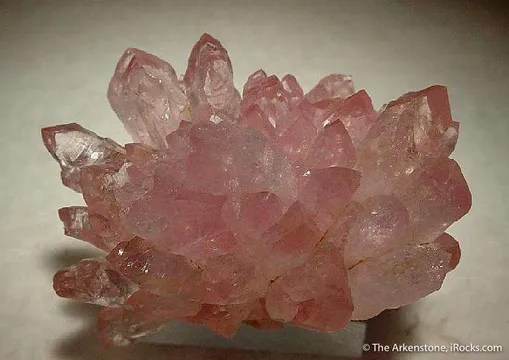
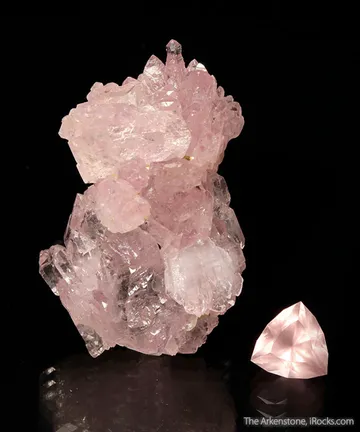
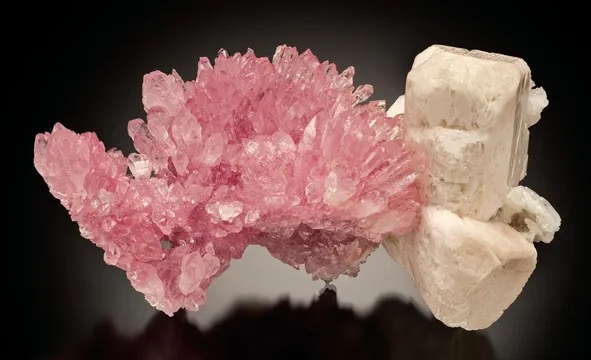
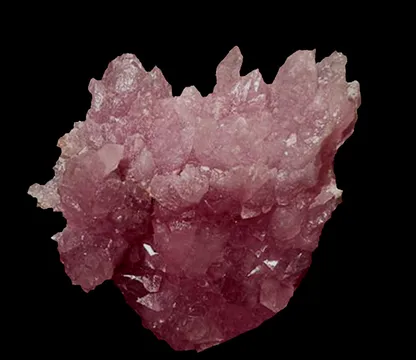
Galiléia rose-quartz belongs to the small, elite category of rose-colored quartz that collectors pursue not as lapidary rough, but as crystallized mineral specimens. The appeal is immediate: sharp, glassy, pale-to-vivid pink quartz crystals, commonly forming sprays, rosettes, halos, crowns, sashes, and partial draperies on smoky, milky, or colorless quartz. In the finest pieces, the pink crystals do not sit passively on matrix; they wrap, fringe, and encircle older quartz forms, giving the specimen a sculptural quality that is unmistakably Brazilian.

Photo: Wikimedia Commons — Rob Lavinsky, iRocks.com, CC BY-SA 3.0
The Galiléia occurrences sit in the Aimorés pegmatite district of the Eastern Brazilian Pegmatite Province, one of the world’s great regions for complex granitic pegmatites. The municipality’s rose-quartz reputation is tied especially to Lavra Berilo Branco near Sapucaia do Norte and to Lavra da Pitorra/Alto da Pitorra at Laranjeiras. These are not simple “pink quartz chunks” localities. They produced true collectible crystals of SiO2, often in association with smoky quartz, microcline, albite, and muscovite, and in the broader district with the phosphate-rich mineralogy for which eastern Minas Gerais is famous.
Collectors should understand a useful mineralogical nuance. The trade and collector world commonly calls these specimens “rose quartz,” but many mineralogists distinguish ordinary massive rose quartz from the rare euhedral “pink quartz” habit. Massive rose quartz owes its hazy color chiefly to submicroscopic fibrous inclusions related to dumortierite-like material; the rare transparent-to-translucent crystals, including those represented by the best Galiléia material, are more often discussed in terms of irradiation-related color centers involving aluminum and phosphorus in quartz. That distinction matters because the Galiléia pieces are prized specifically for their crystallization: lustrous faces, visible terminations, three-dimensional sprays, and rosy color that survives as a mineral specimen rather than merely as cutting rough.

Photo: Wikimedia Commons — Rob Lavinsky, iRocks.com, CC BY-SA 3.0
Historically, Galiléia’s name is inseparable from a few world-famous specimens. Lavra Berilo Branco is the source of the Smithsonian’s celebrated “Van Allen Belt,” a specimen in which rose-quartz crystals form a belt around a larger smoky quartz crystal. The same locality is also associated with “La Madona Rosa,” the towering rose-and-smoky quartz specimen sold by Heritage Auctions in 2013. These museum-class examples explain why even modest Galiléia thumbnails and miniatures command attention: they are small relatives of a very small family of world-class crystallized rose-quartz finds.
Search for specimens: View all rose-quartz specimens from Galiléia, Minas Gerais, Brazil
Galiléia lies in the Rio Doce region of eastern Minas Gerais, roughly east of Governador Valadares, within a pegmatite country long worked for mica, beryl, feldspar, gem minerals, phosphates, and specimens. The collector label “Galiléia rose quartz” may refer to several nearby but distinct sublocalities, and the exact sublocality is important. The principal names encountered are Berilo Branco claim, Sapucaia do Norte; Sapucaia mine or Proberil claim; Pitorra claim at Laranjeiras; and Alto da Pitorra at Laranjeiras.
The Sapucaia pegmatite proper is a famous lithium-rich complex granite pegmatite. It intrudes Neoproterozoic garnet-staurolite-muscovite-biotite schists of the São Tomé Formation of the Rio Doce Group and sericite quartzites of the Crenaque Group. The pegmatite is described as a lenticular body elongated northwest-southeast and dipping steeply to the northeast. Its scientific fame rests heavily on its phosphate mineralogy: weathering and metasomatic fluids generated a large secondary phosphate suite, and the locality has served as the type locality for multiple phosphate species.
The rose-quartz story is more subtle than older labels sometimes suggest. Many specimens historically called “Sapucaia” rose quartz are now understood to have come from Lavra Berilo Branco, a separate claim near Sapucaia do Norte. Berilo Branco is the locality tied to the “Van Allen Belt” specimen, and Mindat specifically notes that samples from Berilo Branco were erroneously labeled as coming from Sapucaia. This matters to serious collectors because a label reading “Sapucaia Mine” on an old rose-quartz specimen may be historically understandable yet locality-imprecise; “Berilo Branco claim, Sapucaia do Norte, Galiléia” is the more exact attribution for many of the classic rose-quartz-on-quartz pieces.
Lavra Berilo Branco is recorded about 8 km south of Divino das Laranjeiras and about 3 km east-southeast of Sapucaia do Norte. It belongs to the Aimorés pegmatite district of the Eastern Brazilian Pegmatite Province and has yielded rose quartz with microcline, muscovite, quartz, and albite. Its classic production is associated with the celebrated 1959–1961 finds, the kind of material that established the visual ideal: vivid pink rose-quartz crystals arranged as belts, halos, or sprays on smoky or colorless quartz.
Pitorra and Alto da Pitorra form the other great Galiléia rose-quartz name. Lavra da Pitorra, at Laranjeiras, is recorded as a specimen quarry for rose-quartz crystals in the Aimorés pegmatite district. Pitorra rose quartz occurs as crystals, commonly associated in specimen records with quartz, smoky quartz, microcline, muscovite, albite, and mica. Alto da Pitorra is also documented for crystallized rose quartz and related pegmatite species, with published treatment by Jacques P. Cassedanne and Jeanete Alves in The Mineralogical Record in 1990.
Mining and collecting access in this district should be treated as private-claim, mine, or quarry access, not casual public collecting. Galiléia pegmatites have been worked commercially and intermittently for decades; access depends on landowners, claimholders, current safety conditions, and local permissions. Historic specimen production appears episodic: a few exceptional pockets created the classic pieces, followed by later smaller finds and occasional recovery of specimens through miners, dealers, and old collections. The best material today is far more likely to surface through the mineral trade than through open field collecting.
Galiléia rose-quartz specimens are valued first for crystallization. The crystals are typically short to moderately elongated prisms, compound crystals, sprays, fans, rosettes, and intergrown clusters. Some are doubly terminated; others form crusts or belts over earlier quartz. The best pieces show distinct faces and terminations rather than sugary massive surfaces. In Pitorra material especially, groups may appear as translucent pink “fingers,” fans, or flower-like clusters, sometimes with no matrix at all.

Color ranges from very pale blush through attractive soft pink to unusually saturated rose or deep pink. Dealers have described some Pitorra examples as nearly purple or almost red when the color is strong. Berilo Branco pieces often owe their drama to contrast: pink rose quartz against smoky quartz, white albite, pale feldspar, or milky quartz. The most coveted pieces combine glassy luster, visibly sharp crystals, balanced composition, and enough translucency that the pink feels internal rather than merely surface-toned.
Specimen sizes vary widely, but many trade examples fall in thumbnail, miniature, and small-cabinet ranges. Documented examples include Pitorra clusters around 3.4 x 2.9 x 2.6 cm, Sapucaia/Berilo Branco crystals around 4.6 x 2.7 x 2.3 cm, Berilo Branco pieces around 6.8 x 5.0 x 4.2 cm and 8.5 x 7.3 x 6.5 cm, and larger cabinet pieces exceeding 10 cm. Museum-class Berilo Branco specimens are much larger, culminating in the famous pieces measured in tens of centimeters rather than single-digit cabinet sizes.
Associated minerals help separate the Galiléia look from generic “Brazil rose quartz.” At Berilo Branco, important associations include quartz, smoky quartz, albite, microcline, and muscovite. At Pitorra, specimen records repeatedly show rose quartz with quartz, smoky quartz, microcline, muscovite, albite, and mica. At Alto da Pitorra, the broader pegmatite association includes albite/cleavelandite, beryl, lepidolite, smoky quartz, citrine, schorl, tantalite, and related pegmatite species. The wider Galiléia district, particularly Sapucaia, is also rich in phosphates, but the rose-quartz specimens themselves are most classically judged in relation to quartz-feldspar-mica matrix.
Quality is determined by a demanding combination of factors. Color must be natural-looking and not washed out; luster should be glassy rather than matte; crystals should be distinct, preferably with sharp terminations; the composition should be balanced and three-dimensional; and condition is crucial because the pink crystals often stand proud on the specimen and are vulnerable to bruising. A pale but superbly formed, pristine spray may be preferable to a darker, damaged mass. Conversely, a strongly colored, glassy Berilo Branco or Pitorra cluster with complete crystals can be one of the most desirable quartz specimens from Brazil.
The first authenticity concern is locality precision. Old labels reading “Sapucaia” should be evaluated carefully, because Berilo Branco rose-quartz specimens were historically mislabeled as Sapucaia, and modern locality work distinguishes the original Berilo Branco rose-quartz occurrence from the Sapucaia mine proper. A specimen with an old “Sapucaia” label is not automatically wrong in collector history, but a serious catalog entry should preserve the old label while noting the likely Berilo Branco attribution when the style and provenance support it.
The second concern is nomenclature. The market will nearly always call these pieces “rose quartz,” but in a technical description they may be discussed as euhedral rose quartz or pink quartz. For specimen collecting, the practical question is not the name alone but the evidence: does the piece show true quartz faces and terminations, natural pink color within the quartz, and the correct Galiléia-style association? Be wary of vague labels such as “Minas Gerais rose quartz cluster” when the price assumes Pitorra or Berilo Branco significance.
Treatments are a real consideration for pink quartz generally. The pink color of transparent euhedral quartz can be more light- and heat-sensitive than the color of ordinary massive rose quartz, and irradiation can intensify certain quartz colors. For Galiléia specimen collectors, the most important practical advice is conservative display: avoid strong direct sunlight, hot display lighting, and unnecessary UV exposure. A specimen that has survived decades with stable color deserves the same care as fine kunzite or fluorite: display with restraint and store away from harsh light when not being viewed.
No locality-specific fake “Galiléia rose quartz” industry is documented in the serious mineral references, but the high value of crystallized examples creates incentives for problems common to fine quartz specimens: inaccurate locality labels, enhanced photographs, repaired crystal sprays, glued contacts, and confusion with dyed quartz or pale amethyst in lower-end material. Natural Galiléia specimens should show quartz luster, natural growth relationships, and plausible matrix or association. Excessively uniform candy-pink color, color concentrated in cracks, or a specimen offered without meaningful locality or provenance should be treated cautiously.
Condition is often the make-or-break factor. Rose-quartz crystals from these occurrences can be exposed around the edges of fans and halos, so small chips on terminations are common. Contact marks are not always fatal, particularly where the back of a smoky quartz host is naturally contacted rather than broken, but front-facing bruises on the pink crystals reduce desirability sharply. Because many pieces are built as sprays, belts, or rosettes, check every exposed tip under magnification.
Availability is limited and episodic. Small Pitorra and Berilo Branco pieces continue to appear through dealers, auctions, and old collections, but high-quality classic material is scarce. Prices span a wide range: modest miniatures may still appear at comparatively accessible fine-mineral levels, while pristine, sharply crystallized small cabinets can move into several-thousand-dollar territory. Exceptional Berilo Branco pieces with history and display power are in a different class entirely, as shown by major auction results for museum-level specimens.
The most famous Galiléia rose-quartz story begins not with a broad mine dump, but with a remarkably narrow seam. In the late 1950s, miners working near Sapucaia opened a rose-quartz-bearing zone that later accounts described as only about six inches wide and 12 inches high, yet extending for roughly 16 feet. It was filled with deep pink rose quartz on smoky quartz — the association that would become the visual signature of Berilo Branco. From that small, improbable seam came the style of specimen that reset collectors’ expectations for what rose quartz could be.
One of the great survivors of that tradition is the Smithsonian’s “Van Allen Belt.” The name is perfectly apt: a ring or belt of lustrous deep pink rose-quartz crystals encircles a larger smoky quartz crystal, echoing the radiation belts around Earth. The specimen was mined at Berilo Branco and donated to the Smithsonian by Fred C. Kennedy. For collectors, it is not merely a famous named piece; it is the reference image for an entire locality style. When a dealer describes a Berilo Branco specimen as having a halo, belt, or sash of pink crystals around smoky quartz, the unspoken comparison is the Van Allen Belt.
Then came “La Madona Rosa,” the Pink Madonna. Heritage Auctions described it as an exceptionally large rose-and-smoky quartz specimen from Lavra Berilo Branco, Sapucaia do Norte, Galiléia, with the smoky quartz forming an abstract central body and the rose quartz outlining it like a halo. The resemblance to traditional depictions of the Virgin Mary gave it its name. At about 15.5 x 8 inches, or roughly 39 x 20 cm, it towered over ordinary rose-quartz specimens and even over the famous Smithsonian example.
La Madona Rosa carried an unusually tangled provenance. One version places it in the original late-1950s discovery; another says it surfaced in Brazil in 1972, while the mine was still being worked sporadically. It passed to a London gemstone collector in 1972, then to a U.S. gem collector in 1977, where it remained for about 20 years without being fully recognized for what it was. When it appeared at the 1997 Tucson Gem & Mineral Show, knowledgeable eyes saw the potential. After cleaning and careful trimming, the specimen emerged as one of the great icons of the mineral world. In 2013, as part of the Hoppel Collection at Heritage Auctions, it sold for $662,500.
The Pitorra story is quieter but no less important to collectors who love specimens on the miniature and small-cabinet scale. Lavra da Pitorra and Alto da Pitorra produced crystallized rose quartz in clusters, rosettes, and fans, sometimes perched on microcline or smoky quartz, sometimes as all-rose-quartz groups with no matrix at all. These pieces do not usually have the monumental silhouette of Berilo Branco’s named specimens, but they often offer a higher concentration of crystallography in the hand: individual pink quartz crystals, compound growth, fan-like sprays, and clusters that look improbably delicate for quartz.