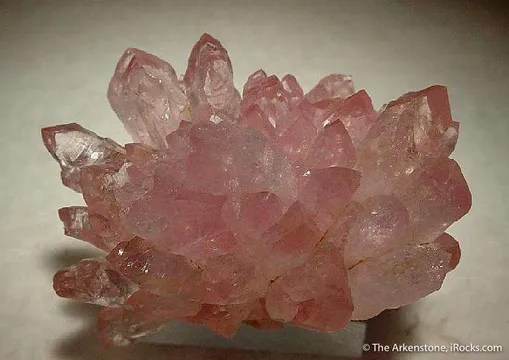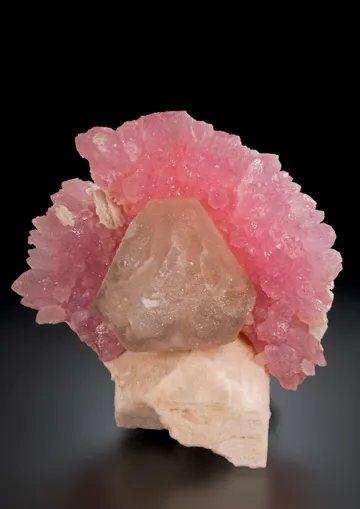
Berilo Branco, Brazil — a small pegmatite locality in Minas Gerais famed for crystalline rose quartz with smoky quartz, shaping world-class specimens.
Key facts
Lavra Berilo Branco is one of the small Brazilian pegmatite occurrences whose influence on mineral collecting is wildly disproportionate to its physical scale. It lies in the Sapucaia do Norte area of Galiléia, eastern Minas Gerais, within the Aimorés pegmatite district of the Eastern Brazilian Pegmatite Province—a terrain famous for zoned granitic pegmatites, industrial feldspar and mica, gem minerals, and an extraordinary density of classic specimen localities. Berilo Branco’s reputation, however, rests above all on a narrow and memorable suite: crystallized rose quartz, commonly in intimate association with smoky quartz, quartz, albite, microcline, and muscovite.
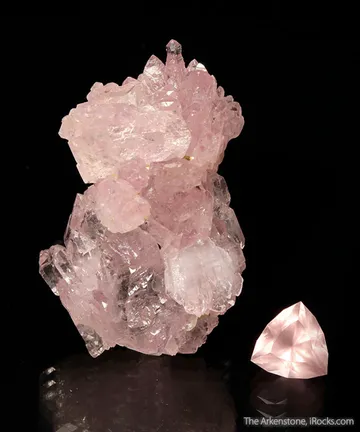
For collectors, Berilo Branco matters because it helped define what “world-class rose quartz” could mean. Ordinary rose quartz is usually massive, lapidary material; Berilo Branco produced lustrous, visibly crystallized pink quartz in pockets and seams, often draped around larger smoky or colorless quartz crystals. The best specimens are not simply pink—they are sculptural. They show a smoky or milky quartz core with rosy crystals forming a wreath, sash, halo, or crust, with white feldspar and albite adding contrast. This is the style behind the celebrated Smithsonian “Van Allen Belt” specimen and the later auction icon “La Madona Rosa.”
Regional View
Country View
The locality also has an important labeling history. For many years, fine crystallized rose-quartz specimens from Berilo Branco circulated under the broader or erroneous name “Sapucaia,” understandable because the claim lies near Sapucaia do Norte and because the neighboring Sapucaia pegmatite is itself one of Brazil’s great phosphate localities. Modern locality work separates the two: the classic rose-quartz-on-smoky-quartz material is Berilo Branco, while the famous phosphate suite belongs to the Sapucaia pegmatite proper.

Photo: Wikimedia Commons — Rob Lavinsky, iRocks.com, CC BY-SA 3.0

Photo: Wikimedia Commons — Rob Lavinsky, iRocks.com, CC BY-SA 3.0
Search for specimens: View all specimens from Berilo Branco claim, Brazil
Berilo Branco is recorded as a claim, locally Lavra Berilo Branco, in the Sapucaia do Norte district of Galiléia, Minas Gerais. Published locality data place it roughly 8 km south of Divino das Laranjeiras and about 3 km east-southeast of Sapucaia do Norte, with the Mindat locality coordinate at approximately 18°51' S, 41°29'15" W. In regional terms it belongs to the Aimorés pegmatite district of the Eastern Brazilian Pegmatite Province, the same broad pegmatitic belt that includes Galiléia, Linópolis, Conselheiro Pena, Governador Valadares, and many other names familiar to Brazilian-specimen collectors.
The deposit is a granitic pegmatite occurrence, best known not as a large industrial mine but as a pocket locality for quartz specimens. Its collectible ore body was not a broad quarry face yielding endless commercial rough; the classic descriptions emphasize a narrow rose-quartz-bearing zone, with deep pink quartz crystallized on or around smoky quartz. The matrix and associated minerals recorded from Berilo Branco specimens—quartz, smoky quartz, albite, microcline, and muscovite—fit the late-stage pocket environment of a differentiated granitic pegmatite, where silica-rich fluids and open space allowed quartz to form well-developed crystal faces rather than only massive material.
The historical producing period that matters most to collectors centers on the late 1950s and early 1960s, with 1959 repeatedly attached to the earliest and finest material. Names preserved in collector literature include the miners Fio Ferreiro, José Gama, João Eduardo, and Paulinho Maritaca, whose work at the deposit is associated with the original crystallized rose-quartz discovery. Formal corporate-operator history is much less visible than the specimen story; in the mineral-collecting record, Berilo Branco is remembered principally through the garimpeiros, Brazilian dealers, old “Sapucaia” labels, and a handful of major pieces that entered elite private and museum collections.
A second phase of interest came when the locality identity was clarified. Brazilian dealer Constantino Vasconcelos is credited in the collector literature with helping reveal that many of the old “Sapucaia” rose-quartz specimens actually came from Berilo Branco, not the Sapucaia phosphate pegmatite. That correction is now central to cataloging these specimens. A label reading “Sapucaia” should not simply be discarded, because it may be part of the specimen’s history, but the more precise modern attribution for the classic rose-quartz-on-smoky-quartz style is Berilo Branco claim, Sapucaia do Norte, Galiléia, Minas Gerais.
The most famous finds produced pink quartz crystals in sculptural association with smoky quartz. Some specimens present as a belt or wreath of rose quartz around a larger smoky crystal; others fill small vugs in white albite and quartz; still others form pink palisades or rosettes on quartz matrix. Documented cabinet examples range from about 6.8 x 5.0 x 4.2 cm and 8.5 x 7.3 x 6.5 cm to larger pieces such as a 14 x 11 x 7 cm rose-quartz-on-smoky-quartz group sold in 2025. The museum-class outlier is “La Madona Rosa,” measured at about 15.5 x 8 inches, or 39 x 20 cm.
Collecting access today should be treated as private-claim access, not as an open public field-collecting locality. The exact ground, mineral rights, and safety conditions must be verified locally before any visit. For most collectors, Berilo Branco is an acquisition locality rather than a field destination: specimens come from old collections, dealer stock, occasional estate material, and rare high-end offerings. Freshly mined material, when encountered, should be scrutinized carefully for precise locality documentation, because the Galiléia district contains several rose-quartz-producing pegmatites with superficially similar material.
At Berilo Branco, quartz is the structural stage on which the locality’s rose-quartz drama occurs: colorless, milky, and especially smoky quartz crystals form cores, vug linings, and matrix for pink quartz growth. The best ordinary-quartz element is not a loose point but a complete, sharply terminated crystal with enough transparency or smoky tone to contrast with the rose quartz; the most desirable pieces show the quartz crystal encircled, flanked, or partially mantled by pink crystals, while lesser pieces are simply broken quartz-feldspar matrix with isolated pink patches. Sizes range from miniature and small-cabinet examples to cabinet specimens, with a few historically important pieces reaching museum scale, and condition is judged harshly because the central quartz must remain intact and visually dominant without losing the delicate rose-quartz rim.
Berilo Branco rose quartz is famous because it occurs as true, lustrous, visibly crystallized pink quartz rather than the massive lapidary material that dominates the species worldwide. Its best habits are rosettes, crusts, palisade-like groups, and halo or wreath growths on smoky quartz, albite, microcline, or quartz; color ranges from pale rose to saturated internal pink, with the most valuable specimens combining sharp morphology, glassy luster, translucency, three-dimensional composition, and undamaged terminations. Many trade pieces fall in thumbnail, miniature, and small-cabinet sizes, while the named icons demonstrate the deposit’s exceptional ceiling; a good Berilo Branco specimen is immediately separated from ordinary rose quartz by its crystallization, its association with smoky quartz or white feldspar, and the unmistakable impression that the pink quartz grew as a late-stage pocket mineral, not as a carved or broken mass.
Smoky quartz from Berilo Branco is collectible chiefly when it carries or frames the rose quartz: complete smoky crystals act as dark, translucent anchors against which the pink quartz reads most strongly. The classic habit is a terminated smoky crystal partly surrounded by rose quartz, sometimes with white albite or feldspar at the base; stronger pieces show the smoky crystal complete all around, with a clean termination, good luster, and little bruising where the rose quartz contacts it. A smoky-only crystal from the claim has far less locality power than one showing the pink-on-smoky association, because Berilo Branco’s distinctive look depends on contrast—smoky brown or gray quartz, rose quartz, and pale feldspathic matrix working together in a balanced composition.
Beyond quartz varieties, the documented Berilo Branco mineral list is short: microcline and muscovite are recorded from the claim, and albite appears repeatedly in specimen descriptions and photo-based associations as the white contrasting matrix for rose quartz. No type-locality mineral is recorded for Berilo Branco itself; the type-locality phosphate fame belongs to the nearby Sapucaia pegmatite, a separate locality that has often complicated old labels. For Berilo Branco, the rarity is not a long species list but a narrow, spectacular paragenesis—rose quartz, smoky quartz, feldspar, and mica in a form that very few pegmatites have equaled.
The most important authenticity issue is locality precision. Old labels reading “Sapucaia,” “Sapucaia mine,” or simply “Minas Gerais” may describe Berilo Branco material in historical collecting language, but they are not precise by modern standards. Preserve old labels, but catalog the piece carefully if the style, provenance, and published history support Berilo Branco: rose quartz in crystallized wreaths, vugs, or palisades on smoky quartz, albite, microcline, or quartz is the key visual signature.
No well-established tradition of fabricated Berilo Branco specimens is associated with the locality in the serious literature, but the market risk is substitution and exaggeration. Brazil has multiple crystallized rose-quartz localities—Berilo Branco, Lavra da Ilha, Pitorra, Alto da Pitorra, Taquaral, and others—and attractive pink quartz from one may be offered under the name of another. A vague “Brazil rose quartz crystal” label should not command Berilo Branco pricing without strong provenance. Likewise, a generic massive rose-quartz specimen, even from Minas Gerais, should not be confused with the rare crystallized pocket material that made the claim famous.
Condition is a major value driver. The pink crystals are commonly perched on exposed ridges or around quartz terminations, so edge bruises, cleaved-looking breaks, rubs, and repairs can be easy to hide in a visually busy cluster. Inspect the contact line between rose quartz and smoky quartz, the tips of individual pink crystals, and the rear of the specimen. Some otherwise fine pieces have contacted backs or trimming from pocket extraction; these are not automatically disqualifying, but they should be reflected in price and description.
Color should be judged under neutral daylight-equivalent illumination, not only under warm case lights. The finest Berilo Branco rose quartz has a convincing internal pink that persists across the crystal, but some specimens are naturally pale. Pink quartz crystals can be sensitive to prolonged heat and intense light, so avoid long-term display in direct sun or very hot cases. There is no need for special chemical handling beyond normal quartz care, but the matrix may include mica and feldspar, which can be more prone to chipping or shedding than the quartz itself.
Market availability is limited and strongly tiered. Modest small-cabinet pieces appear from time to time, especially from old collections, while large, highly sculptural rose-on-smoky groups are rare and can enter five-figure territory. Named or museum-scale specimens belong to a different market altogether. The 2025 Heritage sale of a 14 x 11 x 7 cm rose-quartz-on-smoky-quartz Berilo Branco specimen for $25,000 illustrates how strongly the best balanced cabinet pieces are valued; “La Madona Rosa,” sold in 2013 for $662,500, remains the locality’s headline auction result.
The Berilo Branco story begins with a pocket so small it sounds almost implausible beside the reputation it created. In the late 1950s, miners near Sapucaia opened a rose-quartz-bearing seam described as only about six inches wide and 12 inches high, yet extending for roughly 16 feet. That narrow zone carried deep pink rose quartz draped over smoky quartz, a pairing that collectors had not seen in comparable quality. From that modest opening came a visual language—pink quartz circling smoky quartz—that still defines the locality.
The names attached to that early work are wonderfully human: Fio Ferreiro, José Gama, João Eduardo, and Paulinho Maritaca. They are not the names of a mining company letterhead; they are the names of the people who made the deposit real. Collector history remembers them because the 1959 material became the first widely recognized source of high-quality crystallized rose quartz. The pocket was small, the mineral list was short, and yet the specimens reset the standard for an entire quartz variety.
Then came the “Van Allen Belt.” The name works because the specimen looks like a mineralogical orbit: a belt of lustrous deep pink rose-quartz crystals wrapping a larger smoky quartz crystal. It was mined at Berilo Branco and donated to the Smithsonian by Fred C. Kennedy, where it became one of the reference icons of the Janet Annenberg Hooker Hall of Geology, Gems, and Minerals. For collectors, it is the specimen behind countless comparisons—every Berilo Branco wreath, sash, or halo is measured against that image.
The other great Berilo Branco story is “La Madona Rosa,” the Pink Madonna. The specimen’s outline suggested a traditional Madonna figure: smoky quartz forming an abstract central body, rose quartz making the glowing halo around it. Its origin story is tangled in exactly the way old mineral stories often are. One account links it to the original 1959 discovery; another says it surfaced in Brazil in 1972, when the mine was still being worked sporadically. It went to a London gemstone collector in 1972, then to a U.S. gem collector in 1977, and sat for roughly two decades without being fully appreciated.
At the 1997 Tucson Gem & Mineral Show, the piece finally met eyes that understood what it might become. After cleaning, trimming, and stabilization, La Madona Rosa emerged as one of the great rose-quartz specimens. Heritage later presented it as a “Dark Horse” challenger to the Van Allen Belt for the title of finest rose quartz. Measuring about 15.5 x 8 inches, it was dramatically larger than normal Berilo Branco cabinet pieces. When it sold on June 2, 2013, as part of the Hoppel Collection, the hammer result with buyer’s premium was $662,500.
There is also a quieter but crucial story: the correction of the name. For years, “Sapucaia” was enough for many labels, and the Berilo Branco identity sat in the background. The distinction matters because the nearby Sapucaia pegmatite is a phosphate giant with its own complex mineralogical history, while Berilo Branco is the rose-quartz pocket occurrence. Constantino Vasconcelos’s role in clarifying the locality helped rescue Berilo Branco from being swallowed by a famous neighboring name. In a collection drawer, that correction may look small; in mineral history, it is the difference between a label that points vaguely to a district and one that honors the actual place.