A collector's guide to Sapucaia do Norte, Brazil: its geology, mining history and notable minerals, illustrated with the 48 specimens documented from this locality on EarthWonders.
Key facts
Sapucaia do Norte is one of those Brazilian names that means two rather different things to collectors, and both are important. In the strict mine sense, the Sapucaia, or Proberil, pegmatite is a classic lithium-caesium-tantalum granitic pegmatite of eastern Minas Gerais, famed above all for a phosphate assemblage of exceptional scientific consequence. It lies in the Galiléia–Mendes Pimentel pegmatite field of the Eastern Brazilian Pegmatite Province, within the Araçuaí Orogen and the Rio Doce magmatic arc setting. In the wider collector sense, “Sapucaia” also became the old trade name for the nearby Lavra Berilo Branco rose-quartz occurrence, the source of some of the finest crystallized rose quartz ever recovered.
The true Sapucaia pegmatite is a compact but immensely mineralized body: an elliptical, zoned pegmatite roughly 80 meters long, 40 meters thick, and 50 meters deep, intrusive into São Tomé Formation schists. Its fame rests on rare phosphates formed from the alteration of primary triphylite, with later hydrothermal and meteoric processes generating a dense succession of iron-, manganese-, lithium-, beryllium-, and uranium-bearing species. Ten IMA-recognized minerals are reported as having been discovered from the Sapucaia pegmatite, including frondelite, faheyite, moraesite, barbosalite, tavorite, lipscombite, ruifrancoite, arrojadite-(PbFe), jahnsite-(NaMnMg), and jahnsite-(MnMnMg). A collector who thinks of Sapucaia only as a rose-quartz locality misses the deeper story: this is one of the defining phosphate pegmatites of Brazil.
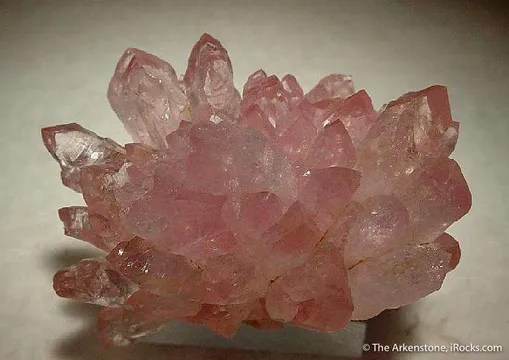
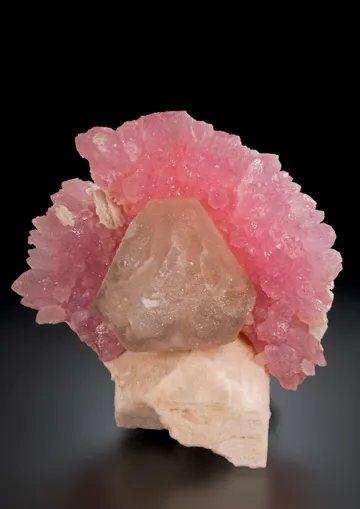
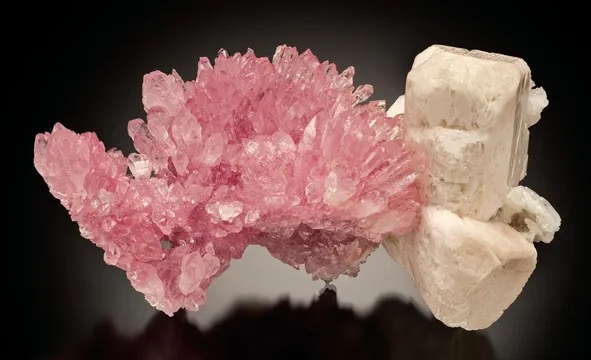
Yet the rose quartz is impossible to ignore. The Berilo Branco claim, a separate occurrence near Sapucaia do Norte, produced the legendary style of specimens in which lustrous pink quartz crystals wrap, fringe, or crown quartz, smoky quartz, albite, feldspar, and mica. At their best, these are not lumps of massive lapidary rose quartz, but true crystallized rose quartz: glassy, sculptural, dimensional, and intensely pink enough to read across a room. The famous Smithsonian “Van Allen Belt” specimen and the auction-record “La Madona Rosa” belong to this Sapucaia do Norte collecting mythology.
Regional View
Country View
For the serious collector, the essential discipline is locality precision. “Sapucaia” on an old label may be historically meaningful, but not always mineralogically exact. Phosphate specimens should generally be understood in relation to the Sapucaia/Proberil pegmatite proper. Classic crystallized rose quartz, especially rose quartz on smoky or milky quartz, most often points to Lavra Berilo Branco, historically confused with Sapucaia because of its proximity to Sapucaia do Norte and its place in the same regional collecting network.

Photo: Wikimedia Commons
Search for specimens: View all specimens from Sapucaia do Norte, Brazil
Sapucaia do Norte is a district of Galiléia, Minas Gerais, in the Rio Doce region of eastern Brazil. The principal scientific locality is the Sapucaia mine, also widely called the Proberil mine or Sapucaia pegmatite. It is positioned east of Governador Valadares and northeast of Galiléia, in the Conselheiro Pena/Aimorés pegmatite district of the Eastern Brazilian Pegmatite Province. The Brazilian Geological Survey records the geosite as a locality of international relevance for mineralogy, and the coordinates used for the Sapucaia pegmatite place it near Linópolis, reached historically by dirt road from that settlement.
Geologically, the Sapucaia pegmatite is a zoned LCT-type granitic pegmatite emplaced in a Neoproterozoic metamorphic setting. The host rocks include sillimanite-staurolite-garnet-mica schists of the São Tomé Formation, with the pegmatite related in regional syntheses to the G2 magmatic supersuite and the broader Araçuaí orogenic system. Field descriptions portray the body as lens- to balloon-shaped, elongated roughly northwest-southeast and dipping steeply to the northeast. Earlier USGS mapping illustrated a symmetrical pegmatite with discrete mica and beryl shoots, workings, an open pit, potassic feldspar masses, and a quartz-rich core.
Modern mineralogical work divides the Sapucaia body into five principal zones. The border zone contains dark shorl-quartz layers alternating with lighter quartz-albite-apatite material. The outer wall zone is dominated by quartz, feldspar, biotite, and muscovite. The inner wall zone contains graphic feldspar with biotite, muscovite, shorl, and beryl. The intermediate or internal zone carries spodumene, locally reported to reach about two meters in length, in a quartz-beryl matrix with yellow mica. The center is a quartz core. That zoning matters because the phosphate assemblages are not randomly distributed display minerals; they are the products of a complex internal evolution of the pegmatite and its phosphate nodules.
The phosphate mineralization begins with triphylite as the essential primary phosphate. Later alteration produced ferrisicklerite and heterosite during oxidation, then hureaulite, barbosalite, tavorite, jahnsite-group minerals, frondelite, and other hydrated phosphates during hydration and meteoric stages. Researchers recognized two phosphate assemblages, both rooted in altered triphylite but developed under somewhat different oxidizing conditions. The result is a locality whose best specimens often reward the microscope as much as the display case: coatings, nodules, seams, botryoids, radiating masses, and tiny crystals of rare species occur in and around altered phosphate pods, albite, muscovite, quartz, and associated pegmatite minerals.
Mining began in the early twentieth century after discovery near the village of Sapucaia do Norte. The most important early production period was during World War II, when the mine supplied industrial beryl and muscovite. After a long quieter interval, the pegmatite returned to activity in the 1980s and 1990s, principally for industrial feldspar, with quartz, beryl, amblygonite-montebrasite, cassiterite, spodumene, mica, and rare mineral specimens as associated products. Brazilian and international geological records do not describe Sapucaia as a public fee-collecting site; any collecting today should be treated as private-property and mineral-rights access only, with the additional caution that old workings, dumps, weathered pegmatite, and phosphate-rich material can be unstable and dusty.
The nearby Berilo Branco claim is the key rose-quartz sublocality. Mindat records it as Lavra Berilo Branco, approximately 3 km east-southeast of Sapucaia do Norte and about 8 km south of Divino das Laranjeiras, in the Aimorés pegmatite district. It is the source connected with the “Van Allen Belt” rose quartz and the locality that corrected a long-standing trade confusion: many specimens long labeled “Sapucaia” rose quartz came not from the Sapucaia phosphate mine proper, but from Berilo Branco. The classic finds include lustrous rose quartz crystals in clusters, frills, wreaths, and palisade-like sprays, often on quartz, smoky quartz, albite, microcline, or muscovite. Fine pieces range from thumbnail and miniature specimens to cabinet and museum-class examples.
Boca Rica, another Sapucaia do Norte claim, is important for a different reason. It is the type locality for lindbergite, a manganese oxalate dihydrate found as minute white prismatic crystals and translucent crusts associated with a phosphate assemblage including triphylite, phosphosiderite, frondelite, strengite, cyrilovite, bermanite, rockbridgeite, hureaulite, tavorite, reddingite, heterosite, and laueite. Boca Rica underscores the broader district pattern: Sapucaia do Norte is not a single-style specimen source, but a cluster of chemically evolved pegmatites where phosphate alteration, rare-element enrichment, and weathering created unusually rich micromineral opportunities.
Quartz from Sapucaia do Norte has to be read in context: at the Sapucaia/Proberil pegmatite it is a major rock-forming and zoning mineral, forming part of the quartz core and the quartz-feldspar-mica framework in which beryl, spodumene, triphylite-derived phosphates, and rare accessory phases occur, while at Berilo Branco it becomes the display partner that gives the rose quartz its architecture. The most desirable Sapucaia do Norte quartz specimens are not ordinary milky pegmatite quartz, but pieces with crisp hexagonal form, pleasing translucency, sharp contrast against albite or feldspar, or dramatic association with rose quartz. Older and dealer labels sometimes describe smoky quartz on Berilo Branco rose-quartz specimens, but smoky quartz from the Sapucaia mine proper has been flagged as an erroneous report, so the best labels preserve the exact sublocality and the visual evidence rather than collapsing every quartz association into “Sapucaia mine.”
Rose quartz is the marquee display mineral of the Sapucaia do Norte area, but the critical attribution is Lavra Berilo Branco rather than the Sapucaia phosphate mine proper. The classic Berilo Branco pieces show true crystallized rose quartz, commonly as lustrous pink crystals, sprays, rosettes, belts, frills, and compact crystal carpets on quartz, smoky quartz, albite, microcline, or muscovite; documented specimens range from thumbnails with millimetric crystals to cabinet pieces around 5–12 cm and museum pieces measured in tens of centimeters. The finest examples combine saturated but natural pink color, glassy luster, individual crystal definition, three-dimensional arrangement, and undamaged exposed terminations. A pale, sharp, pristine rose-quartz cluster can be more desirable than a darker but bruised mass, while the greatest Berilo Branco pieces gain their power from contrast: vivid pink quartz draped across smoky or milky quartz like a sash.
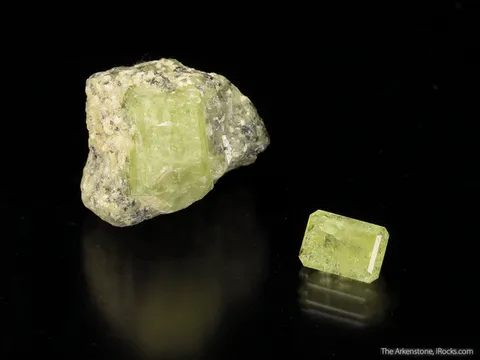
Other documented minerals from Sapucaia do Norte make the district far more than a quartz locality. The Sapucaia mine proper is especially important for phosphate mineralogy, with species including triphylite, ferrisicklerite, heterosite, hureaulite, barbosalite, tavorite, frondelite, faheyite, moraesite, lipscombite, phosphosiderite, strengite, cyrilovite, leucophosphite, variscite, vivianite, rockbridgeite, laueite, bermanite, montebrasite, wardite, childrenite, augelite, and uranium-bearing phosphates such as autunite, saléeite, sabugalite, phosphuranylite, and rutherfordine. Its type-locality list is remarkable: frondelite, faheyite, moraesite, barbosalite, tavorite, lipscombite, ruifrancoite, arrojadite-(PbFe), jahnsite-(NaMnMg), and jahnsite-(MnMnMg) are tied to Sapucaia, while nearby Boca Rica adds lindbergite as another Sapucaia do Norte type-locality mineral.
The single most important collector issue is locality accuracy. A rose-quartz specimen labeled simply “Sapucaia mine” may reflect old and respectable collector usage, but many classic crystallized rose-quartz specimens historically sold as Sapucaia are now assigned more precisely to Lavra Berilo Branco. Keep old labels; do not erase history. But in a modern catalogue, a high-grade rose quartz on quartz, smoky quartz, albite, feldspar, or muscovite from this area should be evaluated for Berilo Branco attribution unless there is contrary provenance.
The second issue is mineral identification in the phosphate material. Sapucaia phosphates are chemically and visually treacherous. Brown, black, greenish, violet, pink, white, and yellow microcrystalline aggregates may represent species that require X-ray diffraction, Raman spectroscopy, or chemical work to identify confidently. Phosphosiderite versus strengite, frondelite versus rockbridgeite-series material, jahnsite-group members, whiteite-group members, ruifrancoite, meurigite, cyrilovite, and altered triphylite products can be difficult even for experienced collectors. Labels naming rare Sapucaia phosphates should be treated as hypotheses unless supported by analysis, a recognized collection pedigree, or a reliable specialist source.
Condition standards differ sharply between the rose-quartz and phosphate sides of the locality. Berilo Branco rose quartz is judged like a high-end aesthetic quartz specimen: exposed crystal tips, edge bruising, contact zones, repairs, trimming, and color strength all matter. The pink crystals often stand proud of the matrix, so even small chips can affect value. Sapucaia phosphate specimens, by contrast, may be naturally earthy, porous, nodular, or microcrystalline; the issue is less “is it glossy and pristine?” and more “is the rare species actually present, stable, well documented, and visible in a meaningful way?”
Treatment and misrepresentation concerns are mostly about names and attributions rather than widespread artificial enhancement. Crystallized rose quartz has been imitated or confused in the broader market by massive rose quartz, pink quartz, dyed material, and vague “Minas Gerais rose quartz” labels. For Sapucaia do Norte prices, insist on true crystal faces and a credible locality trail. Old “avelinoite” labels from the Sapucaia literature should be handled historically, since avelinoite is no longer accepted as a valid species. Uranium-bearing phosphates documented from the Sapucaia mine are not casual handling specimens; keep them labeled, avoid grinding or generating dust, wash hands after handling, and store radioactive micromounts and small specimens sensibly.
Market availability is uneven. Good Berilo Branco crystallized rose quartz appears only intermittently and is strongly competed for, especially when color, luster, crystal definition, and old provenance align. Small, attractive specimens can still surface through dealers and auctions, but top examples have moved into major private and museum collections. Sapucaia phosphate specimens are more available in micromount and rare-species circles than in general display-mineral cases, yet analytically confirmed type-locality rarities remain specialist material. A specimen that combines a credible Sapucaia label, rare phosphate identity, and attractive crystallization deserves careful attention.
The earliest scientific romance of Sapucaia is not pink at all, but brown, black, green, and violet: the colors of altered phosphate nodules that puzzled and rewarded mid-century mineralogists. During the 1942–1945 wartime investigations of the Minas Gerais mica belt, joint field parties of the U.S. Geological Survey and Brazil’s Departamento Nacional da Produção Mineral examined the Sapucaia property as one of many mica and beryl producers. W. T. Pecora and A. L. de M. Barbosa collected and examined a suite of unusual specimens in Rio de Janeiro, and the material was later turned over to Marie Louise Lindberg for full identification. From that work came a cascade of new mineral descriptions. By the early 1950s Sapucaia had become a locality that could produce not merely good specimens, but new vocabulary for mineralogy.
The rose-quartz story belongs to nearby Lavra Berilo Branco, and it began with a seam that sounds almost too small for the legend it created. In the late 1950s, miners working the small mine informally called “Sapucaia” because of its proximity to the village opened pockets of crystallized rose quartz. Then they struck a richer zone: only about six inches wide and 12 inches high, but running for roughly 16 feet. It was filled with deep pink quartz crystals draped over golden smoky quartz. From that narrow space came the visual language of Berilo Branco rose quartz: pink belts, ribbons, and halos on quartz hosts, unlike the massive lapidary rose quartz most collectors had known.
The great named survivor is the “Van Allen Belt.” Its name is not poetic exaggeration; the specimen is a smoky quartz crystal encircled by a belt of lustrous deep pink rose-quartz crystals, an earthly mineral echo of the radiation belts around the planet. It was mined at Berilo Branco and donated to the Smithsonian by Fred C. Kennedy. For collectors, it became a standard of comparison. When a Berilo Branco specimen shows a wreath or sash of pink crystals around quartz, every serious observer feels the pull of that Smithsonian image.
Another Berilo Branco icon, “La Madona Rosa,” carried the story into the public auction world. The specimen stands about 15.5 by 8 inches, roughly 40 by 20 cm, with rose quartz outlining a smoky quartz body in a form that suggested traditional depictions of the Madonna. Its provenance is tangled in the way great old minerals often are. One account places it in the original 1959 Berilo Branco discovery; another says it surfaced in Brazil in 1972, when the mine was still being worked sporadically. It went to a London gemstone collector in 1972, then to a U.S. gem collector in 1977, where it reportedly remained for two decades without its full significance being recognized. At the 1997 Tucson Gem & Mineral Show, knowledgeable eyes finally understood what it was. After cleaning and careful trimming, it entered the Hoppel Collection and, on June 2, 2013, sold through Heritage Auctions for $662,500.
There is also a quieter correction story, important to every label-conscious collector. For years, the earliest great crystallized rose quartz was called “Sapucaia” in the trade. Later locality work, including the Mineralogical Record treatment of Lavra Berilo Branco, separated the Berilo Branco rose-quartz occurrence from the Sapucaia phosphate pegmatite. The correction did not diminish the specimens; it sharpened them. A label that reads “Sapucaia” may be part of a specimen’s life history, but the more exact modern name, Berilo Branco claim, Sapucaia do Norte, Galiléia, Minas Gerais, tells the fuller truth.