






A collector's guide to Rock Candy Mine, Canada: its geology, mining history and notable minerals, illustrated with the 29 specimens documented from this locality on EarthWonders.
Key facts
Rock Candy Mine is one of Canada’s classic fluorite specimen localities and the best-known fluorspar occurrence in British Columbia. Tucked in the wooded Kennedy Creek country north of Grand Forks, it is not a large polymetallic mine in the usual Boundary District sense; its collector importance rests on a distinctive epithermal barite-fluorite-quartz vein system associated with Eocene volcanic rocks and nearby Coryell syenite. The mine produced fluorspar and silica commercially, but its afterlife has been even more important to collectors: plates of apple- to emerald-green fluorite, lavender to purple fluorite, honey-yellow to colourless tabular barite, and sparkling drusy quartz overgrowths form a suite instantly recognizable on a show table.
The deposit is a north-trending fracture-zone system rather than a single simple vein. In and around the workings, closely spaced subparallel veins occupy altered andesitic volcanic rocks adjacent to syenite; the veins pinch, swell, brecciate, and open into vugs. That structure is precisely why Rock Candy specimens can look so varied. Some are massive green fluorite with only modest form; some are botryoidal or stepped purple fluorite; the best pieces preserve octahedral outlines, green-over-purple or clear-over-green phantoms, or golden barite standing cleanly on fluorite, sometimes with a glittering quartz frost that makes the whole surface sparkle.
Regional View
Country View
For collectors, Rock Candy sits in a special middle ground between ore-deposit geology and display-case aesthetics. The commercial record is substantial enough to make the locality historically important, while the vugs and open-space fillings produced specimens refined enough for serious mineral cabinets. Its finest examples are not razor-sharp in the way of some alpine or Chinese fluorites; their appeal is more idiosyncratic: satiny stepped octahedra, translucent green masses glowing through white quartz, lavender fluorite that looks built from stacked cubes, and baryte plates that can be pale blue-grey, honey-yellow, or nearly colourless depending on generation and pocket.

Photo: Pacific Museum of Earth via Wikimedia Commons


Search for specimens: View all specimens from Rock Candy Mine, Canada
Rock Candy Mine is on Kennedy Creek, approximately 27 kilometres north of Grand Forks in the Greenwood Mining Division of southern British Columbia. The main showing lies on wooded slopes north of Kennedy Creek, roughly between 790 and 880 metres elevation. The provincial MINFILE record classifies the deposit as a past producer of fluorite and silica, with copper and lead also listed among commodities reported from the property, and places it in the Omineca Belt, Quesnel terrane.
Geologically, Rock Candy is a barite-fluorite vein and silica-vein system developed in altered volcanic rocks near syenitic intrusions. The area around Kennedy Creek is underlain by Eocene volcanic rocks assigned to the Penticton Group, Marron Formation—andesites, dacites, and trachytes—intruded by syenite and monzonite of the Eocene Coryell plutonic suite. The fluorite veins occupy a silicified, north-trending fracture zone with moderate to steep westerly dips. Fine-grained syenite dikes cut the andesites near the deposit, and the eastern side of the vein system is close to massive pink Coryell syenite.
The developed mineralized zone extends approximately 200 metres north from Kennedy Creek and reaches about 15 metres in maximum width. Individual veins range from a few centimetres to about 10 metres wide, though older descriptions emphasize that many veins were narrow, discontinuous, closely spaced, and separated by altered horses of country rock. At surface near the old workings, a large vein exposure includes a 3- to 4-metre width dominated by massive fluorite, bordered to the west by a 1.5- to 2-metre fluorite-matrix breccia and a thin banded margin against altered volcanic country rock.
The main vein material is chiefly coarse apple-green to emerald-green fluorite with some pale purple fluorite, cut by vuggy quartz veins. The breccia zone contains altered volcanic fragments in a matrix of purple and green fluorite, chalcedony, kaolin, pyrite, quartz, and calcite. Along the banded western margin, crystalline and massive barite occur with calcite, fluorite, chalcedony, and quartz. Older reports also record chalcopyrite, galena, chalcocite, and covellite, although these sulphides have not been a prominent feature of modern collector specimens.
The open spaces made Rock Candy famous. Historical and geological reports describe vugs more than one metre across within the mine, some filled with white kaolin and others lined with crystals of barite, quartz, calcite, and fluorite. This is the setting for the best specimens: fluorite surfaces not simply broken from massive ore, but lined or overgrown in open pockets, with later quartz and barite generations providing contrast and relief. A northern exposure about a kilometre from the main workings shows a 1-metre vein of pale purple and pale green fluorite cut by quartz, including breccia of angular fluorite fragments cemented by small quartz crystals and abundant small quartz-lined vugs.
The discovery story has two versions in the published collector literature. The government record says the deposit was discovered in 1916 by two prospectors who mistook green fluorite for copper mineralization. Collector accounts preserve a more colourful alternate version in which Ruth Stout found translucent green stone in a mountain creek, first thinking it might be jade; once it was identified as fluorite, the Rock Candy Mine followed. In either telling, the key fact is the same: the green mineral was strange enough in the Boundary country to attract attention before its economic identity was understood.
Consolidated Mining and Smelting Company of Canada Limited acquired the property in 1918 after earlier work by the Stewart-Calvert Company of Oroville, Washington. A small shipment was made in 1918, a mill was operating in 1919, and ore and concentrates went to the Trail smelter. The property worked intermittently through 1929, with another recorded production year in 1942. The MINFILE production summary totals 56,018 tonnes mined and 38,471 tonnes milled, yielding 36,759,501 kilograms of fluorite and 1,673,000 kilograms of silica. Concentrates reported for 1919 to 1921 assayed in the mid-80s percent CaF2 with low silica, reflecting the mine’s original industrial purpose.
Mining was carried out through two adits using shrinkage-stope methods. Ore was moved by aerial tramway toward the Granby River valley, roughly 4 kilometres east of the mine site, and from there was shipped for use at Trail. By the late twentieth century the adits were no longer open to casual underground access; government summaries note that they remained open until the early 1980s and were then blasted closed. Later ownership and specimen recovery shifted the emphasis from fluorspar production to mineral collecting, with guided trips and fee collecting documented during the Bob Jackson and Geology Adventures era.
Access has never been equivalent to an open public dump. The mine is a historic industrial site with crown-granted mineral rights and documented private or commercial specimen operations at different times. Modern visitors should treat the locality as permission-only and should not attempt to enter adits, disturb closures, or collect without a current arrangement with the property or trip operator. The old collecting reputation is real, but the best material has generally come from controlled work in vugs and fresh rock, not from casual roadside picking.
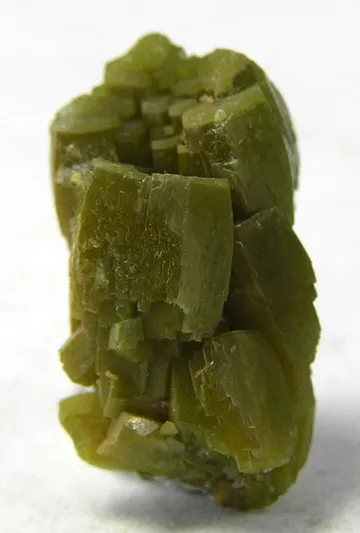
Fluorite is the defining mineral at Rock Candy, occurring as apple-green to emerald-green, pale purple, lavender, colourless, and locally zoned material in veins and vugs. The most characteristic collector habit is octahedral, commonly with stepped growth made up of oriented cube faces, especially along crystal edges; botryoidal and cubic purple fluorite also occur, as do phantom pieces showing green over purple or clear over green. Crystals can range from small drusy or microcrystalline surfaces to multi-centimetre octahedra, and old specimen descriptions record green fluorite crystals to about 4 cm and fluorite plates exceeding cabinet size. The best pieces are those with evident crystal form rather than massive ore texture, saturated green or attractive purple colour, translucency, clean zoning, and balanced associations with tabular barite or drusy quartz; ordinary pieces tend to be massive, bruised, clay-stained, or lacking open-space crystal faces.
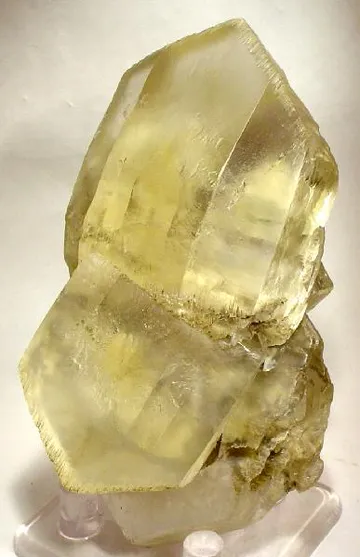
Barite from Rock Candy is prized for tabular crystals perched on fluorite, most famously honey-yellow to golden plates on green or purple fluorite, though colourless, grey, and pale blue-grey examples are also documented. The crystals may be blocky-tabular, platy, diamond-shaped, or stacked in clusters, commonly a few centimetres across; published collector accounts record modern fine crystals around 4 inches tall, museum-displayed examples from the mine, and early reports of barites up to 8 inches end to end. The finest barite specimens are not merely large: they have isolated, undamaged plates standing upright or in well-spaced groups on contrasting fluorite, with translucency, sharp terminations, and a pleasing colour contrast. Lesser pieces are more opaque, crowded, edge-worn, or embedded in massive fluorite or kaolin-rich matrix.
Quartz at Rock Candy is usually important as an aesthetic partner rather than as a standalone species, occurring as vug-lining druse, small clear to white crystals, chalcedony in breccia and banded margins, and later quartz veins cutting fluorite. Fine collector pieces show a sparkling white quartz crust over green fluorite octahedra, preserving the underlying fluorite geometry while adding brilliance; others place drusy quartz as the glittering base for barite and fluorite combinations. The best quartz-bearing specimens are those in which the quartz is clean, bright, and thin enough to reveal green or purple fluorite beneath, or forms a sparkling matrix without smothering the main crystals. Heavy opaque quartz coatings, clay-filled pockets, or fractured vein quartz are much less desirable unless they preserve unusually clear fluorite outlines.
Other minerals documented from Rock Candy include calcite, chalcedony, kaolinite, pyrite, and minor reported sulphides such as chalcopyrite, galena, chalcocite, and covellite. The country rocks and adjacent Coryell syenite add a broader geological mineral suite—actinolite, albite and oligoclase, orthoclase, microcline var. hyalophane, augite, biotite, hornblende-group minerals, magnetite, titanite, zircon, apatite, epidote, chlorite-group minerals, muscovite, and sericite—but these are mostly geological context rather than collector attractions. I found no verified type-locality mineral from Rock Candy Mine itself; its importance is specimen quality and fluorspar history, not new-species mineralogy.
Rock Candy specimens are most often recognized by their colour combination and textures: green or purple fluorite with stepped or octahedral form, honey-yellow to pale barite, and white sparkling quartz. The most common mislabelling risk is generic “Canadian fluorite” being upgraded to Rock Candy without adequate provenance, or confusion with other British Columbia fluorite occurrences whose geology and appearance differ. Rock Canyon Creek, sometimes nicknamed “Deep Purple,” is a separate fluorite-REE locality in southeastern British Columbia and should not be confused with Rock Candy near Grand Forks.
No persistent, well-documented fake industry is associated with Rock Candy Mine specimens, but collectors should still be alert to repaired barite plates and glued crystal clusters. Thin tabular barite is vulnerable along edges and attachment points, and the attractive plates are exactly where damage is most obvious. Green fluorite can be bruised, cleaved, or dulled; many pieces have satiny rather than glassy luster by nature, so quality should be judged by form, translucency, colour, composition, and absence of fresh chips rather than by expecting mirror-bright faces.
Clay is part of the locality’s story. Kaolin-filled vugs are documented, and clay can remain in crevices around barite and quartz. Gentle cleaning is preferable: avoid aggressive acid or harsh mechanical cleaning on mixed fluorite-barite-quartz specimens unless you know exactly what you are removing. Fluorite is soft enough to scratch, cleaves readily, and can chip under vibration; barite is heavy, brittle, and prone to edge loss. Specimens should be packed so that barite plates do not touch box walls or neighboring pieces.
Fluorescence is a legitimate point of interest for Rock Candy fluorite. Published specimen notes and collector discussions report fluorescent responses under ultraviolet light, including longwave and shortwave reactions on some green fluorite, and a Wikimedia-documented miniature is described as showing white and purple fluorescence. Fluorescence should be treated as an added diagnostic and display feature, not as a guarantee of origin; provenance, habit, matrix, and association remain more important.
On the market, Rock Candy is available but not abundant in top quality. Massive green fluorite and small quartz-coated pieces appear more often than balanced barite-on-fluorite combinations. Fine older specimens with sharp or sculptural fluorite, transparent or honey-coloured barite, old collection labels, or documented collection dates from the 1970s, 1980s, or named pocket work command much stronger interest. Large plates are especially condition-sensitive and should be evaluated under good light from multiple angles.
The most retold Rock Candy story begins not with a mining engineer, but with a mistaken stone. Ruth Stout found a piece of translucent green mineral in a mountain creek and thought it might be jade. That mistake matters because it captures the mine’s visual character better than a production table can: Rock Candy fluorite really can look like water-worn green glass or jade to an unprepared eye. Once the stone was identified as fluorite, the locality moved quickly from curiosity to mine, and by 1918 the deposit was in production.
The more official discovery story is less romantic but equally telling. In that version, two prospectors in 1916 mistook the green fluorite for copper mineralization. A collector today may smile at that, but in the Boundary country, with its copper-gold mining history, green secondary copper minerals would have been a natural mental shortcut. The error did not diminish the find. Once the mineral was correctly recognized, Consolidated Mining and Smelting Company took up the property, installed a tramway and mill, and turned a strange green vein system above Kennedy Creek into British Columbia’s most important fluorspar producer.
By the late twentieth century, Rock Candy had become a collecting locality rather than a smelter feed. Bob Jackson’s Geology Adventures is central to that second life. Trips to the mine were described as productive and exciting, with collectors extracting plates of fluorite, barite, and drusy quartz under controlled access rather than wandering a derelict industrial site. The mine’s best plates could be startlingly large. One collector account reports that some plates weighed up to 150 pounds, and that early barite crystals were said to reach 8 inches in length. Even allowing for the romance that often gathers around famous localities, the physical point is clear: Rock Candy pockets were capable of producing display-scale specimens, not just thumbnails and hand pieces.
The most memorable Rock Candy specimens are often described as small mineral landscapes. One account singled out a plate with botryoidal purple fluorite on one side, two large green pyramidal fluorite crystals in the centre, a sparkling drusy quartz frost, and butterscotch-coloured barite on the lower edge. Lit from below, the colours became rich and vivid. That sort of specimen explains why Rock Candy has stayed in collector memory: the mine’s mineralogy is not complex, but the combinations can be theatrical.
A quieter but very human detail appears in the geological literature. In the acknowledgments to the British Columbia Geological Survey’s 1988 fluorspar study, the authors thanked Cominco for access to company files and Lee Whimey, caretaker at Rock Candy Mine, for “helpfulness, chestnuts and cherry tomatoes.” It is the sort of sentence that makes a locality feel inhabited rather than abstract: a government field season, old company files, a caretaker at a closed fluorspar mine, and garden food shared in the mountains above Grand Forks.
.jpg)


.jpg)