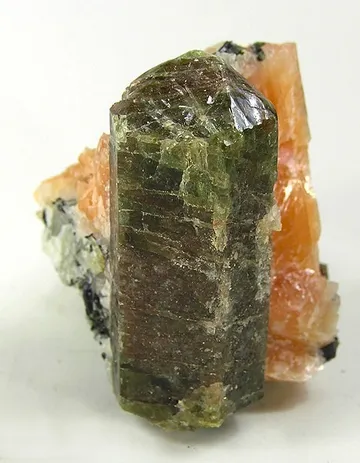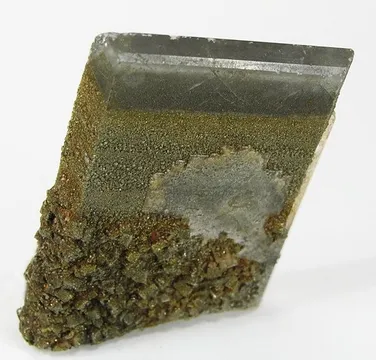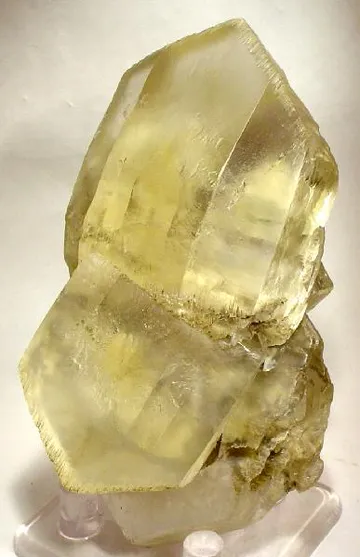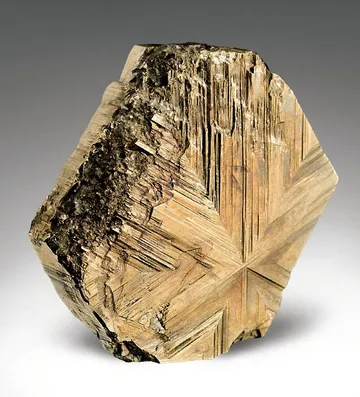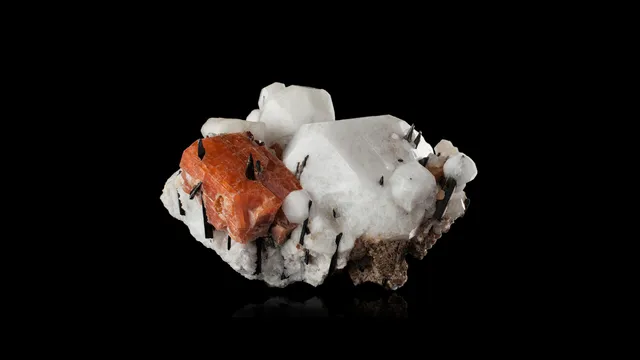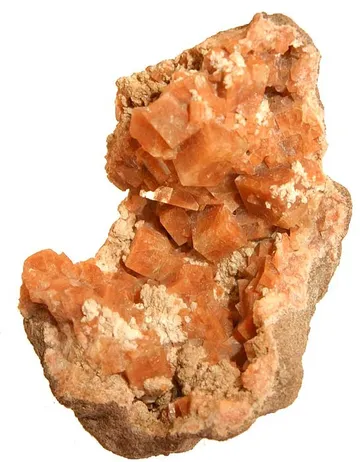
Cumberland County, Nova Scotia — famed Wasson Bluff zeolites, especially salmon-orange chabazite on white heulandite; a premier locality prized by collectors.
Key facts
Cumberland County, at the head and north shore of the Bay of Fundy in Nova Scotia, is one of the classic collecting districts for Canadian zeolites. The specimens most collectors mean when they use the old shorthand “Parrsboro zeolites” come from this coast: Wasson Bluff, Two Islands, Partridge Island, Cape Sharp, Cape d’Or, Horseshoe Cove, and the wave-cut exposures and boulder beaches between them. The setting is the Fundy rift basin, where the roughly 201-million-year-old North Mountain Basalt and associated early Jurassic sedimentary rocks are cut, tilted, brecciated, and constantly refreshed by the highest-energy tidal shoreline in eastern Canada. Vesicles, joints, fault breccias, and open spaces in basalt clasts became the chambers in which hot, mineral-rich fluids deposited chabazite, heulandite, stilbite, analcime, natrolite, gmelinite, calcite, quartz, and locally native copper.
For specimen collectors, Cumberland County’s signature is not simply “zeolites in basalt,” but a very recognizable look: salmon-orange to brick-red chabazite rhombs and penetration twins perched on pearly white to colourless heulandite, commonly accompanied by orange stilbite or sharp calcite. Good pieces have a compact, architectural quality—hard basalt matrix or a thin heulandite plate supporting isolated, lustrous chabazite crystals rather than a rubbed beach cobble of mixed zeolite. The finest Wasson Bluff chabazites are widely treated as world-class for the species group, and their colour—flesh-pink, salmon, orange-red, sometimes with gemmy terminations or curved zoning—is distinct enough that experienced Canadian collectors often recognize them at a glance.
Regional View
Country View
Historically, Cumberland County bridges two collecting traditions. One is the 19th- and early 20th-century fame of Nova Scotia zeolites, long before the Deccan basalt quarries of India reshaped the market for display specimens. The other is the older mining and prospecting history of the county: native copper at Cape d’Or, the Colonial Copper Company workings, coal at Springhill and Joggins, salt and gypsum elsewhere in the county, and a long-lived local culture of beach collecting, museum curation, and amateur-to-professional collaboration. The zeolites themselves were never mined as an ore here; they are specimens from coastal cliffs, basalt breccias, talus, veins, and tide-sorted beach material.

Photo:

Search for specimens: View all specimens from Cumberland Co., Canada
Cumberland County’s collectible zeolite deposits are hydrothermal cavity and vein occurrences in the North Mountain Basalt and in basaltic debris incorporated into the overlying early Jurassic sedimentary rocks of the Fundy basin. At Wasson Bluff, the most important collector locality in the county for chabazite-heulandite specimens, basalt, basalt breccia, sandstone, mudstone, and fault-related talus deposits are exposed in a spectacular coastal section. The outcrop is famous geologically because it preserves the Triassic-Jurassic transition and early Jurassic vertebrate fossils, but to mineral collectors the same faults, breccias, and open spaces are important because they created pathways and voids for zeolite-bearing fluids.
The principal zeolite assemblages vary from locality to locality along the Cumberland shore. Wasson Bluff is dominated by chabazite, stilbite, and heulandite, with documented analcime, natrolite, gmelinite, clinoptilolite, stellerite, thomsonite, calcite, quartz, and baryte. Two Islands is especially noted for analcime with gmelinite, chabazite, stilbite, and natrolite. Partridge Island is best known for chabazite and stilbite, with analcime, epistilbite, natrolite, barrerite, and heulandite. Cape Sharp carries a related suite of chabazite, stilbite, barrerite, stellerite, heulandite, natrolite, calcite, quartz, and amethyst. Cape d’Or adds a strong copper note to the county’s mineralogy: analcime, stilbite, natrolite, mesolite, chabazite, heulandite, stellerite, thomsonite, wairakite, quartz, malachite, magnetite, and native copper are all part of the broader Cape d’Or story.
In outcrop, the zeolites occur in several textures that matter to collectors. The most familiar are amygdules in basalt: once gas bubbles in lava, later lined or filled by zeolites, quartz, calcite, and clay minerals. Better display specimens tend to come from larger cavities, fracture zones, and breccias where crystals could grow with free faces. At Wasson Bluff, zeolites occur not only in basalt but also in basalt clasts within the McCoy Brook Formation and in fault-breccia settings; some vugs show multiple generations of sediment infill and later zeolite growth. This is why some pieces have an unusually complex look, with chabazite and heulandite on basalt fragments, zeolite-cemented breccia, or zeolite-lined cavities in sediment-matrix material rather than a simple basalt amygdule.
The county’s mining history is separate from most zeolite collecting but essential to understanding its older mineral reputation. Cape d’Or was famous to Indigenous peoples and early Europeans for native copper in basalt. The Mi’kmaq used copper and chert from the area long before European mining attempts. Samuel de Champlain saw copper at Cape d’Or in 1607, and the “golden” appearance of the metal contributed to the name Cape d’Or. The serious industrial attempt came later: J. A. Hanway formed the Colonial Copper Company in 1897, and the company developed shafts, drifts, a concentrating plant, a wharf at Horseshoe Cove, a narrow-gauge railway, offices, houses, boarding facilities, and an assay laboratory. By 1900, three mining areas were active. The main Hanway workings included inclined shafts and hundreds of metres of underground development, but the ore disappointed; mining stopped in December 1907 after only modest copper production.
For collectors today, Cumberland County is best approached as a tide, safety, and permission locality, not as an open quarry district. Wasson Bluff is a protected fossil site under Nova Scotia’s Special Places Protection Act, and fossil collecting or hammering on protected outcrops is not casual collecting. All fossils in Nova Scotia are regulated, and the Fundy Geological Museum remains the proper point of contact for guided experiences, reporting discoveries, and understanding current rules. Mineral collecting at any coastal site must also respect private land, park or municipal management, beach-removal rules, and the obvious but often underestimated hazards of Fundy tides and unstable cliffs. At Cape d’Or, access to the classic copper-bearing shoreline near the old Colonial Copper Mine has traditionally required either a boat or a steep descent to the shore, and the tidal window is severe. In 2026, Cape d’Or is being operated by the Municipality of Cumberland as a managed heritage and tourism destination, with an emphasis on guided interpretation, trails, and stewardship rather than unrestricted use of the site.
The notable specimen finds most often discussed by collectors are the Wasson Bluff chabazite-heulandite pockets and beach finds. Old and recent specimens show sharp chabazite-Ca crystals, commonly around a few millimetres to about 1 cm and occasionally approaching 2 cm on exceptional miniatures, on thin plates or druses of heulandite-Ca. More common material consists of densely lined vugs or worn pieces from tide-sorted beach stones. The best pieces are those rescued before the surf and freeze-thaw cycle dulls the luster: fresh salmon-orange rhombs, intact penetration twins, attractive heulandite plates, little or no bruising, and a balanced association with calcite or stilbite.
Cumberland County chabazite is most celebrated from Wasson Bluff, where it forms salmon-orange, red, pink, and white rhombohedrons, simple penetration twins, and rare contact twins in basalt cavities, fault breccias, and zeolite-cemented openings along the Fundy shore. The classic Wasson Bluff look is orange to flesh-pink chabazite-Ca on colourless to pearly heulandite, often with orange stilbite or small calcite crystals; individual crystals are commonly in the millimetre range, while the finest thumbnails and miniatures may carry sharp crystals around 1 cm and rare showpiece crystals approaching 2 cm. Good Cumberland pieces are set apart by fresh luster, strong salmon-orange colour, crisp rhombic form, undamaged edges, and a matrix or heulandite plate that displays the crystals cleanly; ordinary examples are usually dense vug linings, rubbed beach pieces, or dull, etched crystals still interesting as locality material but lacking the snap that made Wasson Bluff famous.
Heulandite from Cumberland County, especially Wasson Bluff, is typically white, colourless, pearly, or glassy and occurs as drusy linings, platy crystal coatings, and individual tabular crystals in small vugs with chabazite, stilbite, calcite, analcime, and basalt. It is rarely the loudest mineral on a specimen, but it is one of the keys to the locality’s best aesthetics: a lustrous heulandite carpet or thin plate can make salmon chabazite look dramatically richer, and isolated heulandite crystals to roughly 8–12 mm have been documented from recent low-tide finds. Collectors should look for pieces where the heulandite is lustrous and intact rather than chalky or bruised; the best examples show clean, pearly, transparent to translucent faces and an association that is unmistakably Cumberland—chabazite-Ca and stilbite-Ca on a basaltic matrix from the Wasson Bluff-Two Islands area.
Other documented Cumberland County minerals broaden the locality well beyond chabazite and heulandite. The Bay of Fundy basalt localities record analcime, natrolite, stilbite, gmelinite, barrerite, stellerite, epistilbite, clinoptilolite-Ca, thomsonite-Ca, mesolite, scolecite, wairakite, quartz, amethyst, chalcedony, calcite, baryte, magnetite, malachite, and native copper. Cape d’Or is the county’s most distinctive rarity locality because it combines zeolites with native copper and secondary copper minerals; rare specimens show copper passing through colourless chabazite or calcite, with cuprite, malachite, or chrysocolla staining and coating the copper. Cumberland County also reaches inland into a different mineralogical world: the Wentworth plutonic complex and West Moose River Pluton of the Cobequid Fault Zone have documented rare-earth and uranium-related mineralization, including cerianite-(Ce), bastnäsite-(Ce), allanite-(Ce), monazite-(Ce), and associated alteration minerals. The county is therefore a collector’s district in two senses: a world-class zeolite shoreline and a historically rich mineral county with copper, coal, salt, gypsum, and rare granitic-mineralization records.
The most common authenticity problem with Cumberland County zeolites is not outright fakery but mislabelling. Specimens labelled simply “Parrsboro,” “Bay of Fundy,” or “Nova Scotia” may in fact come from Wasson Bluff, Partridge Island, Cape d’Or, Cape Sharp, Five Islands, or localities on the opposite side of the basin. For high-grade chabazite, “Wasson Bluff” should be used carefully, because the best pieces have a recognizable look but not every salmon zeolite from Nova Scotia can be assigned to the bluff without old labels, collection history, or field documentation. Another known problem is species confusion: chabazite, gmelinite, and related zeolites can be difficult to distinguish visually, and modified or twinned chabazite from Wasson Bluff has sometimes been labelled as gmelinite. For serious labels, “chabazite-Ca” and “heulandite-Ca” are preferable when analytical support exists; older labels using “chabazite,” “heulandite,” or obsolete variety names should be preserved but not overinterpreted.
Condition is the main market separator. Fundy specimens are exposed to salt water, strong tides, freeze-thaw action, cliff fall, and beach abrasion. Many otherwise attractive pieces have bruised crystal edges, dulled luster, etched chabazite faces, fractured rhombs, or friable basalt. Freshly opened vugs and protected pocket pieces are much better than rolled beach stones. Heulandite can be cleaved, bruised, or chalky, and stilbite sheaves often show worn terminations. Calcite associations should be checked for contact damage and for iron or manganese oxide staining. A thin black coating of wad is known on some chabazite specimens from Wasson Bluff; it can be natural and locality-specific, but heavy coatings may obscure the crystal quality.
No well-documented treatment tradition is associated with Cumberland County zeolites. Cleaning is usually mechanical and conservative: removal of loose clay or salt, careful rinsing, and drying rather than acid work. Acid can damage calcite associations and may change the visual balance of a specimen; aggressive cleaning can also loosen crystals from weathered basalt. Because many pieces originate on sea cliffs or beaches, salt should be leached gently from robust specimens, but delicate zeolites should not be soaked casually for long periods without testing a small area. Fluorescence is not a major selling feature for the chabazite-heulandite assemblage here, though associated calcite from Nova Scotia localities may respond variably; the locality’s value is colour, form, association, and provenance.
Rarity on the market is tiered. Small Cumberland County chabazite, stilbite, and heulandite specimens appear with some regularity from old collections and modern casual finds. Fine Wasson Bluff chabazite on bright heulandite matrix is much less common, particularly if the crystals are sharp, lustrous, vivid orange-red, undamaged, and well displayed. Large, clean, aesthetic miniatures are genuinely scarce. Cape d’Or native copper with zeolites is a separate specialty: attractive copper-chabazite-calcite combinations, especially where copper is visible through colourless zeolite crystals, are far less available than ordinary Bay of Fundy zeolite pieces and should retain detailed locality data whenever possible.
Cape d’Or is the county’s great mineral story of misplaced expectations. Long before companies and assay offices arrived, the Mi’kmaq knew the headland as a source of copper and chert. The metal was workable without smelting, and the chert gave sharp edges for tools. When Champlain sailed the Fundy coast in 1607, the copper in the basalt cliffs appeared golden enough to help give the cape its name. “Cape of Gold” was a romantic name for what proved to be a copper locality, and even that copper would later frustrate industrial hopes.
The Colonial Copper Company chapter reads like a mining boom compressed into a sea-cliff theatre. J. A. Hanway organized the company from New York in 1897 and poured major capital into a place with few roads and immense tides. A wharf had to be built at Horseshoe Cove because people, supplies, and ore moved most easily by water. By 1900 there were three mining areas. Shaft No. 1 reached 113 metres, with short drifts at 66 and 110 metres. The Hanway workings, the main centre of activity, had two inclined shafts—one driven north for 150 metres and one south for 200 metres—and more than 243 metres of underground tunnels. Bennett Brook had a 55-metre shaft and 90 metres of drifts, but water leaks from the ravine beside the brook made mining difficult. Above the roaring tide line stood a concentrating plant, mine offices, an assay lab, miners’ homes, boarding houses, a lodge, and a narrow-gauge railway connecting the workings to the mill.
The numbers at the end of the story are brutal. Mining stopped in December 1907. After all the shafts, drifts, buildings, railway, wharf, and investment, only 1,971 tons of ore had been mined and processed, yielding 12,320 pounds of copper. The mine buildings were scattered after closure: some were barged away to other Fundy communities, others were dismantled for timber or brick, the mine train was sold to the Newfoundland Railway, and the mill equipment went for scrap. Later, when the caretaker’s house burned, detailed production records and documents were lost with it. Today, collectors who work the Cape d’Or coast are reading the remains of that story in a very different way—not as a mine, but as a dangerous, beautiful cliff locality where native copper, cuprite, malachite, chabazite, calcite, and other zeolites still weather from basalt.
Modern collecting at Cape d’Or has its own ritual, and it begins with humility before the Bay of Fundy. The classic copper locality east of Horseshoe Cove is not a casual roadside stop. Access has been described as either by boat or by a steep descent through the cliffside, where ropes and ladders may be necessary. The tide can be about 17 metres, roughly 50 feet, and the collecting window is unforgiving. The safe rhythm is to arrive after the tide begins to fall, work the base of the cliffs, and be gone before the water returns. That is not romantic exaggeration; being trapped under those cliffs as the tide rises is a real danger.
Wasson Bluff tells another kind of story: minerals and fossils sharing the same violent geology. The zeolite collector sees basalt cavities, breccias, faults, and vugs; the paleontologist sees the early Jurassic world after the end-Triassic extinction. In 1984, Neil Shubin found the jaw of a trithelodont, a mammal-like reptile, at Wasson Bluff—the first such discovery in North America. The following summer, Shubin, Paul Olsen, Hans-Dieter Sues, William Amaral, Charles Schaff, and Steven Orzack uncovered twelve complete trithelodont skulls along with teeth of small ornithischian dinosaurs, sphenodontid skulls, ancestral crocodile remains, fish, and shark material. That fossil importance is why the area is protected and why mineral collectors must treat the place as a scientific site first and a specimen locality only where collecting is lawful and responsible.
The same coastal collecting culture produced one of Nova Scotia’s best-known amateur figures, Eldon George of Parrsboro. After a childhood injury left him unable to join other children in sports, he turned to the beaches and cliffs near home, teaching himself rocks, minerals, fossils, and gemology. In 1948 he opened the Parrsboro Rock and Mineral Shop and Museum, where generations of visitors encountered Fundy minerals and fossils. His finds included dinosaur and amphibian tracks, including some of the world’s smallest dinosaur tracks. In 2015, he donated his collection for display at the Fundy Geological Museum, closing the loop between beachcombing, amateur passion, and institutional science.