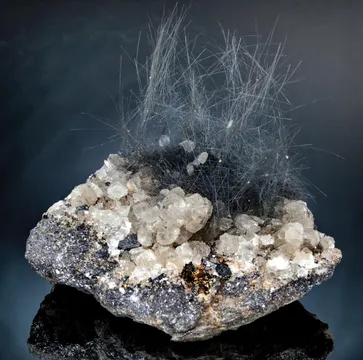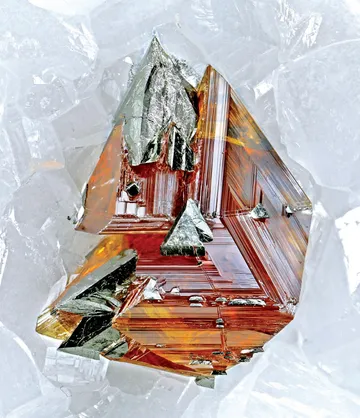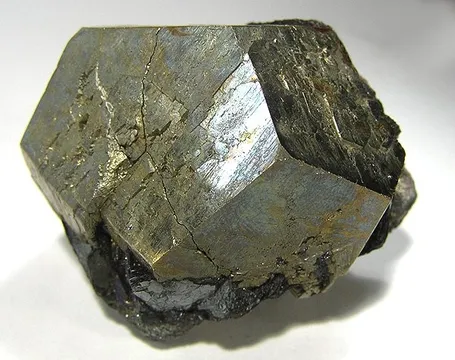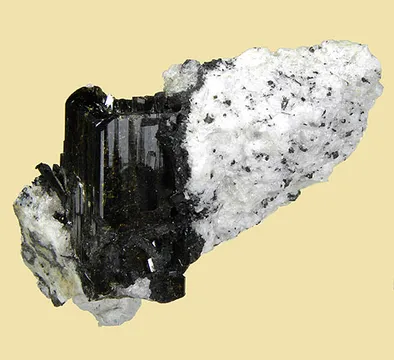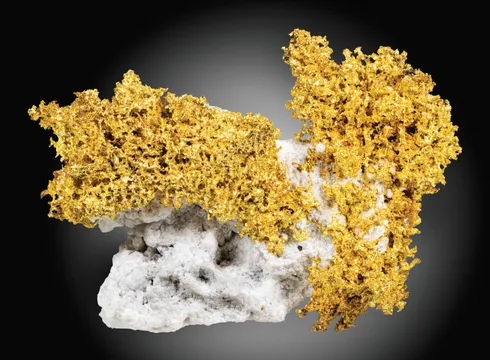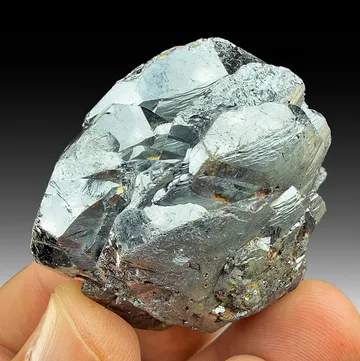
Rio Marina, Italy — a classic Elba iron locality famed for lustrous hematite crystals, pyrite on dark matrix, and ilvaite type locality, prized by collectors.
Key facts
Rio Marina is one of the classic iron localities of the Mediterranean: a mine town on the eastern coast of Elba where collectors think first of mirror-black hematite, brassy pyrite, ochre limonite, and the red-stained open pits climbing immediately behind the village toward Monte Giove. The Rio mine is the historic heart of the Rio Marina–Rio Albano iron district, and its specimens carry the look of a place where ore geology, industrial history, and cabinet mineralogy are almost inseparable. The main collector assemblage is hematite–pyrite–limonite, with quartz, calcite, adularia, epidote, fluorite, galena, sphalerite, chalcopyrite, bismuthinite, and a suite of secondary bismuth and sulfate minerals appearing in particular stopes and alteration zones.
Geologically, Rio Marina sits in the complicated nappe stack of eastern Elba, where Paleozoic to Triassic metasiliciclastic rocks, Verrucano-type formations, carbonate slices, fault zones, and late Miocene magmatic-hydrothermal activity all played roles in concentrating iron. The classic upper ores are lenses, masses, and veinlets of hematite and pyrite in schistose and arenaceous rocks; deeper work and drilling in the 1950s revealed hematite–pyrite bodies associated with skarn silicates, the “Rio Marina Profondo” ore. South of the town, the Torre di Rio–Santa Filomena skarn belongs to the same broad mineralogical landscape and is famous as the type locality of ilvaite.
Collectors prize Rio Marina for a very specific aesthetic: lustrous black to steel-gray hematite crystals, micaceous plates, rhombohedral forms, bright iridescent films, and sharp pyritohedra or cubes of pyrite perched on dark hematite matrix. The best pieces have contrast—the gold of pyrite against metallic black hematite—and enough crystal isolation that individual forms can be read clearly. Ordinary pieces are abundant as iron-rich, glittering ore; great pieces are architectural, sharp, and alive with surface.
Regional View
Country View
Mining at Rio Marina is ancient enough to blur into Mediterranean legend. The Etruscans exploited Elba’s iron ores, the Romans continued the work, and later the Pisans, the lords of Piombino, the Medici administration, the Grand Duchy of Tuscany, and modern industrial operators all left their mark. The modern mine ended in the early 1980s, but the locality did not disappear from collecting culture: the Mining Park of the Island of Elba, the Rio Marina mining museum, old collections, estate labels, and controlled visitor collecting keep the locality present in today’s mineral world.
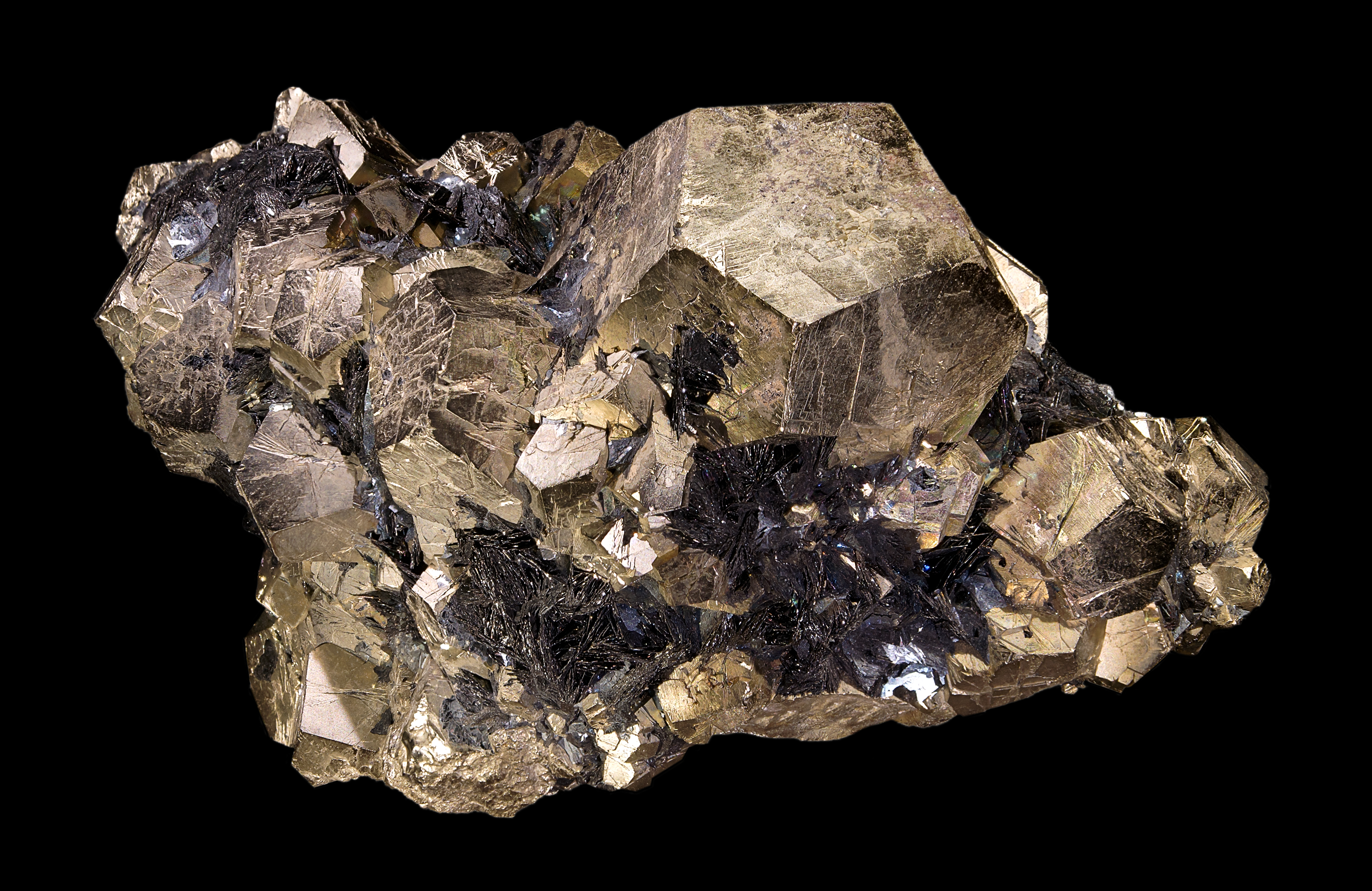
Photo: Wikimedia Commons
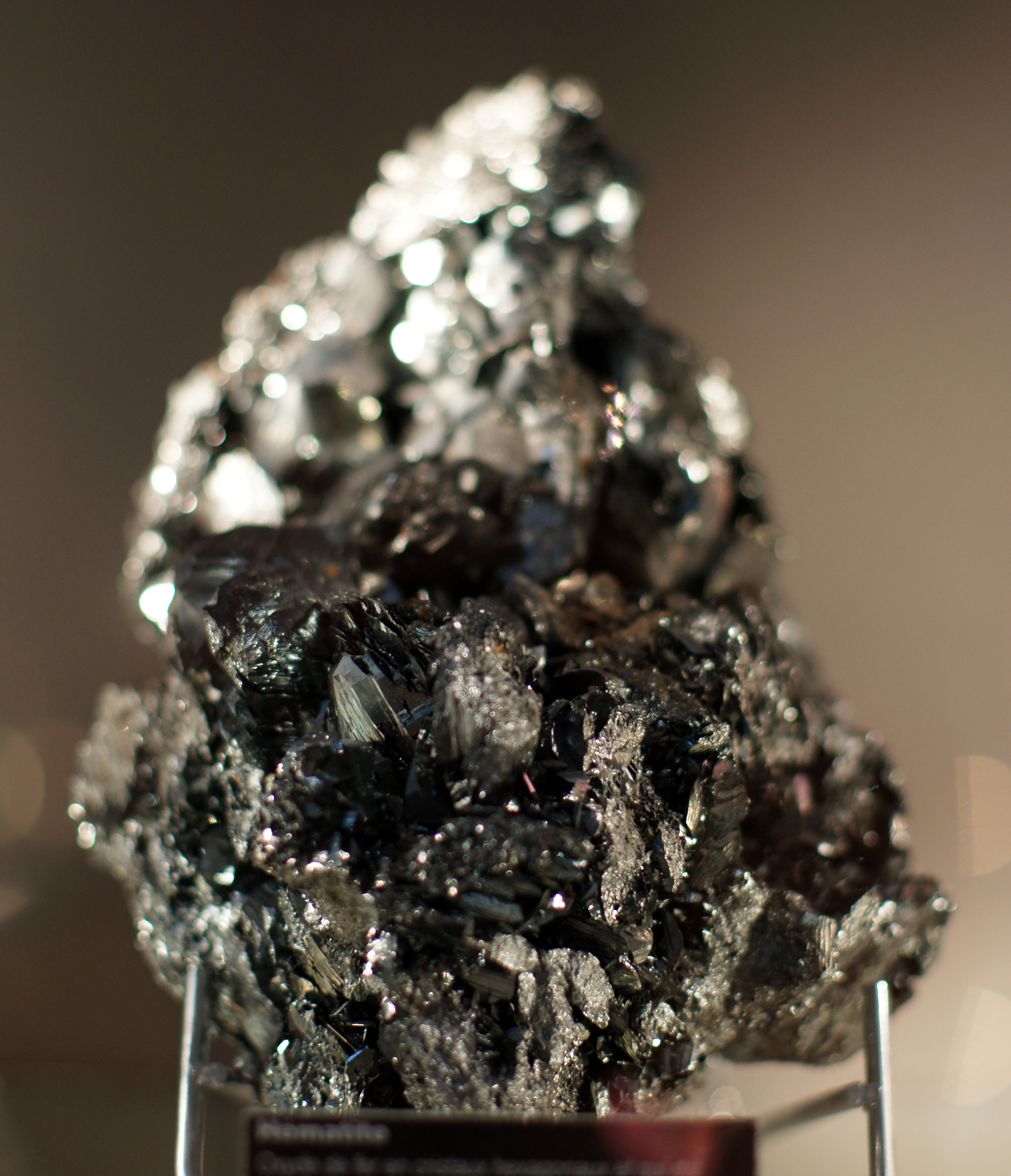
Photo: Wikimedia Commons
Search for specimens: View all specimens from Rio Marina, Italy
The Rio Marina mine lies immediately north and northwest of the village of Rio Marina on eastern Elba, extending toward Monte Giove and forming the best-known part of the Rio district. The principal stopes and working areas associated with the Rio Marina deposit include Bacino, Valle Giove, Falcacci, Vigneria, Rosseto, Antenna, Zuccoletto, Piè d’Ammone, and Pozzo Fondi. In the broader mining-park landscape, Rio Albano and Le Conche lie to the north, while Torre di Rio–Santa Filomena and the skarn localities south of town connect Rio Marina to the wider eastern Elba iron-skarn province.
The shallow Rio Marina deposit is a hematite–pyrite–limonite system hosted chiefly by Paleozoic to Triassic metasiliciclastic rocks and Verrucano-type formations of the Monticiano-Roccastrada and related units. Ore occurs as lenses, irregular masses, and veinlets, locally stratiform or structurally controlled, with hematite as the dominant collectible and economic mineral, pyrite increasing in importance downward, and limonite/goethitic alteration forming the oxidized caps, pockets, coatings, and ochre masses so characteristic of the district. The classic mine-scale description—hematite ore, pyrite at depth or at the lower part of the system, limonite toward the roof and oxidized zones—matches the appearance of many old specimens.
A second, deeper mineralization was recognized by drilling and limited underground work in the 1950s and 1960s. This “Rio Marina Profondo” body consisted of hematite and pyrite associated with skarn silicates, developed where mineralizing fluids interacted with carbonate masses and schistose rocks. At the district scale, the Rio Marina ores are part of the late evolution of eastern Elba’s iron systems, influenced by hot saline hydrothermal fluids and by the late Miocene Porto Azzurro magmatic event. The nearby Torre di Rio–Santa Filomena skarn, just south of the harbor, contains hedenbergite, ilvaite, epidote, quartz, chlorite, magnetite, pyrite, and pyrrhotite, and helps explain why Rio Marina is not just an ore locality but a reference point in skarn mineralogy.
Bacino, north-west of the town, became one of the great collector names for Rio Marina hematite. Industrial work there began in 1860, and the accessory minerals are chiefly pyrite and quartz. Its fame was renewed in the 1980s, after the end of large-scale mining, when remarkable hematite crystallizations from Bacino circulated among collectors. Good Bacino material shows lustrous black hematite in isolated to grouped crystals, sometimes with quartz and sometimes with iridescent alteration films. Dense glittering ore is common; cabinet-grade, sharply crystallized, minimally damaged Bacino hematite is much less common.
Valle Giove, on the slopes of Monte Giove, was the most recent of the major Rio Marina stopes. Work began in the 1950s and continued until the mine closure period in the early 1980s. It is the great open-pit amphitheater seen on many modern tours: terraced benches, red and ochre slopes, and visible iron mineralization in a landscape that still reads as an active geological section. The mineralization there includes hematite and pyrite, with reported accessories including adularia, calcite, epidote, fluorite, galena, quartz, sphalerite, and chalcopyrite. Academic work on Valle Giove describes hematite + pyrite ± sphalerite and chalcopyrite in metric lenses and veins, with acid mine drainage processes driven by unevenly distributed sulfides in what is otherwise an oxide-dominated iron mine.
Falcacci, southwest of Valle Giove, was worked from the early nineteenth century until 1960. It produced hematite and limonite as the principal mined materials, with sphalerite, malachite, galena, and bismuthinite among the notable accessories. For collectors, Falcacci has two reputations: it is a source of pyrite specimens, including cubic forms, and it is the type locality of riomarinaite, Bi(OH)SO4·H2O, a rare hydrated bismuth sulfate found on weathered and corroded pyrite as a product of bismuthinite and cosalite alteration. The Falcacci bismuth suite is highly specialized material—microscopic to small crusts and aggregates rather than showy cabinet crystals—but it gives Rio Marina genuine type-locality importance beyond hematite and pyrite.
Vigneria, closest to the sea, functioned as both mine area and shipping landscape. Ore from the hill stopes—hematite and pyrite from Bacino, Falcacci, Zuccoletto, Piè d’Ammone, Valle Giove and others—was processed and moved down toward the loading structures for transport to the mainland steel works, especially Piombino. Old labels mentioning Vigneria may refer to lamellar hematite and hematite–pyrite material, but many older Elba labels are broad, and locality precision should be treated carefully.
The modern operating history is complex. In the nineteenth and twentieth centuries the mines passed through public administration, leaseholders, and industrial companies. Recorded modern management includes the Royal iron mines and foundry administration in the mid-nineteenth century, Banca Generale and associated companies in the 1880s, Giuseppe Tonietti and Ugo Ubaldo Tonietti at the end of the nineteenth century, Elba società anonima di miniere e alto forni from 1899, the concessionary company of the Elba mines in the 1920s and early 1930s, Ilva to 1939, Ferromin from 1940 to 1963, and Italsider from 1963 to 1989, although iron mining itself had definitively closed in 1981. The mining park was established in 1991 to preserve and reinterpret the post-mining landscape.
Collecting today is controlled. The old stopes are historic industrial ground, not an open public dig. The Mining Park of the Island of Elba organizes guided visits to Rio Marina and Rio Albano, including Bacino, Valle Giove, Falcacci, and Conche, with train tours, 4x4 “safari” excursions, educational laboratories, and selected opportunities to search for small mineral samples under supervision. Serious collectors should work through the park and museum framework and treat all independent access to pits, galleries, walls, dumps, and benches as regulated, potentially hazardous, and dependent on current permission.
Rio Marina pyrite is the classic golden counterpoint to the locality’s black hematite: bright pyritohedra, cubes, and less commonly octahedral forms occur on hematite matrix, in massive ore, and in cavities related to hematite stockworks. Falcacci is especially noted for cubic pyrite, while Valle Giove and other Rio Mine workings yielded pyrite with hematite, sometimes as sharply isolated crystals several centimeters across; dealer and collection records document individual crystals around 3.5–4.5 cm on small to cabinet-size matrix pieces, while older literature and museum references note larger pyritohedral material from Elba. The best Rio Marina pyrites are not merely brassy; they are cleanly formed, lustrous, and set off by dark specular hematite, with crisp edges and minimal oxidation. Ordinary examples are common as pyrite-rich ore or dull, rust-stained matrix, but a balanced pyrite-on-hematite specimen with a dominant aerial crystal has the unmistakable Rio Marina look.
Rio Marina hematite is the locality’s signature mineral, occurring as compact massive ore, micaceous and lamellar aggregates, scaly specularite, flattened rhombohedral crystals, blocky crystals in cavities, and highly lustrous black to steel-gray crystal groups, sometimes with a thin goethitic or iron-hydroxide film that produces iridescent colors. Bacino is the most important collector name for fine crystallized hematite, especially because of the remarkable post-mining finds of the 1980s; Vigneria and Valle Giove are also associated with lamellar and crystalline hematite. Older dealer descriptions record bright black crystals from a few millimeters to more than 2 cm, and better cavity specimens with crystals to roughly 3–4 cm accompanied by quartz. Good Rio Marina hematite is judged by crystal definition, mirror luster, undamaged edges, attractive iridescence where present, and separation from the mass; lesser pieces are glittering but crowded, bruised, oxidized, or simply ore-like.
Beyond pyrite and hematite, Rio Marina is important for limonite/goethite alteration, quartz, calcite, adularia, epidote, fluorite, galena, sphalerite, chalcopyrite, malachite, siderite, and bismuth minerals. Riomarinaite, Bi(OH)SO4·H2O, is the defining type-locality rarity from Falcacci, occurring as whitish-beige to light gray crusts and tiny acicular aggregates on weathered pyrite, associated with bismoclite, bismutite, cannonite, anglesite, hydroniumjarosite, plumbojarosite, bismuthinite, and cosalite. The nearby Torre di Rio–Santa Filomena area, part of the Rio Marina skarn system, is the type locality of ilvaite and has produced black prismatic ilvaite with hedenbergite, quartz, pyrrhotite, magnetite, and epidote; collectors should keep Torre di Rio ilvaite labels distinct from hematite–pyrite specimens of the Rio Mine proper, even though both belong to the Rio Marina mineral landscape.
Rio Marina is a closed classic locality, so the best material is finite and increasingly dependent on old collections, estate dispersals, museum duplicates, older dealer stock, and small modern finds made within the controlled mining-park context. Attractive pyrite-on-hematite miniatures and small cabinet pieces still appear regularly, but top-quality hematite from Bacino and sharp, well-centered pyrite groups on black hematite are not common. A specimen with an old Rio Marina, Rio Mine, Bacino, Valle Giove, Falcacci, or Vigneria label deserves more attention than one generically labeled “Elba,” provided the mineralogy and matrix make sense.
The chief authenticity issue is locality precision. “Elba hematite” and “Elba pyrite” are sometimes used loosely for material from multiple eastern Elba mines, including Rio Marina, Rio Albano, Ortano, Terranera, Calamita, and Ginevro. Rio Marina specimens should be consistent with the hematite–pyrite–limonite assemblage and, when possible, with a named stope. Labels reading “Rio,” “Rio Marina,” “Rio Mine,” “Isle of Elba,” “oligiste,” or “specularite” are common on older material and may be perfectly valid, but a specific stope attribution should be treated as stronger only when supported by old labels, collection history, or a trustworthy dealer note.
No special fluorescence is expected for the main collector species. The real handling concerns are mechanical and chemical. Lamellar hematite edges chip easily, micaceous surfaces can shed or bruise, and iridescent films are surface phenomena that should not be scrubbed. Pyrite should be kept dry and stable; Rio Marina is a sulfide-bearing iron district with documented acid drainage processes in mine waste, and weathered pyrite from Falcacci is part of the secondary bismuth story. Avoid soaking, aggressive acids, household cleaners, and high-humidity storage. If a pyrite appears unusually glossy or darkened, ask whether it has been coated, oiled, lacquered, or otherwise stabilized; such treatment is not inherently fatal for an old pyrite, but it should be disclosed.
Condition grading is stricter for Rio Marina than for many massive iron-ore localities because so much ordinary material exists. On hematite, look for undamaged crystal terminations, strong metallic luster, defined rhombohedral or lamellar architecture, and attractive contrast with quartz or pyrite. On pyrite, look for sharp pyritohedral or cubic faces, freedom from dull brown oxidation, and a composition where the pyrite is not buried in hematite. Matrix is a virtue here: isolated pyrite on black hematite or hematite crystals in a natural cavity usually outrank loose ore fragments or crowded glittery plates.
Rio Marina began as a mining place long before it became the little harbor town collectors know by name. The ore was the reason people kept returning to these red slopes: Etruscan exploitation by the eighth century BC, Roman continuation, Pisan storage enclosures at Spiazzi, and later administrations that treated Elba’s iron as a strategic resource. The village at the sea grew later, when piracy no longer forced people to stay up in the hills. Before that shift, the older community of Rio Alto was divided into three social worlds—quarrymen, farmers, and sailors. When the maritime group moved down to the shore, Rio Marina became a town whose first prestige belonged not to miners but to the sea.
That hierarchy is one of the strangest and most revealing details in Rio Marina’s history. In the nineteenth century, a sailor ranked above a miner because ships, owners, shipbuilders, forwarders, caulkers, and maritime trade still dominated the local imagination. Then steamships arrived and ruined the old sailing economy. The local phrase preserved in the histories is brutal: steam vessels swept away the “windbags.” Sailing ships that had once carried pride and wealth were pushed first into coastal cabotage and then reduced to barges for carrying ore. The sea did not vanish from Rio Marina; it was forced into the service of the mine.
The Tonietti story belongs to that transition. Giuseppe Tonietti, remembered as an old shipowner and commander of his own vessels, became lessee of the mines in 1888. His relationship with workers was described in the language of the sea: master and patron, like a captain before his crew. By 1899, after the Tonietti period and the rise of more formal industrial structures, the working masses had begun to recognize their own strength. In 1911, Rio Marina saw great strikes in which miners and sailors stood together—a reversal of the older hierarchy and one of the defining social moments of the town’s mining identity.
There is a remarkable physical image of the town in that industrial phase: hundreds of men walking through the streets with their tools on their shoulders while washers, canals, railways, overpasses, loading routes, and houses became one continuous machine. Rio Marina was not a village next to a mine; the mine entered the village. That fact matters for collectors because the specimens were not remote alpine curiosities. They came from a lived industrial landscape, from pits immediately behind houses and ore routes running down to the harbor.
Napoleon’s brief Elban episode also touched the iron mines. On May 6, 1814, soon after arriving in exile, he inspected the iron mines above Rio Marina with André Pons de l’Hérault, the administrator of Elba’s mines. The visit was not sentimental tourism. The mines were one of the island’s fiscal engines, and Napoleon understood immediately that iron could help fund the miniature state he was trying to govern. Later accounts emphasize both the antiquity of the open-cast workings and the financial frustration: he heard the mines produced large annual value, only to discover that the economic reality was constrained by prior claims, leases, and the island’s complicated administration.
A twentieth-century travel account gives another memorable view: to understand Elba, one had to visit both mines and furnaces because their influence employed two thousand men and permeated the whole island. From a mineral collector’s standpoint, that sentence is almost an explanation of why Rio Marina specimens turn up in so many old cabinets. The mines were not obscure diggings; they were central, productive, visited, painted, written about, and commercially connected to the mainland.
The specimen story has a quieter modern chapter. Collector Giuliano Bettini began searching for Rio Marina hematite in the late 1980s. In the 1990s there were Saturday and Sunday morning excursions to Valle Giove and occasional guided visits to Bacino. His practical field lesson remains the essential Rio Marina lesson: many pieces from the dumps were rusted and oxidized, but what mattered was whether the crystals were intact. That is exactly how to look at old Rio Marina hematite today. Oxidation is part of the locality; broken edges are the problem.
The Vigneria pier supplied the locality’s most symbolic modern ending. It was the last surviving loading pier of the old ore-shipping system, the structure by which hematite and pyrite from the hill workings had met the sea. During the violent storm of October 28, 2018, the rusted old pier partly collapsed in the night and was then swallowed by the waves on Sunday morning. For a town whose culture came from the sea and was forged in the iron mines, the loss was more than structural. It was as if one of the last pieces of the old ore route had finally returned to the water.
P. Rögner, “Riomarinaite, a new bismuth mineral from Falcacci stope, Rio Marina, Elba (Italy),” Der Aufschluss, 56, 53–60, 2005. The type-mineral paper for riomarinaite, Bi(OH)SO4·H2O, from the Falcacci stope. A detailed English summary appears in American Mineralogist’s New Mineral Names section: RRUFF PDF.
E.S. Grew summary in “New Mineral Names,” American Mineralogist, 90, 1945–1952, 2005. Summarizes riomarinaite’s habit, chemistry, associations, type material, and Falcacci occurrence: RRUFF PDF.
Paolo S. Garofalo, Daniele Redi, Nikita Malafeevskiy, Gunnar Schwarz, Christoph Neff, Peter Keresztes Schmidt, and Detlef Günther, “Failed genesis of a Fe-skarn deposit caused by redox states of intrusion and wall rocks (Torre di Rio, Island of Elba, Italy),” Ore Geology Reviews, 177, 106446, 2025. Modern study of the Torre di Rio skarn, directly relevant to the Rio Marina skarn framework and ilvaite type locality: ScienceDirect.
M. Benvenuti, “Skarn Deposits in Southern Tuscany and Elba Island Central Italy,” 32nd International Geological Congress field-trip guide, B18, 2004. Contains field descriptions of Torre di Rio, Rio Marina, the Rio Mine landscape, and the hematite–pyrite–specularite assemblage: ISPRA PDF.
Tanelli and coauthors, overview of Elba Island iron deposits in Ofioliti. Useful for the Rio Marina metallogenic setting, ore bodies, late Miocene hydrothermal interpretation, and the distinction between Valle Giove-type ores and Rio Marina Profondo: Ofioliti PDF.
D. Servida, L. De Capitani, and G. Grieco, “Determinazione dell’Acid Mine Drainage nel cantiere Valle Giove di Rio Marina (Isola d’Elba, LI),” 85th Congress of the Società Italiana di Mineralogia e Petrologia, 2006. Abstract documenting hematite + pyrite ± sphalerite and chalcopyrite mineralization at Valle Giove and acid mine drainage processes: University of Milan record.
Smithsonian National Museum of Natural History, hematite specimen record from Elba, Rio Marina, Tuscany, Italy. A useful institutional reference for Rio Marina hematite in a major museum collection: Smithsonian object record.
Museo di Storia Naturale dell’Università di Pisa, “Ematite elbana.” Museum presentation of Elban hematite specimens, metallic luster, and goethite-related iridescent films: University of Pisa museum page.
“Isola d’Elba - Parco minerario di Rio Marina (analogico),” grazia video. A YouTube video showing the Rio Marina mining-park landscape with historical narration about the village and mines: https://www.youtube.com/watch?v=OYftMtBve6M
“Elba: vita sotterranea,” Freedom - Oltre il confine, Mediaset Infinity. Broadcast segment including the Rio Marina mining museum and specimens from the old quarries: https://mediasetinfinity.mediaset.it/video/freedomoltreilconfine/elba-vita-sotterranea_F309513001002C02
“Museo Minerali Elba a Rio Marina,” Virtual Elba. Visitor page with museum imagery, a 360-degree view, and embedded media connected to the mineral museum and mining park: https://www.virtualelba.it/conoscere-scoprire-elba/musei-archeologia/museo-minerali-elba-rio-marina/
Rio Mine, Rio Marina, Tuscany, Italy — Mindat — Core locality record for the Rio Mine, its mineral list, sublocalities, and references.
Torre di Rio - Santa Filomena area — Mindat — Essential record for the Rio Marina skarn area and the ilvaite type locality.
Riomarinaite — Mindat — Mineral species record for the Falcacci type-locality bismuth sulfate.
Cantieri Minerari — Parco Minerario dell’Isola d’Elba — Official mining-park page describing Bacino, Valle Giove, Falcacci, Conche, deposit areas, and specimen-relevant mineralogy.
Guided Tours — Parco Minerario dell’Isola d’Elba — Current official access information for guided visits and mineral-search activities.
Mineral Park on the Island of Elba — Infoelba — Clear visitor-oriented summary of the Rio Marina and Rio Albano mining sites, museum, tours, and park history.
Rio Marina: the iron capital — Infoelba — Strong historical account of the town’s transition from maritime village to iron-mining center.
Rio Marina Mining Museum — Musei Arcipelago Toscano — Museum information for the Palazzo del Burò, mineral displays, reconstructed mine settings, and guided mine visits.
Elba Mineral Museum in Rio Marina — Virtual Elba — Useful English-language overview of the mineral museum, Bacino, Valle Giove, Falcacci, Conche, and the classic hematite–pyrite assemblage.
My Hematite from Rio Marina — Giuliano Bettini, Mindat article — Collector field note on Rio Marina hematite habits, old excursions, dump material, and practical specimen judgment.