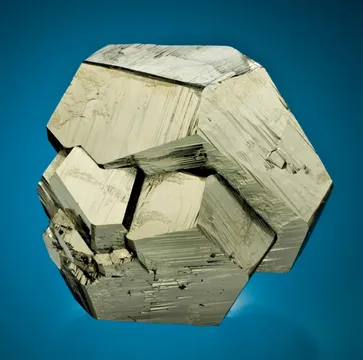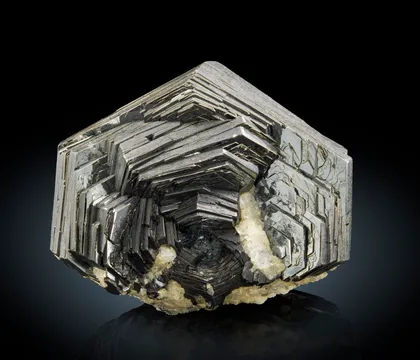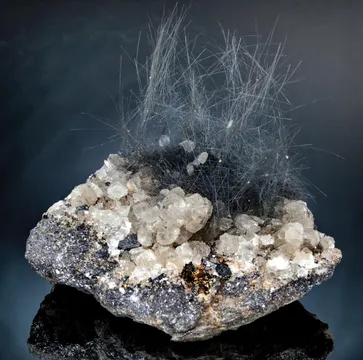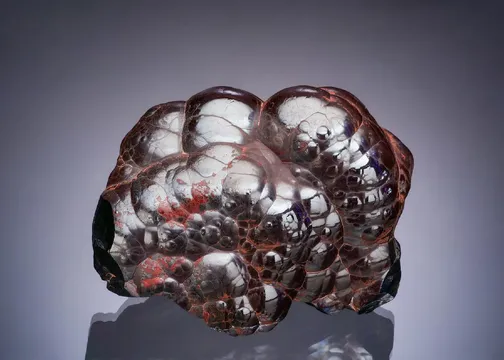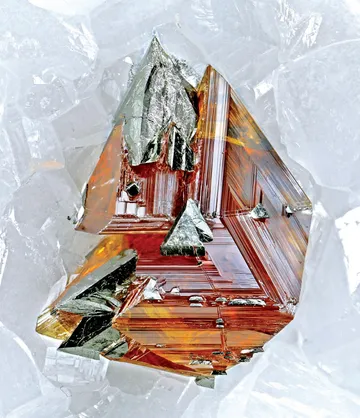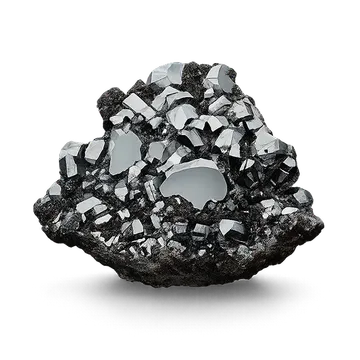
Rio Marina hematite, Elba Island — renowned for mirror-bright crystals (tabular, rhombohedral), iridescent varieties, and classic quartz–pyrite associations.
Key facts
Rio Marina is one of the great European names for hematite: a locality where iron ore history, Mediterranean landscape, and top-tier crystallization meet in the same specimen. The best pieces show the unmistakable Rio Marina look — black to steel-gray, mirror-bright hematite crystals, commonly tabular, lamellar, rhombohedral, or complex, sometimes broken into glittering micaceous plates and sometimes flashed with natural iridescence from thin alteration films of iron oxides and oxyhydroxides. On the finest examples the crystals sit with quartz or brassy pyrite, giving the specimen a sharp contrast between black metallic hematite, pale quartz, and gold pyrite.

Photo: Rob Lavinsky, iRocks.com via Wikimedia Commons
The locality’s importance is not just aesthetic. Rio Marina is part of the eastern Elba iron district, mined since antiquity and long celebrated for hematite-rich ores. The old Rio mine lies immediately north of the town and includes famous workings such as Bacino, Valle Giove, Vigneria, Falcacci, Rosseto, and Antenna. The ore assemblage is dominated by hematite with pyrite and limonite, and the modern geological interpretation places the mineralization within a late Miocene hydrothermal system linked to the Porto Azzurro monzogranitic intrusion and its contact-metamorphic and skarn-related environments.
For collectors, Rio Marina hematite is a classic because it has several distinct faces. Some specimens are dense, glittering lamellar aggregates; others show stout rhombohedral crystals in cavities; others carry pyritohedra of pyrite on hematite matrix; and the most prized pieces show isolated, lustrous hematite crystals separated or accented by quartz. The locality has also produced naturally iridescent hematite — usually more patchy and mineral-textured than the artificial “rainbow” coatings seen on modern commercial material.

Photo: Rob Lavinsky, iRocks.com via Wikimedia Commons
Historically, Rio Marina is inseparable from iron. The town grew around extraction, shipment, and processing of ore; the mine landscape still stains the houses, beaches, and earth in reddish iron colors. The Mining Park of the Island of Elba now preserves the old workings as a cultural and geological landscape, with guided excursions, a mineral museum, and access to selected collecting experiences rather than active commercial mining.
Search for specimens: View all hematite specimens from Rio Marina, Elba Island, Italy
Rio Marina is on the northeastern side of Elba Island in Tuscany, Italy. The historic Rio mine begins essentially at the edge of the town and extends northward toward Monte Giove. In modern locality terminology, the Rio Mine, or Miniera di Rio / Miniera di Rio Marina, includes several named stopes and excavation areas. Bacino is the best-known hematite specimen site; Valle Giove is the stepped open-pit amphitheater familiar from mine tours; Falcacci is famous for pyrite and for the discovery of riomarinaite; Vigneria is important for lamellar hematite ore; and Rosseto and Antenna are also part of the broader mine system.
The deposit is best understood as a hydrothermal iron-oxide and iron-sulfide system with local skarn relationships. The classic upper Rio Marina deposit consists of lenses, clusters, and veins hosted in schistose-sandstone rocks historically referred to as Verrucano. A deeper body, discovered by drilling in the 1950s and known as Rio Marina Profondo, consists of hematite and pyrite bodies associated with skarn silicates in older Paleozoic schists. At the mine scale, the ore body is hematite-rich, with pyrite toward the lower part of the system and limonite/goethitic alteration toward the oxidized upper parts.
Among the principal stopes, Bacino and Vigneria are especially associated with fine- to medium-grained lamellar hematite and minor quartz. Massive coarse hematite with cavities lined by large rhombohedral crystals is also documented. Bacino, the most southerly stope and closest to the built-up area of Rio Marina, has long had a special reputation: nineteenth-century sources and modern locality records both point to Bacino as the source of some of the finest hematite specimens from the district, and spectacular finds in the 1980s renewed its collector fame after the end of large-scale mining.
Mining at Rio Marina began in antiquity. The Etruscans exploited Elba’s iron ores, the Romans continued the work, and later the Pisans and subsequent administrations used the deposits. The locality became industrial in the nineteenth century, with Bacino industrial extraction beginning in 1860. Valle Giove was much later: work there began in the 1950s and ceased in the 1980s. Falcacci was worked from the early nineteenth century until 1960. Mining exploitation ended around 1980, and the closure of the Elban mines is generally remembered as 1981, after which the district shifted toward preservation, tourism, and collecting under controlled conditions.
Today, the mine is not a free-for-all collecting area. The Mining Park of the Island of Elba, established in 1991, organizes visits to the Rio Marina and Rio Albano mining areas. Guided tours run seasonally by reservation, and the popular little-train excursion includes a stop at Valle Giove where visitors can search for samples to take home. Family workshops also include mineral searching at Bacino. Serious collectors should treat the old stopes as historic, unstable, and regulated mining ground: access is through the park and museum framework, not casual independent digging.
The principal museum base is the Mineral Museum of Rio Marina in the Palazzo del Burò, the former Mine Directorate building in the town center. It preserves Elban minerals, mining tools, reconstructed mining environments, photographs, and the historical memory of a town built on iron.
Rio Marina hematite is Fe2O3, but the locality’s character lies in habit and surface. The commonest collector material is specular hematite: metallic, steel-gray to black, highly lustrous, lamellar, scaly, or micaceous. In good light, the surfaces can look almost wet, especially where broad crystal faces are intact. The best crystals are tabular to rhombohedral, sometimes complex, with sharp faces and a black mirror luster.
Bacino is the key name for crystallized hematite. Fine examples include discrete euhedral crystals to about 3 cm across, sometimes separated by quartz seams or set on massive hematite. Such isolated crystals with quartz are particularly desirable because much Rio Marina hematite occurs as dense, intergrown aggregates rather than open, sculptural crystal groups. A specimen with individual lustrous crystals, clean definition, and minimal contact is a far higher-grade object than a simple sparkly ore mass.
Lamellar hematite from Rio Marina can be very attractive in its own right. Dense “jackstraw” masses of blades, sparkling granular layers, and stacked micaceous plates give many specimens a rich textural quality. These are often black, dark gray, or steel gray, with reddish-brown oxidation in crevices. Collectors should expect many pieces to show some rusting or limonitic alteration; the essential question is whether the hematite crystals themselves remain sharp and undamaged.
Natural iridescence is one of the locality’s special pleasures. Rio Marina hematite can show violet, blue, magenta, yellow, green, or bronze flashes, generally as thin, irregular surface films related to alteration by iron oxides or hydroxides. On authentic natural specimens, the effect is usually tied to the mineral texture: it follows blades, pockets, edges, or crystal faces rather than appearing as a perfectly uniform, candy-colored coating over every surface.
Associated minerals are central to Rio Marina aesthetics. Quartz is the classic companion, occurring as seams, small crystals, and pale contrast against the black hematite. Pyrite is another major association, especially in brassy pyritohedra or dodecahedral forms perched on hematite matrix. Goethite and limonite are common oxidation products. Magnetite is also recorded, and the broader Rio mine suite includes calcite, adularia, epidote, fluorite, galena, malachite, sphalerite, scheelite, ferberite, cassiterite, and a range of secondary sulfates and bismuth minerals in specific stopes.
Typical market specimens range from thumbnails and miniatures to small cabinet pieces. Crystals in the millimeter to 1–2 cm range are commoner; well-formed crystals approaching 3 cm are notable, and old cabinet specimens with multiple large, mirror-bright crystals are genuinely important. Pyrite-on-hematite combinations can be larger, but the hematite component is often more massive or bladed than isolated.
The highest-quality Rio Marina hematite is judged by five factors: bright metallic luster, sharp crystal definition, an open and balanced composition, good contrast with quartz or pyrite, and minimal bruising. Because much material came from ore workings and dumps, contact damage, rubbed edges, crushed crystal tips, and oxidized matrix are common. A little oxidation is normal; broken blades and dulled faces are not desirable unless the specimen has exceptional locality importance or historic provenance.
Rio Marina is a closed classic locality, which means supply is finite and increasingly dependent on old collections, estate material, and occasional small pieces from park-permitted collecting or old dumps. Fine old hematite from Bacino is not abundant. Good contemporary specimens do appear on the market, especially small iridescent pieces and pyrite-on-hematite combinations, but top cabinet examples with intact, isolated, mirror-bright hematite crystals are scarce.
Authenticity concerns are less about outright locality forgery and more about overoptimistic labeling. “Elba hematite” is sometimes used broadly, while serious labels should distinguish Rio Marina, Rio Mine, Bacino stope, Valle Giove, Vigneria, or another specific working when that information is known. Older labels may say “Rio,” “Rio Marina,” “Isle of Elba,” “oligiste,” “specularite,” or “hematite, Elba”; such labels can be valuable, but they should be judged alongside the specimen’s appearance and provenance.
Artificial iridescence is the main treatment issue to watch for in hematite generally. Natural Rio Marina iridescence is documented and can be superb, but artificially coated “rainbow hematite” also exists widely in the mineral and metaphysical trade. A suspicious specimen shows extremely uniform, high-saturation rainbow color across all exposed surfaces, often with a slick, continuous appearance unrelated to the crystal texture. Natural iridescence is usually more selective, more textural, and integrated with the hematite/goethite surface. A reddish-brown streak remains a basic confirmation of hematite, but it will not by itself prove locality or prove that an iridescent film is natural.
The common condition problems are bruised blade edges, rubbed high points, rust-filled clefts, matrix crumbling, and pyrite instability on combination pieces. Pyrite from Rio Marina is often handsome, but pyrite can tarnish or oxidize in humid conditions, especially where microfractured or associated with reactive sulfates. Store pyrite-bearing specimens dry, avoid repeated washing, and do not oil specimens as a general “preservative”; oil can darken matrix, attract dust, and complicate future conservation.
Hematite itself is dense and relatively hard, but Rio Marina crystals can be brittle along thin plates. Handle bladed specimens by the matrix, not the crystal edges. Avoid aggressive cleaning: a soft brush and dry air are safer than acids or prolonged soaking. If iron oxide staining is part of the natural matrix, removing it can reduce both aesthetics and locality character.
Market-wise, modest Rio Marina hematites remain obtainable, especially thumbnails and miniatures with lamellar luster or iridescence. Premium specimens are in a different category: old Bacino pieces with sharp, lustrous, discrete crystals; hematite with well-placed quartz; and large pyrite-on-hematite groups with old provenance command collector attention quickly. A historic label from a European collection, museum exchange, or old dealer can add real value because the locality’s best production predates the modern specimen market.
Rio Marina is a place where the geology starts in the street. The old mine is not hidden in some remote mountain valley; it begins just beyond the town, close enough that the red dust of iron entered the color of the village itself. Houses, beaches, paths, and seabeds all took on the glimmer and reddish tone of the ore. The result is a town whose architecture and landscape still read like a specimen label: Rio Marina, Elba, iron.
The older story reaches back to the Etruscans. Elba’s ancient iron industry was so smoky that Greek tradition associated the island with Aethalìa, the “smoky” island. Ore was extracted and smelted locally, but wood was quickly a limiting resource; large quantities of charcoal were needed, and ore was also shipped across the water to Populonia, where forests could feed the furnaces. The sea was not merely scenery here — it was part of the metallurgy.
In the Middle Ages the Pisans worked the mines and built an enclosure for accumulating ore in the area of Spiazzi. For centuries, though, the people connected to Rio lived higher up at Rio Alto. The shoreline settlement grew later, and for a long time the town’s social order favored sailors over miners. The sea had prestige. Shipowners, shipbuilders, caulkers, forwarders, and sailors formed the dominant world of the young Rio Marina, while quarrymen remained a lower-status minority.
Steam changed that. Sailing vessels, once central to Rio Marina’s economy, were pushed off the major routes. Some of the old sailing ships were reduced to small coastal trade and then turned into barges for carrying ore. Families who had made their fortunes at sea moved into mining. Giuseppe Tonietti, once a shipowner and commander, became lessee of the mines in 1888, and the town shifted from maritime identity toward extraction. Over time the village changed physically: washers, canals, railways, overpasses, and ore-handling structures pressed into the same urban space as homes and streets.
The social story became harder in the early twentieth century. After the paternalistic Tonietti period, the workers became more organized, and the great strikes of 1911 brought miners and sailors together. One local line captures the transformation with unusual force: culture in Rio Marina “came from the sea” but was “forged in the iron mines.” For a collector holding a Rio Marina hematite, that is not mere romance. It is exactly what the specimen represents — a mineral that was simultaneously scientific object, industrial raw material, and civic identity.
The specimen story has its own modern chapter. Collector Giuliano Bettini began collecting Rio Marina hematite in the late 1980s. In the 1990s there were Saturday and Sunday morning excursions in Valle Giove, and at times guided visits to Bacino. Bettini’s practical field note is still the right collector’s lesson: many pieces from the dumps were rusted and oxidized, but what mattered was whether the crystals were intact. That is Rio Marina in miniature — surface weathering is expected, but sharp hematite survives as the prize.
One of the most memorable recent accounts is not from a mine face at all. A 2023 Italian mineralogical abstract reports a hematite specimen found by a mason inside a hollow in the wall of an old house in Rio Marina, together with a coin dated 1866. It is a perfect Rio Marina episode: the mine had entered the town so completely that a hematite specimen could reappear not from a dump or stope, but from the architecture of the village itself.