A collector's guide to Bottino Mine, Italy: its geology, mining history and notable minerals, illustrated with the 43 specimens documented from this locality on EarthWonders.
Key facts
Bottino is one of the grand old names of Italian specimen mineralogy: a lead–silver–zinc vein mine in the southern Apuan Alps, above Seravezza and Ruosina in Tuscany, where collectors value not only the ore minerals but the way they crystallized under metamorphic strain. The deposit lies in the Paleozoic basement of the Apuan metamorphic complex, where NW–SE Pb-Ag-Zn vein systems cut and accompany phyllites, porphyroids, porphyric schists, and distinctive tourmalinite bodies once called “black quartz” by the miners. Modern interpretations treat the ore as a complex, multistage metamorphic concentration associated with older boron- and metal-rich tourmalinites, rather than as a simple granite-related vein.
For collectors, Bottino is a sulfosalt locality before anything else. It is the type locality for meneghinite, and it gave its name to bottinoite, a rare blue-green Ni-Sb hydrated hydroxide. The classic specimens are lead-gray to steel-gray assemblages: prismatic meneghinite in quartz vugs, silky to hairlike “plumosite” now established as boulangerite, black iron-rich sphalerite, bright galena, chalcopyrite, pyrite, pyrrhotite, siderite, calcite, dolomite, and quartz. The best Bottino pieces have an unmistakably Apuan look—dense metallic crystals emerging from white quartz and brownish siderite, often with delicate needles or woolly mats of boulangerite softening the geometry of the sulfides.
Regional View
Country View
Historically, Bottino matters because it was not a minor scratch in the hillside. The mine and its Argentiera treatment works were among the great nineteenth-century metallurgical undertakings of Versilia, producing lead and silver from galena and blende and leaving a landscape of adits, inclined-plane haulage, washing works, roasting furnaces, foundry remains, miners’ buildings, and dumps. In specimen terms, its glory came from cavities and fissures opened during mining and later collecting: flattened “almond” or pipe-like pockets in the ore, fissures at the hanging-wall contact, and quartz-dolomite veins in tourmalinite. Those openings produced the pieces that now sit in Italian university museums and serious private collections.

Photo: Aangelo, Wikimedia Commons
Search for specimens: View all specimens from Bottino Mine, Italy
The Bottino Mine is in the Stazzema municipality of Lucca Province, Tuscany, in the Apuan Alps east of Seravezza and above the Argentiera locality on the Vezza valley side. The mineralized system is hosted entirely in the Paleozoic basement of the Apuan metamorphic complex. The principal mineralized belt trends roughly northwest–southeast, and the mined veins dip generally west-southwest to south at steep angles, commonly around 50–70 degrees. The main “Bottino vein” was worked from its outcrop near Senicioni, around 525 m above sea level, down to the low Venezia level, around 174 m; locally the vein thickened to several metres where tectonic disruption opened wider ore shoots.
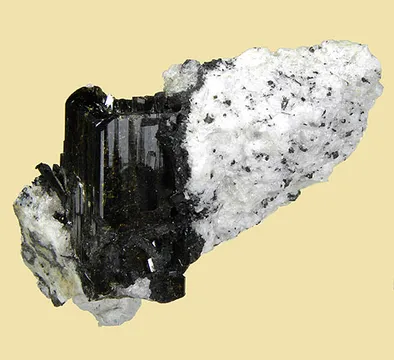
The host sequence includes lower phyllites—metagreywackes and quartzitic phyllites—and Ordovician porphyroidal rocks and porphyric schists. A defining feature of the district is tourmalinite: hard, dark, tourmaline-rich rock occurring as columns or bands near the veins. In modern ore-genetic work, Bottino’s tourmalinites are treated as an important clue to an older boron- and metal-enriched environment, later reworked during Tertiary Apenninic metamorphism. The ore veins are therefore not simple open-space Alpine veins; they are deformed, boudinaged, stretched, and recrystallized bodies in which more ductile sulfides such as galena and meneghinite flowed around more competent phases such as pyrite and arsenopyrite.
The common ore minerals are galena, iron-rich sphalerite, pyrrhotite, pyrite, chalcopyrite, meneghinite, arsenopyrite, and Ag-rich tetrahedrite/freibergite. Boulangerite, bournonite, jamesonite, ullmannite, gersdorffite, pyrargyrite, argentopentlandite, and many oxidation and gangue species add to the complexity. Silver is present especially in galena and Ag-rich tetrahedrite, but discrete silver minerals such as pyrargyrite and argentopentlandite are also documented. Nickel is a real theme at Bottino as well: ullmannite, gersdorffite, argentopentlandite, and bottinoite all show that this is not merely a conventional Pb-Zn-Ag vein.
Specimen production came from three principal geological settings. The first and most famous is the cavity system inside the veins. In poorer quartz-carbonate areas the cavities are small and tend to yield quartz, siderite, calcite, dolomite, and occasional rutile or apatite, but the best pockets occurred in sulfide-rich ore. Contemporary descriptions record elongated cavities like flattened pipes or almonds, exceptionally reaching lengths of several metres and cross sections around tens of centimetres. These produced black sphalerite var. marmatite, galena crystals, boulangerite needles, meneghinite, chalcopyrite, and other sulfides in the classic Bottino style.
The second specimen setting is the fissures at the vein-hanging-wall contact. These are particularly important for post-closure collecting because open pockets in the main vein became scarce. The fissures can run up to a couple of metres long but may be only millimetres to a few centimetres wide; where intersecting fissures create larger spaces, rock fragments may be completely lined with crystals. The weakness of the host rock, which tends to split into thin plates perpendicular to the fissures, makes extraction difficult and is one reason many Bottino specimens show trimming, cleaving, or incomplete matrix.
The third setting is quartz and dolomite veining in tourmalinite, especially at the Rocca and Breviglieri levels. Small fissures and cavities in these veins yielded good meneghinite, sphalerite, galena, pyrite, and hairlike boulangerite. The levels named in the mineralogical literature—Paoli, Due Canali, Rocca, Breviglieri, Redola, Sansoni, Orsini, and related workings—are worth noting on labels, because they often explain the style of a specimen: delicate boulangerite and meneghinite from Paoli fissures, quartz-chlorite pieces from Due Canali, or tourmalinite-associated assemblages from Rocca and Breviglieri.
The mine’s history is layered. Ancient workings in the district have long been connected with Etruscan and Roman activity, and medieval and Renaissance exploitation is documented in the broader Argentiera and Stazzema mining landscape. The Medici-period interest in the sixteenth century revived the silver-lead operations, but Bottino reached its industrial peak in the nineteenth century. The Compagnia del Bottino was founded in 1837 and became the Compagnia Anonima del Bottino in 1841. Angelo Vegni directed important work, and the Argentiera foundry was opened in 1846. In 1858 Frédéric Blanchard, trained at the École des Mines in Paris, succeeded Vegni and developed the mine-and-foundry system into a notably modern metallurgical establishment for its time. By the early 1880s the operation employed 144 workers, including 29 women and one child, and annual production was reported at about 570 tonnes of argentiferous lead.
Twentieth-century mining was more intermittent. The 1918–1927 period left remains of washing works and water-storage infrastructure near the Due Canali area, and later activity continued into the mid-twentieth century under concessionaires including Italo Moresco. The mine has been closed for decades, but its mineralogical reputation actually grew as collectors revisited the dumps, fissures, and old workings and as university mineralogists re-examined Bottino material with modern methods.
Collecting access today should be approached as historical-site and abandoned-mine terrain, not as a casual open collecting ground. The old adits are only partly accessible, with flooding, collapses, unstable debris, and difficult approach routes repeatedly noted in local descriptions. Organized guided walks to the mining landscape do occur, sometimes including short controlled visits near galleries, but underground entry without local permission, equipment, and expertise is unsafe. For collectors, the practical market supply is therefore dominated by old collection pieces, specimens recovered from dumps and accessible fissure material in past decades, and more recent pieces obtained by experienced local collectors under appropriate conditions.
Bottino boulangerite is the mineral behind the locality’s famous “plumosite”: dark lead-gray to steel-gray capillary crystals forming felted, woolly, almost weightless mats over quartz, siderite, galena, sphalerite, meneghinite, calcite, and other sulfides. Early authors variously confused or labelled this material as jamesonite, heteromorphite, zinkenite, meneghinite, or boulangerite, but X-ray work established the Bottino plumosite as boulangerite. The finest material came from vein cavities, including quartz-rich pockets where flexible hairlike boulangerite filled the open space and lay partly free from the walls; those classic plumose examples are now scarce. Later and more accessible fissure material tends to show thicker acicular to prismatic steel-gray crystals rather than impalpable hair, with aggregates reported to exceed 15 cm and individual needles from celebrated finds reaching impressive lengths for the species. The best collector pieces preserve the delicate fibers uncrushed, keep the metallic sheen, and show the boulangerite clearly contrasted on quartz, siderite, or associated meneghinite rather than as a rubbed gray coating.
Meneghinite from Bottino is not simply “from a classic locality”—Bottino is the type locality, and serious specimens should always be judged with that in mind. It occurs as lead-gray to steel-gray metallic prismatic crystals, acicular individuals, curved hairs and needles that can resemble boulangerite, and, more rarely, thicker terminated crystals in quartz cavities. Literature and locality records report crystals commonly in the millimetre to centimetre range, with good pieces exceeding several centimetres; an exceptional displayed Bottino specimen is described with meneghinite crystals over 7 cm associated with boulangerite. The strongest pieces usually come from vugs or fissures where meneghinite is sharp, lustrous, and distinct from the accompanying hairlike boulangerite, commonly with quartz, siderite, sphalerite, galena, chalcopyrite, pyrite, dolomite, and calcite. Ordinary Bottino meneghinite can be confused visually with boulangerite or occur as incomplete gray blades; excellent examples show individual prismatic form, visible terminations or twinning, and enough matrix to demonstrate the characteristic Bottino association.
Pyrrhotite at Bottino is part of the early, metamorphically overprinted sulfide assemblage and is far less often represented as handsome cabinet specimens than the mine’s boulangerite, meneghinite, galena, or sphalerite. It is documented as tabular yellow-brown to bronze-brown crystals, strongly magnetic, with crystals reported up to about 3 cm; it may occur with arsenopyrite, boulangerite, galena, sphalerite, chalcopyrite, quartz, siderite, and other sulfides. One particularly Bottino-style relationship is the parallel growth of tabular pyrrhotite with cuboctahedral galena, with a galena cube face parallel to the basal face of pyrrhotite; pyrrhotite can also be encrusted by galena or partly replaced by tiny pyrite aggregates. Good pieces show recognizable tabular form and association rather than massive sulfide, and they should be protected from abrasion and damp storage because Bottino sulfide assemblages commonly show surface alteration after long exposure in humid mine conditions.
Quartz is the principal gangue mineral of the Bottino veins, but collector-grade quartz here is valued less as a standalone species than as the stage on which the sulfosalts sit. In the vein cavities it occurs with siderite, calcite, dolomite, apatite, rutile, sphalerite, galena, meneghinite, and boulangerite; at Due Canali, older cavities yielded attractive quartz with chlorite inclusions, carbonates, and sulfides. A memorable quartz-rich “almond” pocket was described as opening into a geode filled with flexible plumose boulangerite, partly attached to quartz crystals on the walls and partly free in the cavity, with nearby cavities carrying well-formed meneghinite. Fine Bottino quartz specimens are usually small to moderate, but the best have clear or lightly chloritized crystals, crisp terminations, and a readable association with the metallic assemblage; plain massive quartz from the vein is common and far less desirable unless it hosts well-preserved sulfides or sulfosalts.
Siderite is one of Bottino’s essential gangue carbonates, widespread through the deposit with quartz, calcite, dolomite, sphalerite, galena, chalcopyrite, meneghinite, and boulangerite. It appears in small crystals lining cavities and fissures, and collector descriptions note lenticular crystals reaching around 1.5 cm in better examples; siderite also forms the substrate for associated calcite, aragonite, bottinoite, and sulfides. Because much of Bottino’s aesthetic value lies in contrast—brownish siderite, white quartz, black sphalerite, steel-gray sulfosalts, and bright galena—good siderite pieces are those where the carbonate is fresh enough to set off the sulfides without smothering them. Some carbonate crystals can appear grayish from dense inclusions of fine boulangerite needles, a locality-specific feature that adds interest when intact but can make worn pieces look merely dirty if the association is not preserved.
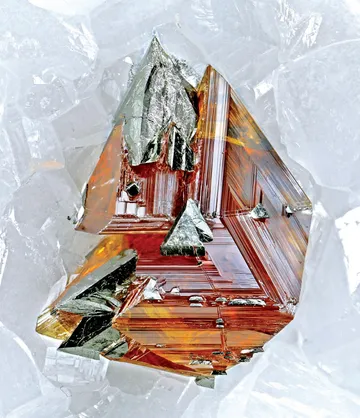
Bottino sphalerite is typically the iron-rich black variety marmatite, one of the main ore minerals and a frequent partner of galena, chalcopyrite, meneghinite, boulangerite, siderite, quartz, and calcite. In the better vein cavities, sphalerite formed bright black crystal carpets and discrete crystals from a few millimetres to centimetric size; records and illustrated specimens include groups associated with galena crystals to several centimetres and sphalerite crystals around 2.5 cm from Due Canali. The “Pozzetto delle Blende” area of the Paoli level was especially noted for a cluster of parallel fissures over an area of roughly eight by two metres that produced beautiful sphalerite-bearing specimens, along with meneghinite, galena, bournonite, pyrite, and capillary boulangerite. Good Bottino sphalerite keeps a strong black luster—often better preserved than accompanying galena in humid mine conditions—and shows sharp marmatite crystals in open space rather than massive blende in quartz-carbonate vein material.
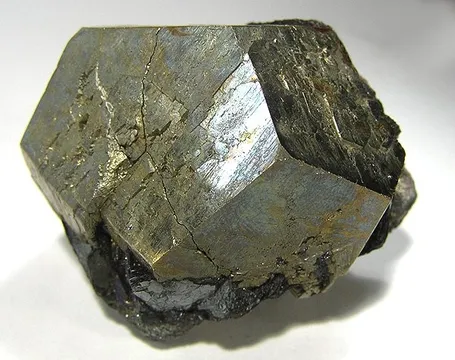
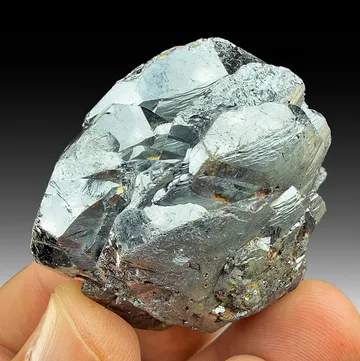
Beyond these six species, Bottino is a locality of real mineralogical depth. Galena is historically the chief ore and produced lustrous cuboctahedral and rarer octahedral crystals, with museum examples reported up to 5 cm and analyses showing typical silver contents around 0.3–0.4 wt% Ag. Bottinoite, Ni(H2O)6[Sb(OH)6]2, is a Bottino type-locality mineral formed by alteration of ullmannite; it occurs as tiny blue-green lamellar or tabular crystals and rosettes on ullmannite with siderite, quartz, galena, chalcopyrite, and carbonates. Other documented rarities and notable associates include acanthite, argentopentlandite, pyrargyrite, bournonite, freibergite-subgroup minerals, ullmannite, gersdorffite, chamosite, apatite, fluorite, aragonite, cerussite, kermesite, senarmontite, sulfur, and several oxides and secondary species. Some older labels require caution: historical “löllingite” from Bottino has been reidentified as arsenopyrite, and old “plumosite” labels should be interpreted in the modern Bottino context as boulangerite unless proven otherwise.
The chief authenticity problem with Bottino is not widespread artificial treatment but old nomenclature and visual misidentification. Hairlike gray sulfosalt material labelled “plumosite” is historically important, but it should not be treated as a separate valid species; for Bottino, modern work established this material as boulangerite. Conversely, thicker acicular gray crystals may be meneghinite or boulangerite, and the two can occur together, sometimes intimately intermixed. For important purchases, especially of type-locality meneghinite or high-value boulangerite, look for modern analytical confidence, an old collection pedigree, or a label history that does not merely repeat a nineteenth-century visual name.
Condition is a major issue. Fine plumose boulangerite is extremely delicate: the best examples look soft, hairy, and metallic, but the fibers crush, mat, or detach with the slightest careless handling. Avoid brushing, ultrasonic cleaning, compressed air, or aggressive rinsing. Sphalerite is generally more robust, and Bottino marmatite often retains luster well, but galena commonly suffers dull or etched faces on pieces recovered after long exposure in the humid, acid-circulating mine environment. Bright, uniformly lustrous galena crystals are therefore more desirable, especially when accompanied by undamaged sulfides.
Matrix matters more here than many sellers admit. A trimmed piece of gray sulfosalt can be difficult to read, while the same crystals in quartz-siderite-dolomite gangue with sphalerite or galena immediately announce Bottino. Fissure specimens may split naturally into thin plates, so thin backing, cleaved host rock, and incomplete cavities are common. This does not necessarily mean damage, but specimens with stable matrix, open vugs, and intact crystal-lined fissures command a premium.
For handling, remember that many Bottino specimens are lead-, antimony-, arsenic-, and sometimes nickel-bearing sulfide and sulfosalt assemblages. They are safe as display minerals when kept intact, dry, and out of reach of children, but they should not be ground, polished, acid-cleaned casually, or stored in damp boxes. Wash hands after handling, keep labels with the specimen, and store delicate boulangerite or meneghinite pieces in rigid lidded boxes with no fiberfill touching the crystals.
Market availability is uneven. Small Bottino sulfosalt specimens appear regularly from old Italian and European collections, but truly fine type-locality meneghinite, undamaged plumose boulangerite, sharp marmatite, and aesthetic multi-species pocket pieces are much scarcer than the locality name might suggest. The mine’s closure, unsafe underground conditions, and the limited number of productive fissures mean that high-quality examples are essentially a finite classic supply.
The name Bottino carries its own mythology. Around Seravezza, the mountain was said to be the place where the old people gathered the “bottino”—the booty, the treasure. Whether or not the etymology can be taken literally, it suits the place. In a short stretch of mountain above the Vezza, generations searched for silver-bearing galena in workings that local and scholarly tradition push back to the Etruscans and Romans. By the Middle Ages, the Argentiera landscape of Gallena, Valdicastello, and Stazzema was valuable enough to sit inside feudal disputes between the families of Corvaia and Vallecchia, Pisa, Lucca, and the rising Tuscan powers.
In the nineteenth century, the mine became a fully industrial undertaking. The Argentiera was not just a portal in the hillside but a valley-floor factory complex: washing works on the Vezza, roasting furnaces, a foundry opened in 1846, stores, workshops, and housing. A plan from 1857 was detailed enough to reconstruct the arrangement of the works along the stream. The scene must have been sharply different from the wooded ruins seen today—ore arriving from the mountain, water power driving preparation machinery, smoke-darkened walls in the foundry, and the rhythms of a company town compressed into a narrow Versilian valley.
One of the most evocative objects of the Bottino landscape was the inclined plane built in 1862. It was not a picturesque footpath but a haulage machine drawn across the side of the mountain: a double-track railway on dry-stone walling, made to straighten the route of the ore wagons. One section ran nearly 800 metres from the Argentiera works to the Due Canali adit at a 13-degree inclination; another climbed from Due Canali to the Paoli adit at 22 degrees, following the Bottino stream. Today only the lower part is recognizable in the landscape, with ruined masonry and remnants of bridges where the line crossed the twisting ravine. Nearby, descriptions still note an old mine cart abandoned in the vegetation and a short length of rusted rail half-hidden in the ground.
The mine’s upper workings give another sense of scale. Due Canali, at about 270 m elevation, was driven in the 1860s and ran roughly 800 metres; later descriptions say only about 100 metres were passable before flooding and debris stopped progress. Above it lay Paoli, Redola, Casello, Nuova, and the near-surface Senicioni workings around 525 m. Redola, about 100 metres long, is described as the lowest medieval-Medicean crosscut, branching into the Sansoni and Orsini workings along the vein. The names are not just cartographic labels. Sansoni recalls one of the founders of the Compagnia del Bottino; Orsini one of its principal administrators; Speranza, the “Hope” shaft begun from Paoli after the Sansoni zone weakened, was intended both for drainage and extraction.
For mineral collectors, the most repeatable story is the “Pozzetto delle Blende” at the Paoli level. At the roof of a ventilation raise, over an area of about eight by two metres, roughly ten parallel fissures were discovered. They produced beautiful specimens: meneghinite crystals often lacking perfect terminations but reaching more than 5 cm, with sphalerite, galena, bournonite, pyrite, and tufts of capillary boulangerite. Around 1969, during the last years of exploitation, the same general level produced notable lustrous galena pieces. That small named zone explains why some Bottino specimens look like slices through a crystal-lined metallic seam rather than freestanding vug specimens.
Another pocket described from the mine reads like a specimen collector’s dream and nightmare at once. In a quartz-rich swelling—a “mandorla,” an almond-like body—an open geode several tens of centimetres deep was found, entirely occupied by a felt of fine, flexible capillary boulangerite with the classic plumose appearance. Some of the fibers were attached to quartz crystals on the walls; some lay free inside the cavity. Small white rhombohedral calcites rested delicately among the boulangerite threads. Nearby, in small quartz cavities, stout well-terminated meneghinite crystals to about 2 cm were observed, and a larger crystal around 4 cm by 1 cm was collected without terminal faces. It is exactly the sort of find that explains both Bottino’s fame and the scarcity of undamaged specimens: beauty here often took the form of hairs, plates, and needles in awkward rock.