Red Cloud Mine, USA - Arizona wulfenite locality famed for glassy red-orange crystals, photogenic pockets, and historic collector-focused significance.
Key facts
Red Cloud is the Arizona wulfenite mine against which other Arizona wulfenite localities are still judged. It lies in the Silver Mining District of the southern Trigo Mountains, in the hot lower Colorado River country north of Yuma, where a narrow oxidized lead-silver-zinc vein cuts a rugged package of volcanic and intrusive rocks. Economically, the mine began as a silver-lead producer; aesthetically, it became famous because the same oxidized vein system made open pockets lined with quartz, calcite, fluorite, iron oxides, manganese oxides, willemite, mimetite, cerussite, and—most importantly—lustrous red to orange-red wulfenite.
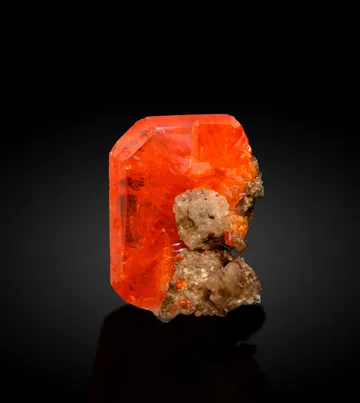
The best Red Cloud wulfenites have a look that is almost architectural: upright, glassy, tabular crystals, commonly beveled at the edges, perched on dark limonitic gossan, pale quartz druse, or calcite-rich vug linings. Good crystals are not merely “red”; many are a hot red-orange, glowing in transmitted light, with sharp form, high luster, and enough isolation on matrix to make each blade visible. The mine has also produced exceptional miniature and cabinet specimens, including historic Ed Over material from 1938 and the celebrated 1996 production associated with Wayne Thompson’s group.
Regional View
Country View
The deposit is a classic oxidized base-metal vein locality rather than a broad disseminated orebody. The collecting significance comes from the pockets: small open spaces along the vein where lead, molybdenum, vanadium, arsenic, chlorine, zinc, carbonate, and silica-bearing fluids produced a compact but wonderfully photogenic secondary-mineral suite. Red Cloud’s reputation also rests on continuity. It was known to mineralogists in the nineteenth century, loved by field collectors in the twentieth, and still appears in modern specimen channels as both historic material and more recent fee-dig material.

Photo: Wikimedia Commons
Search for specimens: View all specimens from Red Cloud Mine, USA
Red Cloud Mine is in the Silver Mining District, Trigo Mountains, La Paz County, Arizona; older labels commonly read “Yuma County,” because the historic Yuma County locality name predates the creation of La Paz County. The mine is near the Arizona-California border in the Sonoran Desert, roughly north of Yuma, at an elevation of about 750 feet. The locality sits on private/patented ground and has long been treated as a mine site requiring permission, not an open public collecting area.
The ore is an oxidized vein system developed along an irregular fault zone. Published locality summaries describe irregular masses and vug linings of argentiferous lead and zinc carbonates, partly altered silver-bearing galena, silver chloride and bromide minerals, pyrolusite, vanadinite, wulfenite, and minor malachite in a gangue of iron oxides, quartz, fluorite, calcite, gouge, and brecciated wall rock. The fault zone has been described as striking roughly north-northwest and dipping moderately to steeply east, with mineralization lying between Tertiary andesite breccia, dacite porphyry, rhyolitic to dacitic tuffs and lapilli tuffs, and Laramide granodiorite to quartz diorite intrusive rocks. Silicification, sericitization, carbonatization, brecciation, and fault gouge are all part of the Red Cloud vein character.
The old ore was mined for silver and lead first. Early work began with small open cuts; by about 1880, the Red Cloud Mining Company of New York had developed more substantial workings, including inclined shafts, stopes, and connecting passageways. Ore was once hauled by wagon down Red Cloud Wash to Norton’s Landing on the Colorado River and then shipped by boat onward for smelting. Estimates for nineteenth-century production vary in the literature, but the mine was an important early producer in the district before silver prices and changing economics slowed activity after 1890.
Later operators and owners included Horton & Knapp, Hubbard & Bowers, Red Cloud Consolidated Mines Company, Primos Chemical Company, Neal Mining Company, Hanna interests, Penn Metals, Riley & Holmes, and Red Cloud Mining & Milling Company. Work in the twentieth century included evaluation, diamond-drilling-related development, a short-lived 1941 flotation effort on dump material, recovery of lead, zinc, and silver from dumps in 1949, underground and specimen-related activity in the late 1970s and early 1980s, and later open-cut work aimed specifically at wulfenite pockets.
The workings have been described as a combination of open cuts, shafts, winzes, raises, drifts, stopes, an inclined working on the vein, and deeper development approaching the 500-foot level. The mineralogically important spaces were not broad ore reserves but vugs and pocket zones. The best ore and the best specimen opportunities tended to occur where the main vein met cross-fractures or where brecciated, open, oxide-rich material left enough room for euhedral secondary crystals to grow.
The most famous collecting episodes are the 1938 Ed Over discovery and the 1996 Wayne Thompson-era pocket. Over’s specimens became the historical standard: thick, glassy, red to red-orange wulfenite crystals, often on contrasting matrix. The 1996 find, opened by Bob Johnson during mining organized by Wayne Thompson and partners, was later described as the largest and most productive Red Cloud wulfenite pocket then known. Many fine modern Red Cloud specimens in private and institutional collections trace to that production.
Current collecting is controlled by the mine operators. The official mine site states that the Red Cloud Mine is open for the 2025/2026 season, that reservations are recommended, that payment is cash only, that prepayment should not be sent to anyone claiming to represent the mine, and that there is no underground access at Red Cloud Mine properties. The same source emphasizes access from the south by Red Cloud Mine Road from the Martinez Lake side and recommends four-wheel drive. Field-trip reports from mineral clubs describe rough desert-road travel, sandy washes, high-clearance vehicles, paid collecting, and seasonal collecting timed for the cooler months.
Red Cloud wulfenite is the locality’s defining mineral: stout to thin tabular PbMoO4 crystals, usually orange-red to deep red-orange, in vugs in oxidized lead-silver-zinc vein material, commonly on limonitic gossan, quartz druse, calcite, fluorite, or oxide-rich breccia. Historic descriptions emphasize sharp form, brilliance, luster, and color; modern observations from the dumps and pit still note small macro crystals and abundant micro crystals, with better pieces showing isolated upright blades, clean glassy faces, minimal edge abrasion, and strong contrast against matrix. Crystals of a few millimeters are still plausible in collected material, centimeter-size examples are far more desirable, and the legendary pieces include multi-centimeter blades from the Ed Over material and the 1996 pocket; “window-pane” crystals with high transparency and electric luster are especially prized, while ordinary pieces tend to be small, crowded, contacted, iron-stained, or broken from the matrix.
Calcite at Red Cloud is part of the vein gangue and vug assemblage rather than the headline species, but it is important because it forms pale, contrasting pocket linings and matrix for wulfenite. Published and field accounts describe calcite with quartz, fluorite, iron oxides, and brecciated wall rock in open cavities; small rhombohedral calcites may sit with wulfenite, and quartz-calcite vugs are specifically reported as hosts for sharp wulfenite crystals. The most collectible Red Cloud calcite is not judged as a standalone Arizona calcite classic, but as attractive matrix: clean, pale, sparkling, three-dimensional calcite that lifts red-orange wulfenite visually and has not been crushed, etched, or stained into visual noise.
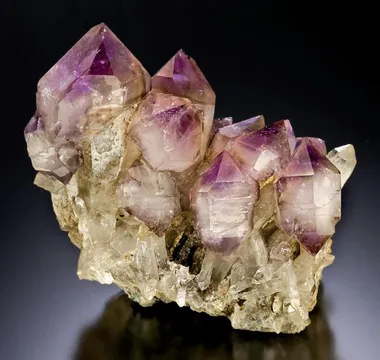
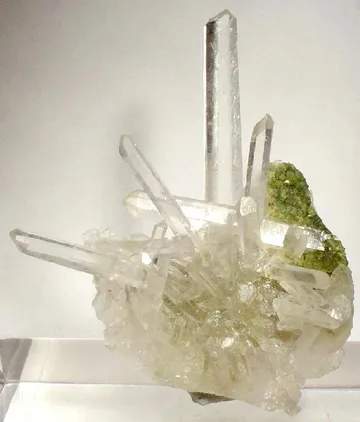
Quartz at Red Cloud occurs as gangue, drusy vug lining, chalcedony, and locally amethystine material in the oxidized vein, with the finest collector role being the sparkling quartz base beneath wulfenite and other secondary minerals. Field observations describe many open spaces lined with drusy quartz crystals, and modern collecting reports note wulfenite crystals on quartz, wulfenite in quartz-calcite vugs, and quartz druses serving as substrates for rarer species such as mimetite, hemimorphite, willemite, cerussite, and fluorite. Good Red Cloud quartz specimens are those in which the quartz is bright, fresh, and compositionally useful to the display—especially as a pale glittering carpet under red-orange wulfenite—whereas loose, iron-coated druse without secondary minerals is commoner and far less compelling.
Mimetite from Red Cloud is a much scarcer arsenate companion to the wulfenite story, documented as yellow to red or orange secondary lead arsenate in the oxidized vein and reported in association with wulfenite, quartz, calcite, fluorite, cerussite, hemimorphite, and willemite. One classic Mineralogical Record figure describes red mimetite from a long channel lined with such specimens but lacking wulfenite, while modern dump collecting has yielded millimeter-scale clusters of tiny hexagonal terminated crystals. The best Red Cloud mimetite specimens are locality-significant rather than large: sharp crystal groups, obvious color, secure identification, and meaningful association with the Red Cloud pocket assemblage separate them from ordinary yellow crusts or ambiguous microcrystalline coatings.
Beyond those four collector staples, Red Cloud has a compact but interesting oxidized lead-zinc-silver suite including acanthite, anglesite, aragonite, baryte, bindheimite, caledonite, cerussite, chlorargyrite, clinoatacamite, descloizite, fluorite, fornacite, galena including silver-bearing galena, goethite, gypsum, hematite, hemimorphite, hydrocerussite, leadhillite, linarite, malachite, massicot, minium, opal, plattnerite, pyrolusite, siderite, smithsonite, stetefeldtite, vanadinite, wickenburgite, willemite, and varieties of quartz including amethyst and chalcedony. Current public mineral lists do not treat Red Cloud Mine as the type locality for a valid mineral species, but the mine is important for rarities in context: fluorescent willemite, small arsenate and vanadate minerals, silver halides, and secondary lead minerals that are easily overshadowed by the world-class wulfenite.
Red Cloud specimens should be evaluated first on locality confidence, then on condition. The classic look—red to orange-red tabular wulfenite on dark iron-oxide matrix, quartz druse, calcite, or mixed oxidized vein rock—is familiar, but not every orange-red Arizona wulfenite is Red Cloud. Nearby and regional localities such as the North Geronimo, Hamburg, Princess, Defiance, Rowley, Glove, 79, and other Arizona mines have also produced wulfenite, vanadinite, mimetite, or oxidized lead-suite specimens. Old “Yuma County” labels are not automatically wrong for Red Cloud; they may be historically correct. Conversely, “Red Cloud” has sometimes been used loosely for Silver District material, so specimens with old collection labels, pocket attribution, or known Ed Over / Wayne Thompson / 1996 provenance deserve extra attention.
Condition is the central issue. Wulfenite has good visual drama but is physically unforgiving: thin tabular edges, exposed corners, and isolated upright crystals chip easily. Red Cloud pieces often reveal tiny edge bruises, contacted side faces, glued repairs, or matrix breaks only under strong light and magnification. Check whether the crystal is naturally attached, whether matrix has been trimmed too close, whether iron oxides are hiding damage, and whether a brilliant “single” is actually a detached crystal re-mounted to matrix. A specimen can still be excellent with minor peripheral contacts, but the premium pieces have complete faces, clean beveled edges, strong luster, and a natural-looking seating in the vug.
No broadly documented, locality-specific treatment tradition dominates Red Cloud wulfenite in the published sources consulted; the more common problems are misattribution, repaired crystal breaks, and condition overstatement. Cleaning should be conservative. The matrix may contain calcite, fluorite, quartz, iron oxides, lead minerals, and delicate secondary species, so aggressive acid work can alter the appearance or remove useful context. Fluorescent material from the mine—especially willemite and fluorite—adds another collecting dimension; shortwave ultraviolet inspection can reveal bright green willemite and blue-purple fluorite, but fluorescence should not be used as a substitute for mineral identification.
Handle Red Cloud material as lead-bearing mineral specimens: wash hands after handling, avoid inhaling dust from trimming or cleaning, and keep friable fragments away from children and pets. For display, vibration and crowding are the enemy. The most elegant Red Cloud crystals often stand proud of the matrix, exactly where a cabinet door, foam lid, or careless finger can ruin them. Use a rigid box, no pressure on the crystals, and avoid shipping specimens loose in soft batting that can catch exposed blades.
Market availability is split. Small Red Cloud wulfenites and recent fee-dig pieces are still obtainable, but historic, highly aesthetic, undamaged, matrix examples with large isolated crystals are scarce and command strong premiums. Specimens tied to the 1938 Ed Over discovery, the 1996 pocket, respected Arizona collections, or published photographs belong in a different market tier from common dump finds. For advanced collectors, provenance is not decoration here; it is part of the specimen.
In the old days the Red Cloud was not a mineral-show name; it was an isolated desert mine on a rough road in the Trigo Mountains. Early silver-lead ore was worked by hand, sorted and high-graded underground, and hauled down Red Cloud Wash toward the Colorado River. The mine’s name is tied to the Red Cloud Trail, and for later collectors the road itself became part of the legend: long desert approaches, military-range signs, sandy washes, heat, and finally the mine buildings and headframe appearing in a barren pocket of western Arizona.
The line every collector remembers is painted in the folklore of the place: “WULFENITE IS LOVE.” An old building at the mine once served as a practical landmark, and directions could be reduced to looking for the shack with those words on the side. It is hard to imagine a better field-collector slogan. Red Cloud had already produced fine wulfenite by then, but the phrase captured what the locality became: not just an ore mine, but a pilgrimage site for people who cared about crystal form, color, and the romance of finding something perfect in rough desert rock.
The great early chapter belongs to Ed Over. In 1938, after Arthur Montgomery persuaded him to visit the mine, Over spent 45 days at Red Cloud. The pocket he collected is still treated by many collectors as the classic standard. Those specimens, with thick glassy red to orange-red crystals, were dispersed into major collections and literature; one 5 cm crystal from the 1938 discovery appeared on the cover of the May-June 1980 Mineralogical Record Arizona issue. The Over name remains so powerful that later specimens with credible Over provenance are not simply “old Red Cloud” pieces—they are relics of the discovery that fixed the locality’s reputation.
The next great chapter began in the 1990s. In 1994, Wayne Thompson and James Horner purchased the Red Cloud Mine; by late 1995 arrangements were in place, and mining began in January 1996. The operating group included Wayne Thompson, James Horner, Bill Larson, Les Presmyk, and Gene Meieran. Their strategy was not casual dump picking. They attacked the pocket-bearing vein by open-cut mining, stripping and following the vein in hopes that it would still contain the sort of open spaces collectors dream about.
On April 1, 1996, Bob Johnson opened what became the famous April Fools Day pocket. It was no joke: later accounts describe it as by far the largest and most productive Red Cloud wulfenite pocket found to that time. Specimens from that pocket entered major private collections quickly, and the best were spoken of as world-class wulfenites, not merely good Arizona pieces. One especially important 10 cm specimen was described in a Mineralogical Record supplement as among the two or three finest from the operation and one of the world’s best for the species; it moved through the hands of Wayne Thompson, Evan Jones, Les Presmyk, Sandor Fuss, and Stuart Wilensky, a provenance chain that reads like a roster of serious American mineral collecting.
Modern field accounts bring the story back down to the grit of collecting. Visitors describe the road from the Martinez Lake side, the washes, the need for clearance, and the way the desert changes from agricultural Yuma country into a stony, dry, military-range-edge landscape. At the mine, collectors may search old dump and surface material for small wulfenites, fluorescent willemite, fluorite, quartz-lined vugs, and micro-minerals. The romance is still there, but the easy large crystals are not. One experienced modern visitor reported finding beautiful small Red Cloud wulfenites and abundant fluorescent willemite, while noting that the truly large crystals came from knowledge, access, and hard-won experience rather than from casual surface scratching.
The resident-mine chapter has its own character too. Field reports describe Roger Sarber as a professional miner and mine watchman with deep underground experience, living at the mine with a trailer, a well, and a 3000-gallon water tank. That detail says much about Red Cloud: even in the twenty-first century, it is not a tidy roadside tourist stop. It is still a remote desert mine where knowledge of ground, pockets, fractures, and weathered vein material matters.
Gary M. Edson, “Famous Mineral Localities: The Red Cloud Mine, Yuma County, Arizona,” The Mineralogical Record, Vol. 11, No. 3, May-June 1980, pp. 141-152. The essential classic locality article, with history, geology, production notes, and Red Cloud specimen context.
Terry Szenics, “Ed Over at the Red Cloud [Arizona]: The Story of One Man’s Discovery,” The Mineralogical Record, Vol. 6, No. 4, July-August 1975, pp. 176-179. The key published account of Ed Over’s 1938 collecting episode at Red Cloud.
Wendell E. Wilson, “Bonanza at the Red Cloud Mine,” The Mineralogical Record, Vol. 27, No. 5, September-October 1996, pp. 347-354. The principal account of the 1996 Wayne Thompson-era pocket and its specimen production.
Peter Bancroft and Garth Bricker, “Arizona’s Silver Mining District,” The Mineralogical Record, Vol. 21, No. 2, March-April 1990, pp. 151-168. A major district-level reference for Red Cloud and related Silver District localities.
Benjamin Silliman, “Mineralogical Notes,” American Journal of Science, 3rd series, Vol. 22, 1881, pp. 198-205. An early reference for vanadates and related Arizona material from the Silver District era.
E. D. Wilson, Geology and Mineral Deposits of Southern Yuma County, Arizona Bureau of Mines Bulletin 134, Geological Series 7, 1933. Foundational regional geology and mining reference for southern Yuma County, including the historic Silver District framework.
E. D. Wilson, Arizona Zinc and Lead Deposits, Arizona Bureau of Mines Bulletin 158, 1951. Important mid-century economic-geology reference for Arizona lead-zinc deposits, cited repeatedly in later Red Cloud summaries.
Raymond W. Grant, “Arizona’s Red Cloud Mine,” Rocks & Minerals, Vol. 61, No. 2, 1986, pp. 54-56. Short locality treatment in the mineral-collecting literature.
Manuel Robbins, “Fluorescent Forum: Willemite Part II,” Rocks & Minerals, Vol. 63, No. 4, 1988, pp. 327-329. Relevant to the fluorescent willemite component of Red Cloud material.
Manuel Robbins, “Fluorescent Forum: Willemite Part III,” Rocks & Minerals, Vol. 64, No. 1, 1989, pp. 57-59. Additional fluorescent-mineral context for willemite-bearing Red Cloud specimens.
“Wulfenite, Red Cloud Mine, La Paz County, Arizona,” Mineralogical Record Special Supplement, January-February 2007. Describes a major 1996 Red Cloud wulfenite specimen and gives a concise provenance and reference summary.
“Going Underground 300ft to find RARE CRYSTALS!” — The Crystal Collector, Bryan Major A 2023 video visit to Red Cloud Mine, presented as a private underground trip to look for wulfenite.
“World Famous Red Cloud Mine Wulfenite | Finally made it there!” — The Crystal Collector, Bryan Major A 2022 field-collecting video at the Red Cloud Mine near Yuma, Arizona.
“WULFENITE | The Official State Mineral of Arizona” — BlueCap Productions and Evan Jones A broader Arizona wulfenite program tied to the state-mineral campaign, with Red Cloud material among the iconic examples.
“Special Report: Magic Minerals in the Red Cloud Mine” — KYMA / 13 On Your Side A local-news video segment featuring the Red Cloud Mine and its wulfenite reputation.
Mindat: Red Cloud Mine, Silver Mining District, La Paz County, Arizona The most useful single locality database page, with coordinates, mineral list, references, photographs, geology notes, and historical ownership details.
Official Red Cloud Mine website Current collecting-season, access, reservation, fee, road, cash-payment, and no-underground-access information from the mine operators.
Western Mining History: Red Cloud Mine A convenient MRDS-derived mining record summarizing commodities, land status, production notes, workings, and references.
D. Joyce Minerals: “The Road to the Red Cloud Mine” A detailed modern field report with road conditions, mine observations, collecting results, fluorescent willemite notes, and specimen photographs.
Mineralogical Society of Southern California: Red Cloud Mine field trip report, October 24, 2020 Useful collector’s account of a paid field trip, collecting conditions, wulfenite, and fluorescent material.
Mineralogical Society of Arizona: Red Cloud Mine field trip announcement, December 2021 Practical club-field-trip information documenting seasonal access, rough travel, safety considerations, and collecting expectations.
Lake Havasu Gem & Mineral Society: Red Cloud Mine field trip, March 2, 2025 Recent club trip notice documenting current-style paid collecting, cash fees, keep-what-you-find terms, and high-clearance vehicle requirements.
Wikimedia Commons: Red Cloud Mine wulfenite photo High-quality freely licensed image of a classic Red Cloud wulfenite specimen.
New Mexico Mineral Symposium abstract: Red Cloud Mine Concise modern abstract summarizing early wulfenite recognition, Ed Over’s 1938 collecting, the post-1960s collector era, and the 1994-1996 Thompson operation.
Collectors Edge: Red Cloud Mine, La Paz County, Arizona Dealer-locality article with historical and specimen-oriented context for Red Cloud wulfenite.