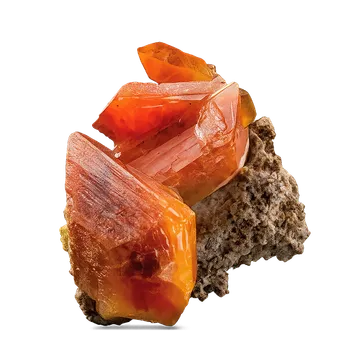
Red Cloud Mine, Arizona — wulfenite prized for saturated orange-red tablets, high luster, and upright, glassy crystals; renowned desert locality for collectors.
Key facts
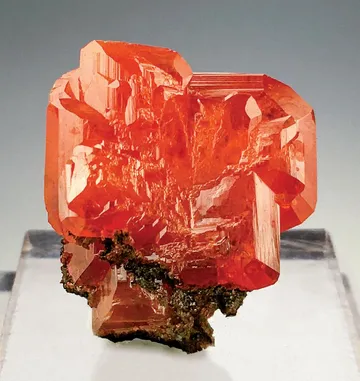
Red Cloud wulfenite is the Arizona classic by which red wulfenite is still judged: lustrous, fiery orange-red to rose-red tablets of Pb(MoO4), typically poised on dark gossan, brecciated quartz, fluorite, or calcite-rich matrix. The best crystals have the combination serious collectors prize most—saturated color, high luster, sharp tetragonal form, translucency to transparency, and a certain improbable poise: thin square plates standing upright like red glass panes in a desert fissure.

Photo: Ivar Leidus, Wikimedia Commons
The mine lies in the Silver Mining District of the Trigo Mountains, in the hot, dry, rugged desert country north of Yuma. Its original economic interest was silver-lead ore, not specimens. Wulfenite formed later in the oxidized portions of the deposit, where lead from galena met molybdenum-bearing solutions in open fractures and vugs. That oxidized-vein environment gave collectors the great Red Cloud aesthetic: red-orange wulfenite standing out against iron-stained, pale, gray, or dark brown matrix, often with little else to distract the eye.
Red Cloud is not a prolific “wall of crystals” locality in the way some large Mexican or African wulfenite occurrences can be. Its fame rests instead on the top pieces: small, perfect thumbnails; dramatic miniatures with isolated upright crystals; rare cabinet specimens from modern open-pit specimen mining; and historic Ed Over material from 1938, which has acquired almost legendary standing. Old labels may read “Yuma County,” because La Paz County was created later; correctly localized modern labels give Red Cloud Mine, Silver Mining District, La Paz County, Arizona, USA.
For collectors, the Red Cloud look is unmistakable when it is right: a saturated red to orange-red tablet, glassy to adamantine, with beveled edges and enough transparency that the crystal glows from within. Fine specimens are scarce relative to demand, and excellent undamaged examples—especially with provenance to the Ed Over find, the 1996 April pocket, or the 2003 Red Gem Pocket—are major locality pieces.
Search for specimens: View all wulfenite specimens from Red Cloud Mine, Arizona, USA
The Red Cloud Mine is a former silver-lead mine and specimen locality in the Silver Mining District, Trigo Mountains, La Paz County, Arizona. The site is roughly north of Yuma in arid southwestern Arizona, historically reached by desert roads through Red Cloud Wash and the Martinez Lake area. The mine sits in a fault-controlled vein system in volcanic and intrusive rocks, with oxidized silver-lead-zinc mineralization carrying galena-derived lead, silver halides and carbonates, iron and manganese oxides, quartz, fluorite, calcite, barite, and the secondary lead molybdate wulfenite.
The mineralized structure is a north-trending fault-vein system dipping eastward. Early workings followed the richer silver-lead zones underground, leaving a maze of inclined shafts, stopes, passages, and broken rock. Wulfenite occurred in vugs, cracks, and fracture linings rather than as a predictable ore layer, which explains the mine’s collecting history: long stretches of barren or ordinary ground punctuated by small pockets and, on rare occasions, extraordinary crystal-lined openings.
Mining began as a small open cut in the late nineteenth century. Early production focused on silver-lead ore hauled by wagon through the desert to the Colorado River for shipment. The Red Cloud Mining Company of New York developed the upper workings around 1880, and the mine became one of the important early producers of the district. Published estimates differ, but early silver-lead production before the mine’s long decline was significant by territorial standards. After the most profitable years, the mine saw cycles of idleness, promotion, exploration, dump reworking, and short-lived mining attempts tied to changing metal prices.
The specimen story became dominant in the twentieth century. Wulfenite was already known from early Red Cloud mining, and old specimens entered eastern institutional collections. The decisive collecting moment came in 1938, when Ed Over worked the mine and recovered superb red wulfenite that later became the benchmark for the locality. From the 1960s through the 1970s, Red Cloud became a pilgrimage site for Arizona and California collectors, who dug through old workings hoping for pockets comparable to Over’s. Most did not find them.
In 1994–1995, a collector group led by Wayne Thompson obtained the property and began a modern specimen-mining campaign. Rather than extending unsafe underground workings, the group used open-pit methods to mine the vein systematically from the surface. In 1996, that approach produced one of the great modern Red Cloud discoveries: a large crystal-lined fissure yielding specimens far larger and more displayable than typical historic finds. Colorado Calumet later worked the property, expanding the open pit and recovering additional pockets, including the 2003 Red Gem Pocket near the end of the operation.
Modern access has varied with ownership, season, and safety conditions. The present Red Cloud Mine operation advertises fee collecting and specimen purchase opportunities seasonally, with important restrictions: no underground access, cash-only payment, recommended or required reservation depending on conditions, access from the south via Red Cloud Mine Road from Martinez Lake, and 4WD recommended. As with any patented mine property, collectors should treat all access as permission-based and confirm conditions directly before planning a trip.
The classic Red Cloud crystal is a tetragonal tabular wulfenite plate: square to rectangular, thin to moderately thick, with bright faces and beveled or pyramidal edge modifications. Crystals may stand singly, occur in loose clusters, or be scattered over matrix as isolated upright “windows.” The most desirable examples balance form and color—sharp outlines, lustrous broad faces, and saturated red-orange body color without becoming too dark or opaque.
Color is the locality’s calling card. Red Cloud wulfenite ranges from orange-red and cherry-red to deep rose-red, with some yellow-orange or brownish pieces also known. The finest crystals are not merely orange; they carry a rich, glowing red component that separates them from many other Arizona wulfenite localities. Transparency varies from translucent to gemmy, and a good crystal often shows a warm internal fire when backlit while still reading strongly under normal case lighting.
Size is an important quality factor. Small crystals are common enough in collected material, but undamaged, well-placed crystals over 1 cm are much more desirable. Crystals to around 5 cm on edge are recorded, and the largest celebrated historic crystals from the Ed Over era reportedly exceed 2 inches on edge. Modern Red Gem Pocket crystals commonly impressed collectors not by great size alone, but by color saturation, brilliance, and gemminess, with many top crystals around the one-inch class. The 1996 pocket was especially important because it produced unusually large matrix specimens and cabinet-scale pieces, not just isolated thumbnails.
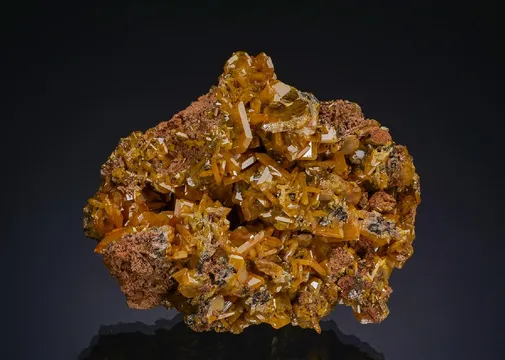
Associated minerals include calcite, quartz, fluorite, mimetite, vanadinite, willemite, cerussite, barite, galena, goethite-limonite, and other secondary lead-zone species. In practice, the best-known Red Cloud wulfenite specimens are often visually simple: wulfenite on gossan, quartz, fluorite, or calcite, with associated species subordinate or absent. Vanadinite and mimetite occur at the locality and can make attractive associations, but Red Cloud is not principally a combination-specimen locality; it is prized above all for red wulfenite.
Collectors evaluate Red Cloud pieces by the same unforgiving standards applied to great wulfenite everywhere, but with locality-specific emphasis. Saturated red-orange color matters enormously. Luster should be bright and glassy to adamantine, not dull. The crystal should be sharply formed, preferably upright or well exposed, and placed on matrix in a way that gives it relief. Transparency is a premium feature, especially when paired with strong color. Damage is critical: wulfenite is brittle, exposed edges chip easily, and the broad tabular faces show abrasions, cleaves, and rehealed-looking contacts plainly. A modest thumbnail with one perfect, glowing crystal can outrank a larger but bruised plate.
Red Cloud wulfenite is a heavily collected classic, so provenance matters. Old labels reading “Yuma County” can be legitimate for Red Cloud specimens collected before La Paz County existed, but a label alone is not proof. Strong provenance to recognized collections, older dealers, or named finds such as Ed Over material, the 1996 April pocket, or the 2003 Red Gem Pocket materially improves confidence and value.
Condition is the central buying issue. Wulfenite has low hardness and brittle tenacity, and Red Cloud crystals often stand exposed on matrix, so corners and edges are especially vulnerable. Look closely for small nicks along the square outline, cleaved plates, bruised terminations, repaired standing crystals, and glued or stabilized matrix. Some Red Cloud matrix can be friable or fractured; other pieces, especially those on silicified matrix, are more stable. Ask specifically about repairs, restoration, and matrix reinforcement, because repaired Red Cloud specimens are known and are not always obvious in photographs.
Authenticity concerns usually fall into three categories: wrong locality, repair, and assembly. Wrong-locality material can be an issue because red to orange wulfenite occurs at other Arizona, Mexican, and world localities. A convincing Red Cloud specimen should fit the locality’s crystal habit, color, matrix, and label history. Repairs are common enough in the broader wulfenite market that they should be expected as a possibility, especially where a prominent upright crystal seems precariously attached. Matrix-assembly fakes—crystals glued onto unrelated rock—are a known general risk for wulfenite and mimetite specimens, so examine attachment points, glue shine, unnatural gaps, and mismatched dirt or matrix texture.
Treatments are less central to Red Cloud wulfenite than physical condition and repair. The main practical concern is preservation: avoid ultrasonic cleaning, acids, aggressive water jets, heat, or prolonged intense light. Dust with a soft brush or air bulb only. Store specimens so the wulfenite does not contact box lids, cotton fibers, or neighboring pieces. A red tabular crystal that has survived more than a century of handling deserves a mount or a fitted box.
Market availability is steady but stratified. Small, modest, or damaged Red Cloud examples appear regularly; clean, gemmy thumbnails and miniatures are much scarcer; historic Ed Over specimens and top modern pocket pieces are major acquisitions. Fine Red Cloud wulfenite has a durable collector base because it sits at the intersection of species quality, Arizona history, iconic color, and named-locality prestige. The best pieces are rarely inexpensive, and when a specimen combines strong red color, transparency, undamaged edges, and a documented pocket or collection history, competition is immediate.
The Red Cloud story begins as an ore story, with wagons and river transport rather than glass cases. In the early years, silver-lead ore was taken from the outcrop and hauled down Red Cloud Wash to Norton’s Landing on the Colorado River, then shipped by boat to a smelter. The road, the wash, and the river mattered as much as the mine itself: a small desert silver-lead operation could only become a producing mine if heavy ore could be dragged out of the Trigo Mountains and moved onward.
By the 1880s, the Red Cloud was no longer just a cut in the outcrop. The Red Cloud Mining Company of New York drove the upper workings, including the inclined shaft and connecting stopes. The old miners were following ore, not red crystal plates for collectors, and their underground work created the very voids and broken-rock settings later generations would search for wulfenite pockets. Much of the later collector romance of Red Cloud comes from that tension: the old-timers built a silver mine; collectors inherited a maze.
Then came Ed Over. In 1938, after Arthur Montgomery saw old Red Cloud specimens and urged him to visit, Over spent 45 days at the mine. Working with simple tools and supplies, he found the pocket that many collectors still treat as the standard. The crystals from that discovery became the comparison point for later Red Cloud finds: the color, the size, the rose-red glow, the perfection. Over was not operating a modern specimen mine with a crew and equipment; the enduring image is one man in a desert mine, recovering the pieces that would make his name inseparable from the locality.
The mine acquired a phrase as famous as some specimens: “WULFENITE IS LOVE.” Collectors’ directions once reportedly included the instruction to look for the shack with those words painted on it. The phrase is charming because it is both absurd and entirely understandable. Red Cloud is a hard desert locality: hot, remote, stingy, and physically unforgiving. Yet the sight of a red wulfenite crystal glowing out of dark rock was enough to turn inconvenience into devotion.
The 1996 operation changed the scale of what collectors thought the modern Red Cloud could still produce. Wayne Thompson and his associates chose not to burrow farther into the old underground workings; they mined from the surface, stripping the vein in horizontal slices. That strategy reduced the randomness that had ruled earlier collecting. If a productive pocket lay in the mined slice, they would expose it.
Late in March 1996, the work began to hint at something better. A crack near the north incline showed crystals as large as 5/8 inch. Encouraging, yes—but four days later it was eclipsed. At the south end of the trench, the miners broke into a large open fissure. Accounts describe it as far beyond a typical Red Cloud pocket: instead of a softball-sized vug or a narrow two-inch crack, this opening reached inches across and extended for many feet. One description gives the great pocket as up to 8 inches wide, 4 feet high, and about 30 feet long; another describes the April 1996 find as an open vein around 10 cm wide and roughly 1 by 4 meters across. The important point for collectors is not the slight variation in reported measurements, but the scale: it produced cabinet specimens, not just thumbnails.
That pocket supplied the modern Red Cloud market with pieces unlike the old random underground finds. Some specimens carried numerous red-orange crystals on contrasting matrix; some reached cabinet size; one account notes a best specimen about 12 inches across. For a mine where quality specimens larger than 2 by 2 inches had been virtually unheard of, the find was a true bonanza. The pieces entered private collections quickly and became a named chapter in Red Cloud collecting.
The 2003 Red Gem Pocket added a different kind of glory. Found near the end of Colorado Calumet’s operation, it produced brilliant, gemmy, deep orange-red crystals on loose fragments of brecciated quartz and fluorite matrix. The pocket did not become famous because it yielded giant plates. Its reputation rests on intensity: small to medium crystals with shocking color saturation, luster, and transparency. Many were thumbnail or miniature pieces, but the finest had the hot red-orange flash that makes collectors stop mid-aisle at a show.
The Red Gem Pocket also carried a sense of finality. Shortly after its recovery, the open pit reached its design limit, and economic and physical constraints ended that phase of mining. Reclamation followed, and the property changed hands. That timing gives Red Gem material a special place in the locality’s modern history: not merely another pocket, but one of the last great recoveries of a specimen-mining campaign that had briefly revived a classic nineteenth-century mine.
Modern visits are a different experience from the underground collecting days. The mine now emphasizes surface access, fee collecting, camping, fluorescents, and safety restrictions. No underground access is allowed. Visitors may still find wulfenite, vanadinite, calcite, fluorite, willemite, quartz, and other material, but the romance has shifted from crawling old stopes to reading the desert surface, checking permitted areas, and respecting a site whose history is deeper than any single pocket.
Gary M. Edson, “Famous Mineral Localities: The Red Cloud Mine, Yuma County, Arizona,” The Mineralogical Record, vol. 11, no. 3, 1980, pp. 141–152 — Classic locality article covering the mine’s setting, early history, and wulfenite fame.
Wendell E. Wilson, “Bonanza at the Red Cloud Mine,” The Mineralogical Record, vol. 27, no. 5, 1996, pp. 347–354 — Publication record for the 1996 article documenting the modern specimen-mining bonanza.
Wendell E. Wilson, “Bonanza at the Red Cloud Mine” reprint page at MineralTown — Accessible online version, credited to The Mineralogical Record, with pocket descriptions, geology, and bibliography.
Les Presmyk, “The Red Cloud mine — an update,” New Mexico Mineral Symposium abstract, 1998 — Concise account of mining history, Ed Over’s 1938 collecting, and the 1996 open-pit operation.
T. Szenics, “Ed Over at the Red Cloud: the story of one man’s discovery,” The Mineralogical Record, vol. 6, 1975, pp. 176–179 — The key Ed Over reference, cited in the Wilson bibliography.
Peter Bancroft and Garth Bricker, “Arizona’s Silver Mining District,” The Mineralogical Record, vol. 21, 1990, pp. 151–168 — Important district-level reference listed for the Red Cloud locality.
E. D. Wilson, “The Geology and Mineral Deposits of Southern Yuma County,” Arizona Bureau of Mines Bulletin 134, 1933 — Early geological reference used by later Red Cloud authors.
E. D. Wilson, “Arizona Lead and Zinc Deposits,” Arizona Bureau of Mines Bulletin 158, 1951 — Ore-deposit reference used in later Red Cloud sections and mine diagrams.
Mindat locality page: Red Cloud Mine, Silver Mining District, La Paz County, Arizona, USA — Current locality entry with coordinates, mineral list, geology summary, references, and photo gallery.
Mindat wulfenite occurrence entry for Red Cloud Mine — Species-specific occurrence record listing habit, color, associated minerals, and gallery data.
Arizona Mining, Mineral and Natural Resources Education Museum: “Featured Mineral: Wulfenite” — Notes Red Cloud wulfenite displayed in the State Symbols case at the Arizona Capitol Museum.
Arizona Highways: “Arizona’s Famous Specimen Mines” — Popular but useful account noting Red Cloud’s world-class wulfenite and Ed Over’s finest finds.
Flickr: James St. John photograph of Red Cloud wulfenite, Cranbrook Institute of Science specimen — Publicly documented institutional specimen photograph with locality and museum information.
“SPECIAL REPORT: Magic Minerals in the Red Cloud Mine,” Arlette Yousif, KYMA / KECY, 2022 — Local television feature on the mine, modern collecting, fluorescents, and recent specimen stories.
“DMB3180 Wulfenite, Red Cloud Mine, USA,” Crystal Classics, Vimeo — Dealer specimen video showing a Red Cloud wulfenite under rotating display lighting.
Red Cloud Mine official website — Current access, fee collecting, seasonal notes, restrictions, and contact information for the mine.
Mindat: Red Cloud Mine locality page — Best single technical starting point for locality data, references, coordinates, mineral list, and photo links.
Mindat: Red Cloud wulfenite occurrence — Focused wulfenite occurrence entry with associated-mineral photo statistics and species details.
Mindat gallery for Red Cloud Mine — Large visual reference set for crystal habits, matrix styles, and specimen quality range.
Wikimedia Commons: Red Cloud Mine category — Open-license photographs of Red Cloud wulfenite specimens and locality-related images.
Collectors Edge: Red Cloud Mine, La Paz County, Arizona — Detailed dealer-locality article on geology, mining history, Colorado Calumet operations, Red Gem Pocket material, and associated minerals.
MineralTown: “Bonanza at the Red Cloud Mine” — Readable online account of the 1996 open-pit specimen-mining operation and its major pocket.
New Mexico Mineral Symposium: Les Presmyk, “The Red Cloud mine — an update” — Compact source for the mine’s production history, Ed Over’s 1938 work, and the 1996 collector-led operation.
Arizona Mining, Mineral and Natural Resources Education Museum: “Featured Mineral: Wulfenite” — Arizona institutional context for wulfenite and Red Cloud’s place in state mineral displays.
Arizona Highways: “Arizona’s Famous Specimen Mines” — Readable overview placing Red Cloud among Arizona’s classic specimen mines.