






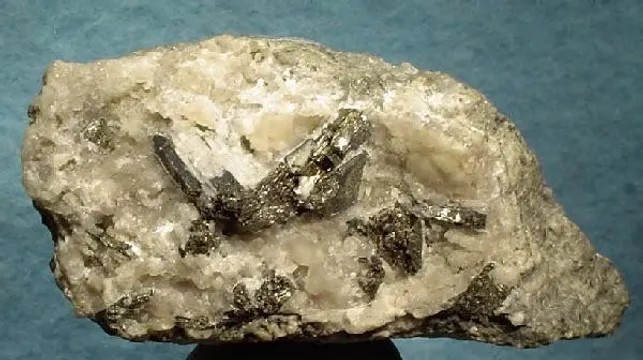
Portland Mine, USA - Cripple Creek locality known for high-grade gold-telluride ore with telluride blades on quartz and purple fluorite.
Key facts
The Portland Mine is one of the classic names of the Cripple Creek gold-telluride district of Teller County, Colorado: a Battle Mountain mine whose significance is far larger than the modest size of many surviving specimens. Collectors know Cripple Creek chiefly for gold-bearing tellurides, and Portland is an especially desirable locality within that suite because it sits in the southern part of the district’s alkaline volcanic-diatreme complex, where narrow fissures, sheeted zones, breccias, and mineralized granite carried the extraordinary gold values that made the camp famous. The mine’s best specimens are not showy in the vein-quartz sense of a great alpine pocket; they are intimate, high-grade ore specimens—etched or vuggy quartz and breccia matrix dusted or splashed with metallic calaverite and sylvanite, often with purple fluorite, pyrite, dolomite or other carbonates, and occasional visible native gold. The aesthetic is compact and concentrated: bright silver-yellow telluride blades or flashes on pale to smoky quartz, with the dark volcanic host and purple fluorite giving the old Cripple Creek material its unmistakable character.
Regional View
Country View
Portland’s geological importance lies in the way it illustrates the Cripple Creek model in miniature. The district is an alkaline igneous rock-related epithermal Au-Te system developed in and around an Oligocene volcanic-intrusive complex. The ore was not a simple quartz vein system; Portland exploited swarms of very narrow seams and sheeted fractures, some in breccia and some in granite or dike rocks, where late tellurides were deposited in open spaces, tiny joints, and mineral films. That makes fine Portland specimens unusually demanding: the best pieces show clear locality character and visible telluride mineralization, while ordinary ore may carry its value invisibly in grains too small for the naked eye.

Photo: Wikimedia Commons

Photo: Wikimedia Commons
Search for specimens: View all specimens from Portland Mine, USA
Portland Mine, also known as Portland No. 1 in mineralogical databases, is in the Cripple Creek Mining District near Victor and Goldfield, Teller County, Colorado, at roughly 38°42'58" N, 105°8'15" W. It was a gold mine on Battle Mountain, close to some of the best-known historic producers of the Victor side of the district. The locality is not merely “Cripple Creek” in the broad sense; for specimen collectors the mine-level label matters, because Portland-labeled telluride pieces are distinctly scarcer on the market than generic Cripple Creek or Cresson-open-pit material.
The broader deposit is an alkaline igneous rock-related, low-sulfidation-style epithermal Au-Ag-Te system. Modern work describes the Cripple Creek district as a large gold-telluride deposit spatially associated with an Oligocene intrusive and volcanic complex. The system includes high-grade gold-silver telluride veins, disseminated gold-pyrite mineralization, and breccia-hosted ore. At Portland, the most characteristic old ore occurred in fissures and sheeted zones cutting breccia, granite, and dike rocks. The USGS classic description of the district emphasized that Portland ore could be extraordinarily inconspicuous: calaverite was commonly present in very narrow joints and seams, often associated with crystalline carbonate films, a little silica, and fluorite, while the surrounding gray breccia could be impregnated with fine pyrite and still show little visible telluride.
The Portland workings are especially important in descriptions of Cripple Creek sheeted veins. The Captain vein system in the Portland Mine was used by Lindgren and Ransome as a classic example of a broad mineralized sheeted zone composed of many narrow, approximately parallel seams. Later summaries of alkaline gold deposits continued to use the Portland Captain vein as an illustration of how Cripple Creek differs from more familiar low-sulfidation quartz-adularia veins: the seams could be vuggy and lined with quartz, fluorite, dolomite, pyrite, calaverite and minor minerals, but they lacked the thick crustiform quartz bands many collectors associate with epithermal veins elsewhere.
The paragenesis matters when judging specimens. Early mineralization in the district included quartz, adularia, dark purple fluorite, and relatively coarse pyrite. Later mineralization introduced lighter purple fluorite, milky to smoky quartz, fine pyrite, carbonates such as dolomite or ankerite, and the tellurides. Portland’s documented mineral list includes quartz, calaverite, sylvanite, native gold, hessite, pyrite, fluorite, baryte, epsomite, and forsterite. Among these, the collector minerals are overwhelmingly the gold tellurides and their quartz-fluorite-pyrite associations; the other species are important as paragenetic and locality context rather than as major display minerals.
Mining began in 1892, and by the mid-1890s the Portland had become one of the great Cripple Creek producers. Its early history is inseparable from James F. Burns, James Doyle, John Harnan, and the turbulent consolidation of Battle Mountain claims. The mine grew from a tiny and legally precarious patch of ground into a major operation with multiple shafts and extensive underground workings. By 1916, contemporary mining press reports described 58 miles of underground workings in the Portland Mine and recorded 418,937 tons produced that year, excluding the Independence Mine, valued at more than $3 million. The Portland Mining Company later acquired the Independence Mine and Mill in 1915, tying two of the district’s most famous names under one operator.
Portland also belongs to the modern Cripple Creek story, though not as a collecting locality. The district is now dominated by the large Cripple Creek & Victor gold operation. Newmont owned CC&V until the sale to SSR Mining closed on February 28, 2025; current large-scale mining in the district is an industrial open-pit and heap-leach operation. Historic Portland ground and adjacent mine lands should be treated as private or controlled mine property, not as an open collecting site. Old dumps, shafts, and workings in the district can be hazardous, and access should never be assumed from the presence of historic roads, ruins, or online videos. For collectors today, legitimate Portland material comes from old collections, museum deaccessions, historic dealer stock, and specimens recovered during authorized mining or reclamation work—not casual field collecting.
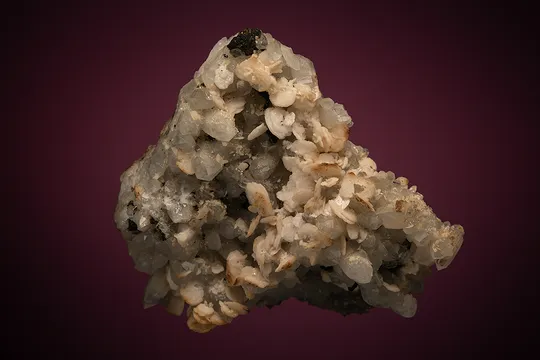
Quartz from the Portland Mine is valued less as a standalone crystal species than as the stage and matrix for the mine’s precious-metal tellurides. The characteristic material is vuggy, etched, drusy, milky to smoky, or sinter-like quartz in breccia or vein fragments, commonly accompanied by purple fluorite, pyrite, carbonate films, and scattered calaverite or sylvanite. In the Portland style, good quartz specimens are the pieces that preserve open-space texture: small vugs and fracture surfaces where late tellurides sparkle rather than disappear into massive ore. Ordinary Portland quartz can look plain, pale, fractured, or iron-stained; the better collector pieces show sharp contrast between the quartz and metallic telluride crystals, with enough matrix left to tell the geological story of a narrow, high-grade Cripple Creek seam.
Sylvanite is one of the prestige species from Portland, especially when the label is secure and the mineral is visible as metallic silver-white to pale yellowish blades, flakes, or small leafy aggregates on quartz. The historic Portland vein was described as a rich sylvanite-bearing vein in early accounts, and a Denver Museum of Nature & Science specimen photographed from the locality shows the classic association of sylvanite on quartz from the Cripple Creek diatreme. Collectors should expect small-scale mineralization rather than large freestanding crystals: millimeter-scale blades or bright streaks on quartz are typical, and fine examples are those where the sylvanite is unmistakable, abundant for the species, and aesthetically placed. Because miners and dealers historically used “sylvanite” rather loosely for silvery gold tellurides at Cripple Creek, strong Portland sylvanite specimens deserve careful visual comparison and, for high-value pieces, analytical confirmation.
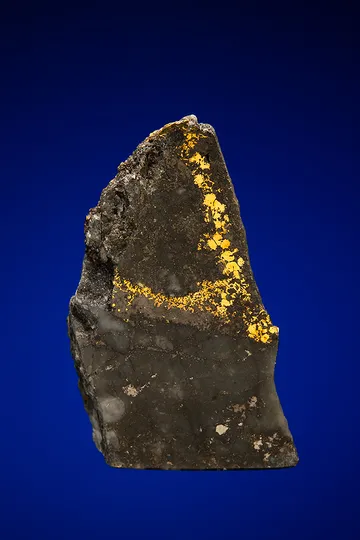
Calaverite is the signature Portland telluride and the most important collector species from the mine. In the best pieces it occurs as bright metallic yellow-silver to brassy crystals, blades, plates, or sparkling crystal groups on etched quartz, commonly with purple fluorite and pyrite; EarthWonders has recorded a Portland cabinet specimen with calaverite crystals to about 6 mm scattered over naturally etched quartz with limited purple fluorite and pyrite on the reverse. Historic descriptions stress that the calaverite was often concentrated in very narrow joints in breccia and could be nearly invisible in ordinary ore, so specimen-grade material is the exception rather than the rule. Top Portland calaverites combine visible, well-positioned crystals, crisp quartz-fluorite association, and a reliable old mine label; lesser pieces may be geologically authentic but read merely as dark breccia or quartz with tiny metallic specks.
Other documented Portland minerals include hessite, native gold, pyrite, fluorite, baryte, epsomite, and forsterite. Hessite is the notable silver telluride rarity in the mine list, but confirmed, display-quality hessite from Portland is far less commonly encountered than calaverite or sylvanite. Native gold is documented from the mine and represented in museum material, but the Portland collector identity remains centered on the tellurides rather than leafy free gold. Purple fluorite is one of the most useful association minerals for visual locality character, pyrite is common in the ore assemblage, and baryte and epsomite are recorded accessories. Portland is not famous as a type-locality mine; its mineralogical weight comes instead from being a classic, historically rich, mine-specific occurrence within one of the world’s great gold-telluride camps.
Portland Mine specimens require unusually careful labeling discipline. “Cripple Creek” material is common enough in old collections, but precise Portland pieces are much less common, and many old labels were written at district, town, or dealer shorthand level. A Portland label is most convincing when it appears on an old collection tag, a museum record, a reputable dealer description, or a specimen whose matrix and association fit the mine: quartz or breccia with purple fluorite, pyrite, carbonate films, and visible gold tellurides. Generic telluride ore from Cripple Creek should not be upgraded to Portland without evidence.
The biggest identification issue is calaverite versus sylvanite. Cripple Creek miners historically used the names inconsistently, with silvery calaverite sometimes called sylvanite and yellowish or tarnished telluride crystals called calaverite. Fine-grained pale pyrite can also mislead the eye. On valuable specimens, especially those sold as sylvanite rather than calaverite, analytical support is highly desirable. X-ray diffraction, Raman spectroscopy, SEM-EDS, or a reputable historic determination can add real value; a hand-lens opinion alone is not ideal for expensive Portland tellurides.
Condition is another major value factor. Calaverite and sylvanite are soft, brittle metallic minerals, and the crystals are usually tiny. They are easily rubbed, dulled, or lost from exposed quartz surfaces. Avoid ultrasonic cleaning, aggressive brushing, acids, and heat. Sylvanite and other tellurides are not minerals to test with a flame or hot needle; heating tellurides can alter them and can release unpleasant or hazardous vapors. The safest care is dry handling, gentle air dusting, and stable cabinet storage away from abrasion.
The most attractive Portland pieces are small-cabinet to cabinet specimens with visible tellurides distributed across etched quartz or quartz-fluorite matrix. Thumbnail and miniature examples can be excellent if the telluride is sharp and placed in a protected vug. Massive ore with no visible crystals is historically interesting but generally much less competitive as a mineral specimen unless supported by assay, provenance, or unusually rich polished/telluride texture. Because legitimate new supply is limited, the market favors old-label examples and specimens from recognized collections; fresh-looking pieces with vague “Cripple Creek” labels should be bought as district material unless the Portland provenance is documented.
The Portland began with one of those improbable Cripple Creek stories that sounds exaggerated until the numbers appear in the old accounts. In January 1892, James F. Burns and James Doyle found a tiny unclaimed patch on Battle Mountain. Later retellings describe it as an “orphan plot,” only 0.069 acre, hemmed in by surrounding claims and made legally dangerous by the apex law, under which a vein’s ownership could follow its dip far beyond the surface boundaries of the claim. With John Harnan’s help, Burns and Doyle located rich telluride ore—reported in some accounts as a sylvanite vein—and the little claim became the Portland, named for the Maine city associated with the men who found it.
The first ore was not hauled out with the confidence of a great corporation. It was removed with secrecy. The men knew that the claim boundaries and neighboring interests could turn a bonanza into litigation overnight, so they worked quietly and carried ore away at night. Early accounts describe sacks of ore being packed down the trails to wagons and sent to Pueblo. One detailed labor-history account gives the first shipment as thirty-two sacks in January 1893, mined while the shaft was still only thirty-five feet deep, and says the ore returned $640 a ton in gold. Another later retelling says that by this nocturnal method they accumulated about $70,000 in roughly a year—enough to change the balance of power around the little triangle of Battle Mountain ground.
The mine then grew from a legal sliver into an empire. The Victor Heritage Society summarizes the transformation vividly: what had started as a tiny triangular parcel became a 183-acre property with three separate shafts, producing millions of dollars in gold. The Portland Mining Company was incorporated in 1894, with Burns as president and a board that included James Doyle and Winfield Scott Stratton. The partnership did not remain a simple prospector’s friendship. The Portland’s history quickly became a story of lawsuits, boardroom struggles, consolidation, dividends, and the diverging temperaments of men who had once shared the same precarious patch of mountain.
James F. Burns is one of the more unusual figures in Cripple Creek mining history. He was rich, but not easily absorbed into the hard anti-union line of many mine owners. The Colorado Springs Pioneers Museum calls him “one-in-a-million,” a mine owner who supported his workers’ right to unionize and was often popular with employees while unpopular among his peers. During the labor conflicts, this mattered. Portland repeatedly stood apart from other operators, and that independence made the mine a political as well as an industrial landmark.
In the 1903–1904 labor war, Portland’s position became dramatic. While the Western Federation of Miners strike spread through the district, Portland reached agreement with the union and continued operating as a “fair” mine. That could not be tolerated by forces determined to break union power in the district. According to Benjamin McKie Rastall’s labor history, Adjutant General Bell went to the Portland mine offices in June 1904 and forced the superintendent to shut down. Miners who would renounce the Federation and take mine owners’ cards could return; others were deported or driven from the district. Burns then sued Governor Peabody, General Bell, Sheriff Bell, and the Mine Owners’ Association for $100,000 in damages for the forcible closing of the Portland and the deportation of its miners.
The later engineering scale of the mine was equally impressive. By 1916, the Engineering and Mining Journal reported 58 miles of underground workings in the Portland Mine. That same report recorded more than 418,000 tons produced for the year, excluding the Independence Mine, with value above $3 million and substantial dividends. The underground Portland of that era was no longer the secret night-packing venture of Burns, Doyle, and Harnan; it was an immense industrial labyrinth beneath Battle Mountain, tied into mills, drainage, hoists, cyanide treatment, flotation plans, and the evolving technology of Cripple Creek metallurgy.
_2_(49216770252).jpg)
_(17017274056).jpg)