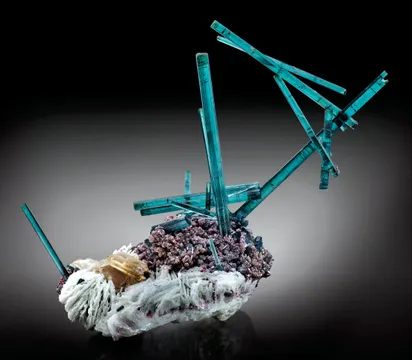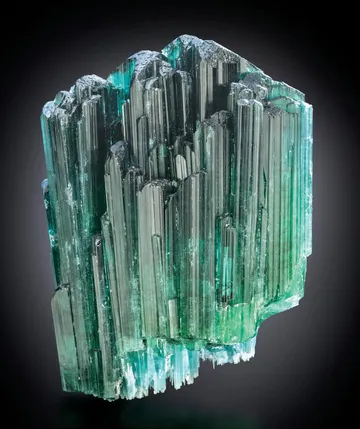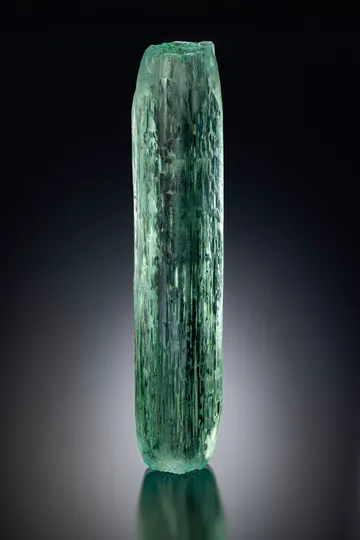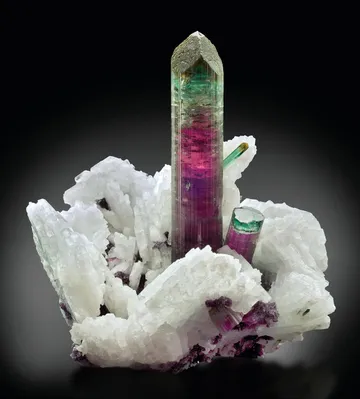
Paraíba, Brazil - renowned for cuprian elbaite tourmaline of electric blue to blue-green hues, scarce complete crystals, and legendary provenance.
Key facts
Paraíba matters to collectors because one small, weathered pegmatite field in the dry interior of northeastern Brazil changed the language of gem tourmaline. The famous locality is the Mina da Batalha, also known as the Heitorita mine or Batalha pegmatite, near São José da Batalha in the municipality of Salgadinho. There, in altered rare-element pegmatites on Morro Alto and the Serra do Frade ridge, elbaite incorporated copper and manganese in a way that produced colors the gem trade had scarcely seen before: electric blue, blue-green, turquoise, mint green, violetish blue, and purple. The finest pieces have a color that seems lit from within rather than merely transparent or saturated.
Geologically, the locality belongs to the Borborema Pegmatite Province, a classic northeastern Brazilian belt of granitic pegmatites emplaced in the Seridó fold belt. The best-known Batalha pegmatites are narrow tabular to vein-like bodies cutting muscovite quartzite of the Equador Formation. Their feldspar is commonly kaolinized, and the mineralized zones are small, irregular, and unforgiving: fist-sized clay pockets, thin stringers, quartz-core contacts, and zones where elbaite grew with lepidolite, quartz, feldspar, schorl, manganotantalite-tantalite, and accessory phosphates.
For specimen collectors, Paraíba is not a cabinet-filling locality in the usual sense. It is a place of few great specimens, many damaged fragments, and a handful of pieces whose color pedigree makes them legendary. The most desirable specimens show cuprian elbaite crystals with visible blue to blue-green color, preferably on quartz or in original pegmatitic matrix, with honest old provenance to São José da Batalha rather than a broad “Brazil” or “Paraíba-type” label. Complete crystals are scarce; terminated, undamaged, matrix examples are much scarcer. Many famous stones were cut, so a surviving mineral specimen with strong color, matrix, and mine history carries a premium beyond its size.
Regional View
Country View
The historical importance of Paraíba is inseparable from Heitor Dimas Barbosa, whose persistence in the 1980s turned a marginal pegmatite prospect into the original source of the gem material now called Paraíba tourmaline in the trade. The name is commercial rather than a mineral species: the mineral is elbaite, and the celebrated color is associated chiefly with copper and manganese. Later discoveries in Rio Grande do Norte, Nigeria, and Mozambique complicated the gemological use of “Paraíba,” but for mineral collectors the original Brazilian locality remains São José da Batalha.

Photo: Wikimedia Commons
Search for specimens: View all specimens from Paraíba, Brazil
The collector name “Paraíba, Brazil” usually points, first and foremost, to the cuprian elbaite occurrences around São José da Batalha, especially the Mina da Batalha or Heitorita mine. The mine lies on Morro Alto, on the Serra do Frade ridge, about 4.5 km northeast of Salgadinho and close to the village of São José da Batalha. The terrain is semi-arid sertão country, and the pegmatites crop out in a landscape where older small-scale mining had already targeted industrial and rare-element pegmatite minerals.
The deposit is a rare-element granitic pegmatite system within the Borborema Pegmatite Province. The regional host is the Seridó fold belt, where Equador Formation quartzites and associated metasedimentary rocks were intruded by late Brasiliano-age pegmatites. At Batalha, the mineralized pegmatites are not broad, regular ore bodies. They are narrow, steeply dipping, roughly parallel dikes, commonly described by miners as “lines.” Published work records six such lines, with thicknesses from about 20 cm to 4 m, though the most productive tourmaline-bearing dikes were typically less than 1 m thick. The dikes strike roughly southeast and cut foliated muscovite quartzite, with comparatively sharp contacts.
The mine assemblage is that of a highly evolved pegmatite altered by later kaolinization. The major material is kaolinized feldspar with quartz and mica, especially muscovite and lepidolite. Schorl and elbaite are the tourmalines of interest. Tantalite, manganotantalite, columbite-tantalite minerals, amethyst, citrine, smoky quartz, and other accessory phases occur in the system; Paraíba’s wider pegmatite province also produced beryl, spodumene, gahnite, cookeite, autunite, and important phosphate and tantalate rarities. The kaolinization at Batalha is particularly strong and postdates the crystallization of the pegmatites and their gem minerals; it is not itself the cause of the copper-bearing tourmaline.
The ore controls are subtle, which helps explain both the romance and the frustration of the locality. The best elbaite was concentrated irregularly near quartz-core zones, in association with lepidolite, in clay-filled pockets, thin stringers, or embedded in kaolinized feldspar and massive quartz. Some larger crystals in quartz were partly or completely replaced by lepidolite, leaving pseudomorph-like forms that are important scientifically but often disappointing as display specimens. Color also varied by line and level. Line 1 reportedly yielded the largest quantity and larger crystals, many green or grayish purple material that could heat to bright greenish blue. Line 2 yielded less material but better color, including prized blue stones that did not need heat treatment. Lines 3 and 4 produced a variety of colors in lesser amounts, line 6 yielded small blue-to-green crystals, and line 5 was not productive.
Mining history at Batalha began before the fame of the blue tourmaline. The locality had been worked for manganese-tantalum minerals, and older tailings played a role in the recognition of the tourmaline. In 1982, Heitor Dimas Barbosa saw bright colored specks in pegmatite material shown by the local garimpeiro José Pereira. Barbosa and companions searched the district, located similar fragments in tailings of a small manganotantalite prospect, and spent years driving shafts and galleries in decomposed pegmatite. Green tourmalines appeared before the now-famous blue; the first distinctive “electric” and sapphire-blue material was encountered in the late 1980s, and Batalha tourmaline first entered the market in the final years of that decade.
The great production period was short. Maximum gem production occurred in 1990–1991, when numerous shafts, some more than 60 m deep, followed the pegmatite lines underground. Hundreds of meters of narrow tunnels were driven by hand, and much of the early work was done by candlelight, with simple tools and only occasional blasting. Buckets of pegmatite were lifted by hand-driven winches, then sieved or washed, with tourmaline picked out manually. Published estimates for 1989–1991 production from the Mina da Batalha and surrounding area are roughly 10,000–15,000 grams of gem-quality crystals and fragments, a tiny amount considering the global impact of the deposit.
Legal disputes, ownership conflicts, and competing mining groups slowed and complicated production through much of the 1990s. From about 1992 onward, production was sporadic and limited; for several years, much of the material recovered came from reworking dumps and eluvial or alluvial material around Morro Alto. By the late 1990s and early 2000s, new tunnels, drilling, improved access, washing plants, lighting, and pneumatic tools were introduced in parts of the deposit. Work also expanded into adjacent eluvial and alluvial deposits, where small fragments could be recovered from older stream-channel or slope material.
Later exploration showed that the São José da Batalha area was structurally more complex than the first mapped dikes suggested. Adjacent workings and newly recognized dikes around Morro Alto produced additional small amounts of tourmaline, while other cuprian elbaite localities were found in nearby Rio Grande do Norte and, later, outside Brazil. Within Paraíba State itself, the Glorious and Mineração Batalha occurrences were reported in the 2000s as additional copper-bearing tourmaline deposits not far from the original source, though the original Batalha/Heitorita material remains the benchmark for color and prestige.
Collecting access today should be treated as effectively closed for casual visitors. These are active or historically sensitive mining claims, not public collecting ground. The deposit has a history of legal disputes, restricted access, and law-enforcement action against unauthorized mining. Serious collectors should assume that legitimate specimens come through established dealers, old collections, or documented mine-channel material, and that high-value crystals or cut stones require strong provenance and, for gems, laboratory confirmation of copper-bearing tourmaline and preferably geographic origin.
Elbaite from Paraíba’s São José da Batalha district is the locality’s defining mineral: cuprian, commonly manganese-bearing, and celebrated for electric blue to blue-green colors that may appear as rims, zones, or whole crystals. Most recovered crystals and fragments were small, naturally broken, corroded, fractured, and commonly under a gram; euhedral crystals with good terminations are rare, while specimen-scale examples showing bright blue or peacock-blue elbaite attached to quartz are exceptional. The best pieces come from the Batalha/Heitorita pegmatite lines on Morro Alto, especially near quartz-core contacts with lepidolite and in clay pockets or stringers within kaolinized feldspar. Associations include milky or smoky quartz, lepidolite, muscovite, kaolinized feldspar, schorl, and tantalum minerals. A top Paraíba elbaite specimen is judged less by size alone than by unmistakable saturated color, visible crystal form, matrix context, old locality documentation, and freedom from misleading “Paraíba-type” ambiguity.
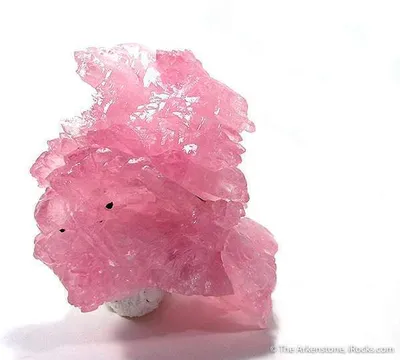
Quartz is the stage on which the best Paraíba elbaite specimens perform. At Batalha and related pegmatites, quartz occurs as central core material and as massive milky, hyaline, smoky, morion, rose, amethyst, and citrine varieties in the broader district. For collectors, the most desirable quartz from Paraíba is usually not an isolated quartz crystal but a pegmatite matrix retaining cuprian elbaite in place: milky or rough quartz with a blue-green elbaite crystal, smoky quartz associated with kaolinized pockets, or quartz-lepidolite contacts that show the growth environment of the tourmaline. Ordinary quartz from the province is abundant by comparison; important pieces are those that preserve context, contrast, and a credible São José da Batalha association rather than a detached tourmaline fragment with no geological setting.
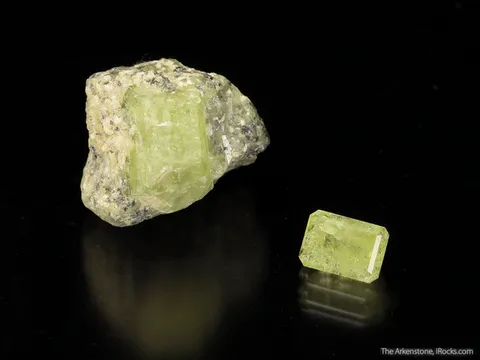
Apatite in Paraíba is a pegmatitic accessory rather than the locality’s showpiece mineral, but it is significant because it belongs to the same evolved Borborema pegmatite environment that produced lithium, tantalum, beryllium, phosphate, and tourmaline mineralization. Fluorapatite is documented in related cuprian-tourmaline pegmatites of the region, and apatite is also part of the broader phosphate-rich assemblages in Paraíba’s rare-element pegmatites, especially around Pedra Lavrada and other Borborema localities. Collector-quality apatite from the state is much less standardized in the market than elbaite: well-formed, transparent to translucent crystals, attractive color, and matrix association with albite, muscovite, quartz, or other pegmatite minerals separate worthwhile Paraíba examples from anonymous “Brazil apatite.” Because blue apatite has repeatedly appeared as an imitation or mistaken substitute for Paraíba tourmaline, any apatite with a neon blue-green color should be appreciated as apatite, not allowed to drift into a speculative cuprian-elbaite story.
Beyond elbaite, quartz, and apatite, Paraíba’s pegmatite province is important for rare-element minerals and type-locality species. The Alto Serra Branca pegmatite near Pedra Lavrada is the type locality for serrabrancaite, MnPO4·H2O, a manganese phosphate described from a complex phosphate assemblage. The Alto Quixaba granitic pegmatite near Quixaba, Frei Martinho, is the type locality for fluornatromicrolite, (Na,Ca,Bi)2Ta2O6F, an adamantine green microlite-group mineral found in albite. The Raposa pegmatite at São José do Sabugi is the type locality for tantalaeschynite-(Y), a rare yttrium-tantalum-titanium oxide described from prismatic crystals. The state’s evolved pegmatites also contain or have been reported with albite-cleavelandite, microcline, muscovite, lepidolite, schorl, beryl, spodumene, gahnite, cookeite, autunite, tantalite-(Mn), tantalite-(Fe), columbite-tantalite minerals, and secondary phosphates.
The greatest collecting issue is locality and identity. “Paraíba” is a gem trade name, not a mineral species, and since Nigerian and Mozambican copper-bearing tourmalines entered the market the word has become detached from Paraíba State in many commercial settings. A specimen label reading “Paraíba tourmaline” may mean an original São José da Batalha specimen, a copper-bearing tourmaline from another country, a blue-green non-cuprian tourmaline, or simply a color description. For mineral specimens, insist on the actual locality: Batalha mine, Heitorita mine, São José da Batalha, Salgadinho, Paraíba, Brazil. For high-value cut stones, origin determination by trace-element chemistry is far more meaningful than color alone.
Documented imitations and misidentifications are common enough to matter. Gemological literature records non-copper tourmalines, blue-green apatite, blue cat’s-eye apatite, tourmaline-and-glass doublets, beryl-and-cement triplets, topaz-and-cement triplets, irradiated blue topaz, hydrothermal synthetic beryl, and ordinary indicolite being mistaken for or sold as Paraíba tourmaline. SSEF has reported small blue cabochons thought by a client to be early São José da Batalha Paraíba tourmalines that proved to be apatite, probably heated and partly fissure-filled. For collectors, the lesson is straightforward: vivid color is not proof of copper, and copper is not proof of Brazil.
Treatment is a second major issue. Heat treatment is well documented for Paraíba tourmaline. Purplish, violetish, greenish blue, or dark blue stones may be heated to improve or shift color toward brighter blue, turquoise, or greenish blue. Some Batalha material does not need heat treatment, and this is especially prized, but “no heat” should not be assumed without evidence. Specimens are less often discussed in treatment language than faceted gems, but heating fractured crystals is risky and can worsen damage; old specimen collectors generally value undisturbed natural crystals with visible zoning, coatings, matrix, and provenance.
Condition is often imperfect. Many crystals are naturally broken, etched, corroded, fractured, or clay-stained. Complete terminations are rare, and a contacted termination on a matrix specimen is not automatically a defect in the way it might be for more abundant tourmaline localities; it may simply reflect how scarce intact Paraíba crystals are. Look carefully for glued fragments, repairs at matrix contacts, filled fractures, reconstructed terminations, and color-enhanced photography. Matrix pieces should be examined for physical plausibility: Batalha elbaite commonly occurs with milky quartz, smoky quartz, lepidolite, muscovite, kaolinized feldspar, and schorl, but an attractive blue crystal attached to unrelated white matrix should be treated with caution until the specimen’s history is clear.
Fluorescence is not usually a useful screening tool. Published work on Paraíba tourmaline found the examined stones inert to both long-wave and short-wave ultraviolet radiation, consistent with many gem tourmalines. Handling is more important than UV response: fractured crystals, lepidolite-replaced areas, kaolinized matrix, and small clay-pocket specimens can be fragile. Avoid ultrasonic cleaning, strong thermal shock, and aggressive acids. Dust and clay can be left in place when they support the specimen’s natural pegmatitic context.
Market availability is sharply divided. Small fragments, tiny crystals, melee stones, and ambiguous “Paraíba-type” material are seen regularly, but fine old Brazilian São José da Batalha specimens remain scarce. Matrix specimens with saturated blue to blue-green elbaite are rare and expensive; complete crystals with documented Batalha provenance are exceptional. African Paraíba-type gems may be beautiful, larger, and more available, but they do not substitute for an original Paraíba State mineral specimen in a locality collection.
The Paraíba story begins with a tiny visual clue. In 1982, Heitor Dimas Barbosa, who had previously mined tourmaline in Minas Gerais, saw bright specks in pegmatite material brought by José Pereira, a local garimpeiro. Those specks were enough. Barbosa and Pereira searched pegmatite prospects across the region for months before locating similar colored fragments in the tailings of a small manganotantalite prospect on a hillock at the base of Serra do Frade. It was not a triumphant discovery at first; it was a promise in scraps.
For years, Barbosa’s group dug into decomposed pegmatite under conditions that sound almost pre-industrial. About 15 garimpeiros sank shafts as deep as 50 m in the early account, later workings exceeding 60 m, and followed the pegmatite in narrow galleries. The tunnels were roughly man-high but scarcely shoulder-wide, and the miners worked by candlelight. Water was scarce, daytime heat was intense, ventilation was poor, and waste rock had to be hauled by hand. In the middle 1980s they found green tourmaline, but not the electric blue that would make the mine famous. The breakthrough came only after years of digging, when the distinctive blue material finally appeared.
The first important blue production created disbelief as much as excitement. Gems & Gemology recorded that the colors entering the market in 1989 were called “neon,” “electric,” “turquoise,” “sapphire,” and “tanzanite” blue, along with mint green. The words sound like sales language now, but at the time they were attempts to describe something outside the usual tourmaline palette. Later accounts recall that some gemologists initially suspected such color and brilliance could not be natural. The stone had the odd distinction of being so good that experts needed proof it was real.
The mining itself was a battle of small targets. The richest zones were not broad pockets packed with crystals but tiny clay-filled cavities and stringers near quartz-core contacts. Material was lifted in buckets, washed, sieved, and searched by hand. Most crystals broke naturally or emerged as corroded fragments. A blue crystal of a few grams could be meaningful; a good blue crystal over 3 grams was rare. The largest reported good-quality blue tourmaline crystal from the early literature weighed 41 grams, while one 14.8 gram crystal yielded a 15.0 ct faceted stone for a pendant surrounded by diamonds.
Then the hill became valuable enough to divide people. In the 1990s, legal disputes over mine ownership slowed production and drew in competing groups, foreign investors, politicians, and local claimants. Mining was disorganized and, at times, ineffective. Barbosa later restored underground workings, built a stone wall to prevent illegal entry, installed lighting and an electric winch, and brought in pneumatic hammers and washing plants. The image is almost cinematic: a small arid hill, once worked by candlelight, enclosed by a wall and re-equipped because the world had decided that its tiny blue crystals were among the most desirable gems on Earth.
The later history carries a darker chapter. In 2015, Brazilian authorities and the Ministério Público Federal investigated and interdicted operations connected with illegal extraction of Paraíba tourmaline at São José da Batalha. Reports described armed security, unlicensed mining, international sales channels, and claims of production measured in kilograms during a peak period around 2013–2014. For collectors, this is not gossip but provenance history. The locality’s fame attracted science, romance, and serious money, but also legal conflict and illicit exploitation. A fine Paraíba specimen should therefore be beautiful, but it should also be traceable.
Fritsch, Emmanuel; Shigley, James E.; Rossman, George R.; Mercer, Meredith E.; Muhlmeister, Sam M.; Moon, Mike. “Gem-Quality Cuprian-Elbaite Tourmalines from São José da Batalha, Paraíba, Brazil.” Gems & Gemology, Vol. 26, No. 3, 1990, pp. 189–205. — The foundational scientific and gemological paper on the original Batalha material, including color, chemistry, inclusions, heat treatment, and early mining history.
Shigley, James E.; Cook, Brian C.; Laurs, Brendan M.; Bernardes, Marcelo de Oliveira. “An Update on ‘Paraíba’ Tourmaline from Brazil.” Gems & Gemology, Winter 2001. — Essential update on Batalha geology, pegmatite “lines,” production, legal disputes, alluvial/eluvial recovery, and other Brazilian cuprian-elbaite sources.
Abduriyim, Ahmadjan; et al. “Paraíba-Type Copper-Bearing Tourmaline from Brazil, Nigeria, and Mozambique: Chemical Fingerprinting by LA-ICP-MS.” Gems & Gemology, Spring 2006. — Important for distinguishing original Brazilian material from later African sources using trace-element chemistry.
Sun, Ziyin; Palke, Aaron C.; Breeding, Christopher M.; et al. “Geographic Origin Determination of Paraíba Tourmaline.” Gems & Gemology, Winter 2019. — Modern laboratory treatment of origin determination, including why standard gemological observations are insufficient for many Paraíba-type stones.
Henry, Darrell; Dutrow, Barbara. “Zinc-Enriched Fracture-Fill and Fibrous Overgrowths in Paraíba Tourmaline from São José da Batalha, Brazil.” Geological Society of America Abstracts with Programs, 2021. — A focused mineralogical note on Zn-rich late tourmaline fracture fill and overgrowths in São José da Batalha material.
Henn, U.; Bank, H.; Bank, F. H.; von Platen, H.; Hofmeister, W. “Transparent Bright Blue Cu-bearing Tourmalines from Paraíba, Brazil.” Mineralogical Magazine, Vol. 54, 1990, pp. 553–557. — Early mineralogical study of the bright blue copper-bearing Brazilian tourmalines.
Brandstätter, F.; Niedermayr, G. “Copper and Tenorite Inclusions in Cuprian-Elbaite Tourmaline from Paraíba, Brazil.” Gems & Gemology, Vol. 30, No. 3, 1994, pp. 178–183. — Documents native copper and tenorite inclusions, a memorable microscopic feature of some Paraíba material.
Witzke, Thomas; Steins, Manfred; Doering, Thomas; Schuckmann, Walter; Wegner, Reinhard; Pöllmann, Herbert. “Fluornatromicrolite, (Na,Ca,Bi)2Ta2O6F, a New Mineral Species from Quixaba, Paraíba, Brazil.” The Canadian Mineralogist, Vol. 49, 2011, pp. 1105–1110. — Type-mineral description for fluornatromicrolite from the Alto Quixaba granitic pegmatite near Quixaba, Frei Martinho.
Witzke, Thomas; Wegner, Reinhard; Doering, Thomas; Pöllmann, Herbert; Schuckmann, Walter. “Serrabrancaite, MnPO4·H2O, a New Mineral from the Alto Serra Branca Pegmatite, Pedra Lavrada, Paraíba, Brazil.” American Mineralogist, Vol. 85, 2000, pp. 847–849. — Type-mineral description of serrabrancaite from Paraíba’s phosphate-rich Alto Serra Branca pegmatite.
Adusumilli, Maria S.; Kieft, C.; Burke, E. A. J. “Tantal-aeschynite, a New Mineral of the Aeschynite Group from the Borborema Region, North-eastern Brazil.” Mineralogical Magazine, Vol. 39, No. 305, 1974, pp. 571–576. — Original description tied to the Raposa pegmatite at São José do Sabugi, Paraíba, now treated as tantalaeschynite-(Y).
Silva, M. R. R.; Höll, R.; Beurlen, H.; et al. “Mineral Chemistry of Tantalate Species New in the Borborema Pegmatitic Province, Northeast Brazil.” Anais da Academia Brasileira de Ciências, 2005. — Useful context for Paraíba and Rio Grande do Norte rare-element pegmatites, tantalates, and type-locality significance.
Carrino, Thais Andressa; Barreto, Sandra de Brito; Oliveira, Paula Jussara Azevedo de; Araújo Neto, José Ferreira de; Correia, Aldine Maria de Lima. “Linking Gemology and Spectral Geology: A Case Study of Elbaites from Seridó Pegmatite Province, Northeastern Brazil.” Brazilian Journal of Geology, 2019. — Helpful for pegmatite zoning, replacement bodies, Batalha kaolinization, and comparison with Quintos, Capoeiras, and Bulandeira elbaites.
“An Overview of the 2014 GIA Brazil Expedition” — GIA — Field report with embedded video segments in which Brian Cook discusses Paraíba tourmaline country, Batalha geology, mining methods, and his long connection with the locality.
“Turmalina Paraíba existe de verdade e foi encontrada em São José da Batalha” — Mais Você / Globoplay — Short Brazilian television segment connecting the gem’s popular fame to São José da Batalha and Heitor Dimas Barbosa.
“Sertão da Paraíba abriga garimpo de turmalina, uma das joias mais caras do mundo” — Repórter em Ação / R7 — News-video visit to Salgadinho and São José da Batalha, emphasizing the contrast between the world value of the gem and the poverty of the mining district.
“Fantástico mostra mina onde pedra raríssima é extraída ilegalmente” — Fantástico / Globoplay — Brazilian investigative television piece on illegal extraction of Paraíba tourmaline.
“Bahia Rutilated Quartz and Brazil Paraiba Tourmaline” — Brian Cook, Dallas Mineral Collecting Symposium / Vimeo — Lecture including the original São José da Batalha Paraíba tourmaline locality and its mineral-collecting significance.
Heitorita mine, São José da Batalha, Salgadinho, Paraíba, Brazil — Mindat — Core locality page for the Batalha/Heitorita mine, including coordinates, alternate names, and mineral listings.
São José da Batalha, Salgadinho, Paraíba, Brazil — Mindat — Regional Mindat entry that helps separate the village-level locality from individual mines and claims.
Gem-Quality Cuprian-Elbaite Tourmalines from São José da Batalha, Paraíba, Brazil — GIA PDF — The original detailed GIA study of Paraíba tourmaline from the classic mine.
An Update on “Paraíba” Tourmaline from Brazil — GIA — Best single overview of Batalha geology, mining history, production, and market complications.
Geographic Origin Determination of Paraíba Tourmaline — GIA — Modern laboratory perspective on separating Brazilian, Nigerian, and Mozambican Paraíba-type tourmalines.
Copper-Bearing Tourmalines from New Deposits in Paraíba State, Brazil — GIA PDF — Short report on the Glorious and Mineração Batalha occurrences discovered after the classic Batalha production.
Linking Gemology and Spectral Geology: A Case Study of Elbaites from Seridó Pegmatite Province — SciELO — Technical paper with useful discussion of pegmatite zoning, replacement bodies, and elbaite occurrences in the Borborema region.
Mineral Chemistry of Tantalate Species New in the Borborema Pegmatitic Province, Northeast Brazil — SciELO — Context for Paraíba’s rare-element pegmatites and type-locality tantalate minerals.
Fluornatromicrolite, (Na,Ca,Bi)2Ta2O6F, a New Mineral Species from Quixaba, Paraíba, Brazil — RRUFF PDF — Primary description of a Paraíba type-locality mineral from Alto Quixaba.
Serrabrancaite — Mindat — Mineral and type-locality data for serrabrancaite from Alto Serra Branca, Pedra Lavrada.
Tantalaeschynite-(Y) — Mindat — Type-locality data and references for the Raposa pegmatite, São José do Sabugi.
Justiça interdita mineradora localizada no Distrito de São José da Batalha — Jornal da Paraíba — Portuguese-language report on the 2015 interdiction connected with illegal Paraíba tourmaline extraction.
Envolvido na exploração de turmalina detalha esquema na PB — Jornal da Paraíba — Follow-up report with details from a plea agreement about illegal mining and sales channels.