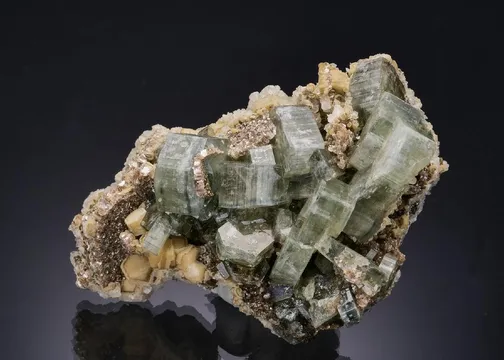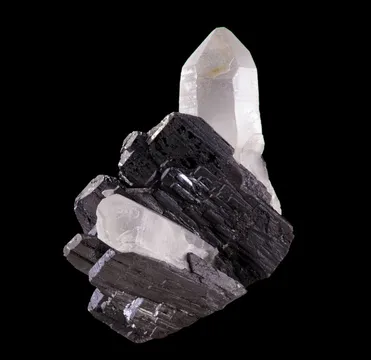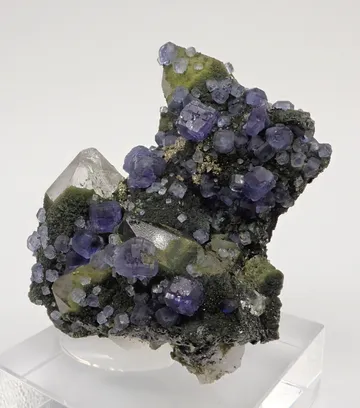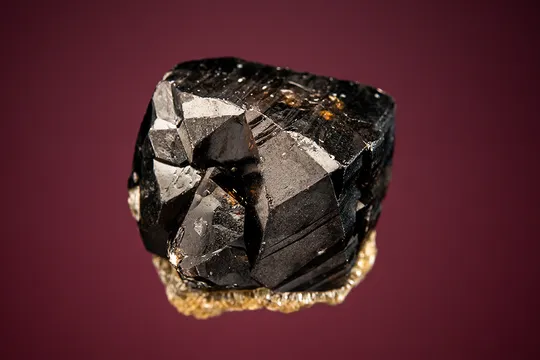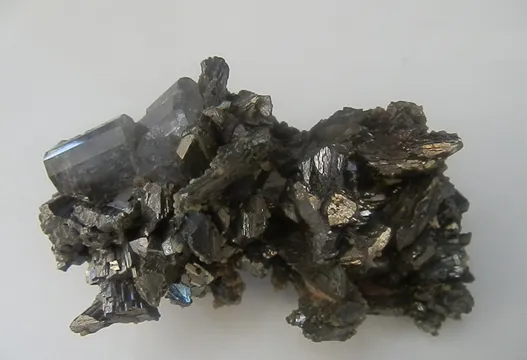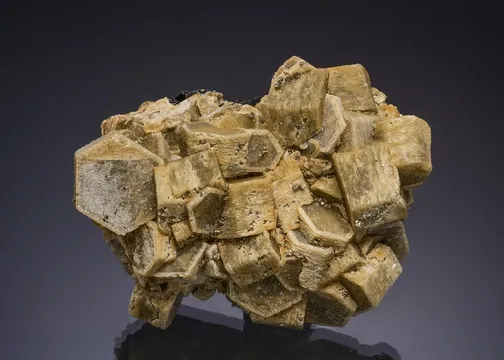
Panasqueira Mines, Portugal — premier locality yielding tungsten, ferberite, arsenopyrite, fluorapatite, and colorful quartz associations prized by collectors.
Key facts
Panasqueira is one of the great European mineral localities: not merely a productive tungsten mine, but a specimen-producing ore system whose open quartz veins have yielded classics for more than a century. The deposit lies in central Portugal, in the Castelo Branco district on the southern edge of the Serra da Estrela region, where a concealed Variscan granitic system drove W-Sn-Cu hydrothermal mineralization into the Beira schists. Collectors know the mine for the unmistakable “Panasqueira look”: lustrous black ferberite blades and books, bright silvery arsenopyrite, glassy quartz, brown to honey siderite, pale muscovite, violet fluorite, brassy pyrite and chalcopyrite, and above all those green, blue-green, lilac, violet, grey, or color-zoned fluorapatites that sit so well on contrasting matrices.
The best specimens have a structural clarity that reflects the geology. Wolframite-group crystals grew early along vein margins, often perpendicular to the walls. Later sulfides and carbonates occupied the center of the veins and the open spaces. In fortunate cavities, the mine produced display pieces where the mineralization reads almost like a cross section of the lode: ferberite against white quartz, arsenopyrite in crisp metallic sprays, siderite as brown lenticular or rhombohedral crystals, and fluorapatite perched like a colored punctuation mark. Panasqueira’s appeal is therefore not just species quality; it is association, sequence, and contrast.
Regional View
Country View
Historically, Panasqueira is also a mining landmark. Discovery rights in the district date to the late 1880s, organized tungsten mining began in the 1890s, and the mine passed through the hands of British, Portuguese, Canadian, Japanese, and now Almonty-related ownership while remaining one of the few long-lived underground tungsten producers in western Europe. Its specimen legacy grew alongside that industrial history: pockets and geodes encountered during normal mining were recovered, sorted, and sold through the mine and by specialist dealers, making Panasqueira one of the unusual localities where classic specimens continued to appear from an active industrial operation rather than from old dumps alone.

Photo: Wikimedia Commons

Photo: Wikimedia Commons
Search for specimens: View all specimens from Panasqueira Mines, Portugal
Panasqueira is a vein-type W-Sn-Cu deposit, developed as a broad system of stacked, generally sub-horizontal quartz veins in metamorphosed Beira schists and phyllites above a concealed granitic source. The mine is not a single shaft locality in the narrow specimen-label sense, but an integrated mining district whose names include Panasqueira, Barroca Grande, Cabeço do Pião/Rio, Vale da Ermida, Vale das Freiras, Corga Seca, Rebordões, and other working areas. For collectors, the important point is that many labels collapse this complex mining geography simply to “Panasqueira,” while better-documented modern pieces may carry level numbers or area names such as Level 0, Level 1, Level 2, Level 3, Vale da Ermida, or Barroca Grande.
The ore system is famous for its flat quartz veins, locally called “filões normais,” which occur as lenticular bodies in open fractures. Individual veins are commonly much less than a meter thick, and many average around a few decimeters, yet they can extend laterally for substantial distances. The same vein may break into lenses and wedge-shaped ends known in mine terminology as “rabos de enguia,” or “eel tails,” places that can be especially metal-rich. Steeper mineralized cross veins, locally called “filões galo,” may cut the flatter veins. This geometry matters to collectors because the best specimens generally came from open cavities, druses, and geodes within these quartz veins rather than from massive ore.
The classic vein architecture begins at the wall-rock contact with a micaceous selvage rich in muscovite and commonly associated with tourmaline, topaz, and cassiterite. Wolframite-group crystals, overwhelmingly ferberite-rich at Panasqueira, grew early and often stand perpendicular to the vein walls. Sulfides occupy more central parts of the veins: arsenopyrite, pyrite, chalcopyrite, sphalerite, stannite, pyrrhotite, and galena in variable abundance. Later alteration of pyrrhotite produced much of the marcasite-pyrite-siderite assemblage, and the late carbonate stage introduced siderite, calcite, dolomite, and fluorite into remaining spaces. Fluorapatite belongs to the phosphate-rich part of the paragenesis and is especially important in collector material because it bridges the ore-stage mineralogy with the late open-space aesthetics.
Economically, Panasqueira has been mined chiefly for tungsten, with tin and copper as important by-products. The ore minerals are wolframite/ferberite, cassiterite, and chalcopyrite; arsenopyrite and pyrite are abundant associates rather than principal pay minerals. Production has been strongly influenced by tungsten prices and world events. The mine expanded dramatically during the first half of the twentieth century, especially in the world-war years, then modernized through mechanized underground methods in the later twentieth century. Milling historically centered at Rio/Cabeço do Pião before final concentration equipment was moved to Barroca Grande in the 1990s.
Modern ownership traces through Beralt Tin & Wolfram. After earlier ownership by Wolfram Mining & Smelting, Beralt Tin & Wolfram Limited, Beralt Tin & Wolfram (Portugal), Minorco, Avocet, Primary Metals, and Sojitz, the mine came under Almonty ownership in 2016 through Beralt Tin and Wolfram (Portugal), S.A. The active concession, Contract of Exploitation C-18, covers a large irregular area, and the underground workings have moved progressively downward through levels separated by tens of meters. Current collecting is not casual field collecting: this is an active underground mine, and specimen recovery is tied to mining, mine permission, safety rules, and commercial channels. The old romantic idea of walking into the workings with a hammer is not realistic or appropriate.
The best collector specimens are repeatedly associated with geodic cavities encountered during mining. Published Portuguese sources emphasize Vale das Freiras, Vale da Ermida, Panasqueira, and Barroca Grande as especially important sources of high-quality collector crystals, while noting that the mineralization is irregular across the mining areas and becomes sparser in some deeper parts of Barroca Grande. Dealer records also document distinctive modern pockets by level: Level 2 pieces with unusual fluorapatite on ferberite from 2017, Level 0 elongated fluorapatites with chlorite from a small 2020 vug, Level 3 fluorapatite-on-ferberite pieces from the early 2000s, and older classic material from the late twentieth century. Such level and date information adds real value, because Panasqueira has produced recognizable “generations” of specimen style rather than one uniform product.
Fluorapatite is the signature collector mineral of Panasqueira and the species by which many non-tungsten collectors first recognize the mine: thick tabular to short prismatic hexagonal crystals, commonly 1-3 cm but known in much larger examples, in green, grey-green, blue-green, lilac, violet, colorless, grey, yellowish, and complex color-zoned forms. The strongest pieces show glassy luster, sharp hexagonal outlines, geometric zoning, and a poised placement on siderite, quartz, muscovite, arsenopyrite, pyrite, fluorite, or ferberite; ordinary pieces are duller, crowded, or dominated by contact damage. Vale da Ermida and Panasqueira have been especially important for apatite-rich material, while some deeper Barroca Grande levels have been less generous; modern dealer records document notable Level 2 fluorapatites on ferberite and siderite, Level 0 elongated green zoned crystals with chlorite, and older lilac-to-blue pieces with quartz. Many green crystals fluoresce yellow under ultraviolet light, often zoned, whereas some lilac quartz-associated crystals are reported as non-fluorescent, a useful locality-specific observation for collectors rather than a universal rule.
Quartz is the main vein mineral at Panasqueira and the architectural stage for nearly all of the mine’s best combinations: massive milky quartz forms the lodes, while open cavities produced transparent to nearly colorless prismatic crystals, druses, flattened or doubly terminated crystals, and cabinet-size groups with siderite, fluorapatite, arsenopyrite, pyrite, muscovite, cassiterite, marcasite, and ferberite. Crystals can be much larger than the accessory species, with reported examples exceeding 50 cm and heavy druses from larger cavities, but the finest collectible quartz is not simply large; it is clean, well terminated, and compositionally integrated with other Panasqueira minerals. Inclusions of tourmaline needles, arsenopyrite, cassiterite, fluorapatite, pyrite, muscovite, and fragments of ferberite are locality-characteristic features. Pale amethystine quartz has been reported from Vale da Ermida, but it is much less central to the locality’s classic identity than clear quartz with siderite, apatite, or sulfides.
Siderite is one of the essential Panasqueira species, common throughout the mineralized structures and crucial to the mine’s specimen palette as brown, tan, honey, grey-brown, or darker iron-carbonate crystals on quartz, muscovite, sulfides, fluorapatite, and ferberite. It occurs in several locality-distinct habits: the familiar lenticular “disc” crystals formed by curved obtuse rhombohedral faces, sharper rhombohedra, and a prismatic habit with pinacoid terminations that is especially associated with Panasqueira material. Large siderite crystals may reach impressive sizes, but collectors usually prize sharp luster, undamaged edges, warm color contrast, and good spatial relationships with fluorapatite, pyrite, quartz, arsenopyrite, or marcasite more than bulk. Internal growth and chemical zoning with dolomite can give darker cores and paler outer zones, and late carbonate overgrowths may complicate identifications between siderite, dolomite, and calcite on mixed pieces.
Panasqueira arsenopyrite is among the world’s most attractive collector arsenopyrite, occurring as bright silver-grey metallic prismatic crystals, parallel groups, sprays, wedges, and often doubly terminated forms, commonly around 2 cm but capable of reaching several centimeters larger. The classic crystals are vertically striated and may form compact, architectural clusters on quartz, siderite, muscovite, fluorapatite, chalcopyrite, or marcasite; some show greenish iridescent patinas that can mislead the eye toward marcasite at first glance. The best specimens combine high metallic brightness, sharp terminations, three-dimensional separation, and association with contrasting carbonates or apatite, while ordinary material is massive, crowded, or flattened against the vein. Unlike arsenopyrite from some localities, Panasqueira specimens have a reputation for good stability when kept dry and protected from chemical cleaning.
On Panasqueira labels, “apatite” almost always refers to fluorapatite, Ca5(PO4)3F, but the older and shorter label wording persists in collections and dealer inventories. The locality’s apatite is famous for thick tabular to short prismatic hexagonal crystals with green, blue, lilac, violet, grey, colorless, and zoned coloration, most often associated with siderite, quartz, muscovite, pyrite, arsenopyrite, fluorite, and ferberite. Good pieces show clean faces, bright vitreous luster, intact pinacoids, and an aesthetic perch rather than a buried or contacted crystal; the top tier includes zoned green “ox-eye” crystals, saturated violet-blue crystals on quartz, and apatites placed against black ferberite or brown siderite. Because “apatite” is a group name rather than the precise species name, advanced collectors should retain old labels but identify the collector species as fluorapatite unless analytical evidence says otherwise.
Ferberite is the ore and the visual backbone of many Panasqueira classics: black, heavy, lustrous monoclinic crystals in blades, books, tabular groups, and parallel aggregates, commonly a few centimeters and in notable cases far larger. The best crystals are sharply terminated, ribbed or striated, brilliant rather than dull, and positioned with enough open space to show their bladed habit; matrix associations with quartz, muscovite, siderite, fluorapatite, arsenopyrite, pyrite, and cassiterite greatly increase desirability. Ferberite commonly grew early along vein margins and perpendicular to vein walls, so many mining specimens show contact or attachment surfaces that are not damage but part of their growth setting. Ordinary pieces are heavy black ore masses; exceptional pieces are sculptural, with contrast from pale muscovite or quartz and one or more later species decorating the ferberite without obscuring it.
Fluorite is a late and comparatively uncommon Panasqueira species, most often seen as violet to purple cubic crystals, sometimes with whitish coatings or patinas, in cavities with quartz, fluorapatite, carbonates, pyrite, chalcopyrite, muscovite, and siderite. The best fluorite is associated particularly with Vale da Ermida material, where crystals can reach about 3 cm on an edge and parallel aggregates may be larger; many specimens elsewhere show only small cubes or partial late coatings. Collectors should look for clearly cubic, undamaged, saturated violet crystals with clean contrast on quartz or carbonate, and be cautious with pieces where white carbonate or later coatings conceal the fluorite’s form. Fluorite is not the dominant Panasqueira mineral, but a good fluorite association gives an otherwise familiar apatite-siderite-quartz specimen an extra level of locality character.
Muscovite is the second great gangue mineral of Panasqueira after quartz, forming micaceous selvages and attractive silvery, pale tan, brownish-green, or white aggregates that frame the ore minerals. It occurs as platy to hexagonal crystals, foliated plates, sparkling druses, and rosette-like masses, especially along vein margins and in association with ferberite, fluorapatite, siderite, quartz, arsenopyrite, pyrite, chlorite, and topaz. Good muscovite pieces are not valued simply for mica; they are valued when the mica creates a clean, glittering base that lifts apatite, arsenopyrite, siderite, or ferberite into a balanced composition. Condition matters because mica edges bruise and cleave easily, and older specimens may carry dust in the mica books that should not be aggressively washed or brushed away.
Pyrite at Panasqueira occurs both as fine granular masses and as later crystals, commonly associated with marcasite as a product of pyrrhotite alteration and with late carbonates. The collector material includes small bright cubes, octahedral to modified crystals, sprays, coatings on quartz or calcite, and sparkling accents around fluorapatite, siderite, muscovite, arsenopyrite, and sphalerite; crystals can range from millimeter size to a few centimeters, although the most attractive examples are often small but brilliantly placed. Barroca Grande is especially noted for abundant pyrite related to effective hypogene alteration of pyrrhotite. The best pyrite specimens from the mine are those where the pyrite adds golden contrast without overwhelming the more diagnostic Panasqueira species; dull granular pyrite in massive sulfide is commoner and much less desirable.
Cassiterite is Panasqueira’s principal tin mineral and a serious collector species here, occurring as black to brown, adamantine tetragonal crystals, simple crystals, cyclic twins, dipyramidal forms, and “cross-bit” aggregates with quartz, ferberite, fluorapatite, siderite, muscovite, and sulfides. Richer cassiterite crystal material has been noted from Vale da Ermida, Corga Seca, and Guerras, where crystals can exceed 3 cm, while more recent Barroca Grande crystals are often smaller and may not reach 1 cm. The best pieces have sharp, lustrous cassiterite crystals that are clearly visible rather than hidden in quartz, ideally with apatite or siderite for contrast. Because cassiterite is dark and dense like ferberite at a glance, careful examination under good light is important; its adamantine luster, twinning, and tetragonal forms distinguish fine specimen crystals from broken ore.
Chalcopyrite is an economic copper by-product at Panasqueira and occurs throughout the mining district, with Vale da Ermida especially noted for abundance. Much of it is massive or associated with sphalerite and other sulfides, but collector specimens show brassy pseudotetrahedral crystals, commonly a few centimeters and rarely larger, in cavities with quartz, sphalerite, arsenopyrite, siderite, muscovite, dolomite, calcite, fluorite, and occasionally fluorapatite. Strong pieces require fresh metallic luster, recognizable crystal form, and good contrast; chalcopyrite that is tarnished, massive, or hidden among dark sulfides is far less appealing. As with many Panasqueira sulfides, combination value matters more than the isolated species, and chalcopyrite’s best role is often as a brassy accent within a quartz-carbonate-sulfide assemblage.
Calcite is a late-stage carbonate at Panasqueira, usually appearing as white, colorless, faintly pink, brownish, or pale coatings and small rhombohedral crystals over earlier minerals. Collector examples include rhombohedral crusts, lenticular or “poker chip” aggregates to around 1 cm, and calcite on fluorapatite, pyrite, quartz, siderite, dolomite, and sulfides. It can improve a specimen by adding sparkle and pale contrast, but heavy calcite overgrowth may also mask sharper earlier crystals, so the best calcite-bearing pieces are those where calcite is subordinate and compositionally useful. Because calcite and dolomite can be chemically zoned or intergrown in Panasqueira carbonates, and calcite pseudomorphs after fluorite have been observed, exact identification on small late carbonate coatings can require testing rather than label confidence alone.
Dolomite is another late Panasqueira carbonate, occurring less conspicuously than siderite but importantly in the mine’s late open-space assemblages. It forms cloudy white to pale rhombohedral crystals, sometimes saddle-shaped or distorted, commonly to about 1 cm, and it coats or accompanies quartz, fluorapatite, sulfides, ferberite, siderite, marcasite, calcite, and pyrite. Dolomite can be most attractive when it forms a pale crystalline skin over darker sulfides or sits as sharp rhombs around apatite and siderite, but many examples are subtle and easily passed over as “white carbonate.” Advanced collectors should note that dolomite may occur as microcrystalline growth on magnesium-rich siderite and can be chemically intergrown with calcite, making acid response and analytical confirmation useful on ambiguous specimens.
Sphalerite is not abundant at Panasqueira and is generally iron-rich, dark brown to nearly black, often approaching the collector variety traditionally called marmatite. It occurs as granular to spathic masses and less commonly as poorly defined tetrahedral crystals or silky parallel-growth aggregates, with better crystal occurrences reported from shallower veins and small Vale da Ermida cavities with quartz. In upper-vein cavities it may accompany siderite, fluorapatite, pyrite, quartz, chalcopyrite, and other sulfides. Good sphalerite specimens are scarce because the species is usually dark and massive; worthwhile examples show distinct crystal form, glossy or silky luster, visible association, and enough contrast from siderite or quartz to separate the sphalerite visually from the other dark sulfides.
Marcasite at Panasqueira is a late hypogene alteration product of pyrrhotite and is commonly associated with pyrite, siderite, dolomite, arsenopyrite, and quartz. The locality produces attractive subparallel “cockscomb” aggregates, strongly striated twins, and cyclic pseudohexagonal “spear iron” forms, with crystals reported to about 3 cm. Barroca Grande material is noted for stronger marcasite development than Vale da Ermida, where the alteration process was less pronounced. The best marcasite specimens have crisp striated blades, a greenish-yellow metallic tone, and stable association with arsenopyrite or carbonates; ordinary examples darken, crowd together, or are confused with flattened arsenopyrite groups. Panasqueira marcasite is considered relatively stable compared with marcasite from many other localities, but dry storage remains essential.
Topaz is a vein-margin and greisen-related silicate at Panasqueira, comparatively common in the geology but uncommon as fine, crystallized collector material. It is associated especially with Rebordões and Barroca Grande, where it may occur with quartz and muscovite along the borders of the veins, commonly corroded and greenish, grey, or rarely colorless. Crystals may reach around 2 cm but sharp, attractive crystals are rare for the locality; many specimens require magnification to appreciate the form. The best Panasqueira topaz pieces show identifiable orthorhombic crystals with muscovite, quartz, arsenopyrite, or fluorapatite, and their value lies in locality completeness and paragenetic interest rather than the gemmy perfection expected from pegmatite topaz localities.
“Wolframite” on older Panasqueira labels usually refers to the wolframite-group ore mineral that is compositionally ferberite-rich, and collectors should preserve the historical wording while recognizing that the classic black crystals are generally treated as ferberite. It occurs as dense, black, lustrous blades, books, tabular groups, and large coarse aggregates in quartz veins, often with muscovite, siderite, quartz, fluorapatite, cassiterite, arsenopyrite, and pyrite. Good wolframite-labelled pieces have the same standards as ferberite pieces: sharp terminations, strong luster, visible striations, freedom from heavy quartz masking, and attractive later mineral decoration. Massive black ore without form is common; crystallized wolframite/ferberite with apatite, siderite, or arsenopyrite is one of the reasons Panasqueira remains a world-class locality.
Chlorite at Panasqueira is usually an accessory coating or fine-grained aggregate rather than a showy primary display species, but it matters in specimen descriptions because green chloritic microcrystals and coatings occur with fluorapatite, siderite, quartz, muscovite, pyrite, and ferberite. Some modern apatite finds, especially elongated green fluorapatites with siderite from small vugs, are described with chlorite microcrystals or coatings, and the contrast can be attractive when the chlorite is thin and textural rather than muddy. Good chlorite-bearing specimens are those where the chlorite sharpens the color story of the piece—green on pale quartz, around brown siderite, or in recesses near apatite—without dulling crystal faces. Heavy chlorite films can reduce luster and make otherwise good apatite or quartz look dirty, so condition and visual balance are decisive.
Pseudomalachite is a rare secondary copper phosphate at Panasqueira and should be treated as a micromount-to-small-cabinet curiosity rather than a major locality classic. Verified dealer material shows bright dark-green to lighter-green botryoidal crusts and tiny isolated crystal groups, generally requiring magnification, on matrix from the mine’s copper-bearing assemblage. It is far scarcer than the primary sulfides and phosphates, and good pieces are those with confirmed identification, rich green color, glossy botryoidal texture, and clean contrast rather than indistinct green staining. Because many green secondary copper minerals can look similar in photographs, Panasqueira pseudomalachite deserves caution: labels from reputable sources or analytical confirmation matter more than visual resemblance.
“Mica” on Panasqueira specimen labels almost always means muscovite unless the specimen has been studied more precisely, and the label commonly reflects older dealer shorthand rather than a separate collector identity. The mica occurs as silvery to tan plates, books, lamellar aggregates, and sparkling selvage material with quartz, ferberite, fluorapatite, siderite, arsenopyrite, pyrite, chlorite, and topaz. Good mica-bearing Panasqueira specimens use mica as an aesthetic matrix: a bright platy base that supports a colored apatite, a black ferberite blade, or metallic arsenopyrite without flaking or overwhelming the display. When a label says only “mica,” serious collectors should record the historic label but identify the visible species as muscovite where appropriate.
Autunite is a rare uranium phosphate entry in the broader Panasqueira mineral list and is not part of the locality’s mainstream tungsten-sulfide-carbonate specimen suite. When present, it should be expected as small, secondary yellow-green platy crystals or coatings rather than large display crystals, and confirmed examples are much scarcer on the collector market than fluorapatite, siderite, quartz, ferberite, or arsenopyrite. Good Panasqueira autunite specimens require reliable provenance and careful handling because autunite-group minerals can fluoresce strongly and may dehydrate toward meta-autunite; they should be stored dry but not heat-stressed, kept out of prolonged direct sun, and treated as low-level radioactive specimens with sensible labeling and containment. Because “bright green under UV” is not enough to identify a uranium phosphate, unattributed Panasqueira autunite should be regarded cautiously unless supported by a trustworthy source.
Beyond the headline species, Panasqueira has a deep mineral list that includes pyrrhotite, stannite, galena, bismuth minerals, molybdenite, tourmaline in the schorl-dravite series, rutile, ilmenite, clinochlore, chamosite, vivianite, althausite, wolfeite, scorodite, wagnerite, florencite-(Ce), svanbergite, chalcocite, covellite, chalcanthite, and other rarities. Its most important rare-mineral distinction is as the type locality for panasqueiraite, CaMg(PO4)(OH,F), and thadeuite, a related Mg-Fe-Mn-Ca phosphate; both are collectors’ minerals in the scientific sense rather than showy cabinet species. Panasqueiraite is reported as orange to pinkish or massive material in phosphate-rich vein selvages, associated with fluorapatite, wolfeite, thadeuite, althausite, topaz, muscovite, sphalerite, quartz, chalcopyrite, pyrrhotite, siderite, arsenopyrite, chlorite, and vivianite. These rare phosphates give Panasqueira an importance that reaches beyond aesthetics into phosphate mineralogy and hydrothermal geochemistry.
Panasqueira specimens are abundant enough that modest examples remain available, but truly fine pieces are not common. Small quartz-siderite-pyrite or quartz-muscovite pieces can be affordable; sharp arsenopyrite clusters, good fluorite, quality cassiterite, and balanced siderite combinations are progressively scarcer; top fluorapatite on ferberite, large clean apatite on quartz or siderite, and sculptural ferberite combinations remain serious classic-mineral purchases. Provenance matters, especially for older pieces from well-known collections and for specimens documented by level and date.
The most frequent mislabeling issue is not fraud but imprecision. “Apatite” should usually be understood as fluorapatite. “Wolframite” usually means ferberite-rich wolframite-group material. “Mica” usually means muscovite. Dark sphalerite may be described as marmatite. Late white carbonates may be labeled calcite, dolomite, or simply carbonate, but Panasqueira calcite-dolomite-siderite intergrowths and zoned coatings can be difficult without testing. Green crusts or films should not be casually upgraded to pseudomalachite, autunite, or another rare species without support.
Documented fakes are not a defining problem for Panasqueira in the way they are for some classic localities, but assembled and repaired specimens should be expected in the high-end market because the mine produces attractive loose components—apatites, ferberites, quartz crystals, and siderite plates—that invite reconstruction. Look for unnatural glue lines at apatite-to-matrix contacts, mismatched dust or luster, suspiciously perfect contact geometry, resin-filled breaks on quartz, and ferberite blades inserted into drilled or chipped quartz pockets. Many genuine specimens have natural contacts or rehealed backs, so the issue is not the presence of a contact surface but whether the attachment makes mineralogical sense.
Condition is central. Fluorapatite can show edge bruising, cleavage chips, back contacts, and internal cracks; its value drops sharply when the main pinacoid or prism edges are damaged. Quartz points may have rear contacts, but front-face bruises are more serious. Siderite discs chip along rims and can be scuffed by rough cleaning. Muscovite flakes easily and catches dust. Arsenopyrite and marcasite should be kept dry; Panasqueira marcasite is comparatively stable, but no marcasite benefits from humidity. Pyrite is generally safe in normal dry cabinet conditions. Autunite-bearing specimens, if encountered, require radioactive-mineral common sense: store labeled, contained, away from children, avoid dust, and do not grind, soak, or heat.
Fluorescence can be a useful bonus on apatite. Many green Panasqueira fluorapatites fluoresce yellow under longwave or shortwave ultraviolet light, sometimes in zones, while some lilac crystals associated with quartz are reported as non-fluorescent. Fluorescence should be considered an added feature, not a stand-alone proof of origin or species. The most important selection criteria remain composition, luster, sharpness, color, condition, and the unmistakable Panasqueira association of quartz, siderite, muscovite, sulfides, and ferberite.
The Panasqueira story begins in scrubland, not in a mine office. At the end of the nineteenth century, the hills between the Serra do Açor and the Gardunha were covered in heather, broom, arbutus, and pine, plants that fed the charcoal trade to Fundão and Covilhã. One charcoal burner, remembered as “O Pescão de Casegas,” picked up a black, lustrous, unusually heavy stone and carried it to Manuel dos Santos of Barroca do Zêzere. Dos Santos recognized that the stone might matter and went to Lisbon to consult the mineralogist and engineer Silva Pinto. When Pinto later saw the abundance of wolframite on the ground, he bought the collected ore and the land, and the first mining registration was made under Almeida Silva Pinto e Comandita. In collector terms, it is a wonderfully literal origin story: the classic black ferberite that now anchors museum specimens first entered the record as a strange heavy black stone carried out of the brush.
The early operation was artisanal and opportunistic. Shepherds and local people picked ore from the hills and sold it to Manuel dos Santos, while the first larger workings followed outcropping veins. By the first years of the twentieth century, a rudimentary washing plant had given way to mechanized treatment, the first underground galleries were opened, and a shipping record dated November 25, 1909 recorded 41 tonnes of wolfram concentrate—already a notable figure for a young operation in those mountains.
War transformed the mine. During the First World War, tungsten prices rose and monthly concentrate production stabilized around roughly 30 tonnes. After the war, prices collapsed, tin became more important, and the mine reorganized. Then the 1930s and the Second World War brought another surge. The technical report records the mine’s workforce rising from about 750 workers in 1933 to 3,300 in 1940 and nearly 5,800 in 1943, with approximately 4,800 individual miners working small veins on the surrounding hills. Neutral Portugal could sell tungsten into a world desperate for hard metal, and Panasqueira became not just a mine but an entire landscape of ore gathering, small workings, cables, mills, and people.
The numbers from 1943 still startle. Portuguese historical accounts give monthly tungsten-concentrate production of about 300 tonnes at the height of the war, and the gallery connection from Barroca Grande to Panasqueira was made in that same period. Photographs from the era show women crushing wolframite, miners drilling, and shift changes at the main entrance. The best mineral specimens were incidental to this industrial urgency; pockets opened in the same veins that fed wartime production, and the mine’s later reputation for world-class ferberite, arsenopyrite, siderite, quartz, and fluorapatite grew from a system being mined for strategic metal, not for beauty.
The postwar years were a repeated lesson in tungsten’s volatility. Prices fell after 1945, rose again during the Korean War, then weakened through periods when the company compensated by producing more tin and copper. Mechanization changed the underground world: longwall methods gave way increasingly to room-and-pillar mining, deeper levels were opened, an inclined shaft served Level 2, and later a shaft connected Levels 2 and 3. In the 1990s, after Minorco closed the mine, Avocet reopened it and moved the remaining milling operations from Rio to Barroca Grande. Each technical change altered not only ore flow but specimen flow: new levels meant new cavities, new styles of apatite, fresh sulfide-carbonate associations, and occasional pockets distinctive enough for dealers to record by month and level.
A collector visiting the Panasqueira story through specimens sees those episodes as mineral texture. A Level 3 fluorapatite on ferberite from 2002 carries a different aura than an older late-twentieth-century lilac apatite on quartz, or a 2020 Level 0 pocket of elongated green zoned fluorapatites with chlorite, or a Level 2 ferberite-siderite-muscovite piece from 2017. The mine is still alive in the specimen record: not only a historic name on a yellowed label, but a locality whose pockets have been tied to identifiable workings, levels, and dates.