






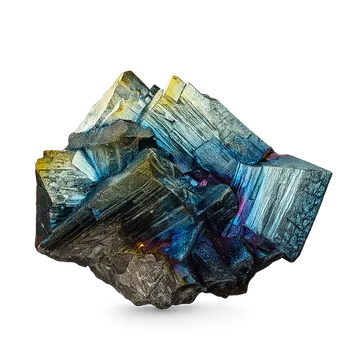
Arsenopyrite from Panasqueira, Portugal - architectural, lustrous crystals in open cavities with quartz and mica, a premier European locality for collectors.
Key facts
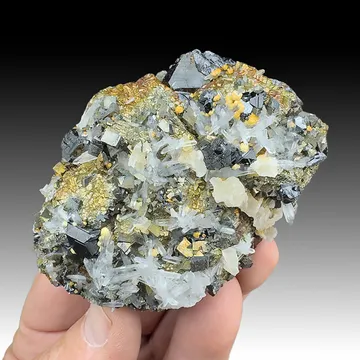
Panasqueira is one of the great European mineral-specimen localities, and arsenopyrite is one of the minerals that gives the mine its unmistakable “look.” The best pieces show bright steel-silver to pale brassy, sharply striated crystals in sculptural clusters, often with the crisp, bladed, spear-like or cock’s-comb habit that makes Panasqueira arsenopyrite recognizable at a glance. Unlike many arsenopyrite localities that yield mostly massive ore or small embedded crystals, Panasqueira has produced free-standing clusters and dramatic combinations where metallic arsenopyrite is staged against milky to clear quartz, books of muscovite, pale to greenish fluorapatite, siderite, pyrite, cassiterite, chalcopyrite, wolframite-group minerals, and topaz.

Photo: James St. John / Wikimedia Commons
The deposit is a granite-related W-Sn-Cu hydrothermal vein system in central Portugal, developed as a swarm of subhorizontal quartz veins in metasedimentary rocks above a concealed greisenized granite cupola. The ore is famous economically for wolframite and cassiterite, but collectors know Panasqueira for the open cavities in those quartz veins: the spaces where slow crystal growth produced large, lustrous, well-separated crystals instead of ordinary vein fill. Arsenopyrite belongs to both the early oxide-silicate mineralizing history and the later sulfide evolution of the deposit, so it can appear in several textural settings—from discrete metallic sprays in quartz to heavy intergrown arsenopyrite-rich matrices that support later collector favorites.

Photo: Rob Lavinsky / Wikimedia Commons
For the collector, the appeal is twofold. First is form: Panasqueira arsenopyrite has a habit and surface character that are far more architectural than most examples of the species. Second is association: a fine Panasqueira arsenopyrite specimen can be a complete miniature portrait of the mine’s paragenesis, with metallic sulfarsenide blades, quartz, mica, carbonate, apatite, cassiterite or wolframite all sharing a compact cabinet-scale stage. Old pieces are rightly considered classics, but the mine’s long operating life has kept the locality familiar in the market, and good modern pieces still appear when mining intersects specimen-quality cavities.
Search for specimens: View all arsenopyrite specimens from Panasqueira Mines, Portugal
The Panasqueira Mines are in central Portugal, in the Castelo Branco district near Covilhã, within the mining district historically called the Couto Mineiro da Panasqueira. The industrial complex has included several working areas, notably Rio, Panasqueira, Vale das Freiras, Vale da Ermida and Barroca Grande, with the modern underground operation and processing center associated with Barroca Grande near Aldeia de São Francisco de Assis.
Geologically, Panasqueira is a vein-type tungsten-tin-copper deposit developed in the Central Iberian Zone of the Variscan belt. The mineralized system is not a simple fissure vein, but a stacked swarm of thin, mostly flat-lying quartz veins emplaced in open joints in Beira schists above and around a concealed Panasqueira granite. Individual veins commonly average about 30 cm thick, with reported ranges from a few centimeters to around a meter. They can persist for long distances, pinch and reappear, and overlap in the mine workings. This structural style is the reason Panasqueira can be both an industrial tungsten mine and an extraordinary mineral locality: the same open spaces that gave miners coarse wolframite and cassiterite also gave collectors crystal-lined vugs.
The accepted paragenetic framework is usually described in broad stages. The oxide-silicate stage produced much of the quartz, cassiterite, wolframite, muscovite, topaz, tourmaline and part of the arsenopyrite. The main sulfide stage added abundant arsenopyrite, pyrite, pyrrhotite, sphalerite, chalcopyrite and stannite. A pyrrhotite-alteration stage introduced minerals such as marcasite, siderite, galena and Pb-Bi-Ag sulfosalts, followed by late carbonate deposition dominated by dolomite and calcite. This sequence matters to collectors because Panasqueira arsenopyrite is not merely an accessory speck in quartz; it is one of the minerals woven through the mine’s essential ore-forming history.
Mining began in the modern industrial sense in the late nineteenth century. A company was founded in 1896 to mine tungsten, and Panasqueira has operated more or less continuously since then, aside from closures at the end of World War II and in the mid-1990s. The first wolframite was recovered at Cabeço do Pião, later known as Rio, and a mechanized treatment plant was built there in 1904. In 1912 a 5,100 m aerial rope tramway was installed to move ore from different mining sites to the Rio plant, a striking reminder of how early the district reached industrial scale. Milling at Rio continued until September 1996, when final concentration equipment began moving to Barroca Grande.
Production history gives a sense of the deposit’s scale. Between 1937 and 2016, roughly 40 million tonnes of rock were mined, producing approximately 128,000 tonnes of tungsten concentrate, 6,600 tonnes of tin concentrate and 32,000 tonnes of copper concentrate. Panasqueira has also been described in modern studies as the main known tungsten deposit in Europe, a long-lived benchmark for granite-related W-Sn-Cu lode systems.
Collecting access should be understood in the context of an active industrial underground mine. Specimen recovery is tied to mine operations and the chance intersection of cavities in quartz veins. This is not a casual public rockhounding locality where collectors can freely enter workings or collect underground. The legitimate specimen stream is commercial and provenance-dependent: pieces reach collectors through mine-related recovery, established dealers, older collections and auction channels. For serious collectors, a good Panasqueira label should preserve not just “Portugal,” but the mine name, and, when known, the level, mining area, previous collection or dealer history.
Notable finds are not confined to arsenopyrite. Panasqueira is celebrated for fluorapatite, ferberite/wolframite, cassiterite, quartz, siderite, muscovite, chalcopyrite, pyrite, fluorite and a long list of rare species. It is also the type locality for panasqueiraite and thadeuite. Arsenopyrite’s particular role is as one of the locality’s classic metallic species: less colorful than the best apatites, less economically central than wolframite, but often more sculptural and more immediately diagnostic of the mine’s sulfide-rich aesthetic.
Panasqueira arsenopyrite is typically metallic, opaque, and bright steel-gray to silver-gray, often with a pale brassy cast. Fresh crystals can be mirror-bright; older or exposed pieces may show darker gray surfaces, bronzy highlights, or natural iridescence. Some iridescent Panasqueira arsenopyrites have been questioned by collectors unfamiliar with the material, but the effect is a known natural surface phenomenon on some specimens rather than a standard artificial coating.
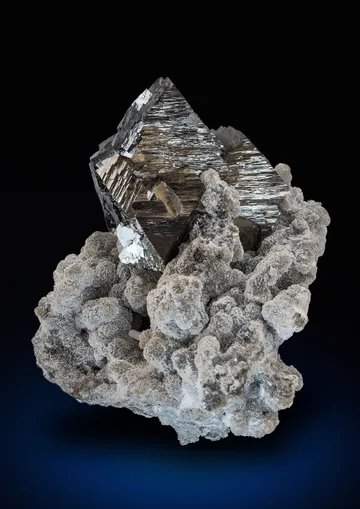
The most desirable crystals are sharply formed, strongly striated and arranged in fan-like, bladed, cockscomb, bow-tie or radiating clusters. Individual crystals may be tabular to prismatic, with chisel-like or spear-like terminations. The striations are an important quality marker: on fine pieces they create a silky metallic flash across the crystal faces, giving the specimen movement as it is turned in the light.
Size varies widely. Small crystals and aggregates are common on quartz and sulfide matrices, while collector-grade miniatures and small cabinets often show crystals in the centimeter range. Documented specimen descriptions include Panasqueira arsenopyrite crystals to about 5 cm on quartz-rich matrices, and older collector literature and locality summaries describe exceptional crystals approaching 10 cm. Cabinet specimens are usually valued less for a single giant crystal than for the balance of crystal form, luster, three-dimensional arrangement and association.
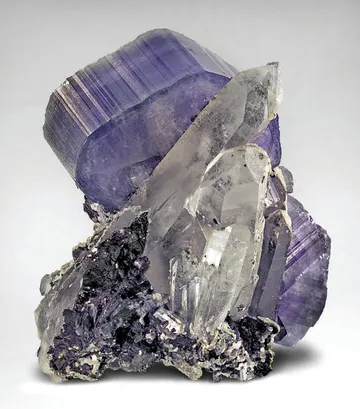
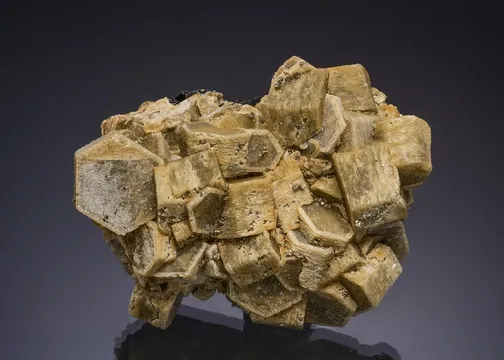
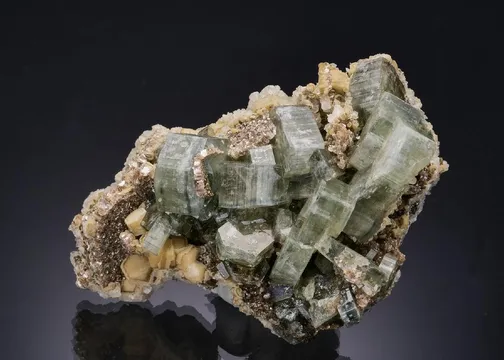
Associations are central to evaluation. Arsenopyrite on quartz with muscovite is the classic clean look: bright metallic blades rising from pale quartz with tan mica accents. Arsenopyrite with fluorapatite is more colorful and highly collectible, especially when the apatite is green, blue-green, lavender or purple and sits naturally on or among arsenopyrite and quartz. Arsenopyrite with siderite can be very sculptural, with brownish rhombs or curved carbonate aggregates contrasting against the metallic crystals. Cassiterite, pyrite, chalcopyrite, stannite, sphalerite, topaz, fluorite and wolframite-group minerals add both mineralogical interest and locality character when the relationships are natural and undisturbed.
Quality factors are straightforward but unforgiving. Look for sharp undamaged terminations, strong metallic luster, clear striation, three-dimensional architecture, and a stable matrix that displays the arsenopyrite without crowding it. The best Panasqueira pieces have an organized “built” quality: clusters rise from the matrix in flowing groups rather than appearing as broken ore fragments. Complete 360-degree clusters are especially desirable, as are pieces where arsenopyrite is not just an accessory but the visual anchor of the specimen.
Condition is a major discriminator. Arsenopyrite is hard enough to resist casual abrasion, but it is brittle, and Panasqueira specimens often occur in intergrown clusters with edges and terminations exposed. Cleaved, bruised or contacted crystal tips are common. Pyrite microcrystals coating arsenopyrite can add sparkle, but they can also obscure the arsenopyrite’s own luster and crystal form. Muscovite can detach, siderite can bruise, and quartz points can chip at the edges, so the entire association should be assessed rather than the arsenopyrite alone.
Panasqueira arsenopyrite is common enough that representative specimens remain available, but truly fine pieces are not common. The market ranges from inexpensive small clusters and mixed sulfide miniatures to high-end cabinet specimens with exceptional luster, complete form, old provenance or important associations. Recent dealer and auction examples show the breadth: modest miniatures can trade at entry-level prices, while sculptural small-cabinet clusters and old collection pieces may reach the high hundreds or low thousands of dollars, especially when undamaged and visually dramatic.
The main authenticity issue is locality confidence rather than synthetic arsenopyrite. Arsenopyrite itself is not a species that is routinely faked in the way brightly dyed agates, coated quartz or lab-grown novelty crystals are. The practical risks are repaired clusters, composite assemblies, vague labels, and Panasqueira attribution given to arsenopyrite from another locality because “Panasqueira” is the more desirable name. A genuine Panasqueira arsenopyrite should make mineralogical sense: quartz, muscovite, siderite, fluorapatite, cassiterite, pyrite, chalcopyrite, topaz, fluorite or wolframite associations are all plausible, but the structure should show natural growth contacts rather than glue lines or mismatched matrix.
Natural iridescence deserves special mention. Some Panasqueira arsenopyrites display colorful surface films in purple, blue, green, magenta or bronze tones under strong lighting. These are not automatically suspect. The collector’s test is not simply “is it colorful?” but whether the color follows natural crystal surfaces, whether it is consistent with the specimen’s exposure and mineral coating, and whether there is any evidence of artificial metallic coating, paint, oil or residue.
Condition problems are more common than outright fakery. Check the high points of cockscomb clusters with a loupe; tiny chips can be visually masked by the brightness of the crystal faces. Inspect contact points where crystals meet the matrix. Look for suspiciously glossy glue in recesses, blue-white fluorescence from modern adhesives under longwave UV, and broken arsenopyrite blades reattached at unnatural angles. Heavy arsenopyrite specimens can also be vulnerable in shipping because dense metallic clusters concentrate stress at narrow attachment points.
Storage is simple but should be thoughtful. Arsenopyrite is an arsenic-bearing sulfarsenide, FeAsS, and should be treated as a mineral specimen rather than handled casually. Keep it dry, avoid grinding or trimming without proper precautions, wash hands after handling, and keep loose fragments or dust away from children, pets and food-preparation areas. Normal display in a closed cabinet is appropriate for stable specimens.
The Panasqueira story begins not with a tidy museum label but with a working landscape of valleys, cableways, small pits and hard price cycles. The early mine centered on Cabeço do Pião, the Rio area, where wolframite was first recovered and where a mechanized plant was built in 1904 beside the Zêzere for water. By 1912 the operation had invested in a 5,100 m aerial rope-tramway, long enough to make the movement of ore itself part of the mountain scenery. That year’s figures read like a snapshot of an ambitious young tungsten mine: 267 tonnes of 65% WO3 wolframite concentrate, 244 workers, 10,791 tonnes of vein material and 86,063 tonnes of host rock.
World War I transformed Panasqueira from a regional mine into a strategic operation. The plant was enlarged, a furnace was installed, and the workforce rose to about 800. Around the mine, roughly 1,000 individuals were allowed to work small surface vein exposures and sell small quantities of ore back to the company. That detail explains why the hills around the present operation are still marked by old pits and shafts: not all of Panasqueira’s history happened in a neat underground plan. Some of it was scratched into the slopes by small teams and individuals following tungsten-bearing quartz wherever it showed itself.
The mine’s most dramatic human expansion came during World War II. Tungsten prices recovered in 1934 and stayed high through the war years, creating Panasqueira’s peak production period. Manpower climbed from about 750 workers in 1933 to 3,300 in 1940 and nearly 5,800 in 1943. Beyond the company workforce, around 4,800 individual miners worked small veins on the surrounding hills. Portugal remained neutral, and Panasqueira’s tungsten was sold into a world where both sides of the conflict wanted the same strategic metal. For collectors holding a bright arsenopyrite cluster today, it is easy to forget that the same vein system was once part of a wartime economy measured not in cabinet specimens, but in workers, concentrates, ropeways and international demand.
The specimen story is inseparable from the miner’s term for cavities: rotos. These openings, varying from centimeter scale to meter scale, are the places where Panasqueira stops being simply an ore deposit and becomes a classic mineral locality. They occur unpredictably as the underground work advances. One stope may show little beyond vein quartz and ore; another may open into a pocket lined with quartz, muscovite, metallic sulfides, apatite or wolframite. The best arsenopyrite specimens are pocket survivors—pieces that made it out of the mine with sharp metallic edges intact, preserving a moment of crystal growth that took place in open space rather than in crushed mill feed.
.jpg)
