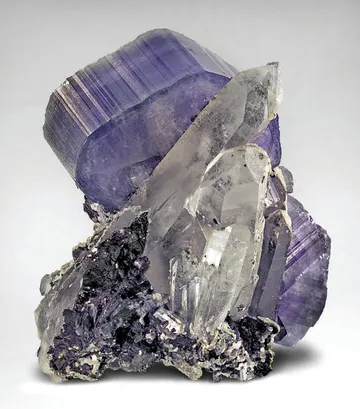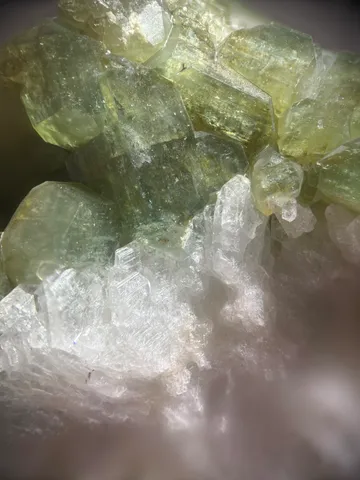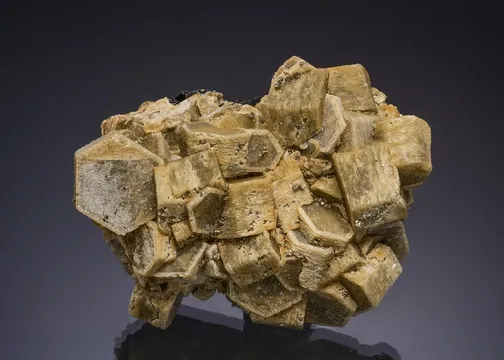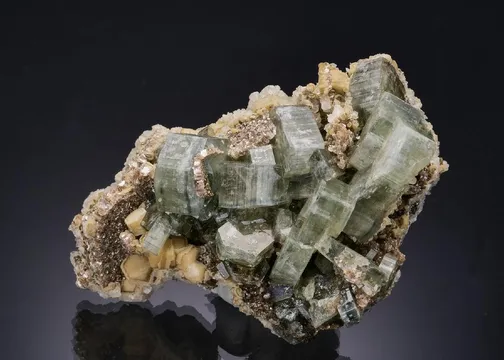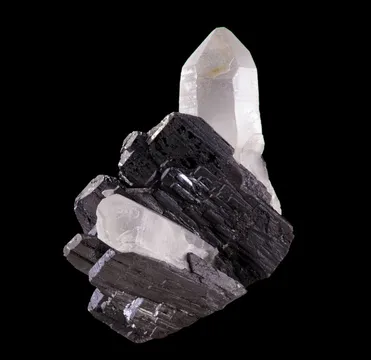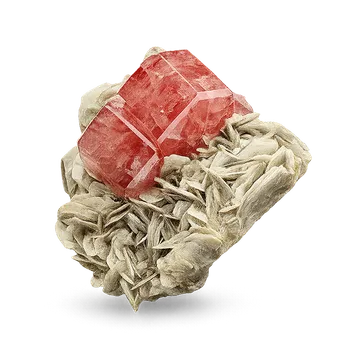
Apatite from the Panasqueira Mines is one of the signature mineral classics of Europe: glassy, hexagonal fluorapatite, most often in green, blue-green, colorless, pale yellow, violet, or purple crystals, set against the unmistakable Panasqueira palette of silvery arsenopyrite, ribbed black ferberite, sparkling muscovite, siderite, quartz, pyrite, sphalerite, fluorite, calcite, and other vein minerals. In serious collections the label is usually shortened to “apatite,” but the collector-specimen species from Panasqueira is fluorapatite, Ca5(PO4)3F.
Key facts
Apatite from the Panasqueira Mines is one of the signature mineral classics of Europe: glassy, hexagonal fluorapatite, most often in green, blue-green, colorless, pale yellow, violet, or purple crystals, set against the unmistakable Panasqueira palette of silvery arsenopyrite, ribbed black ferberite, sparkling muscovite, siderite, quartz, pyrite, sphalerite, fluorite, calcite, and other vein minerals. In serious collections the label is usually shortened to “apatite,” but the collector-specimen species from Panasqueira is fluorapatite, Ca5(PO4)3F.
The visual appeal is immediate. The best crystals look machined: squat to tabular hexagonal barrels, bright pinacoids, beveled prism edges, internal color zoning, and, in many pieces, the kind of floating placement on matrix that makes the specimen read well from across a room. Panasqueira green is a locality color in its own right—olive, celadon, gray-green, sea-green, or bluish green depending on thickness and lighting. Purple pieces are less common and especially pursued when the color is clean, gemmy, and zoned rather than muddy. Colorless-to-pale specimens can be just as desirable when the faces are sharp and the matrix is rich with metallic ore minerals.
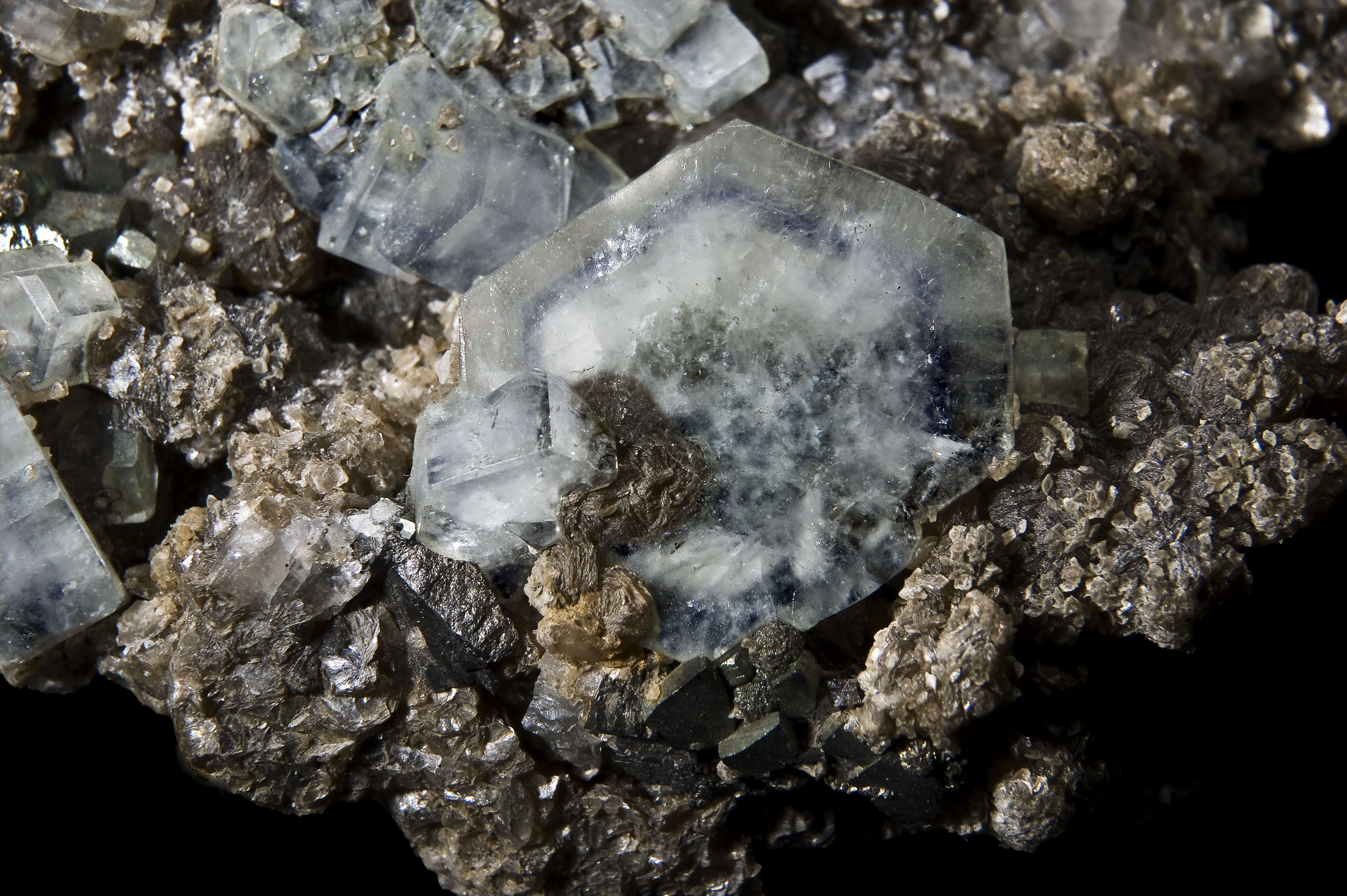
Photo: Wikimedia Commons
Geologically, Panasqueira is a world-class W-Sn-Cu hydrothermal lode deposit in central Portugal, developed in a swarm of subhorizontal quartz veins hosted by the Beira schists and related to a concealed, highly evolved Variscan granite system. The mine is famous as an ore producer for tungsten, tin, and copper, but to collectors it is equally famous for the quality of its open-space vein minerals. Apatite is not an accidental extra here; it is one of the characteristic phosphate phases of the lode system, and in collector terms it is the mineral that gives Panasqueira its instantly recognizable fine-mineral identity.
Panasqueira apatites are prized because they combine three things that rarely coincide so consistently: attractive color, strong crystallography, and excellent associations. A single specimen may show translucent green fluorapatite perched on bladed muscovite, purple-zoned apatite half buried in siderite, or tabular apatites resting among arsenopyrite rosettes and quartz points. The best pieces are not merely isolated crystals; they are miniature records of the mine’s paragenesis, with phosphate, carbonate, sulfide, oxide, and silicate minerals staged together in tight, elegant arrangements.

Photo: Wikimedia Commons
Historically, Panasqueira’s importance goes well beyond mineral collecting. Modern tungsten mining began in the late nineteenth century, the mine expanded dramatically during the world wars, and it has remained one of the great long-lived tungsten mines outside China. That continuity has kept specimens entering the market for generations. Many older pieces carry European dealer labels, mine-period attributions to Barroca Grande or levels within the workings, or provenance through well-known collections; newer pieces still appear, but the finest modern examples are watched closely by collectors because the mine is active, access is controlled, and collector-quality cavities are not predictable.
For the collector, the ideal Panasqueira apatite has a clear identity at first glance: a sharply defined hexagonal crystal, fine luster, attractive zoning, minimal edge bruising, and an association that tells the Panasqueira story. A green or purple crystal on muscovite, siderite, arsenopyrite, quartz, ferberite, or a combination of these is the benchmark. Size helps, but only when the crystal retains definition and condition; a small, gemmy, undamaged purple thumbnail may outrank a larger but dull, contacted crystal.
Search for specimens: View all apatite specimens from Panasqueira Mines, Portugal
The Panasqueira Mines are in central Portugal, in Castelo Branco District, on the southern edge of the Serra da Estrela region, near Covilhã and the village of Panasqueira, with the modern industrial center at Barroca Grande near Aldeia de São Francisco de Assis. The mine is not a single pocket or small dig, but a broad, historically integrated mining district, including Panasqueira, Barroca Grande, Rio/Cabeço do Pião, Vale da Ermida, and related concessions.
The deposit is a granite-related tungsten-tin-copper lode system. Its ore is hosted in stacked, subhorizontal quartz veins that cut metasedimentary rocks of the Beira schist sequence. The veins occur above and around a concealed, greisenized granite cupola. Rather than forming a simple vertical vein mine, Panasqueira presents a dense, laterally extensive swarm of flat to gently dipping quartz lodes. These veins contain the economic wolframite-series ore, chiefly ferberite, along with cassiterite and chalcopyrite, and a broad suite of accessory and collector minerals.
The mineralized zone has been described as extending roughly 2,500 meters in length, from about 400 to 2,200 meters in width, and to at least 500 meters depth. Individual quartz veins are typically far thinner than the fine specimens might suggest: commonly around 30 centimeters thick, though local vein thicknesses vary widely. This is important for collectors because the showy mineral specimens come from cavities and openings within a mining environment whose economic target is primarily the ore mineralization, not the specimen pockets.
Panasqueira’s paragenesis is complex. Mineralogical work on the quartz lodes recognizes multiple fluid events, from early oxide-silicate stages through main sulfide deposition and later carbonate stages. Apatite appears in this system both as an important phosphate in the lodes and as a collector mineral in open spaces where crystals could grow freely. Associated minerals on specimens commonly include siderite, muscovite, quartz, arsenopyrite, pyrite, ferberite, fluorite, calcite, chalcopyrite, sphalerite, cassiterite, chlorite, dolomite, topaz, tourmaline, and marcasite.
Modern mining rights are held through Beralt Tin and Wolfram under Almonty Industries. The mine is an active industrial operation, so it should not be treated as a recreational collecting site. Underground access is controlled, and collectors should assume that any legitimate visit, purchase, or field opportunity requires permission through the operator or authorized local channels. Historic and modern pieces in the trade generally come through miners, dealers, mine-related channels, or later resale from collections, not casual collecting.
The mine’s production history is unusually long. Prospecting and early recognition of wolframite date to the late nineteenth century, and the formal mining company was established in the 1890s. In the early twentieth century, the Wolfram Mining and Smelting Company invested in equipment and a long aerial rope-tramway to move ore to the Rio treatment plant. Mining expanded during World War I, contracted and shifted with tungsten prices between the wars, and reached extraordinary manpower during World War II. Later, mechanization, new levels, room-and-pillar mining, conveyor and shaft improvements, and plant consolidation at Barroca Grande allowed the mine to continue through repeated tungsten-price cycles.
Notable specimen finds have occurred across many decades rather than in a single brief boom. The classic older material includes green and purple fluorapatite with ferberite, quartz, arsenopyrite, siderite, and muscovite. Dealer and museum records also document later finds of more unusual habits, including elongated, doubly terminated fluorapatites with pale yellow to violet zoning and distinctive fluorescence from Level 0 material found around 2020. These finds show why the locality remains alive to collectors: even after more than a century, Panasqueira can still produce unexpected styles.
Panasasqueira apatite is best understood as fluorapatite in hydrothermal quartz-lode cavities. Crystals are most commonly hexagonal prisms or thick tabular to barrel-shaped forms, often with bright basal pinacoids and beveling around the edges. Many are squat, cogwheel-like, or platy when viewed down the c-axis; others are more elongated prismatic crystals. Doubly terminated crystals are less common but highly attractive, especially when set on matrix rather than crowded into massive intergrowths.
Color is one of the locality’s great strengths. Classic crystals range from clear and nearly colorless through pale yellow, smoky gray-green, apple-green, olive-green, bluish green, violet, and purple. Some crystals show strong internal zoning: green cores with paler rims, purple edges around clearer centers, white geometric zoning near terminations, or concentric bands that resemble an “eye” when the crystal is viewed end-on. This zoning is not merely cosmetic. Scientific work on Panasqueira fluorapatite has shown that trace elements and volatiles are unevenly distributed within crystals, and that zoning can record changing hydrothermal conditions during growth and later events.

Photo: Wikimedia Commons
Typical collectible crystals range from a few millimeters to about 1–3 centimeters. Fine miniatures may feature a main crystal around 1–2 centimeters with good matrix balance. Cabinet pieces with crystals in the 3-centimeter range and larger are more desirable when sharp, lustrous, and not heavily contacted. Very large apatite crystals from Panasqueira exist and are famous in the trade, but size alone is not enough; large crystals often show edge wear, contact marks, internal cloudiness, or crowded growth. A clean, gemmy, well-positioned 1.5-centimeter purple crystal may be more satisfying than a 5-centimeter bruised green one.
The most desirable associations are strongly locality-specific. Fluorapatite with siderite is a standard Panasqueira combination: pale to tan rhombohedral siderite provides a warm matrix and often contrasts well with green or violet apatite. Muscovite gives a silvery, bladed sparkle that flatters blue-green crystals. Arsenopyrite adds metallic brilliance, commonly in silvery rosettes, sprays, or sharp intergrown crystals. Quartz provides clarity and height, especially when water-clear points rise behind or between the apatites. Ferberite associations are among the most classic: black, ribbed tungsten ore crystals with pale green or gray-blue fluorapatite make an unmistakable Panasqueira statement.
Fluorescence is a secondary but interesting feature. Some Panasqueira apatites show zoned responses under longwave or shortwave UV, and dealer records document pieces with white, purple, peach, orange, or yellow fluorescence depending on crystal zone and wavelength. Fluorescence should be treated as a bonus rather than a primary value driver, unless it is unusually strong, zoned, and well documented in photos or video. Daylight color, luster, composition, crystal form, and condition remain more important.
Quality is judged by a cluster of factors. The top tier has sharp geometry, bright glassy luster, attractive and visible color, good transparency or translucency, pleasing matrix, and minimal damage. Zoning is especially valued when it is visible without extreme backlighting. Purple is generally scarcer and often more sought after than ordinary green, but exceptional green or blue-green specimens with perfect placement can equal or exceed average purple pieces. The best matrix specimens have a coherent composition: apatite as the focal point, with Panasqueira’s metallic and silicate minerals adding texture rather than overwhelming it.
Authenticity concerns for Panasqueira apatite are less about wholesale locality fabrication and more about repairs, enhancements, and misdescriptions. The material is common enough in the trade that authentic specimens are widely available, but fine pieces can be valuable enough to justify careful inspection. Apatite is brittle, and Panasqueira crystals commonly sit on friable or platy matrices of muscovite, siderite, arsenopyrite, quartz, and ore minerals; repairs are therefore not rare. A disclosed, clean repair on a major crystal may be acceptable to some collectors, but an undisclosed reattachment, disguised glue seam, or assembled composite should materially affect value.
Inspect crystal-to-matrix junctions carefully. Natural Panasqueira apatite often grew partly enclosed by matrix minerals, so contact is not automatically suspicious. However, straight glue lines, mismatched matrix grains, small pools of resin, offset striations across a break, or a crystal that appears visually “parked” on an implausibly fresh patch of matrix deserve scrutiny. UV light can help reveal some adhesives, but it is not definitive; some natural mineral zones fluoresce, and some glues are inconspicuous. A loupe and side lighting remain essential.
Condition issues are common and should be weighed realistically. Basal edges on tabular crystals chip easily. Purple rims may show tiny nicks that are visually obvious because the color is concentrated at the edge. Green crystals may have internal fractures that do not break the surface but reduce clarity. Siderite can cleave or bruise, muscovite can shed flakes, arsenopyrite points can abrade, and quartz can hide small bruises until inspected under oblique light. Because many Panasqueira pieces are matrix specimens, check the whole composition rather than focusing only on the apatite.
Polishing and grinding are less commonly advertised but should be considered when a termination looks unnaturally flat, mirror-smooth, or texturally different from the side faces. Natural pinacoids on Panasqueira apatite should show mineral growth texture, even when lustrous. A polished face may still be attractive, but it is no longer equivalent to a natural, undamaged termination.
Treatment by heating or irradiation is not a standard issue for Panasqueira specimen apatite in the same way it can be in some gem materials. The more practical concerns are repair, stabilization, glued bases, and specimen assembly. Acrylic bases are common and not a problem when clearly described; permanent glue to a base should be distinguished from glue used to reattach mineral components.
Rarity is tiered. Ordinary small green or pale fluorapatite on muscovite or siderite is available with patience. Good thumbnails and miniatures are regular on the market. Fine purple crystals, strongly zoned pieces, clean crystals over 2 centimeters, classic ferberite associations, older collection pieces, and balanced cabinet specimens are much scarcer. Exceptional Panasqueira apatites are not disappearing from the market, but they are increasingly provenance-sensitive: collectors pay for older labels, documented finds, level information, major collection pedigrees, and honest condition disclosure.
Market availability remains healthy compared with many classic localities. Dealer inventories, auction archives, and collection dispersals regularly show Panasqueira fluorapatite, from modest study specimens to expensive display pieces. The challenge is selectivity. Avoid paying merely for the locality name. Pay for the qualities that make Panasqueira great: crystal definition, zoning, luster, association, and a composition that could not be mistaken for any other apatite locality.
The Panasqueira story begins not with a collector’s cabinet, but with a heavy black stone in a rough mountain landscape. At the end of the nineteenth century the area was covered with scrub, broom, arbutus, pine, small terraces, and poor stony ground. Local accounts name the discoverer as a charcoal burner from Casegas, known as “O Pescão de Casegas,” who found unusually heavy black rocks in the Panasqueira area. The sample reached Manuel dos Santos of Barroca do Zêzere, who took the matter seriously enough to seek expert help in Lisbon from the mineralogist and engineer Silva Pinto. Dos Santos then bought land and began mining wolfram. That first practical recognition of the black ore set in motion one of Europe’s great tungsten districts—and, much later, one of the world’s great fluorapatite specimen localities.
The scale changed quickly. In 1911, the Wolfram Mining and Smelting Company acquired the rights, buildings, equipment, and rural land, then invested heavily in machinery. By 1912 a 5,100-meter aerial rope-tramway carried ore from the mining sites to the Rio treatment plant. That same year, production records cite 267 tonnes of 65% WO3 wolframite concentrate from 10,791 tonnes of vein material, handled by 244 workers, along with a much larger tonnage of host rock. It is an image worth holding beside a delicate apatite miniature: the same vein system that later gave collectors glassy hexagons was already being industrialized with tramway cables, washing plant machinery, and a growing labor force.
World War I pushed Panasqueira harder. The workforce rose to about 800, and the company permitted individuals to work small surface veins within the concession, selling recovered ore back to the company. Around 1,000 people were involved in those small workings. The hills around the modern mine still preserve traces of this phase—old pits and shafts from hand mining, the rough surface echo of the subhorizontal lodes underground. Those small operators were chasing tungsten, not fluorapatite, but their workings belong to the same mineralized landscape that collectors now know by its green and purple crystals.
The World War II years were the dramatic peak. Tungsten prices rose, Portugal remained neutral, and Panasqueira sold into a market shaped by both sides of the conflict. Manpower rose from hundreds in the early 1930s to thousands: roughly 3,300 mine workers in 1940, nearly 5,800 in 1943, plus about 4,800 individual miners working small veins on the surrounding hills. Other historical summaries place the combined number above 10,000 at the wartime high. In the local imagination wolfram became “black gold,” a metal that could pull farmers, laborers, and opportunists out of agriculture and into the mines, the hills, and sometimes illegal or semi-formal recovery schemes. Behind every later cabinet specimen from Panasqueira sits that deeper history: a mineral district where geology, wartime demand, poverty, risk, and sudden money all converged.
The mine survived because it kept changing. After the postwar tungsten collapse, production continued through mechanization, tin recovery, copper recovery from tailings, new levels, and changes in ownership. Longwall stoping gave way to more mechanized room-and-pillar mining. Ore that once moved by rope-tramway and older treatment plants was eventually concentrated through the modern Barroca Grande operation. For collectors, that continuity matters. Panasqueira specimens did not arrive as a single sealed-off nineteenth-century classic. They came in waves: old ferberite and arsenopyrite combinations, classic green and purple apatites, later siderite and muscovite associations, unusual newer fluorapatites with elongated habits and fluorescence, and pieces recycled through collections decades after leaving the mine.
The most vivid collector field note is the one repeated again and again in specimen descriptions: Panasqueira still surprises. Around 2020, a small vug on Level 0 produced an unusual style of elongated, doubly terminated fluorapatite, pale yellow to violet, with white geometric zoning near the terminal areas, on matrix with quartz, sphalerite, muscovite, and chlorite coatings. Dealers described it as completely different from the familiar Panasqueira style and noted that only a few specimens came from the pocket. That is the charm of the locality after more than a century: the broad identity is classic and instantly recognizable, yet a single cavity can still add a new page to the visual vocabulary of Panasqueira apatite.