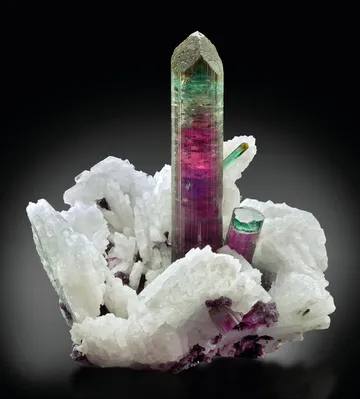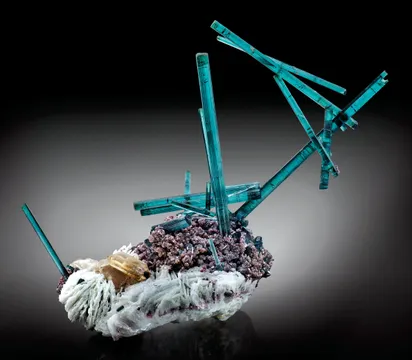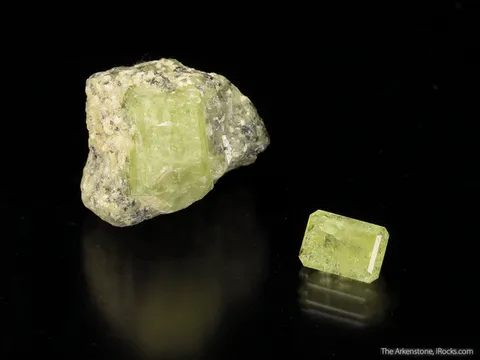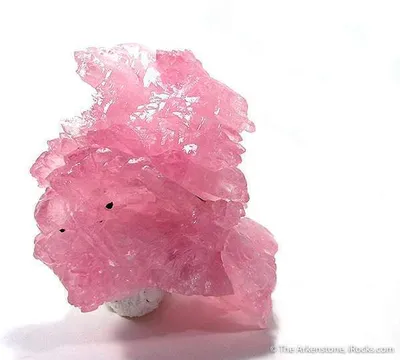
Ouro Preto, Brazil — world-class imperial topaz from an iron district, plus hematite rose plates and fine euclase crystals, a top collector locality.
Key facts
Ouro Preto is one of the great names a collector can put on a label: a colonial gold city, a classic iron district, and the world’s touchstone locality for imperial topaz. The mineralized belt lies in the Ouro Preto district of Minas Gerais, within the Quadrilátero Ferrífero, where deeply weathered Precambrian metasedimentary rocks of the Minas Supergroup and related units have been cut, altered, and partly replaced by fluorine-rich hydrothermal systems. In the field the famous topaz ground is not a clean pegmatite pocket in hard rock, but a much stranger and more Brazilian kind of deposit: chocolate-brown to yellow clayey, talc-rich weathered rock sliced by white kaolinite veins and pockets, with topaz, quartz, specular hematite, rutile, mica, and rarer euclase surviving as resistant crystals after the host has gone soft.
Regional View
Country View
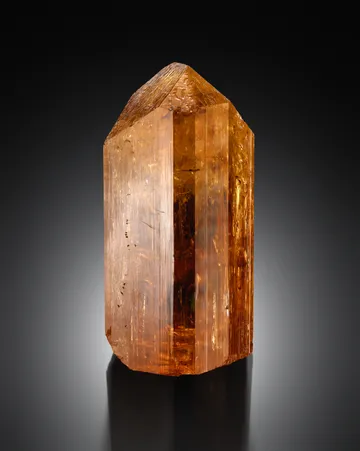
For specimen collectors, Ouro Preto’s best topaz crystals are not merely “gem rough.” They are elegant, vertically striated, prismatic crystals in golden yellow, orange, sherry, peach, reddish orange, pink, and rare purplish tones, often with brilliant glassy luster and a sharp pyramidal or rhombic termination. Most surviving crystals are small, fractured, or singly terminated; the exceptional collector pieces combine color saturation, transparency, intact termination, and enough original form to read as a crystal rather than cutting material. The district’s hematites form a second, quite different collecting tradition: metallic black to silvery gray plates and compound “iron rose” groups, some with a surprisingly Alpine aesthetic despite their tropical Brazilian origin. Euclase gives Ouro Preto a third distinction, for the Rodrigo Silva area is accepted as the type area for the species, and fine crystals from the district can be glassy, striated, transparent, and pale blue, greenish, yellowish, or colorless.

Photo: Wikimedia Commons
Ouro Preto’s mineral fame cannot be separated from its human history. Before collectors spoke of imperial topaz, the town was Vila Rica, the “Rich Village” of Brazil’s eighteenth-century gold rush. It became the capital of Minas Gerais from 1720 to 1897, and the wealth of the mines paid for the Baroque churches, steep streets, and civic buildings that made Ouro Preto Brazil’s first UNESCO World Heritage city. The specimen label therefore carries a rare combination: a mineral district of first-rank importance and a city whose mining history shaped the culture and politics of colonial Brazil.

Photo: Wikimedia Commons
Search for specimens: View all specimens from Ouro Preto, Brazil
The specimen-producing area normally meant by “Ouro Preto” is a cluster of mines and occurrences west, southwest, and locally northeast of the historic city, including Saramenha and the Vermelhão mine, Dom Bosco, Hargreaves, Boa Vista, Rodrigo Silva, Capão do Lana, Tripuí, Antônio Pereira, and related small workings. The topaz belt is narrow and discontinuous rather than a single cavernous mine: classic descriptions place much of the mineralization in east-west belts, with many of the best-known mines concentrated between Dom Bosco and Rodrigo Silva, and with additional occurrences around Antônio Pereira and Saramenha. The rocks are part of the greater Quadrilátero Ferrífero terrain, a world-famous iron province dominated in many places by ferruginous quartzites, phyllites, itabiritic iron formations, dolomites, impure marbles, and other metamorphosed Precambrian sedimentary rocks.
The deposit type is best described as hydrothermal, stratabound to structurally controlled imperial-topaz mineralization in intensely weathered metasedimentary rocks. Earlier writers argued over whether the occurrence was pegmatitic because topaz and quartz appeared together in vein-like bodies, but the most useful collector’s mental picture is a weathered hydrothermal system: centimeter- to decimeter-scale kaolinite-rich seams, pods, and “nests” in brown clayey altered rock. In the classic Capão do Lana workings, topaz crystals were recovered from kaolinite with quartz, mica, and specular hematite, and sometimes rutile and rare green or blue euclase. Later mineralogical work on imperial topaz from the region identified crystalline inclusions that include carbonates, hematite, ilmenite, mica, rutile, quartz, tremolite, euclase, and apatite, with fluid-inclusion studies pointing to hot, pressurized aqueous-carbonic fluids rather than a simple low-temperature weathering product.
Mining has always followed the nature of the ground. Because the host rock is deeply decomposed, important operations have worked by open-cast methods, stripping and washing the altered material rather than drilling hard pocket rock in the manner of a pegmatite. At Capão do Lana, mechanized work used bulldozers, draglines or dragscrapers, screens, water cannons, and hand sorting. White kaolinite veins were especially important visual targets: when such a vein appeared against the brown clay, work could stop while designated miners searched the seam by hand for better crystals. The harsh hydraulic recovery produced volume, but hand-recovered crystals from intact veins were more likely to keep sharp terminations, edges, and luster.
The best-known commercial operations have included the Capão do Lana mine, associated with Topázio Imperial Mineração, and the Vermelhão/Saramenha area, historically worked by Mineração Vermelhão. Capão do Lana, near Rodrigo Silva, became one of the best documented and most mechanized imperial topaz operations in Brazil. By the 1980s and 1990s it was widely described in gemological literature as one of the district’s most productive mines, using water-based concentration and conveyor-belt hand sorting to recover crystals from enormous volumes of clayey ore. Production figures vary by period and source, but all credible descriptions emphasize the same point: mine-run topaz was abundant compared with the tiny percentage of faceting-grade, undamaged, richly colored material, and collector-grade crystals with complete form were a much smaller prize within that stream.
Ouro Preto topaz mining is much older than the modern mechanized pits. Reports of “Brazilian rubies” from the Vila Rica area were recorded in the mid-eighteenth century, and the official discovery of topaz in the region was celebrated by the Portuguese court in 1768. Nineteenth- and early twentieth-century travelers and geologists, including John Mawe, Wilhelm Ludwig von Eschwege, Spix and Martius, Henri Gorceix, Orville Derby, and later USGS geologists, turned the district into a classic locality of mineralogical literature. The early literature is also useful to collectors because it records large crystals, confusion between species, old locality names, and the mining vocabulary of kaolinite, brown clay, quartz, and specular hematite that still makes Ouro Preto material recognizable.
Collecting access today should be regarded as highly restricted. The major topaz mines are commercial operations on private concessions, not open collecting grounds, and the Tripuí occurrences are associated with a protected ecological station and geosite. Specimens reach collectors through dealers, old collections, mine-related purchases, and legally released material rather than casual field collecting. Labels should be read carefully: “Ouro Preto” may mean the broader district, while better old labels may specify Capão do Lana, Vermelhão, Saramenha, Dom Bosco, Rodrigo Silva, Boa Vista, Tripuí, Miguel Burnier, or Antônio Pereira. That sublocality information matters, especially for topaz and hematite.
Notable finds range from small parcels of intense gem crystals to museum-scale topaz. The literature records crystals on the order of 20 cm and larger, including a famous large crystal from the Rodrigo Silva area later associated with the Los Angeles County Museum of Natural History collection, and an older report of a nearly 2 kg crystal in Rio de Janeiro. Such giants are the exception. The collector market is built mostly on crystals from a few millimeters to several centimeters, with a premium for intactness, natural color, strong luster, and readable morphology. Hematite “rose” specimens, especially old pieces from the 1960s and 1970s, form a parallel vintage market. Euclase from the type area is much scarcer than topaz, and fine, transparent, well-terminated crystals are legitimately important even when small.
Ouro Preto topaz is the imperial topaz by which other localities are judged: prismatic, vertically striated Al2SiO4(F,OH)2 crystals ranging from pale yellow through golden orange and sherry to orange-red, pink, and rare purple, typically found in kaolinite-rich seams and pockets within deeply weathered brown clayey rock, with quartz, specular hematite, mica, rutile, and rare euclase. Most crystals are small, with many in the 1–4 cm range and larger crystals far less common; doubly terminated examples are specifically noted as rare, and many crystals show internal tubes, veils, fractures, or “crazing” that may reduce gem value while preserving specimen character. Good collector pieces from Ouro Preto show saturated natural color, glassy luster, sharp termination, minimal bruising, and strong transparency or internal glow; ordinary pieces are pale, chipped, incomplete, water-worn, or too fractured to display the classic imperial fire.
Ouro Preto hematite occurs both as a major iron mineral of the district’s ferruginous rocks and as specimen-quality metallic crystals associated with the topaz-bearing systems, where specular hematite accompanies kaolinite, quartz, mica, rutile, and topaz. Collector specimens are best known as bright black to silvery gray plates, stacked hexagonal blades, compound rosettes, and blockier mirror-faced crystals on massive iron-rich matrix; the “iron rose” habit is especially prized because it gives some Ouro Preto and nearby Miguel Burnier pieces the sculptural look more often associated with Alpine clefts. Size varies from thumbnail plates to cabinet pieces, but the best examples combine complete rosette form, high metallic luster, sharp edges, and little rubbing or edge wear; ordinary pieces are massive, dull, broken, or too matrix-bound to show the geometry.
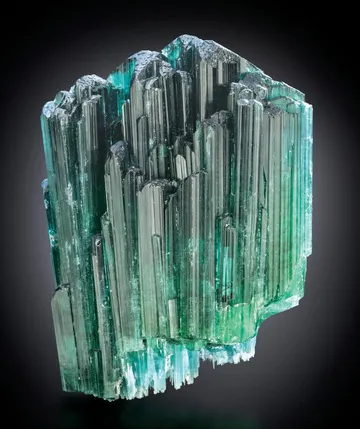
Euclase from Ouro Preto is historically and mineralogically central because Rodrigo Silva, in the imperial topaz district, is the type area for BeAlSiO4(OH), and the early material almost certainly came from topaz workings near the village. The classic crystals are striated, prismatic, vitreous, transparent to translucent, and may be colorless, white, pale green, yellowish green, blue-green, pale blue, or deeper blue; older gemological accounts also describe common light yellow “kerosene” stones and much rarer violet crystals. In the Ouro Preto district euclase occurs in quartz veins and topaz-like matrix in crystalline schists, with specular hematite and locally topaz, and it was historically confused with both topaz and aquamarine. Fine collector pieces are sharply terminated, bright, transparent, and undamaged despite euclase’s easy cleavage; mediocre examples are cleaved fragments, cloudy crystals, or pale pieces lacking termination.
Quartz at Ouro Preto is not the headline species, but it is fundamental to the district’s specimen aesthetics and geology: euhedral quartz occurs in the remnant hydrothermal veins with topaz, kaolinite, hematite, mica, rutile, and euclase, and it can form matrix for imperial topaz crystals that would otherwise be loose singles. The best quartz-associated specimens show a clear genetic relationship, such as topaz perched on or partly enclosed by quartz, or bright quartz crystals set against specular hematite, preserving the vein environment that mining and washing often destroy. Standalone quartz is generally of secondary collecting importance here unless it carries hematite, topaz, or other diagnostic associations; ordinary pieces are simply broken vein quartz, while good examples help prove context, orientation, and paragenesis.
Beyond these collector staples, Ouro Preto is unusually rich in historically important species. Tripuí, now associated with the Estação Ecológica do Tripuí and the Fazenda Três Cruzes cinnabar occurrences, is the type locality for derbylite, tripuhyite, and florencite-(Ce), and is tied to the early history of hydroxycalcioromeite under the old name lewisite. Rodrigo Silva is the type area for euclase. Other documented minerals from the district and its sublocalities include rutile, mica-group minerals, kaolinite, dolomite and other carbonates, ilmenite, apatite, tremolite, chloritoid, cinnabar, pyrite, sphalerite, monazite, xenotime-(Y), gold, and iron oxides and hydroxides. Many of these are not common cabinet-specimen minerals from the commercial market, but they make Ouro Preto one of Brazil’s most consequential mineralogical districts rather than a one-species topaz locality.
The first authenticity issue is locality breadth. “Ouro Preto” is a legitimate district label, but it can conceal very different sources: Vermelhão and Saramenha for topaz, Capão do Lana near Rodrigo Silva, Dom Bosco, Boa Vista, Antônio Pereira, Tripuí, and Miguel Burnier are not interchangeable for a serious label. When buying old specimens, preserve every scrap of locality data, including Portuguese spellings, obsolete names such as Hargreaves, and mine names written in variant forms. For topaz, a vague “Brazil” label is not enough to justify an imperial-topaz premium; color, habit, refractive data for gems, inclusions, and provenance should all be consistent with Ouro Preto material.
Treatments are a real concern for imperial topaz. Heating of brownish yellow to orange Ouro Preto topaz can produce peach to pink colors, and older literature also discusses unstable irradiation-induced brownish “imperial” overtones that fade with heat or daylight. This does not make all pink or red Ouro Preto topaz treated—natural pink, reddish, and purplish crystals are documented—but it does mean color claims deserve caution. For cut stones, gemological testing and treatment disclosure are essential. For crystals, evaluate whether the color is evenly distributed, whether it follows natural zoning, whether the piece has been oiled or cleaned to exaggerate transparency, and whether the price assumes untreated color.
Condition is the central specimen issue. Topaz has perfect basal cleavage and many Ouro Preto crystals were recovered by washing, screening, hydraulic disaggregation, or conveyor sorting; bruised terminations, cleaved bases, chipped prism edges, and internal fractures are common. A small, complete, gemmy, sharp, richly colored crystal may be more important than a much larger damaged one. Doubly terminated crystals deserve special attention but also careful inspection, because repairs, glued breaks, and rehealed-looking natural surfaces can be confused by sellers or buyers. The best display crystals show their vertical striations and termination geometry cleanly under strong light.
Euclase is even more sensitive to handling because its name alludes to easy cleavage. Avoid ultrasonic cleaning, thermal shock, and pressure on mounted or repaired crystals. Small euclase crystals from Ouro Preto can be disproportionately valuable when transparent and undamaged, especially if old and well labeled from Rodrigo Silva or the broader type area. Hematite is physically tougher but not indestructible: thin plate edges and rosette margins chip easily, and high metallic luster shows every rub. Many attractive hematites on the market are older collection pieces, and minor edge wear is common; the premium is for complete form, bright faces, and honest condition.
Fluorescence is not usually the buying point for Ouro Preto specimens, though gemological work on Capão topaz has investigated ultraviolet reactions as a possible supporting distinction between some heat-treated and untreated material. For collectors, the practical test is visual and documentary rather than fluorescent: good natural light reveals pleochroism, zoning, internal tubes, and fractures better than a lamp-lit dealer case. Because imperial topaz remains a valuable gemstone material, fine crystals have always competed with cutting demand. Truly elite crystals—saturated, gemmy, sharp, undamaged, and confidently localised—are scarce and should be expected to trade as important Brazilian classics, not as ordinary topaz.
In the eighteenth century, the first Ouro Preto topaz did not enter the record under the name that collectors use today. It appeared in courtly and commercial language as “Brazilian ruby,” a phrase that captures both the excitement and the confusion of the early gem trade. The earliest report cited in the classic literature places these red stones near Vila Rica in 1751, and the official discovery of topaz in the Ouro Preto area was important enough that Lisbon marked it in 1768 with a formal celebration. It is easy to forget, looking at a two-centimeter sherry crystal in a modern tray, that the first imperial topaz was part of a colonial mining economy intense enough to alter the fortunes of Portugal’s American empire.
By the early nineteenth century, the district had become a destination for travelers who were as interested in mines as in cities. John Mawe reached Vila Rica after crossing bleak mountain country and stopping near a house whose owner was said to possess a topaz mine. His description of the city is memorable because the gold boom had already passed its first glory: residents joked that the capital should be called “Villa Pobre” rather than “Villa Rica.” For the mineral collector, that remark lands with a particular irony. The exhausted gold city was already becoming a mineralogical capital of another kind, one whose topaz, euclase, hematite, and rarities would keep its name alive in cabinets long after the richest gold gravels were gone.
Orville Derby’s 1901 paper gave the district one of its best geological phrases. Faced with decomposed rocks so altered that the original textures had to be inferred from clays, nodules, and earthy streaks, Derby called the work “mud geology”—“an attempt to reconstruct from earthy materials the original rock types from which they were derived.” That is still a wonderfully accurate field description of Ouro Preto topaz mining. The collector wants a hard, gleaming crystal; the miner often finds it inside an unpromising smear of brown earth, white kaolinite, granular quartz, and iron oxide.
The mechanized Capão do Lana operation added its own modern choreography. In the 1980s, tons of lateritic clay were hit with water cannons and sent down sluices so that topaz, quartz, hematite, and other heavy minerals could be left behind for sorting. Below the official washing area, independent garimpeiros waited with simple sieves and shovels to rework the discarded residue, hoping for a crystal missed by the sorters above. The scene is almost a mineralogical food chain: bulldozers and water cannons at the top, hand sorters at the screens, and patient garimpeiros in the runoff, all pursuing crystals small enough to hide in mud.
The most telling moment in the mine descriptions comes when a white kaolinite vein appears. Against the dark brown clay, a white seam could signal topaz. At Capão, when a bulldozer uncovered one, the driver stopped, and selected miners—identified in the later account by red hats—scraped the vein by hand. In the earlier description, an old and trusted miner followed the bulldozers and searched exposed veins with only a knife. Those crystals, freed slowly from kaolinite rather than battered through the hydraulic plant, were often in better condition. For a collector, that single detail explains why two Ouro Preto crystals of similar color can be worlds apart: one rode the water cannon and screens; the other came out under a knife blade.
The 1996 visit to Capão do Lana recorded a half-day production that any topaz collector would remember: 3.5–4 kg of topaz from the main pit was considered very good, while about half a kilogram was more typical. In that lot were yellow, orange, pink, and at least one 5.5 cm orange-red crystal expected to yield a 12 ct faceted stone, plus an 8 cm crystal that was deep red down the c-axis. The smaller pit produced only 500–600 grams in the same period, but with a higher proportion of pink stones. The figures are a useful antidote to romance. Enormous volumes of altered rock produced handfuls of crystals; only a tiny fraction was faceting quality, and an even tinier fraction survived as a display-worthy natural crystal.