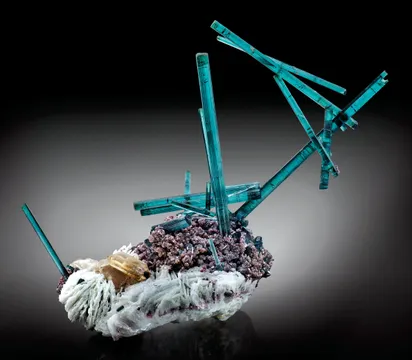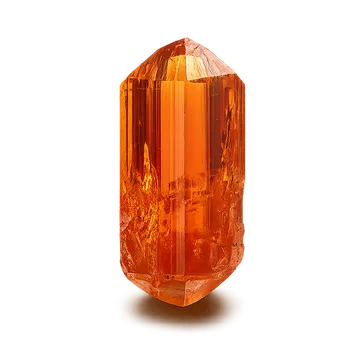
Ouro Preto topaz - renowned Brazilian locality producing imperial topaz in wine, honey, pink hues; gem crystals with sharp prisms, yet terminations are rare.
Key facts
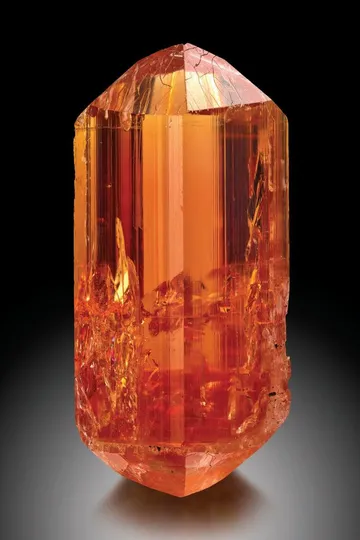
Ouro Preto topaz is one of the mineral world’s great locality names: a gem crystal with the color vocabulary of old wine, hot honey, peach skin, burnt orange, and rose. The material is the classic source of “imperial topaz,” the trade name long attached to the yellow-orange, orange-red, sherry-red, pink, and rare purplish-pink topaz from the Ouro Preto district of Minas Gerais. For collectors, its appeal is not merely that it can be faceted into superb gems; it is that the best crystals hold that gem color in sharp, lustrous, striated prisms, often with a slightly smoky warmth and a saturated red-orange axis that seems to glow from within.

Photo: Wikimedia Commons
The geological setting is unlike the familiar pegmatite-topaz localities that yield pale blue or colorless crystals by the handful. Around Ouro Preto, topaz occurs in a narrow, east-west mineralized district in the Quadrilátero Ferrífero, the iron-rich highland terrain of southern Minas Gerais. The host rocks are deeply weathered Precambrian metasediments of the Minas Supergroup, cut by kaolinite-rich, quartz-bearing, potassium-feldspar-derived veins and lenses. The original mineralization is generally understood as hydrothermal and fluorine-rich, later modified by deep tropical weathering that reduced much of the host to lateritic clay and left topaz concentrated in pockets, veins, and clayey “nests.”
That weathering is central to the look and the collecting history of the locality. Many Ouro Preto crystals were not blasted from hard pegmatite pockets but recovered from chocolate-brown lateritic clay, white kaolinite seams, and washed heavy-mineral concentrates. The same process that made extraction possible also damaged many crystals: abrasion, natural breakage, hydraulic washing, and handling mean that undamaged, lustrous, gemmy crystals with complete terminations are a much smaller subset of total production.

Photo: Wikimedia Commons
Historically, the district belongs to the earliest chapter of Brazilian gem mining. Topaz from the Ouro Preto area was publicly announced in the eighteenth century, entered European gem and mineral literature in the nineteenth century, and by the late nineteenth and early twentieth centuries had already become a celebrated locality. The principal names recur across the literature and in old labels: Capão do Lana, also called Capão, near Rodrigo Silva; Vermelhão, also called Saramenha, near Ouro Preto; Boa Vista; Dom Bosco; Antônio Pereira; Trino; and smaller workings and alluvial occurrences spread across the district.
Collectors look first for color, then crystal integrity. A rich orange crystal is desirable; a sherry-red or pinkish-red crystal with strong transparency is better; a fine purplish-pink or clearly bicolored crystal is exceptional. The best specimens show bright vitreous luster, strong vertical striation, sharp prism faces, a clean termination, and enough internal clarity to light up under backlighting. Miniatures and thumbnails dominate the collector market. Large, complete, gemmy crystals are major pieces, and historic specimens with old labels from Capão do Lana or Vermelhão are especially prized.
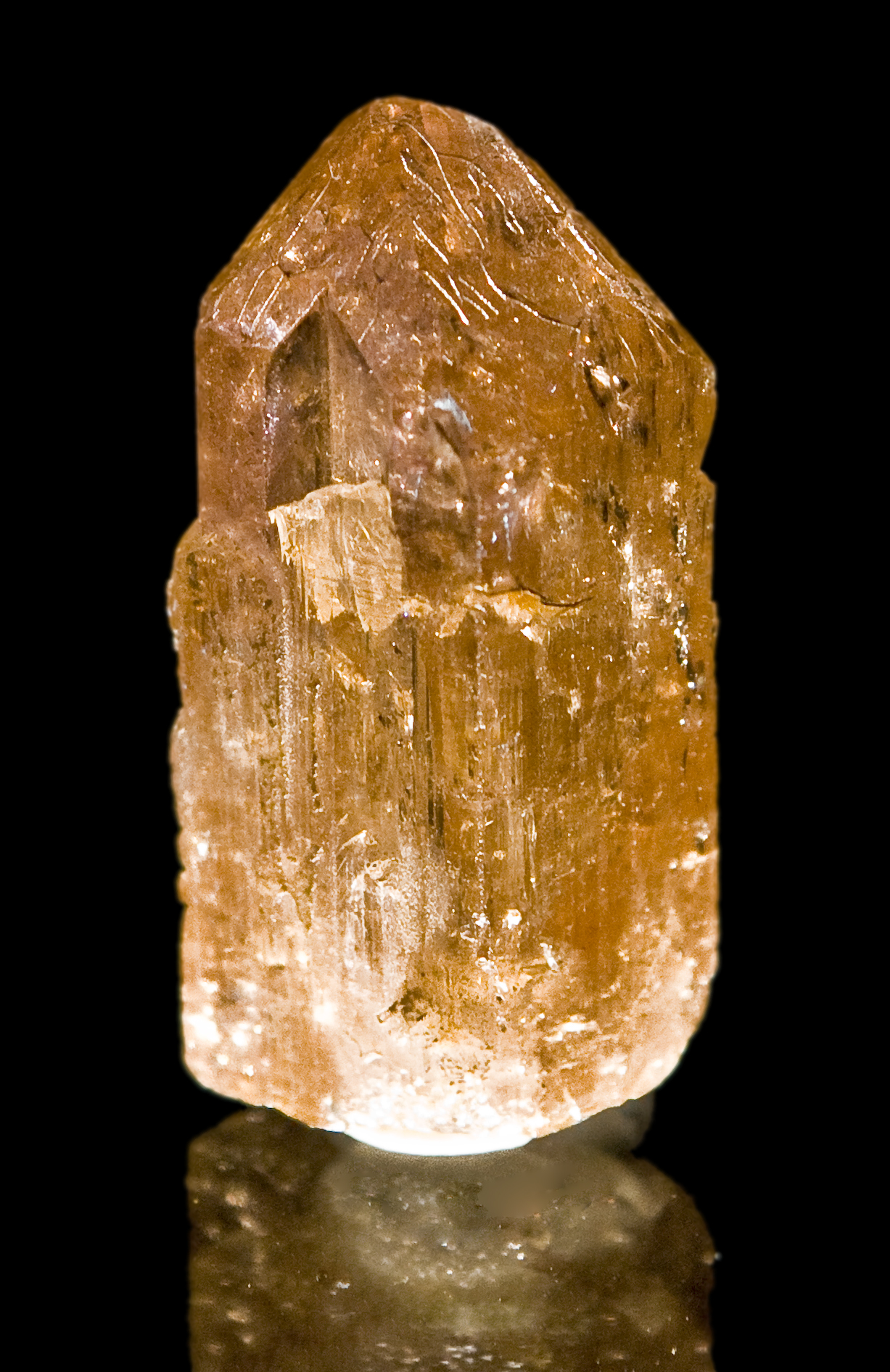
Photo: Wikimedia Commons
Search for specimens: View all topaz specimens from Ouro Preto, Brazil
The Ouro Preto topaz district lies in southern Minas Gerais, within the Quadrilátero Ferrífero, a region better known globally for iron ore than for gem crystals. The topaz occurrences form a relatively narrow east-west belt west and around the colonial city of Ouro Preto, with important workings near Rodrigo Silva, Dom Bosco, Cachoeira do Campo, Saramenha, and Antônio Pereira. Capão do Lana, Vermelhão/Saramenha, Boa Vista, Trino, Morro do Caxambu, and the Antônio Pereira claims are among the names most likely to appear on good collector labels.
The deposit type is best treated as a weathered hydrothermal topaz system rather than a conventional granitic pegmatite occurrence. The topaz-bearing horizon is hosted by deeply altered metasedimentary rocks of the Minas Supergroup. In the best-described Capão workings, topaz occurs in kaolinite veins and lenses within dark brown, heavily decomposed clayey rock, with quartz, mica, specular hematite, rutile, and locally euclase. Earlier writers debated pegmatitic versus replacement or hydrothermal origins, partly because the original rock textures are masked by extreme weathering. Modern summaries emphasize strata-bound, hydrothermal mineralization involving fluorine-bearing fluids that moved through fractures and reactive layers, followed by deep weathering that left the present soft, clay-rich ore.
Mining history is long and unusually well documented for a gem locality. Early references describe red material as “Brazilian ruby,” and the public announcement of topaz from the area dates to the eighteenth century. By the early nineteenth century, European mineralogists and travelers had begun describing the deposits, and by the late nineteenth century Ouro Preto topaz was already a classic specimen and gem locality. At different times, production has included primary clay-hosted workings, small hand-dug prospects, alluvial recovery, and mechanized open-pit mining.
Capão do Lana became the best-known mechanized operation. In the 1980s it was already described as one of Brazil’s more sophisticated gem mines, using bulldozers, high-pressure water cannons, sluices, sieves, and hand sorting to recover topaz from lateritic clay. By the mid-1990s the operation had expanded to two large open pits, with dragscrapers hauling weathered ore to washing stations, water cannons breaking the clay into slurry, screens separating the concentrate, and workers hand-picking topaz from conveyor belts. White kaolinite veins were treated as important indicators; when exposed by a bulldozer, work could stop while designated miners searched the seam by hand.
Collecting access should be viewed as restricted. Capão has operated as a commercial mine, not a public collecting site, and access described in field reports was by permission. Smaller private mines and prospects have existed around the district, but serious collectors should assume that legal access requires prior permission from owners or operators. Most collectors acquire Ouro Preto topaz through dealers, old collections, gem shows, and specialized mineral marketplaces rather than field collecting.
Production has always been selective in quality. Large volumes of weathered ore can yield surprisingly little facetable or specimen-grade topaz. Published accounts from Capão describe large daily ore movement, but only a small percentage of recovered topaz is gem quality. Much of the production is broken crystal, included material, cleavage pieces, or small fragments destined for cutting. Fine complete crystals survive in much smaller numbers, which explains the premium placed on undamaged specimens with good terminations and strong color.
Notable finds range from historic museum crystals to modern gem rough. The Natural History Museum in London has an exceptional Capão topaz crystal about 150 mm x 50 mm x 35 mm, associated with Henry Heuland and later the Walker collection. GIA also documented reports of very large Ouro Preto crystals, including a 27 cm x 5 cm crystal in the Natural History Museum of Los Angeles County and historic references to crystals weighing nearly 2 kg. More recently, the “Imperial Flame,” a 332.24 ct freeform carving, was cut from a 615 ct Ouro Preto crystal reportedly mined from old production.
Ouro Preto topaz is topaz, Al2(SiO4)(F,OH)2, but it has a visual identity so distinctive that experienced collectors often recognize it instantly. The crystals are typically prismatic, vertically striated, and lustrous, with terminations that may show contrasting forms on opposite ends. Complete crystals can be singly or doubly terminated, though clean, damage-free examples are not common. Many crystals are naturally etched, abraded, internally fractured, or broken along cleavage because of both their geological history and the physical realities of mining.
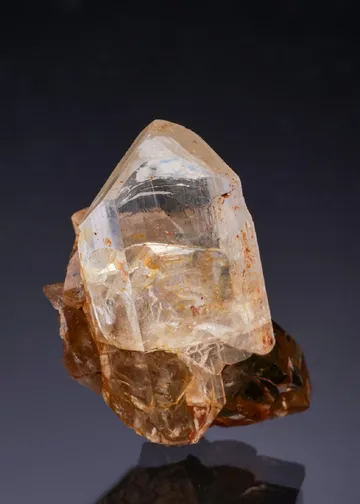
The locality’s color range is its signature. Specimens may be pale yellow, golden yellow, orange-yellow, brownish orange, pinkish orange, salmon, peach, reddish orange, orange-red, sherry red, pink, and rarely pinkish purple to purple. The finest collector crystals usually occupy the saturated orange to reddish-orange and sherry-red range, especially when the color is not merely a thin surface impression but visible through the body of the crystal. Pink and purplish-pink material is rarer, and clearly bicolored orange-and-pink crystals are particularly desirable.
Size varies widely, but the collector market is dominated by thumbnails and small miniatures. Many crystals are under 2 cm, and good crystals in the 2–5 cm range already command attention when color and condition are strong. Larger crystals exist, including museum-scale examples over 10 cm and exceptional historic pieces much larger than that, but most large crystals are fractured, included, cleaved, or retained in institutional and old private collections. For display specimens, a 3–5 cm transparent crystal with strong orange or sherry color, sharp termination, and minimal edge wear is already a serious Ouro Preto piece.
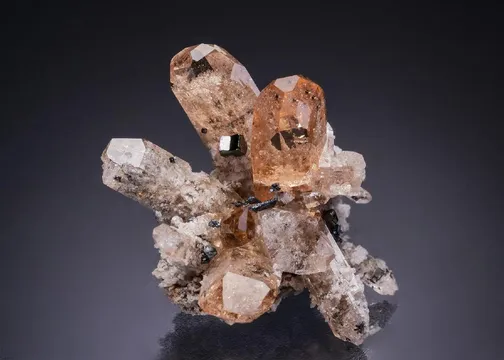
Associated minerals are important for locality context but generally subordinate in specimen aesthetics. Quartz is common in the veins and in heavy-mineral concentrates. Specular hematite is a characteristic associate and reflects the iron-rich geological setting. Rutile, mica, and euclase are documented from the topaz-bearing material, with euclase sometimes occurring as green to blue crystals. Kaolinite is the practical field indicator rather than a display associate: the white clay veins and lenses were key guides for miners working the brown lateritic ground.
Internal features are common and should not automatically disqualify a specimen. Liquid-and-gas inclusions, tube-like inclusions parallel to the c-axis, fingerprint-like inclusion patterns, internal fractures, small crystal clusters, and negative crystals have all been described in Ouro Preto material. For faceting, these inclusions reduce yield and increase the risk of breakage. For mineral specimens, they are part of the locality’s character, provided they do not obscure color, destroy transparency, or indicate repaired or unstable damage.
The strongest quality factors are saturated natural-looking color, transparency, luster, completeness, and freedom from obvious basal cleavage damage. A small but sharply terminated, glowing orange-red crystal is usually more desirable than a larger pale or heavily bruised one. A crystal that shows intense color down the c-axis is especially appealing when mounted or displayed with backlighting. The most coveted specimens combine three difficult traits: a complete crystal form, true gem transparency, and a saturated sherry-red, pink, or bicolored body color.
The main authenticity issue with Ouro Preto topaz is not the identity of topaz itself, which is straightforward for a gemological laboratory, but the claims attached to color, treatment, and origin. “Imperial topaz” is a trade term rather than a strict mineralogical variety, and dealers use it inconsistently. In serious collecting, the term is most meaningful when tied to the classic Ouro Preto district and to the orange, reddish-orange, sherry, pink, or purplish-pink color range. Pale yellow or brownish material may be genuine Ouro Preto topaz but not necessarily top collector-grade imperial color.
Heat treatment is well documented. Some brownish yellow or orange Ouro Preto topaz can be heated to produce peach, pink, or purplish-pink colors by reducing or removing yellow color centers. Published experiments and trade observations describe heating cut stones in controlled conditions, with slow cooling to avoid thermal shock. Earlier literature also describes a “pinking” process in which yellow topaz is packed in inert material and heated to produce pink to red hues. Natural pink and peach material does occur, so the presence of pink color is not proof of treatment; however, high-value pink or purplish-pink stones and crystals deserve careful documentation.
Irradiation is another concern in the broader topaz trade. Experimental gamma irradiation of pale to medium yellow topaz has been shown to produce a richer brownish imperial-like color in some samples, but the induced color was unstable and faded with gentle heating or exposure to daylight. This is especially relevant when considering parcels of unusually uniform “imperial” color rough. For valuable material, insist on a reputable lab report addressing species, treatment, and—when relevant—origin.
Condition is a major collector issue. Topaz has perfect basal cleavage, and Ouro Preto specimens often show bruised terminations, cleaved bases, chipped edges, internal fractures, and mining abrasions. Hydraulic recovery increased production but also damaged crystals; hand-recovered crystals from kaolinite pockets tend to have better surfaces when they survive intact. Examine the termination under magnification, look for unnatural resin filling or glued repairs, and be cautious with specimens mounted in ways that hide the base or critical cleavage surfaces.
Color should be judged in neutral light, not only under warm dealer lighting. The best crystals hold orange-red or sherry color without needing theatrical illumination. Backlighting is useful for appreciating zoning and c-axis color, but it can make mediocre material look more saturated than it appears in a cabinet. Ask for photographs in daylight-equivalent light, transmitted light, and normal reflected light when buying remotely.
Rarity is highly stratified. Small pale yellow to orange fragments and included crystals are available with some regularity. Attractive thumbnails are obtainable but increasingly competitive. Fine miniatures with bright sherry, pink, or red-orange color, sharp termination, good transparency, and minimal damage are scarce. Large, clean, complete crystals from old collections are genuinely rare and should be treated as major locality specimens.
Current market availability is strongest for small crystals, crystal fragments, faceting rough, and cut stones. Fresh large-scale production has not been comparable to the heavily mechanized period described in the 1980s and 1990s, and important pieces increasingly surface from older stocks and established collections. The best purchases are specimens with precise labels—Capão do Lana, Vermelhão/Saramenha, Rodrigo Silva, Antônio Pereira, Dom Bosco, or Ouro Preto district—and a credible ownership history.
The old story begins with a name that can mislead modern collectors: “Brazilian ruby.” In the eighteenth century, red topaz from near Vila Rica—the original name of Ouro Preto—was important enough to enter Portuguese royal records. The official discovery of topaz in the district was publicly celebrated in Lisbon in 1768, a reminder that these crystals were never merely local curiosities. They were imperial objects in the literal sense, bound up with colonial Brazil, Portuguese court spectacle, and the European appetite for vividly colored gems from Minas Gerais.
A century later, the problem was not admiration but interpretation. Orville Derby’s 1901 study of the deposits faced a geological puzzle: almost everything had been weathered into earthy material. He called the task “mud geology,” an attempt to reconstruct the original rocks from decomposed clays and residual minerals. That phrase remains one of the most apt descriptions ever applied to Ouro Preto topaz. Unlike a clean Alpine cleft or a hard pegmatite pocket, the deposit asked geologists to read a ghost rock—kaolinite where feldspar had been, laterite where bedrock had collapsed, and topaz crystals left behind like hard punctuation marks in a soft brown manuscript.
The Capão mine in the late twentieth century offered a different kind of drama. Heavy equipment stripped the dark clay, high-pressure water cannons turned ore into slurry, and the heavy fraction—topaz, quartz, hematite, and resistant fragments—moved across screens and concrete surfaces before human eyes made the final selection. In one description, after the official sorting was finished, independent garimpeiros waited below the operation with sieves and shovels, reworking the residue for overlooked topaz. The picture is vivid: mechanized Brazil above, hand labor below, both chasing the same orange flash in wet clay.
Even in a mechanized mine, the decisive moment could still belong to a person with a small tool. When a bulldozer exposed a white kaolinite vein against the dark chocolate-brown clay, work could stop. The vein was a signal. In the 1983 account, one of the oldest and most trusted miners followed the bulldozers and searched these exposed seams with only a knife. By 1996, the operation had a formalized version of the same ritual: special miners, identified by red hats, were sent in to scrape the vein by hand. Those hand-recovered crystals were often better preserved than crystals that had endured water cannon, screens, and conveyors.
One of the most memorable historic specimens left Brazil through the nineteenth-century mineral trade. The Natural History Museum in London preserves a large imperial topaz crystal from Capão, found around 1832 and collected by the celebrated dealer Henry Heuland in 1833. It was sold to Isaac Walker for £100—an enormous price for a mineral specimen in that period—and later entered the museum with the Walker collection in 1912. The crystal measures about 150 mm x 50 mm x 35 mm, unusually large and transparent for the locality. Its earlier owner called it “the finest yellow topaz known,” a phrase that still carries the tone of old-school connoisseurship: not just big, not just pretty, but a standard against which others were measured.
Modern cutting stories have their own tension because topaz is treacherous on the wheel. Its perfect basal cleavage means a cutter must respect the crystal’s structure or lose the stone. The “Imperial Flame,” shown at Tucson in 2016, began as a 615 ct Ouro Preto crystal of exceptional color and clarity, reportedly old production. The Kreis family studied the rough for four months before purchasing it in December 2015, intending to fashion the largest top-quality imperial topaz known. Alexander Kreis ultimately produced a 332.24 ct freeform carving. That transformation—from old Brazilian crystal to modern sculptural gem—captures the permanent dilemma of Ouro Preto material: every great crystal is both a mineral specimen and a possible gemstone, and the decision to cut is irreversible.