A collector's guide to Old Dominion Mine, USA: its geology, mining history and notable minerals, illustrated with the 40 specimens documented from this locality on EarthWonders.
Key facts
Old Dominion is the classic copper locality at Globe, Arizona: a great underground mine cut into the southern Globe Hills just north of town, where a vein-and-replacement system turned shattered quartzite, limestone, and diabase into one of the most productive early copper mines of the Globe-Miami region. For collectors, its fame rests less on a single spectacular species than on an unmistakable oxidized-copper suite: emerald malachite, blue-green chrysocolla, red to brown cuprite, bright native copper, drusy quartz, and colorless calcite arranged in layered paragenetic sequences that seem to record the chemistry of the oxidized zone in miniature.
The mine belongs to the Old Dominion vein system, a northeast-striking structural belt that includes the Old Dominion, Buffalo, Maggie, Josh Billings, Copper Hill, Iron Cap, Buckeye, Stonewall, and related veins. Modern regional interpretations place that vein system in the upper reaches of the Copper Springs porphyry-copper environment, while the mine itself is best understood by collectors as a fault-controlled and replacement-style copper deposit: oxidized masses and lodes developed along the Old Dominion fault, Interloper fault, bedding contacts, and broken permeable horizons in quartzite and limestone.
Historically, Old Dominion bridges two eras of Arizona mining. It began in the silver rush atmosphere of the 1870s, became a copper producer in the 1880s, grew into the dominant Globe mine under a succession of companies, and closed as an underground producer in 1931 when water, declining grade, and low copper prices overwhelmed the operation. By then it had helped define Globe as a copper town. Its production figures are staggering for a vein-type system: commonly cited totals for the Old Dominion and United Globe operations are on the order of hundreds of millions of pounds of copper, with substantial silver and gold credits.
The best specimens have the look of old Arizona oxidized ore rather than modern open-pit production. Fine pieces show velvety or microcrystalline malachite on vuggy brown gossan, chrysocolla in turquoise-blue to apple-green seams and botryoidal crusts, sharp pale calcite rhombs or scalenohedra perched on quartz druse, and sometimes native copper as hackly or branching accents. The collector’s ideal Old Dominion specimen is not merely “green copper ore,” but a readable sequence: sulfide altered to carbonate, carbonate veiled by quartz, quartz carrying calcite, calcite or quartz accented by copper or cuprite.
Regional View
Country View
Today the mine is as much a historic landscape as a specimen locality. The headframe, dumps, foundations, smelter remains, and interpreted trails of Old Dominion Historic Mine Park make the scale of the operation visible, but the collector market is supplied almost entirely by old collections, older dealer stock, and specimens recovered before modern access restrictions and park protection. That old-collection character is part of the appeal: the locality rewards labels, provenance, and a careful eye for the layered copper-carbonate and silica associations that separate true Old Dominion pieces from generic Globe-Miami oxidized copper ore.

Photo: Wikimedia Commons
Search for specimens: View all specimens from Old Dominion Mine, USA
Old Dominion is at the southeastern base of Buffalo Hill, roughly north of Globe in Gila County, Arizona. The principal mine workings followed the Old Dominion vein system through a structurally complex block of the Globe Hills, with mine entries and shafts including the Old Dominion A, B, and C shafts, Interloper, Kingdom, Globe, Hoosier, Grey, and Cuprite shafts. The workings ran along Alice Gulch and northeastward toward Copper Gulch, tying together several claims and earlier mines that became part of the broader Old Dominion–United Globe operation.
Geologically, the deposit is a fault-controlled copper system with ore in limestone, quartzite, and diabase, especially where faults, shattered zones, and bedding contacts gave solutions access to reactive or permeable rock. The principal host rocks cited for the mine include Troy Quartzite, Mescal Limestone, Dripping Spring Quartzite, Martin Limestone, Escabrosa Limestone, and Naco Limestone, with Madera Diorite and Schultze Granite important nearby units. The ore zone is described as a long, steeply dipping body along the Old Dominion vein, with mineralization controlled by northeast and north-south faults and by bedding planes that dip gently to the south-southwest.
The ore bodies were not all simple veins. Ransome’s early work distinguished lodes, replacement masses in limestone, and irregular mineralization of shattered or permeable rock. That distinction is essential for understanding the specimens. Some mineralization filled fissures; some replaced limestone near the master fault; and some occupied innumerable fractures in brittle quartzite between the Old Dominion and Interloper faults. In the limestone, oxidized ore masses could be lenticular and irregular, lying roughly parallel to bedding and commonly associated with hematite or limonite. One Old Dominion ore mass was described at about 200 feet long, 100 feet wide, and 60 feet thick, partly in limestone and partly in quartzite. In the quartzite zones, the ore graded outward into less-broken rock stained by malachite and chrysocolla, a habit that helps explain why many specimens show thin films, seams, and drusy cavity linings rather than isolated freestanding crystals.
The primary sulfide assemblage was comparatively simple: pyrite with chalcopyrite, with bornite, chalcocite, covellite, sphalerite, galena, and tetrahedrite-subgroup minerals reported in parts of the system. Supergene and oxidized alteration produced the collector’s suite: cuprite, malachite, chrysocolla, hematite, limonite, tenorite, native copper, quartz, calcite, and copper sulfates in the old workings. Compact chalcocite was reported chiefly near the transition from oxidized ore to pyritic ore on the eleventh and twelfth levels, while cuprite, native copper, and hematite were considered characteristic of the lower part of the oxidized zone. Chrysocolla commonly preceded malachite where the two occur together, and quartz and calcite could form repeatedly through the mineralizing history.
Mining history at Old Dominion is complicated by name changes. The “original” Old Dominion was a separate early property, also called the Keystone in later references, about four miles from Globe on a quartzite vein. The mine now famous to collectors was formerly the Globe mine or Globe Ledge group. In the early 1880s the Old Dominion company shifted its attention from the original Old Dominion to the Globe properties, and the producing Globe mine became popularly and commercially known as Old Dominion. That name transfer is a frequent source of confusion in old labels.
The Globe Ledge silver claims were discovered in the 1870s, and the historical marker at the site gives 1873 as the discovery year for the claims included in the later mine. Copper soon became the real prize. The Old Dominion company erected early furnaces, and by May 1884 the mine was in full operation, producing hundreds of tons of copper from two 30-ton furnaces. The property changed hands repeatedly: the Old Dominion property was sold at auction to William Keyser in 1886; operations resumed after reorganization; the Lewishon interests reorganized the company in the 1890s; Phelps Dodge became deeply involved through the United Globe and Old Dominion consolidations; and Miami Copper later acquired the property. The main underground mine ceased production in 1931, after nearly half a century as the great copper engine of Globe.
Production was driven by high-grade oxidized ore at first, followed by deeper sulfide and lower-grade material. Early ores were rich enough that the mine could survive high freight costs before the railroad reached Globe in 1898, though not without shutdowns. Later, as the mine deepened, water became a constant adversary. By the early twentieth century Old Dominion was famous not only for copper but for the scale of its pumping problem; major water inflows in 1915 flooded lower levels and required enormous pumping capacity. The mine eventually closed during the Depression era when copper prices fell, grades declined, and water levels rose in deep workings.
Collecting access today is not a normal open-digging proposition. Much of the mine area is historic, protected, private, or municipal park land. Old Dominion Historic Mine Park is a public interpretive park where visitors can see industrial remains, equipment displays, trails, and signs, but park rules prohibit removing, digging, or disturbing rocks, minerals, soil, plants, signs, and historical resources. Collectors should treat the locality as closed to specimen recovery unless they have explicit legal permission from the appropriate landowner or authority. In practice, serious collection pieces are purchased from established dealers or from old collections, and labels predating the park era are especially important.
The notable specimen “finds” are therefore better described as historical mineralized zones and old collection suites rather than modern pockets. Ransome recorded a specimen kept in the mine office that showed chalcocite partly altered to malachite, then malachite covered by quartz druse, then calcite crystals, then branching crystalline native copper on the calcite. Old dealer and collection records also document pre-1903 pieces of quartz on chrysocolla and malachite-calcite combinations, plus mid-twentieth-century or older cabinet specimens with emerald malachite microcrystals on gossan and colorless calcite rhombs. Those documented old pieces are a guide to what the mine could produce at its best: intimate, multistage oxidized copper assemblages in which every surface tells part of the alteration story.
Old Dominion calcite is most desirable when it is clearly part of the mine’s oxidized copper sequence rather than a loose carbonate gangue mineral. The classic habits are colorless to pale glassy rhombs and scalenohedral groups in cavities in limestone or on vuggy gossan, commonly associated with malachite, chrysocolla, drusy quartz, and occasionally native copper. Individual crystals on documented specimens are commonly small, from millimetric accents to groups around the centimeter scale, but their value lies in contrast: sharp, lustrous calcite sitting on emerald malachite, on sparkling quartz over chrysocolla, or as the final carbonate stage before copper deposition. The best pieces are balanced combinations with undamaged transparent crystals and obvious Old Dominion paragenesis; ordinary pieces are merely calcite-stained ore without sharp form or meaningful copper-mineral association.
Old Dominion malachite is the green signature of the mine’s oxidized quartzite and limestone ores: it occurs as veinlets, vug linings, stains, botryoidal coatings, velvety microcrystalline crusts, and later generations scattered over earlier copper minerals. Fine old cabinet pieces show sparkling emerald-green malachite microcrystals or bubbly botryoidal aggregates on vuggy brown gossan, often with colorless calcite rhombs as bright accents; documented specimens also show multiple generations, with darker primary-looking malachite overgrown by lighter green and pastel-green coatings. In quartzite ore it may fill countless hairline fractures, tinting the rock a vivid green, while in combination pieces it is commonly joined by chrysocolla and drusy quartz. The best Old Dominion malachites have saturated color, velvet texture, open vugs, and crisp calcite or quartz contrast; dull green smears on massive ore are much less collectible.
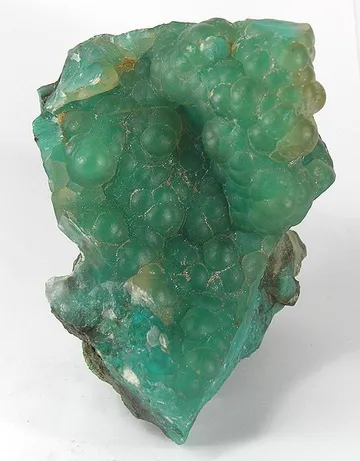
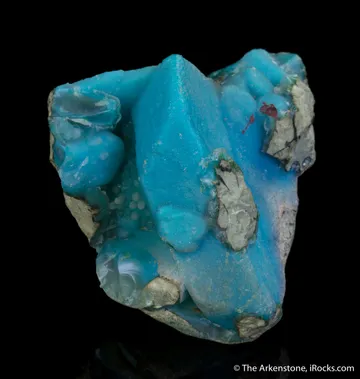
Chrysocolla from Old Dominion is one of the mine’s defining minerals and is documented as an important ore mineral there, occurring in the oxidized copper zones as blue, blue-green, apple-green, dark green, brownish, and locally manganese-darkened material. It appears as seams, bunches, veinlets, botryoidal cavity linings, and chalcedony-like banded masses, commonly with malachite, quartz, calcite, cuprite, and native copper. The most collectible pieces show turquoise to green chrysocolla under sparkling drusy quartz, with narrow bands or islands of malachite providing green contrast; larger documented display specimens reach cabinet size, while smaller pieces around 5 to 7 cm are known from old collections. The important distinction is silica-rich, lustrous, color-zoned chrysocolla in an Old Dominion-style copper assemblage; nondescript blue-green copper staining from the wider Globe-Miami area needs strong provenance before it should be accepted as Old Dominion.
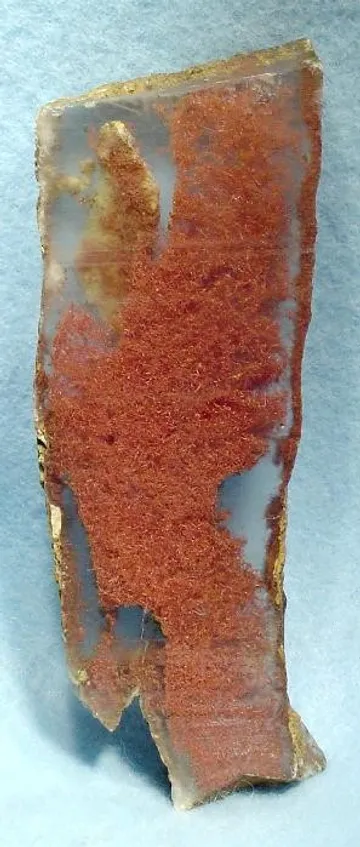
Old Dominion cuprite belongs chiefly to the lower part of the oxidized zone and to the high-grade brown copper ore, where it may be massive, cryptocrystalline, or intergrown with hematite and limonite rather than forming the sharp, isolated red crystals familiar from some other Arizona localities. Specimens attributed to the mine include cuprite with calcite and native copper, and the broader Old Dominion vein system includes related Buffalo and original Old Dominion occurrences where cuprite, chrysocolla, and malachite were important ore constituents. Good Old Dominion cuprite specimens are valued for recognizable red to reddish-brown cuprite surfaces, luster, crystal form where present, and associations with calcite, copper, malachite, or chrysocolla; much ordinary material is simply dark brown oxidized copper ore in which cuprite is present but visually subdued.
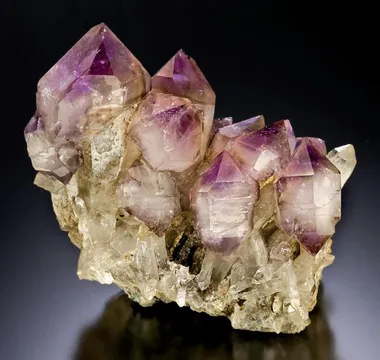
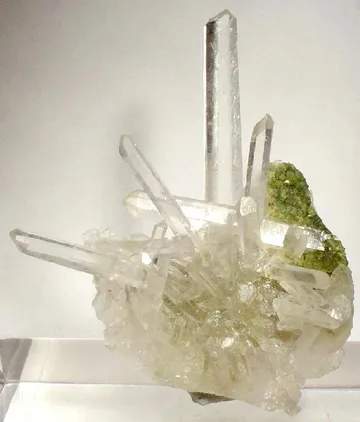
Quartz at Old Dominion is not usually the main event, but it is often the mineral that turns copper ore into a specimen. It occurs as drusy coatings over malachite and chrysocolla, as small sparkling crystals lining vugs in specularite- or limonite-rich ore, and as silica that can enclose or accompany native copper. Classic pieces show chrysocolla or malachite sealed beneath a glittering quartz crust, sometimes followed by calcite crystals on the quartz; that specific sequence is one of the locality’s most recognizable habits. The best quartz specimens from Old Dominion are not large quartz crystals but clean, bright druses that preserve blue-green copper color underneath and provide a stage for calcite or copper; dull massive quartz with only weak copper staining is far less distinctive.
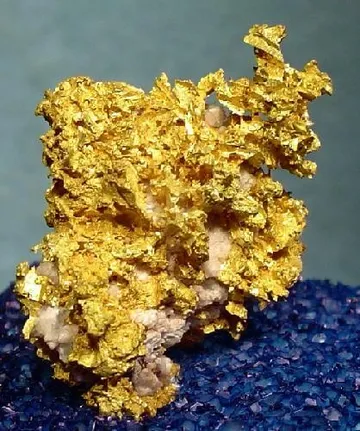
Other documented minerals from Old Dominion include actinolite as “mountain leather” along bedding planes in Mescal Limestone, alunite in veins in altered diabase, bornite, chalcocite, chalcopyrite, covellite, galena, sphalerite, stromeyerite, chlorargyrite, native silver, native copper, hematite including specularite, limonite, tenorite, chalcanthite, melanterite including copper-bearing melanterite, goslarite, halloysite, kaolinite, muscovite/sericite, garnet-group minerals, psilomelane, wad, uraninite, and tetrahedrite-subgroup minerals. The locality is not chiefly known as a type locality; its rarity value lies in old Arizona oxidized-copper combinations, unusual sulfide and silver-bearing records, and the historically important documented sequence of chalcocite, malachite, quartz, calcite, and native copper.
Old Dominion specimens need provenance. The Globe-Miami region contains many copper localities that produced chrysocolla, malachite, quartz, calcite, cuprite, and native copper, and casual labels such as “Globe,” “Miami,” “Old Dominion,” “Live Oak,” “Inspiration,” and “Buffalo” have sometimes been used loosely in old collections. The safest pieces have old handwritten labels, dealer history, collection notes, or a distinctive assemblage: vuggy brown gossan or quartzite with emerald malachite, blue-green chrysocolla, drusy quartz, and pale calcite in a credible Old Dominion sequence.
The most common mislabelling issue is not deliberate fakery but over-broad attribution. Drusy quartz on chrysocolla from Arizona has been traded under several famous locality names, and some pieces labelled Bisbee, Globe, Miami, or Old Dominion may actually belong to a different copper mine in the region. Collectors should be especially cautious with polished chrysocolla/gem-silica material, loose blue-green nodules, or generic malachite-coated matrix offered without labels. Old Dominion produced attractive chrysocolla, but it is not enough for a specimen simply to be blue-green Arizona copper silicate.
Condition is a major value factor. Malachite microcrystals and velvety coatings abrade easily; calcite rhombs on old specimens are often chipped at edges; drusy quartz can be bruised; and cuprite-rich brown ore may be friable or visually dull if rubbed. Many pieces came through mining, ore sorting, and decades of collection storage, so edge wear is common. A specimen with one clean display face and honest peripheral damage may still be desirable if the association is strong and old labels support the locality.
Handle copper-sulfate minerals from the old workings with caution. Chalcanthite, melanterite, and goslarite are soluble or humidity-sensitive efflorescences, and they should not be washed or stored in damp conditions. Even on ordinary malachite-chrysocolla pieces, avoid aggressive cleaning: acids attack calcite, soaking can loosen porous gossan, and brushing can flatten velvet malachite. Chrysocolla-rich material may vary from soft porous copper silicate to quartz-hardened chalcedonic material, so hardness tests and polishing assumptions should not be generalized.
Old Dominion specimens are available, but the best old-time combination pieces are not common. Small examples of chrysocolla with quartz, malachite with calcite, or cuprite-calcite associations appear periodically, especially from dispersed Arizona collections. Larger cabinet pieces with strong aesthetics, pre-World War II labels, or documented old mine-era provenance command a premium because new collecting from the historic mine area is not a practical source of supply.
The first story every collector should understand is that “Old Dominion” is a name with a migration history. The original Old Dominion mine was not the later great Globe producer; it was an earlier property on a quartzite vein. When the company acquired the Globe mine and Globe Ledge claims, the producing center of gravity moved, and the Globe mine became the Old Dominion known to collectors. Old labels can preserve either side of that transition. A nineteenth-century label reading “Old Dominion” may refer to a different physical mine than a twentieth-century label with the same name, and that wrinkle is part of the locality’s charm.
In the early copper years, the mine fought geography as much as geology. Before the railroad, supplies had to be hauled over long distances, and coke for the furnaces could come from astonishingly far away, including Cardiff, Wales. Imagine oxidized copper ore from the Globe Hills being smelted in territorial Arizona with fuel that had crossed an ocean and then the interior West. The cost was brutal enough that copper prices and freight could close the mine despite rich ore.
The railroad changed the mine’s rhythm. When the Gila Valley, Globe & Northern Railway reached Globe in December 1898, freight costs fell, and in January 1899 a celebrated copper shipment left Globe as one of the largest single Arizona copper shipments of its time. For a mine that had previously depended on wagon haulage and expensive fuel, the rails were not merely convenience; they were geology made economic.
Water was Old Dominion’s underground enemy. As mining went deeper, workings beneath dacite and broken ground encountered increasing flows. In early 1915, after abnormal precipitation, the drainage problem became spectacular: the eighteenth and sixteenth levels flooded in March, and in the first six months of that year the pumps handled more than 1.6 billion gallons of water. March alone accounted for more than 407 million gallons. Those figures belong in the collector’s mental picture of the mine. The specimens came not from a dry desert hole but from a deep, wet, heavily engineered underground system where keeping the workings open was itself a major industrial achievement.
Labor history also runs through the dumps. Hundreds of Cornish hardrock miners—“Cousin Jacks”—worked at Old Dominion, bringing mining culture and union strength with them. The 1917 strike placed Globe in the wider labor conflict of the wartime copper West. Martial law was declared, and troops of the 17th Cavalry were brought in; temporary barracks rose on the slag dumps in front of the mine. The strike was eventually settled and production resumed, but the episode left Old Dominion with a place not only in mineral and mining history but in the history of Arizona labor.
The most vivid mineralogical story is Ransome’s mine-office specimen. It was not just a pretty rock; it was a complete sequence. Chalcocite had altered partly to malachite. The malachite was covered by quartz druse. Calcite crystals sat on the quartz. Branching crystalline native copper grew on the calcite. In one hand specimen, the mine showed the collector the movement from sulfide ore to carbonate, silica, carbonate again, and native metal. It is exactly the kind of old specimen that makes Old Dominion important: compact, complex, and unmistakably born from a changing oxidized zone.
The last act is civic rather than industrial. After decades as a closed mine landscape, Old Dominion became a public historic park. Community advocates pushed for more than forty years before the site opened to the public on February 12, 2011. By 2017, the park’s own accounting credited 162 volunteers, 4,157 formal volunteer hours, and more than $700,000 in combined donations, grants, and valued volunteer labor. That transformation matters to collectors because it explains the modern access reality: the mine is no longer a place to pry specimens from dumps, but a protected historical landscape where the surviving equipment, foundations, and trails give context to the specimens already in collections.