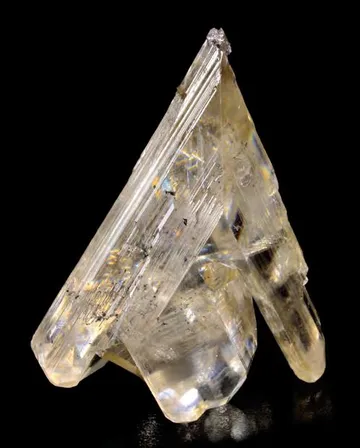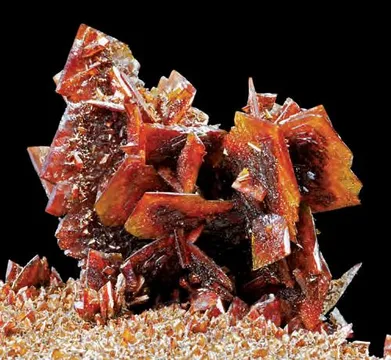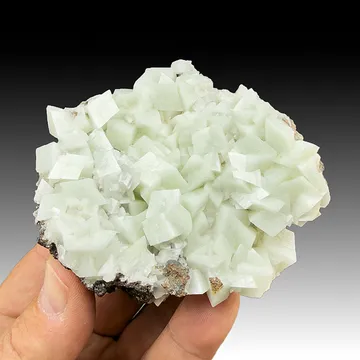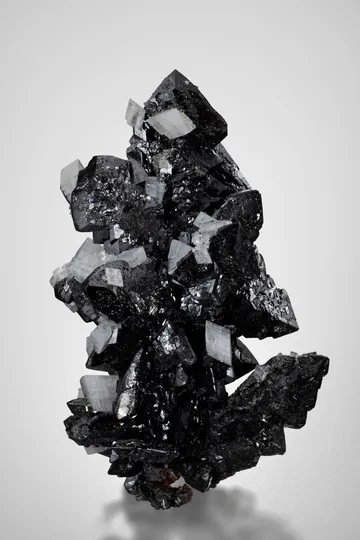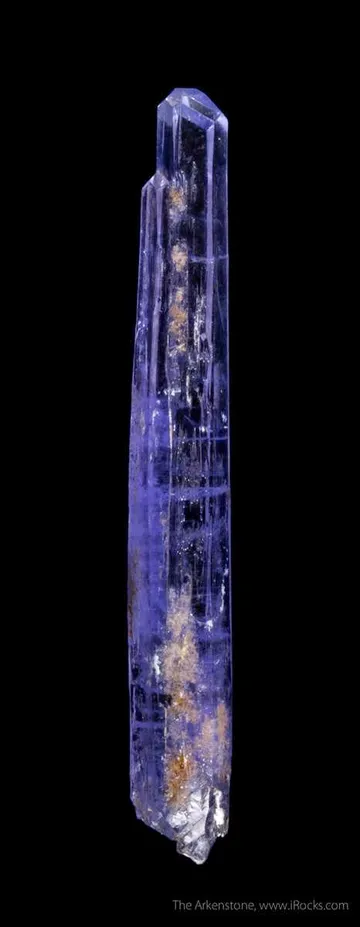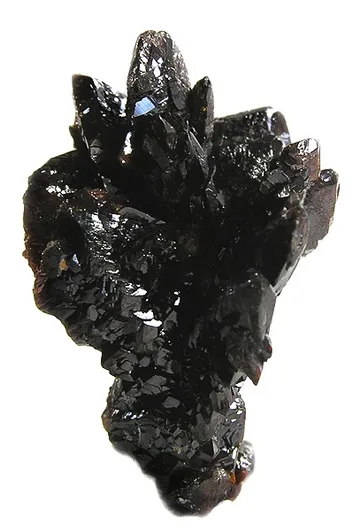
Okorusu Mine, Namibia — a premier fluorite locality renowned for lustrous cubes in sea-green to cranberry-purple, with phantom interiors and distinct pockets.
Key facts
Okorusu is one of the great modern fluorite localities: a mine where an industrial acid-grade fluorspar operation happened to cut, again and again, into specimen pockets of remarkable color and architecture. The locality lies north of Otjiwarongo in the Otjozondjupa Region of north-central Namibia, within an alkaline igneous–carbonatite complex emplaced into Damara metasedimentary rocks. For collectors, the essential point is that the fluorite did not simply fill anonymous cracks; it replaced reactive carbonate-rich rocks, pegmatitic carbonatites, fenitized marbles and schists, then crystallized in vugs and open spaces left by brecciation and dissolution. That setting produced the signature Okorusu look: lustrous cubes and cube-modified crystals in sea-green, emerald, blue-green, yellow, mauve and cranberry-purple, often with sharp internal phantoms that read like nested crystals suspended inside glass.
Regional View
Country View
The best Okorusu specimens are immediately recognizable even across a show case: broad plates of intergrown stepped cubes with green centers and purple rims; single cuboctahedral crystals with floating cranberry “diamond” phantoms; and cabinet-size groups where a dusting of quartz, calcite or iron oxide gives contrast without obscuring the fluorite. The mine’s specimen history is unusually well documented because, during the modern Solvay era, specimen recovery was carried out under contract rather than being merely an afterthought of ore mining. As a result, labels may preserve pit or pocket names—A Pit, B Pit, B Satellite, C Pit, D Pit, Diamond Pocket, Polish Prodigy Pocket, and more recent trade names—and those designations matter because the colors and internal patterns vary strongly from zone to zone.

Photo: Rob Lavinsky / iRocks.com, CC BY-SA 3.0, via Wikimedia Commons
Search for specimens: View all specimens from Okorusu Mine, Namibia
Okorusu is an open-pit fluorspar mine on Marburg Farm 1, north of Otjiwarongo, historically also seen on labels as Okarusu. Geologically it belongs to the Cretaceous Damaraland Igneous Province, a chain of alkaline and carbonatitic intrusions related to the opening of the South Atlantic. The Okorusu complex is a roughly circular syenite–nepheline syenite–carbonatite ring complex with a fenite aureole developed in late Precambrian Damara rocks—marble, schist, quartzite, conglomerate and related calc-silicate lithologies. The radiometric age commonly given for Okorusu is 126.6 ± 7.3 Ma.
The fluorite deposit formed where fluorine-bearing fluids interacted with reactive carbonate-rich host rocks. In the collector’s hand this history is not abstract: the finest specimens are the crystalline expression of a replacement system that also produced massive ore. Fluorite replaces calcite in pegmatitic carbonatites and sodic fenites and also replaces marbles and biotite schists. Scientific descriptions emphasize massive replacement fluorite, banded replacement textures in fenitized marbles and schists, vug-grown fluorite crystals, and remnants or pseudomorphs after the minerals of the original carbonatite. In some ores, goethite, martite and limonite pseudomorphs after magnetite, aegirine-augite and pyrrhotite-pyrite preserve the ghost of the rock that fluorite consumed.
The ore bodies exposed by mining have traditionally been separated into pits or zones. Specimen accounts repeatedly refer to A Pit, B Pit, B Satellite, C Pit and D Pit, with C Pit also known for the Diamond Pocket. The A Pit is associated in collector lore with all-green cubes; the B Pit yielded some yellow and cranberry material; B Satellite produced lustrous cranberry-and-clear phantom pieces; the C Pit produced cranberry and yellow phantoms in 2003 within a shallow zone only several meters from the surface, and deeper in the C ore body came the classic cranberry diamond-shaped phantom fluorites. D Pit is remembered for fluorite with quartz, including sharply proportioned “dice” combinations. These distinctions are not merely marketing language. They reflect real differences in ore body, depth, local paragenesis, pocket geometry and later corrosion or overgrowth.
Mining at Okorusu has a long history. The locality was worked before the modern open-pit era, with records of mining since around 1920 and closure in 1963. South African Iron and Steel Industrial Corporation, later associated with the ArcelorMittal South Africa lineage, worked the property intermittently for metallurgical-grade fluorspar after acquiring it in the mid-20th century. Modern production began in 1988 under Okorusu Fluorspar (Pty) Ltd., and Solvay acquired the operation in 1997. Under Solvay, Okorusu became one of the world’s leading carbonatite-related fluorspar producers, supplying high-purity acid-grade concentrate for hydrofluoric acid production.
The 2014 closure marked a turning point. Public reports from that period describe depleted easily mined high-grade ore, more difficult beneficiation of remaining material, weak fluorspar demand and suppressed prices. The closure affected more than 400 workers, with a smaller care-and-maintenance and exploration staff retained. Afterward, the mine assets passed to Gecko Namibia, which developed a new geological model and published a resource estimate of 18 Mt at 41% CaF2, with the long-term concept of underground mining beneath the central A–D deposit. The Okorusu site has also been used for processing graphite from the nearby Okanjande project, although more recent public filings describe the relocation of graphite-processing equipment from the former Okorusu site to Okanjande and an approved environmental process for adding rare-earth-element processing at Okorusu. For specimen collectors, the practical implication is simple: Okorusu remains an industrial mine site, not an open collecting locality, and access requires permission from the mineral-rights and land holders.
Specimen recovery at Okorusu is part of what separates the locality from many industrial fluorspar mines. Before formal specimen contracts, mine personnel reportedly collected and sold pieces informally, with proceeds used for community development. The first formal specimen-mining contract was granted in 2001 to Christopher L. Johnston of Johnston Namibia CC, who worked specimens into late 2003. Later, Peter Eysselein became closely associated with legal specimen extraction and preparation at the mine. This documented recovery chain helps explain why many better Okorusu specimens carry strong provenance and why pit names have survived on labels more consistently than at many comparable open-pit localities.
Fluorite is the reason Okorusu is famous, and its best examples are among the most distinctive modern fluorites from any locality: sharp, lustrous cubes and cuboctahedral crystals, commonly transparent to translucent, with deep sea-green or emerald cores, violet to purple edges, yellow zones, cranberry phantoms and, in some pockets, clear overgrowths enclosing sharply geometric internal crystals. Specimen crystals commonly range from small thumbnails to cabinet-size groups with individual cubes of several centimeters; published collector notes describe exceptional crystals to about 15 cm, while many prime plates show 3–5 cm stepped cubes. Associations include quartz, calcite, baryte, fluorapatite and goethite, but the fluorite itself carries most of the drama: good pieces show undamaged corners, bright luster, transparency, strong color contrast and sharply readable phantoms, whereas ordinary examples are massive, bruised, cloudy, iron-stained or too dark to show their internal zoning. Pit provenance is meaningful here: A Pit is prized for green cubes, B Satellite for cranberry-clear phantoms, C Pit for cranberry/yellow and diamond-shaped phantom material, and D Pit for fluorite with quartz.
Quartz at Okorusu is not the headline species, but it is an important companion mineral in both the geology and the specimen aesthetic. It occurs in the altered carbonatite–fenite system as hydrothermal quartz and in specimen pockets as colorless to white crystals or drusy coatings associated with fluorite; collectors particularly value pieces where quartz gives a clean architectural base to a transparent green or purple-zoned fluorite cube. The most appealing Okorusu quartz specimens are combinations rather than quartz-alone showpieces: D Pit material is especially noted for fluorite-and-quartz “dice” specimens, and dealer and collection records document green fluorite plates with numerous small white quartz crystals scattered among the fluorite cubes. Ordinary pieces show quartz merely as a granular or drusy background, but better examples have well-separated quartz crystals that frame the fluorite without crowding, etching, or hiding the phantoms.
Calcite at Okorusu is both a primary geological actor and a specimen associate: the deposit is fundamentally about fluorite replacing calcite-rich carbonatite and marble, yet unreplaced or later calcite remains in parts of the system. Documented calcite occurs in pegmatitic carbonatites and sodic fenites, with crystals reported to about 10 cm, and on collector specimens it commonly appears as white to pale calcite on or among fluorite cubes. The finest calcite-bearing specimens are those where calcite provides contrast without making the fluorite look dull or overgrown—small bright calcite coatings, isolated crystals, or clean matrix accents can enhance a green or purple fluorite group—while heavily calcite-coated pieces are generally less desirable unless the calcite itself is unusually sharp and undamaged. Because Okorusu’s carbonatites include very coarse calcite in pegmatitic pods, calcite on a label should be evaluated carefully: massive carbonatite calcite is common geological material, but crystallized calcite in balanced association with fluorite is the collector grade.
Goethite at Okorusu is most interesting when understood as a residue and pseudomorph mineral of the replacement system rather than as a classic standalone display species. Scientific work on the ore describes goethite, martite and limonite pseudomorphs after magnetite, aegirine-augite and pyrrhotite-pyrite in fluorite-replaced pegmatitic carbonatite, and specimen data records goethite in association with fluorite, quartz and calcite. On specimens, it may appear as brown to black earthy coatings, botryoidal or iron-oxide crusts, or dark inclusions and matrix material that set off pale green and purple fluorite. Good goethite-bearing Okorusu pieces use the iron oxide visually: a dark, stable matrix or crisp pseudomorphic texture can add contrast and locality character, while friable limonitic coatings, powdery films and staining that masks the fluorite usually lower the appeal.
Beyond these familiar collector species, Okorusu has a broad carbonatite–fenite mineral list that reflects alkaline magmatism, replacement and late hydrothermal alteration. Documented minerals include aegirine, aegirine-augite, analcime, andradite var. melanite, ankerite, baryte, bastnäsite-group minerals, burbankite, cancrinite, celestine, chalcopyrite, cryolite, diopside, dolomite, fluorapatite, galena, halite, hematite var. martite, magnetite including titanium-bearing magnetite, marcasite, microcline, nepheline, orthoclase, parisite-group minerals, perovskite, phlogopite, pyrite, pyrrhotite, röntgenite-(Ce), sodalite, sphalerite, strontianite, sylvite, synchysite-group minerals, thorite, titanite, topaz, xenotime-(Y) and zircon. Okorusu is not known as a type locality for a valid mineral species; its mineralogical importance lies instead in being a well-studied carbonatite-related fluorite deposit with REE-, Sr-, Ba- and phosphate-bearing accessory minerals that illuminate the evolution of carbonatitic fluids.
Okorusu fluorite is widely available on the specimen market, but quality varies dramatically. The mine produced everything from broken ore fragments and cloudy masses to world-class cabinet specimens; the name alone is not enough. Serious buyers should look for sharp corners, balanced composition, high luster, transparency, readable internal zoning and, where present, well-centered phantoms. The most desired examples show strong green-to-purple contrast, cranberry or diamond-shaped phantom forms, or unusually clear “window” fluorite with color suspended inside the crystal.
Condition matters. Fluorite cleaves perfectly, and Okorusu cubes commonly have chipped corners, bruised edges, contacted backs or sawed bases from preparation. These are not automatic disqualifiers—many fine open-pit specimens required trimming or careful prep—but damage should be priced honestly. Iron staining and limonitic coatings are common; some are natural and attractive, others simply obscure the glassy faces. Because many pieces came from industrial mining, inspect for repaired cracks, glued-on crystals and stabilized matrix. I found no well-documented Okorusu-specific epidemic of dyed or artificially colored fluorite, and the vivid green, purple, yellow and cranberry phantoms are natural hallmarks of the locality, but extraordinary color on a poor-provenance specimen should still be judged by internal zoning, surface continuity and credible source.
Fluorescence is a useful bonus for Okorusu collectors. Many specimens fluoresce blue, often best under longwave ultraviolet, with some pieces also responding under shortwave; associated calcite may add a pinkish or reddish response. UV response is not a substitute for locality proof, but it can be an attractive display feature. Handle all Okorusu fluorite like any fine fluorite: avoid thermal shock, ultrasonic cleaning, acids unless you know exactly what is on the specimen, and prolonged bright sunlight for display pieces where color stability has not been tested.
Pit and pocket labels add value. A specimen simply labeled “Okorusu, Namibia” may still be excellent, but pieces documented as A Pit, B Satellite, C Pit, D Pit, Diamond Pocket or Polish Prodigy Pocket carry more interpretive and market interest. Labels naming Chris Johnston, Johnston Namibia CC, Peter Eysselein, Mine Rat Minerals/Open Adit West, or older Solvay-era channels are especially useful when they connect the specimen to the formal recovery history. Recent market offerings show that Okorusu material remains active in circulation, including newly released or newly prepared pieces, but public collecting at the mine should not be assumed.
The collecting story of Okorusu is unusually vivid because it sits at the meeting point of a working industrial fluorspar mine, a harsh Namibian landscape, and a small circle of specimen people who persuaded management that crystals deserved saving. Mark Kielbaso of Mine Rat Minerals described working directly with the mine under contract from 2002 until active open-pit mining closed in 2014. His field accounts begin not with polished show cases but with the practicalities of a remote mine visit: the turnoff north of Otjiwarongo, the guard shack conference about where the visitors could go, the specimen shed where saleable crystals were kept, and the pits visible beyond the mine infrastructure.
One of the memorable early images from those visits is the A Pit itself: green fluorite pockets exposed in the open-pit walls while Chris Johnston, Roy Verburgt, Mark Kielbaso, Claus Hedegaard, Mike New and others examined the faces. The A Pit material became part of Okorusu’s classic identity—green cubes, clean and direct, without the later riot of cranberry and yellow phantoms. In field photographs, the contrast is striking: dusty benches and hard rock walls outside, then sudden cavities lined with vivid fluorite.
The mine’s infrastructure tells a second story, one less romantic but just as important. Okorusu was not a hand-dug gem pocket; it was a large fluorspar producer moving ore by truck and rail. Kielbaso’s account shows ore rail cars waiting at the railhead before shipment toward the coast, and it places the specimen business beside the regular machinery of industrial production. That setting explains both the abundance and the attrition of Okorusu specimens: pockets could be spectacular, but they were exposed by blasting, mucking, hauling and ore scheduling. A good specimen survived because someone noticed it, had permission to remove it, and had enough time to prepare it.
Then came the pocket personalities. According to the field accounts, each major producing area had its own style. A Pit was the green-cube source. B Pit had yellow pieces and later cranberry examples. B Satellite produced “strange lustrous cranberry and clear phantoms.” C Pit delivered cranberry and yellow phantoms in 2003, recovered within only four to five meters of the surface before the developing ore body mined that shallow zone away. Deeper in C, the classic cranberry diamond-shaped phantom fluorites appeared. These are exactly the details collectors repeat because they let one read a specimen like a map: color is not merely color, but a clue to where and when the crystal came out.
B Satellite seems to have been one of the great field moments. Photographs from the recovery show workers waiting on equipment, hand digging fluorite specimens, discussing the removal operation, and later moving uncleaned crystals into the mineral shed. The language is practical rather than theatrical—digging, mucking, loading, locking overflow crystals away—but the objects are anything but ordinary: cranberry phantom fluorites, clear overgrowths, and cabinet pieces that later became the kind of Okorusu specimens collectors chase for years.
The “Specimen Shed” became a character in its own right. In the accounts it is not a metaphor; it was the place where crystals were kept, sorted, priced and prepared. Kielbaso records Chris Johnston discussing prices with Mark Kielbaso and Mike New, Peter Eysselein working in the Mineral Shed, specimens being loaded inside, and high-grade pieces being inspected. One caption catches the specificity of the operation perfectly: Peter Eysselein looking for specimen number 937. It is a small detail, but it says everything about the formalization of the recovery—these were not anonymous rocks tossed in buckets, but tracked specimens from a mine that, at its best, treated mineral preservation as part of its legacy.
The field stories also preserve the wildness of the place. Roy Verburgt is photographed with a zebra snake and a puff adder caught outside the mine office, and another image shows a worker with a black mamba killed in C Pit. These details are not mineralogical, but they put the collecting into its real Namibian context: heat, distance, industrial benches, venomous snakes, and a landscape where a specimen trip was never just a shopping visit.
The human ending is more complicated. Public reports in October 2014 described the closure of Okorusu after 26 years of modern operation, with 407 workers affected—321 full-time employees and 86 contractors. The mine that had produced around 132,000 tons per year of 97% acid-grade fluorspar concentrate at its peak had run into depleted high-grade ore, difficult metallurgy and weak market demand. For collectors, the closure froze the classic open-pit era in time. For the people of the mine, it meant livelihoods, care-and-maintenance crews, rehabilitation plans, and the hope that exploration or new processing solutions might bring the site back to life.