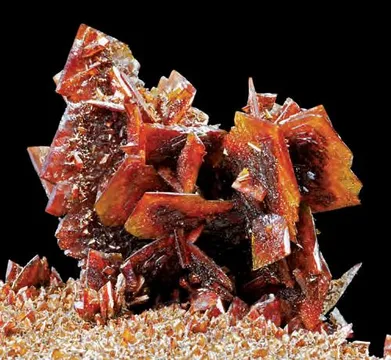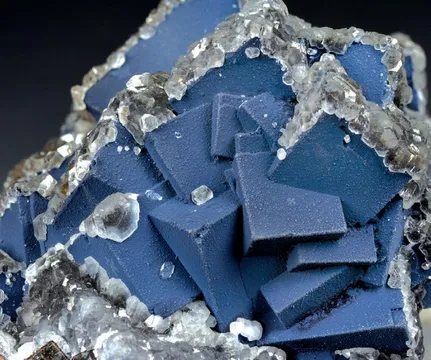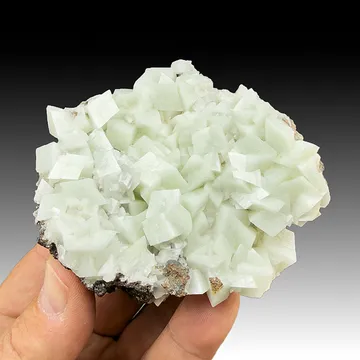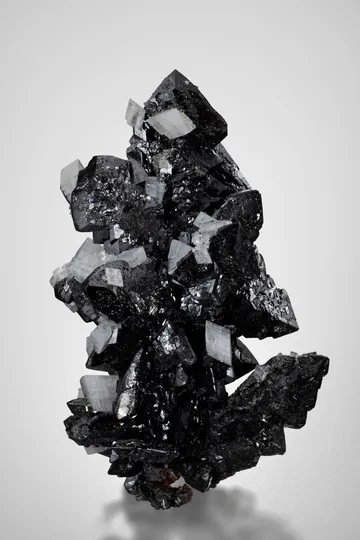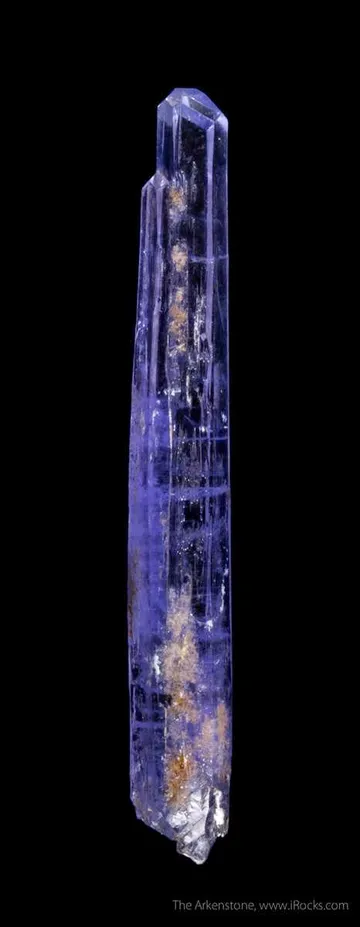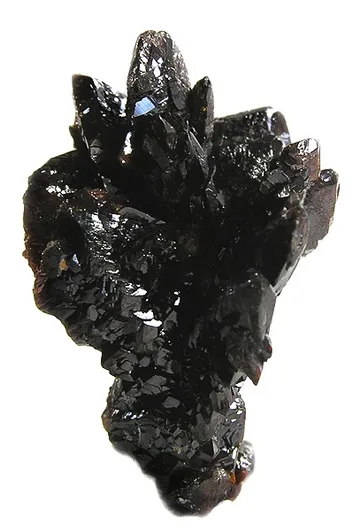
Kombat Mine, Namibia — renowned for sharp cerussite twins and rare red nambulite among Cu-Pb-Ag ores and Fe-Mn minerals, a standout for collectors.
Key facts
Kombat is one of the great Otavi Mountain Land names that never had to compete by volume. Tsumeb overwhelms the collector with abundance and breadth; Kombat impresses by sharp contrasts: a copper-lead-silver orebody locked into carbonate structure, a separate iron-manganese mineral world capable of producing exotic species, and a small population of specimens whose quality has made them disproportionately famous. The mine lies in northern Namibia near the settlement of Kombat, on the southern margin of the Otavi Mountain Land, where Neoproterozoic carbonate rocks, phyllites, faults, folds and hydrothermal brines created a compact but mineralogically exceptional system.
The collecting identity of Kombat rests on two very different specimen traditions. The first is aesthetic: transparent, glassy cerussite, commonly in elegant heart-shaped twins, some so clear that they behave like natural prisms. The second is systematic and rare-species oriented: red to cherry-red nambulite, arsenosilicates, lead oxychlorides and manganese silicates from the Fe-Mn assemblage associated with the mine. Kombat specimens at their best have a restrained, high-contrast look—clear lead carbonate against dark matrix; hot red nambulite perched on pale or black gangue; microscopic orange asisite in hausmannite; and unusual lead oxychlorides or manganese minerals that often demand analytical respect rather than casual visual identification.
Geologically, Kombat is not simply a “copper mine with secondaries.” Modern work treats the Cu-Pb-Ag mineralization as a carbonate-hosted, hydrothermal, MVT-style variant emplaced along structural traps near the contact between upper Tsumeb Subgroup dolostones and phyllitic rocks of the Kombat Formation. The iron-manganese ores, spatially associated but genetically more complex, include stratiform Fe-Mn material and later hydrothermal overprints; it is within that manganese-rich environment that much of Kombat’s rare-mineral personality developed.
Regional View
Country View
For collectors, Kombat’s best pieces are classics because they combine locality scarcity with instant recognition. A fine Kombat cerussite is usually not a bulky reticulated showpiece in the Tsumeb manner; it is more often a lustrous, transparent twin, compact and highly refined, with a smoky or water-clear interior and a twin outline that can be read across the room. Good nambulite is even less available: the memorable Kombat material came from a limited find, and the finest crystals are small, glassy, cherry-red to deep red, and far rarer on the market than their visual impact might suggest.

Photo: Wikimedia Commons

Photo: Wikimedia Commons

Photo: Wikimedia Commons
Search for specimens: View all specimens from Kombat Mine, Namibia
Kombat Mine is situated in the Grootfontein–Otavi part of the Otjozondjupa Region, roughly between Otavi and Grootfontein and about 49 km south of Tsumeb. The mine is part of the Otavi Mountain Land, a celebrated carbonate-hosted base-metal province containing hundreds of mineral occurrences and a series of historically important Cu-Pb-Zn-Ag and vanadium deposits. Kombat’s ore occurs on the northern limb of the Otavi Valley Synclinorium, in a structurally prepared contact zone between dolostones of the upper Tsumeb Subgroup and overlying phyllite, shale and related rocks of the Kombat Formation.
The principal economic mineralization is Cu-Pb-Ag, with chalcopyrite, bornite, covellite and galena among the important indicators, and with minor chalcocite, sphalerite and tennantite reported in modern mineralogical studies. The deposit is controlled by structure: thrust-related fold or “roll” geometries, faults, shear fractures, cavities and breccia zones governed fluid movement and ore precipitation. Modern fluid-inclusion work points to a saline hydrothermal brine system with MVT-style characteristics, while field observations show copper mineralization in veins, breccias and disseminations in dolostone and calc-silicate rocks. Alteration is comparatively focused rather than broad: dolomitization, silicification, quartz veining and calcite are concentrated around the principal controlling structures.
Kombat’s mineralogical importance, however, comes from the conjunction of this base-metal system with Fe-Mn mineralization. Stratiform iron-manganese ore occurs as magnetite-hematite-rich and hausmannite-bearing material in calc-silicate and dolostone settings, with barite, jacobsite, manganite, rhodonite and other manganese species forming a chemical environment reminiscent, in miniature, of the great metamorphosed manganese associations of Franklin and Långban. Late hydrothermal veins cut across the layering of the manganese bodies; these veins are the setting for nambulite and several of the rare arsenosilicate, calcium silicate, lead oxychloride and manganese carbonate-hydroxide species that make Kombat so attractive to systematic collectors.
The mine’s history is long and uneven. Kombat-style mineralization was noted in the nineteenth century, and early exploitation at Kombat began under the Otavi Minen- und Eisenbahn-Gesellschaft period in the early twentieth century; mining was interrupted by groundwater problems in the 1920s. The modern mine was developed and commissioned in the early 1960s, with a concentrating plant and multiple shafts serving the ore lenses. Production continued for decades under changing ownership, including Tsumeb Corporation Ltd., later Ongopolo, Weatherly, Trigon and, most recently, New Horizon Copper/Horizon-related ownership. From 1962 to 2008 the mine produced approximately 12.5 million tonnes of ore at around 2.6% Cu, making it one of Namibia’s significant historic copper producers.
Flooding is a recurring theme in Kombat’s operational history. Production was halted after flooding in 1988, interrupted again in 1997, and the mine finally went onto care and maintenance in 2008 after flooding and weak base-metal prices made continued operation uneconomic. Restart attempts in the 2020s focused first on open-pit and near-surface material, then on dewatering and re-entering the underground Asis West workings. By late 2025 Horizon Corporation had acquired the controlling interest formerly held by Trigon, and New Horizon Copper became the operating vehicle for redevelopment. The 2025 Chamber of Mines review records Kombat under New Horizon Copper control, with redevelopment work, dewatering upgrades and plant expansion aimed at a 2026 restart.
For field collectors, Kombat should be treated as an active or controlled mine locality rather than a casual collecting site. The mine workings, shafts, plant, dumps and exploration areas are on mining licences and are subject to company, safety and regulatory control. The most important collector specimens historically came through mine channels, company geologists, miners, mine collections and old dealer networks, not from open recreational digging. Modern access for collecting is therefore not something to assume; any visit requires permission from the landholder and mineral-rights operator, and underground access is out of the question without formal mine authorization.
The most famous collector finds are clustered around two themes. The cerussites are classic oxide-zone or lead-carbonate specimens associated with galena-bearing parts of the system; notable pieces include flawless transparent twins in the 2–5 cm range and at least one celebrated museum-caliber crystal group published repeatedly in major specimen literature. The nambulite material belongs to the manganese-ore vein system and is associated in the literature with gypsum, brushite, cahnite, barite, calcite, chlorite, kentrolite, manganite, serandite, rhodonite and johninnesite. The nambulite-bearing veins at Kombat are reported up to 10 cm thick, but individual fine crystals are usually small; the rare, intensely red, gemmy crystals are the pieces serious collectors remember.
Kombat cerussite is one of the locality’s true aesthetic signatures: brilliantly lustrous, commonly colorless to faintly smoky, and prized above all when it forms transparent, sharp, heart-shaped twins rather than cloudy fragments or ordinary massive carbonate. Published and photographed specimens show individual crystals and twins in the thumbnail to small-cabinet range, commonly around 2.5–5.3 cm, with a famous museum example described at about 7.5 x 7.5 x 10.5 cm overall and a main crystal around 5 cm. The look is distinct from Tsumeb’s large snowflake and reticulated styles; Kombat’s finest cerussites are more sculptural and gemlike, acting almost as optical objects when light passes through them. Associations include lead-ore alteration minerals and, in documented photo data, minerals such as hematite and the rare lead carbonate grootfonteinite; quality is defined by transparency, complete twin form, undamaged terminations, strong glassy to adamantine luster and freedom from iron staining or bruised edges.
Kombat nambulite is a world-class rarity for the species and is famous for small but intensely colored red crystals from a limited early-1970s find in the mine’s manganese assemblage. Schneider’s work describes the Kombat occurrence as a hydrothermal vein system cutting the layering of manganese ore bodies, with nambulite-bearing veins up to 10 cm thick; the material includes prismatic light-red crystals reported up to about 3 x 4 x 2 mm and fibrous pink crystals, while larger deep-red crystals up to 3 cm have also been reported in the earlier literature. Collector specimens typically show cherry-red to deep red, bladed or prismatic crystals and clusters, sometimes on matrix, with associated gypsum, hausmannite and manganese minerals; the best pieces have vivid saturated color, translucency to gemminess, discernible crystal faces, minimal coating, and enough matrix to prove the Kombat occurrence rather than appearing as an anonymous red sliver.
Beyond cerussite and nambulite, Kombat is exceptional for type-locality and rare-species mineralogy. Minerals described from Kombat include asisite, erikjonssonite, grootfonteinite, hereroite, holdawayite, jaffeite, janchevite, johninnesite, kombatite, milanriederite, ribbeite, roymillerite, vladkrivovichevite, yangite, damaraite and carlfrancisite, with some tied specifically to the Asis West sector or even the E15-11 south stope on the 11 level. The paragenesis is rich in lead oxychlorides, manganese silicates and arsenosilicates, and many of these species are not hand-specimen minerals in the ordinary sense; they occur as microscopic grains, crusts, platy aggregates or inclusions in barite, hausmannite, hematophanite, cerussite, dolomite and related Mn-rich matrix. Kombat is therefore a dual-purpose locality: it can supply a dramatic cabinet-level cerussite, but it can also reward the collector who values a tiny, verified type-locality grain more than a showy crystal.
Kombat specimens call for careful locality discipline. Cerussite twins from Kombat are sometimes visually compared with Namibian Tsumeb pieces or Moroccan Touissit/Mibladen material, and undocumented examples should be judged by provenance, old labels, crystal style and matrix rather than by a seller’s locality claim alone. The most convincing Kombat cerussites tend to have the locality’s distinctive transparent, heart-shaped twinning habit and old southern African collection histories; pieces with vague “Namibia” labels deserve caution.
Nambulite requires still more care. The best Kombat nambulites are rare, small and intensely colored, and the species can be confused in casual trade with other red manganese silicates or with altered rhodonite-like material. A serious nambulite purchase should ideally have analytical support, strong provenance, or a defensible chain through old Kombat material. Deep red color alone is not enough; look for crystal morphology, association and credible history. The finest crystals are few, and matrix examples with glassy red crystals are significantly more desirable than loose, tiny fragments.
Condition is central to both of Kombat’s collector classics. Cerussite is dense, brittle and highly susceptible to edge bruising; transparent crystals reveal internal veils, chips and cleavages mercilessly under strong light. A tiny nick on the apex of a clear twin matters more than it would on a granular ore specimen. Nambulite is harder but commonly small, and crystals may be partly coated, contacted or embedded; because the aesthetic value rests on color and luster, dull surfaces and black or pale coatings lower desirability unless the specimen is otherwise unusually large or well documented.
Handling considerations are straightforward but important. Cerussite is a lead carbonate and many Kombat rarities are lead- or arsenic-bearing minerals. They are safe as display specimens when handled sensibly, but they should not be cut, ground, soaked in acids, used in elixirs, or left where children can handle them. Wash hands after handling, avoid dust, and store delicate cerussite in a padded box or stable mount. Many rare Kombat species are microscopic or matrix-bound, so overcleaning can destroy the very minerals that make the specimen important.
On the market, Kombat cerussite appears occasionally but not abundantly, and top examples are usually absorbed quickly by collectors of southern African classics. Nambulite is much scarcer; fine crystals from the original material have long been dispersed through old collections, and fresh supply is not a dependable expectation even when the mine is operational. Type-locality rarities from Kombat generally circulate through specialist dealers, micromount collections and analytical-reference holdings rather than through ordinary aesthetic-mineral channels.
Kombat’s history is inseparable from water. The deposit is in arid northern Namibia, yet its underground life has repeatedly been determined by flooding. Early twentieth-century workings under Otavi Minen- und Eisenbahn-Gesellschaft were stopped by groundwater ingress in the 1920s. The modern operation ran for decades, then floodwater shut production in November 1988 for nearly a year. In 1997, flooding again stopped mining for months. The final 2008 closure came after the mine was overwhelmed by the same problem at a time when low copper prices made recovery difficult to justify.
That long battle with water took on a strikingly Namibian twist during the twenty-first-century restart. Dewatering of the old underground workings was not just a mine-engineering operation; it became part of a regional water story. Reports during Trigon’s restart described pumps removing thousands of cubic metres of water per hour from the old shafts, with potable water being channelled away from Kombat into reservoirs serving central Namibia. In a dry country, the water that had once helped kill the mine became a useful asset.
The rare-mineral story is quieter but just as memorable. The finest nambulite from Kombat is remembered by collectors as a one-time event from the early 1970s. Published specimen descriptions and old collection notes preserve the sense of how little material existed: cherry-red crystals only millimetres across, yet so gemmy and saturated that they became legendary among collectors who might otherwise overlook a thumbnail. The late John Barlow’s name appears repeatedly in the provenance of important nambulite pieces, and his handling of a significant lot of the material helped seed today’s surviving examples into major private and dealer records.
There is also a wonderful asymmetry in Kombat’s reputation. The mine was built for copper, lead and silver; its infrastructure, shafts and concentrator were designed for tonnes of ore, not millimetre crystals. Yet the locality’s most coveted collector objects include a 5 mm cherry-red nambulite crystal, microscopic orange asisite in black hausmannite, and transparent cerussite twins so clear that their owners treat them more like optical sculptures than ore minerals. Kombat’s best mineral stories are not about abundance. They are about small, improbable survivals from a working mine that flooded, reopened, changed hands and kept producing surprises.