N'Chwaning I Mine, South Africa - legendary Kalahari manganese locality near Hotazel, yielding rhodochrosite, manganite, hausmannite, and rare Mn minerals priz…
Key facts
N'Chwaning I is one of the great collector localities of the Kalahari Manganese Field: a closed underground manganese mine near Black Rock and Hotazel in South Africa’s Northern Cape, worked in a Paleoproterozoic manganese succession whose specimen history is almost as important as its ore history. The mine sits in the Hotazel Formation of the Transvaal Supergroup, where chemical sedimentary iron- and manganese-rich beds were later transformed by fault-related hydrothermal upgrading and, in selected fracture systems, by younger low-temperature fluids. That combination is why a mine opened for manganese ore became legendary for cherry-red rhodochrosite, metallic black manganite, sharp hausmannite, amber-red shigaite, pink-to-peach olmiite/poldervaartite-group material, ettringite-group sulfates, calcite, barite, and a long tail of rare manganese silicates, borates, hydroxides, sulfates, phosphates, and carbonates.
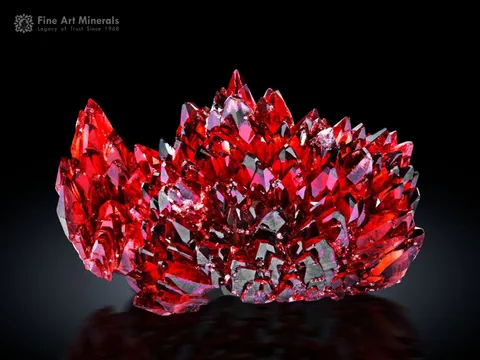
The mine’s fame rests first on its rhodochrosite. The great 1970s N'Chwaning I production gave collectors deep red scalenohedra, “dogtooth” crystals, wheat-sheaf bundles, spherical and stalactitic aggregates, and plates of vivid crystals on black manganite or manganese ore. These were not merely good South African rhodochrosites; they helped define what world-class rhodochrosite could look like before the Sweet Home mine’s later celebrity broadened the comparison. The best N'Chwaning I examples combine saturated wine-red to cherry-red colour, glassy lustre, high transparency, and an unmistakable visual snap against black manganese oxides.
Regional View
Country View
N'Chwaning I also has a second identity: the mine is one of the Kalahari’s great small-pocket localities. In the north-western workings, where mining began, rhodochrosite was associated especially with manganite and drusy secondary quartz. Later work in southern areas produced a different collector suite, with well-crystallized hausmannite, barite, hydroxyapophyllite-(K), inesite, brucite, and celestine, while fine rhodochrosite became much less common. The result is a locality whose labels often carry real geological meaning: “N'Chwaning I” is not just a mine name, but a signal of a particular era, pocket style, and mineral association.

Photo: Wikimedia Commons
The finest pieces are small sculptures in red, black, amber, and pink: rhodochrosite fans or wheat-sheaves perched on lustrous black manganite; red-brown, micaceous shigaite on drusy pink rhodochrosite; peachy ball-like olmiite or poldervaartite-group aggregates rising from dark manganese-rich matrix; and rare clear-to-pale thaumasite crystals from late-stage vugs. Even miniature-sized specimens can be major objects when the habit is right, the faces are glassy, and the pocket history is credible.

Photo: Wikimedia Commons
Search for specimens: View all specimens from N'Chwaning I Mine, South Africa
N'Chwaning I is part of the N'Chwaning mine group in the northern Kalahari Manganese Field, within the Joe Morolong Local Municipality of the Northern Cape. The mine is recorded at approximately 27° 8' 7'' South, 22° 52' 13'' East, close to the Black Rock mining area and only a short distance from N'Chwaning II and N'Chwaning III. The name comes from farm N'Chwaning 267, and the broader mining licence area includes the historic Black Rock area.
The deposit is a stratabound manganese orebody hosted by the Hotazel Formation of the Griqualand West Sequence, part of the Proterozoic Transvaal Supergroup. Regionally, the Hotazel Formation is built from repeated iron- and manganese-rich chemical sedimentary units; in the Kalahari field, the principal ore occurs in manganese-rich beds associated with banded iron formation, braunite-rich manganese rock, carbonates, and later metamorphic and hydrothermal mineral assemblages. The economically important high-grade ore in the northern field is commonly described as Wessels-type ore: coarser grained, lower in carbonate than the more primary Mamatwan-type ore, rich in braunite and associated manganese oxides, and carrying gangue minerals such as andradite and barite. Parts of N'Chwaning I also contained Hotazel supergrade-style ore, where hausmannite is prominent and carbonate is relatively sparse.
Structurally, the N'Chwaning orebody is gently dipping and regular, but the collector minerals owe much of their richness to irregularity: faults, fractures, open cavities, and dissolution vugs. A major hydrothermal event affected the north-western Kalahari field about 1.3 billion years ago and reached high temperatures in the Wessels, N'Chwaning, and Black Rock area. That event upgraded ore and produced a complex manganese mineralogy. Later, cooler fluids moving through open fractures produced some of the more familiar specimen minerals, especially the classic rhodochrosite-manganite-quartz style in N'Chwaning I.
Mining at the N'Chwaning property began with N'Chwaning I, originally established in the early 1970s with a single vertical shaft by Associated Manganese Mines of South Africa, the company later known through the Assmang operations. N'Chwaning II came into production in 1981 with a deep vertical skip shaft and underground crushing station, and N'Chwaning III became fully operational in the mid-2000s with a personnel shaft and a long decline conveyor system. N'Chwaning I is now closed and listed as abandoned, while the modern Black Rock Mine Operations comprise active underground manganese workings at N'Chwaning II, N'Chwaning III, and Gloria.
Specimen recovery at N'Chwaning I was tied directly to mining. Numerous rhodochrosite pockets were encountered during shaft sinking and underground development, with the major classic discoveries in 1976–1978 and related material circulating into the collector market around that period and the early 1980s. The north-western starting area of the mine was the key rhodochrosite ground, yielding crystals and aggregates on black manganite and manganese ore. Later southern workings were less generous for rhodochrosite but important for hausmannite, barite, hydroxyapophyllite-(K), inesite, brucite, and celestine.
Collecting access today should be treated as closed, private, and industrial. N'Chwaning I itself is no longer a collector destination, and the active N'Chwaning and Gloria operations are controlled underground mines with normal mine-safety, security, and ownership restrictions. Modern collector specimens reach the market through older collections, historical mine production, authorised recoveries from the broader operating complex, and well-documented dealer or collection dispersals. For serious collectors, a precise old label, mine-number attribution, pocket-era information, and chain of ownership can be as important as the crystal itself.
Rhodochrosite is the signature mineral of N'Chwaning I: wine-red to pale pink MnCO3 occurring as glassy scalenohedra up to about 7 cm, classic cherry-red “dogtooth” crystals, wheat-sheaf bundles, spherical aggregates, fan-shaped groups, and stalactitic forms with internal concentric layering. The major discoveries came during shaft sinking and mining, especially the 1976–1978 production that made the locality famous, with the best pieces showing transparent to translucent saturated red crystals on black manganite or manganese ore, commonly with drusy quartz, chalcedony, gypsum, or other late-stage fracture minerals. Ordinary pieces may be attractive pink druse or crowded, bruised fragments, but great N'Chwaning I rhodochrosites have separation, lustre, colour depth, sharp terminations, and a vivid red-on-black contrast that instantly distinguishes them from paler rhombohedral rhodochrosite from other parts of the Kalahari field.
Manganite at N'Chwaning I is both a collectible species and the visual stage on which the mine’s best rhodochrosite performs. It occurs as metallic black to steel-black MnO(OH), commonly in coarsely crystalline masses, bladed aggregates, and lustrous matrix pieces associated above all with rhodochrosite; photo-based records also show associations with calcite, sturmanite, ettringite, gaudefroyite, gypsum, quartz, bixbyite-(Mn), and andradite. The most desirable N'Chwaning I manganite specimens are not dull black ore fragments, but sharp, lustrous blades or ridges that provide a sculptural matrix and strong contrast for cherry-red rhodochrosite, yellowish sulfate minerals, or white calcite; damage to the high-relief black blades and contact marks where rhodochrosite detached are the usual downgrades.
Hausmannite from N'Chwaning I belongs to the mine’s darker, high-grade manganese-oxide character, especially the later southern-area suite in which well-crystallized hausmannite appeared with barite, hydroxyapophyllite-(K), inesite, brucite, and celestine after the richest rhodochrosite zones had become less common. The species is typically jet-black to black-brown Mn2+Mn3+2O4 with bright lustre, pseudo-octahedral to composite crystal habits, and associations in the Kalahari field that include andradite, gaudefroyite, ettringite, rhodochrosite, calcite, hematite, barite, kutnohorite, and celestine. Good N'Chwaning I examples are judged by crystal definition and lustre rather than colour, with crisp black crystals on contrasting garnet-rich, carbonate, or sulfate-bearing matrix preferred over massive hausmannite-rich ore.
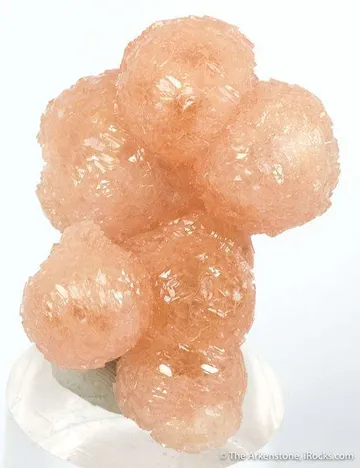
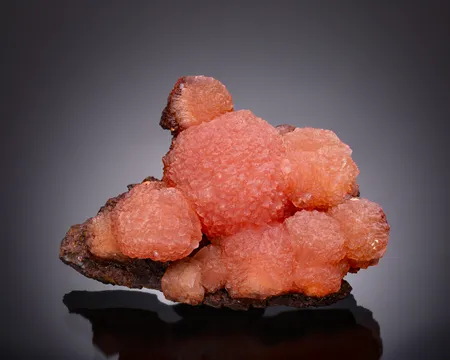
Poldervaartite from N'Chwaning I must be approached with unusual caution because much material historically sold under that name from the N'Chwaning area was later found to be olmiite or olmiite-dominant material in the olmiite–poldervaartite series. Specimens attributed to N'Chwaning I show pale pinkish-brown, peach, beige, to cherry-red crystallized aggregates, commonly as ball-like or sheaflike masses on manganese-rich matrix, and older records describe both translucent red gemmy aggregates and more opaque beige crystalline balls on the same specimen. For collectors, the finest examples are three-dimensional, complete globular aggregates with bright lustre and clear separation from the matrix, but species-level confidence is critical: a “poldervaartite” label from this district is not enough without analysis or a reliable modern provenance.
Sturmanite is present in the N'Chwaning I assemblage as part of the complex ettringite-group sulfate mineral suite for which the Kalahari Manganese Field is famous. On N'Chwaning I specimens it is encountered as yellow, amber, olive, or honey-coloured hexagonal to prismatic crystals and aggregates, often with calcite, manganite, hematite, ettringite, or other manganese minerals, but visual identification is notoriously treacherous because sturmanite, ettringite, charlesite, and related members can overlap in habit and colour. The best collector pieces are not merely yellow sulfate crystals from “N'Chwaning,” but analysed or credible old N'Chwaning I specimens with sharp, lustrous, undamaged crystals on matrix and attractive contrast against black manganese oxides, white calcite, or pink rhodochrosite.
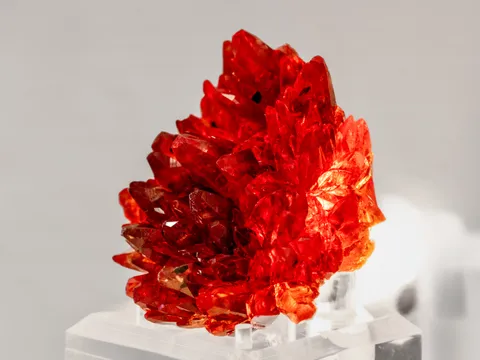
Shigaite is one of the mine’s great rarities and one of the reasons N'Chwaning I remains important beyond rhodochrosite. It occurs as micaceous, hexagonal tabular crystals and rosettes, pale yellow through burnt orange, brown, amber-red, and wine-red, scattered on drusy pink rhodochrosite or associated with barite, kutnohorite, manganocalcite, pyrochroite, fibrous sussexite, caryopilite, gageite, waterhouseite, and gatehouseite. Early 1990s N'Chwaning I material overlapped with the famous Wessels production, but the first half of 2006 brought exceptional N'Chwaning I pockets in which vugs from centimetre scale up to about soccer-ball size yielded higher-lustre red-amber crystals; most were tiny, while rare crystals reached roughly 2.5–3.2 cm, and the finest pieces are intact matrix specimens with bright, undamaged, well-positioned crystals still anchored on pink rhodochrosite rather than loose blades blasted from the cavity wall.
Calcite at N'Chwaning I is a supporting but important late-stage species, appearing as white, colourless, pale pink, or manganese-bearing calcite in vugs and on manganese-rich matrix, and it is part of the same cavity chemistry that produced rhodochrosite, shigaite, sturmanite-group minerals, thaumasite, olmiite/poldervaartite-group material, and fibrous or drusy accessory species. In the 2006 shigaite pockets, one cavity about 13 cm long yielded light-pink kutnohorite and fluorescent manganocalcite, showing how carbonate growth could vary sharply from pocket to pocket. The best calcite-bearing N'Chwaning I specimens are combinations: transparent or lustrous calcite giving structure and contrast to rarer manganese species, rather than plain calcite crystals that would be unremarkable without their Kalahari association.
Thaumasite from N'Chwaning I is a rare late-stage sulfate-carbonate-silicate hydrate occurring as colourless to pale yellow, gemmy, hexagonal prismatic crystals, usually in small vugs and often compared visually with ettringite-group material. Documented N'Chwaning I specimens include matrix clusters with abundant lustrous prismatic crystals, commonly around the millimetre-to-centimetre range, with some recorded crystals about 1.4–2.1 cm and associated white xonotlite. Fine pieces are prized for transparency, sharp hexagonal form, and matrix preservation; loose single crystals are attractive, but matrix clusters with many intact, glassy prisms and a verified N'Chwaning I attribution are far more significant.
Hematite is documented at N'Chwaning I as Fe2O3 in the manganese-oxide and high-grade ore assemblage, appearing as black to steel-grey lustrous crystals, specular plates, coatings, and accessory crystals with andradite, barite, olmiite, calcite, sturmanite, and, on some rhodochrosite specimens, tiny dark crystals dusting red carbonate surfaces. Unlike the spectacular hematite plates known from some other Kalahari mines, N'Chwaning I hematite is usually collected for association and contrast: the best pieces have bright, well-formed crystals that add black metallic punctuation to pink, red, white, or amber species, while massive or dull hematitic ore has little specimen value unless it carries rarer minerals.
Olmiite from N'Chwaning I is a collector’s trap and delight in equal measure: a rare CaMn2+SiO3(OH) species closely related to poldervaartite, commonly forming peach, pinkish-brown, beige, grey-white, or brownish-orange spherical and globular aggregates of tiny lustrous crystals on manganese-rich matrix. A notable body of N'Chwaning-area material was first sold as poldervaartite before modern work and collector experience showed that much of it is actually olmiite; N'Chwaning I examples include small round aggregates about 1–2 cm on matrix, larger specimen spheres, and even rare facetable rough reportedly found in 2004. Good mineral specimens show complete, freestanding balls or sharp prismatic sprays with bright lustre and credible identification, while the best gemstone-related material is translucent peachy to brownish orange and unusually clean for such a rare species.
Beyond these headline species, N'Chwaning I has produced or recorded a broad manganese-field assemblage that includes afwillite, andradite, aragonite, barite, bixbyite-(Mn), braunite, brucite, bultfonteinite, bustamite, caryopilite, celestine, chalcopyrite, creedite, ettringite, friedelite, gageite, gageite-2M, galena, gatehouseite, gaudefroyite, gowerite, groutite, gypsum, henritermierite, hydroxyapophyllite-(K), inesite, jouravskite, kutnohorite, lepidocrocite, malachite, marcasite, oyelite, portlandite, pyrite, pyrochroite, quartz and chalcedony, ruizite, sugilite, vesuvianite, and waterhouseite. Gatehouseite and waterhouseite are especially important rarities tied to the N'Chwaning I mineralogical record, while broader N'Chwaning Mines type-locality history includes major modern manganese minerals such as nchwaningite and olmiite from neighbouring N'Chwaning shafts.
N'Chwaning I demands careful label discipline. “N'Chwaning,” “N'Chwaning Mines,” “N'Chwaning I,” “N'Chwaning II,” “N'Chwaning III,” “Kuruman,” “Hotazel,” and “Kalahari Manganese Field” are often used loosely on old labels and dealer tags, but they are not interchangeable for collector value. Classic deep red dogtooth, wheat-sheaf, spherical, and stalactitic rhodochrosite on manganite is strongly associated with N'Chwaning I’s 1970s production; later pale rhombohedral rhodochrosite, olmiite, inesite, ettringite, and other species may come from N'Chwaning II or III instead. A specimen with an old “N'Chwaning Mine” label may be entirely legitimate, but the shaft attribution should not be upgraded to N'Chwaning I without supporting evidence.
The most important misidentification issue is olmiite versus poldervaartite. Much Kalahari material originally sold as poldervaartite later proved to be olmiite or olmiite-dominant, and the two cannot be separated reliably by eye. A specimen sold as “poldervaartite” from N'Chwaning I should be considered provisional unless it has analytical backing or comes from a source that explicitly addresses the olmiite/poldervaartite problem. The same caution applies to sturmanite, ettringite, charlesite, and related ettringite-group minerals: colour and habit are not enough. Amber crystals are not automatically sturmanite, yellow prisms are not automatically ettringite, and visual names assigned decades ago may be educated guesses rather than confirmed identifications.
Rhodochrosite condition is the great market divider. N'Chwaning I crystals are often perched, protruding, and glassy; edge bruising, cleaved terminations, missing tips, and small impact scars are common, especially on dogtooth and wheat-sheaf specimens recovered during active mining. Some 2006 shigaite crystals were physically popped off their matrix by blasting, and similar shock damage or detachment scars occur on other pocket minerals. On red rhodochrosite, tiny rubs can be hard to see in photographs but obvious under angled light. For premium pieces, inspect the highest points, the terminations, and the contact between crystal and matrix.
Colour should be judged cautiously. N'Chwaning I rhodochrosite can be naturally vivid cherry-red, wine-red, orange-red, pink-red, or pale pink, and fine material is often remarkably gemmy. Strong lighting and oversaturated photography can exaggerate colour, while backlighting can make incomplete crystals look richer than they are. Dyeing is not a major documented issue for serious N'Chwaning I rhodochrosite specimens, but ordinary pink carbonate or calcite from elsewhere can be misrepresented online as “South African rhodochrosite.” True N'Chwaning I style is usually recognizable by habit, lustre, association, and matrix, but provenance still matters.
Manganese minerals deserve careful handling. Shigaite has perfect basal cleavage and a micaceous habit; thin plates can flex, split, or detach. Thaumasite and ettringite-group minerals are hydrated and relatively soft, and should be kept away from heat, excessive dryness, water, ultrasonic cleaning, and aggressive chemical cleaning. Rhodochrosite is softer than quartz and reacts to acids; even weak acid cleaning can etch or dull it. Fibrous minerals reported from the assemblage, such as sussexite, should be handled conservatively: do not abrade or blow dust from specimens, and store delicate fibrous material in a box.
Market availability varies sharply by species and quality. Small N'Chwaning I rhodochrosites appear regularly, but top red dogtooth, wheat-sheaf, spherical, or stalactitic specimens with old provenance are intensely competitive and often remain in private collections for decades. Shigaite from N'Chwaning I is rare but known on the market, especially from 1993 and 2006 material; intact matrix pieces with large red-amber crystals are exceptional. Olmiite is available more often than true poldervaartite, but N'Chwaning I-attributed examples with strong aesthetics and verified identity are still specialist pieces. Hausmannite, calcite, hematite, sturmanite, and thaumasite from N'Chwaning I are generally collected either as good associations or as part of a systematic Kalahari suite rather than as plentiful stand-alone classics.
The defining N'Chwaning I story begins underground in the 1970s, where a commercial manganese operation unexpectedly cut into one of the great rhodochrosite-producing zones in mineral-collecting history. The best pockets were not modest seams of pink carbonate; they produced red scalenohedra, dogtooth crystals, wheat-sheaf bundles, spheres, and stalactitic growths on black manganite. One of the most famous individual specimens from that era became known simply as “the Snail,” an 8 cm rhodochrosite on manganite collected in 1976. Bill Larson bought it in Africa while on his honeymoon with Jeanne Larson, kept it for nearly 30 years, and later saw it enter the private-collection world through a trade-and-cash arrangement involving Wayne Thompson before it eventually returned to him. In the mineral world, that piece became less a specimen than an icon: a compact red form with an internal glow that was compared in published collector literature to a masterpiece of art.
Another chapter came in 1993, when rare shigaite entered the serious collector conversation in a way it never had from its original Japanese type locality. At Wessels, lustrous amber crystals were found with small pink rhodochrosite, leucophoenicite, gageite, and caryopilite; at about the same time, similar material was collected at adjacent N'Chwaning I, and the proximity of the workings meant that some early labels and attributions became difficult to separate cleanly. The crystals were mostly micromount-sized, but the best reached around 2 cm across, large enough to transform a once-obscure micaceous manganese sulfate into a prize cabinet species.
Then, in the first half of 2006, an old area of N'Chwaning I produced shigaite again. This time the story was more vivid: the mineral appeared in small vugs, most only a centimetre to a few centimetres across, lined with drusy pink rhodochrosite. The largest pocket was described as roughly the size of a soccer ball. One cavity about 13 cm long yielded six loose pieces of light-pink kutnohorite and fluorescent manganocalcite, and some pieces were floaters: small bits of rock completely coated with drusy rhodochrosite and carrying scattered shigaite. The best crystals were bright, lustrous dark amber to red, generally hexagonal and micaceous, from tiny 1 mm plates to rare crystals around 2.5 cm. The most dramatic detail is also the most painful for collectors: blasting shocks knocked some of the larger crystals loose from the walls of the cavities, leaving them on the pocket floor rather than standing on matrix. The premier specimens are the survivors that remained attached to rhodochrosite.
The 2006 discovery also shows how unforgiving pocket mineral collecting can be in an active mine. In a specimen field such as the Kalahari, “found” does not mean gently lifted from a geode. It may mean recovered from freshly blasted manganese ore, washed of clinging fibrous sussexite, trimmed, stabilized, and sorted under pressure before the next mining cycle erased the context. That is why intact N'Chwaning I shigaite on rhodochrosite has a special authority: it preserves not just a rare species, but the original geometry of a fragile cavity.
A quieter but important modern rhodochrosite episode came in September 2017, when Paul Balayer recovered a new lot very near the old N'Chwaning I pocket zone of the late 1970s. The new crystals were still deep red, gemmy, and lustrous, but they were squat scalenohedra rather than the classic 1970s dogteeth, and many carried light dustings of black manganese-oxide spots. The discovery did not dethrone the old bonanza pockets, but it proved that the famous ground still had geological memory: the same fracture architecture and manganese-carbonate chemistry could, decades later, produce a recognizably N'Chwaning I style with its own distinct look.