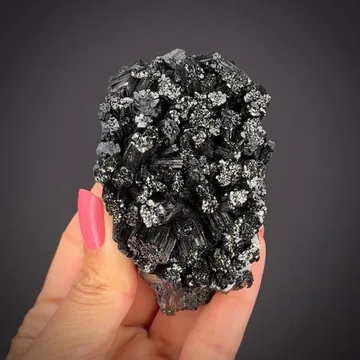
Manganite — black metallic MnO(OH) with steel-gray luster and crisp, striated crystals; sought for large, lustrous specimens from Ilfeld and Kalahari Field.
Key facts
Manganite is a manganese oxyhydroxide (MnO(OH)) and a classic “black metallic” species beloved for its brilliant submetallic to metallic luster and sharply striated crystals. It crystallizes in the monoclinic system and most often forms as prismatic to bladed crystals, commonly in tight parallel bundles, jackstraw jumbles, or radiating sprays. Fresh manganite gleams with a steel-gray to iron-black sheen that can look almost wet; this high reflectivity is a signature trait that elevates top specimens. It occurs in low-temperature hydrothermal and metamorphosed Mn-ore environments, often with other manganese minerals (pyrolusite, ramsdellite, hausmannite, braunite) and sometimes with carbonates (rhodochrosite, kutnohorite) or calcite and quartz.
The species is historically important: Ilfeld, Germany, produced some of the most famous manganite crystals in mineral history, setting an enduring standard for form and luster. Modern finds from South Africa’s Kalahari Manganese Field (notably the N’Chwaning and Wessels mines) redefined the species with spectacular sprays and jet-black prisms on contrasting white or pink matrix. While micro and massive manganite is common in many districts, large, lustrous, damage-free crystals and showy matrix pieces are scarce—and highly collectible.
Collectors prize manganite for its aesthetics and pedigree. The combination of mirror-bright luster, crisp striations, and distinctive sprays or bundles makes it one of the most charismatic black metallic minerals, rivaling the visual appeal of hematite or acanthite but with its own unmistakable look. Historically, Ilfeld specimens became cornerstones of European collections; many carry 19th-century labels and museum provenance. Beginning in the late 20th century, the Kalahari Manganese Field injected new excitement into the market with world-class crystallized manganite on striking matrix, creating modern classics that sit alongside Ilfeld pieces at top shows.
Good manganite is not ubiquitous. Pristine, undamaged sprays or stout prisms with perfect tips are uncommon due to brittleness and perfect cleavage; most large clusters required repairs. As a result, truly fine pieces—especially those on aesthetically contrasting matrix—command strong prices, while smaller, high-luster single crystals and thumbnail sprays remain within reach for many collectors. The species’ enduring appeal comes from its combination of history, form, and that unmistakable “wet-black” shine.
Ilfeld (Nordhausen District, Thuringia) is the classic and historically most celebrated manganite locality—the benchmark by which all others are judged. Crystals from Ilfeld are typically stout, highly lustrous, and prominently striated along the length, occurring as single prisms, parallel bundles, or intergrown stacks. Many rest on or are associated with other Mn-oxides and ore matrix, with occasional calcite or quartz. The best Ilfeld pieces possess that mirror-bright steel-gray luster and razor-sharp form that define the species; some crystals reach impressive sizes, and well-arranged groups remain trophy-level classics with coveted old labels.
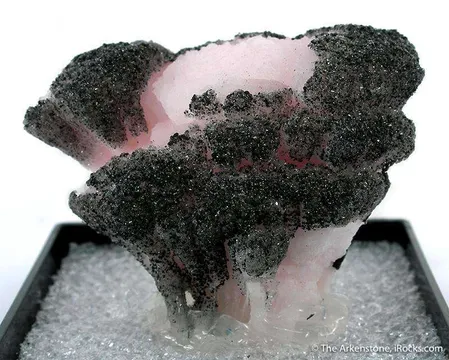
The N’Chwaning complex in the Kalahari Manganese Field produced spectacular modern manganite: dazzling, jet-black sprays and bundles of sharply terminated prisms, sometimes with individual crystals to several centimeters. The association on contrasting matrix—such as pink rhodochrosite or kutnohorite, white calcite, or brown-black hausmannite—creates dramatic, high-contrast specimens. Many show elegant radiating clusters or fan-shaped groups that display beautifully. These pieces helped reestablish manganite as a top-tier display species in contemporary collections.
Another pillar of the Kalahari Manganese Field, Wessels Mine yields elegant manganite in delicate sprays, clusters of fine bladed crystals, and jackstraw piles of lustrous prisms. The crystals often grow on bright white or pastel matrices (calcite and other manganese-associated minerals), amplifying visual contrast. While individual crystals may be finer and more needle-like than at N’Chwaning, the best Wessels pieces are both refined and artistic, with superb sheen under case lighting.
Color and Luster:
Crystal Form:
Matrix and Aesthetics:
Size:
Condition:
Repairs:
Coatings and Old Finishes:
Pseudomorphs/Alteration:
Handling:
Light and Temperature:
Humidity and Environment:
Cleaning:
Display:
With careful handling and stable display conditions, manganite can retain its remarkable luster and sharp aesthetics for generations—whether it’s a storied Ilfeld classic or a dazzling modern spray from the Kalahari.