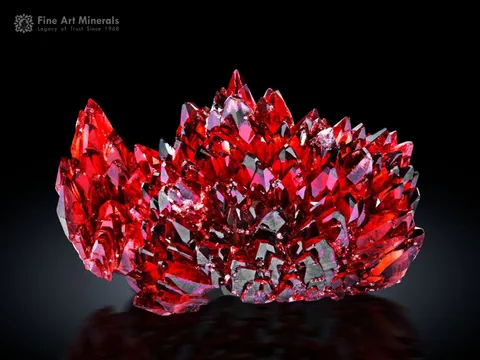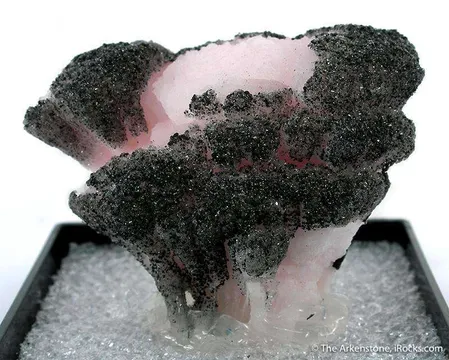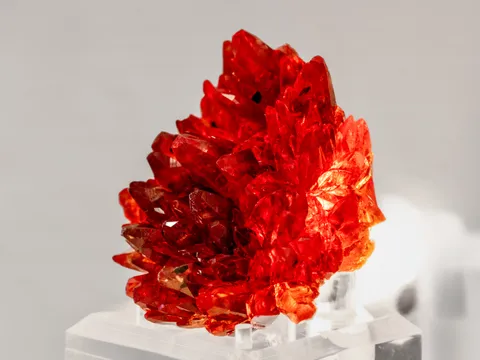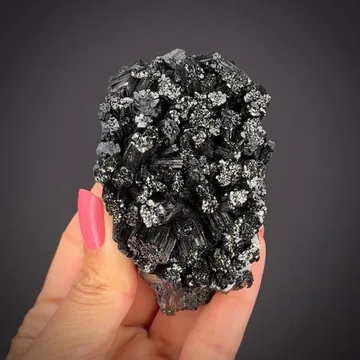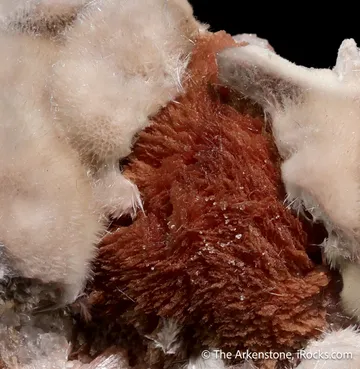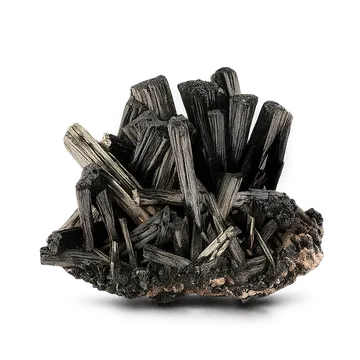
Manganite from N’Chwaning Mines, South Africa — a Kalahari manganese locality prized for metallic-black crystals and rhodochrosite and calcite.
Key facts
Manganite from the N’Chwaning Mines is not the bold, thick, architectural manganite of Ilfeld, Germany. Its appeal is more Kalahari in character: metallic black to steel-gray crystals, sprays, coatings, and sharp small aggregates set against a mineralogical theatre of red rhodochrosite, yellow sturmanite or ettringite, white calcite, drusy quartz, and dense manganese ore. In the best pieces, manganite acts as both species and stage—its black luster making the color of N’Chwaning rhodochrosite look hotter and cleaner than it would on a pale matrix.

Photo: Wikimedia Commons
The locality belongs to the Kalahari Manganese Field of South Africa’s Northern Cape, one of the great manganese provinces of the world and one of the most consequential specimen districts of the modern collecting era. N’Chwaning is not a single little prospect but a group of major underground manganese mines—N’Chwaning I, II, and III—developed in high-grade ore within the Hotazel Formation of the Transvaal Supergroup. The ore body was later upgraded by hydrothermal alteration along fault systems, a history that helps explain why a commercial manganese mine became a source of collector minerals far beyond the ore minerals themselves.
For manganite collectors, N’Chwaning material is prized less for giant single crystals than for association, contrast, and locality pedigree. Classic pieces include metallic-black manganite with red rhodochrosite from the famous 1970s and early 1980s finds; lustrous black prismatic or feathery manganite with calcite; manganite and quartz miniatures; rare sphenoidal or stacked tabular-pyramidal habits; and sturmanite or ettringite combinations where the black manganese mineral anchors the specimen visually. A fine N’Chwaning manganite is a Kalahari specimen first and a manganite specimen second: the best examples make immediate sense in a case devoted to South African manganese-field classics.
Search for specimens: View all manganite specimens from N’Chwaning Mines, South Africa
The N’Chwaning Mines are in the Black Rock area of the Kalahari Manganese Field, northwest of Kuruman in the Northern Cape. The mines take their name from farm N’Chwaning 267 and form part of Assmang’s Black Rock Mine Operations, together with Gloria. N’Chwaning I was established in 1972; N’Chwaning II came into production in 1981 with a deep vertical shaft and underground crushing facilities; and N’Chwaning III became fully operational in the mid-2000s, serviced by a personnel shaft and a long decline conveyor system.
Geologically, the ore sits in the Hotazel Formation of the Griqualand West Sequence, part of the Proterozoic Transvaal Supergroup. The Hotazel Formation is famous for its rhythmic iron- and manganese-rich sedimentary rocks: banded iron formation, hematitic lutite, and manganese formation in repeated cycles. At N’Chwaning, this primary sedimentary manganese package was overprinted by hydrothermal processes, especially in faulted northwestern parts of the field. The result was upgraded high-grade manganese ore and a remarkable suite of secondary and late-stage minerals.
Mining is underground and mechanized, not a casual collecting environment. Specimen recovery has historically depended on miners, mine contacts, dealers, and occasional preservation of pocket material encountered during shaft sinking or production. Collecting access should be treated as closed industrial access unless arranged through legitimate mine channels; contemporary specimens generally enter the collector market through established dealers and older collections rather than recreational field collecting.
The production history matters to collectors because many of the famous N’Chwaning specimen styles are tied to specific mining windows. N’Chwaning I is especially associated with the classic rhodochrosite discoveries of the 1970s, where manganite commonly forms the dark matrix beneath red crystals. N’Chwaning II has supplied many of the best-known Kalahari specimen minerals, including manganite associations, hausmannite, ettringite, sturmanite, inesite, gaudefroyite, and rare species. N’Chwaning III is better known in recent literature for additional manganese-silicate and rare-mineral occurrences.
N’Chwaning’s specimen reputation rests on far more than manganite, but manganite is one of the visual threads running through the locality. It is the black metallic ground against which the red rhodochrosite finds became legendary, the ore-mineral matrix that links the specimens to the mine’s industrial purpose, and a collectible species in its own right when it forms sharp, lustrous, well-positioned crystals.
N’Chwaning manganite is typically black to dark steel-gray with a metallic to submetallic luster. Crystal size is usually modest: many examples show small crystals, sprays, drusy coatings, or clusters rather than large freestanding crystals. Documented specimens include lustrous feathery crystals to about 0.75 cm, sharp isolated clusters on quartz, prismatic black crystals on massive manganite with white calcite, and rare sphenoidal forms with stacked, shallow tabular-pyramidal plates and four-sided shallow pyramidal terminations.
The most recognizable habit in collection pieces is the black, lustrous manganite matrix or coating beneath contrasting minerals. Rhodochrosite-on-manganite pieces are the classic expression: red, pink, or wine-red rhodochrosite crystals perched on a dark manganese-oxide surface. The dark matrix is not incidental; it is a major part of the aesthetic. N’Chwaning rhodochrosite without the black manganite contrast often feels less dramatic.
Quartz associations also occur, including specimens in which manganite clusters are isolated on sparkling drusy quartz. Calcite can appear as white crystals with prismatic manganite, producing a crisp black-and-white contrast. Sturmanite and ettringite combinations bring yellow to orange tones into the palette, while olmiite, hausmannite, and andradite associations connect manganite to the broader N’Chwaning mineral assemblage.
Quality in N’Chwaning manganite is judged by luster, definition, contrast, and association. A small sharp cluster on quartz may be more desirable than a larger, dull coating. Good manganite should look metallic rather than sooty; crystals should be distinct under magnification; and the specimen should have a composition that lets the black mineral contribute rather than disappear into an undifferentiated ore mass. For combination pieces, collectors look for undamaged rhodochrosite, sturmanite, ettringite, or calcite crystals placed naturally on the manganite, with no obvious trimming that destroys the balance of the matrix.
The best N’Chwaning manganites are therefore locality-character specimens: thumbnails and miniatures with strong black luster, classic Kalahari associations, and labels that distinguish N’Chwaning I from N’Chwaning II when that information is known. Precise shaft attribution adds value, especially for rhodochrosite-on-manganite material from the famous N’Chwaning I era and for manganite combinations known from N’Chwaning II.
No widely documented treatment problem is specific to N’Chwaning manganite, and manganite as a species is not commonly faked in the way that brightly dyed agates, artificial sulfates, or fabricated copper minerals are. The greater risks are mislabeling, overbroad locality attribution, and misidentification of black manganese oxides. Labels may say simply “N’Chwaning,” “N’Chwaning Mine,” “Kuruman,” or “Kalahari Manganese Field,” and older specimens may not reliably distinguish N’Chwaning I from N’Chwaning II. For high-value pieces, especially rhodochrosite on manganite, older provenance, dealer history, and consistency of habit matter.
Manganite can also be confused visually with other black manganese minerals and manganese-oxide mixtures. Dense black ore, pyrolusite, hausmannite, and unidentified manganese oxides may be sold or inherited under simplified labels. True manganite should show the expected crystal habit and luster, and for important specimens an analytical confirmation is ideal. This is especially relevant for specimens where manganite is not the obvious display mineral but the matrix beneath rhodochrosite, sturmanite, calcite, or other species.
Condition issues are typical for small metallic manganese minerals. Edges and terminations can be bruised, and black crystals on exposed ridges may show rubs that are difficult to see until the specimen is tilted under strong light. Drusy manganite coatings can look excellent from the front but be abraded on the high points. Combination specimens introduce further vulnerabilities: rhodochrosite cleaves and bruises; sturmanite and ettringite crystals can be delicate; calcite may be chipped or etched; and quartz druse can hide small repairs or contact points.
Rarity depends strongly on style. Massive manganite-bearing matrix from N’Chwaning is not a rarity in the abstract, but well-crystallized, lustrous, aesthetic manganite specimens are much scarcer. Rare sphenoidal forms, sharp isolated manganite clusters on quartz, and classic rhodochrosite-on-manganite pieces from the 1970s–early 1980s finds are the material serious collectors compete for. Modern availability is intermittent: specimens appear through dealer stock, auctions, and collection dispersals, but the finest old rhodochrosite-on-manganite pieces are no longer common casual purchases.
The most famous N’Chwaning manganite story is really a manganite-and-rhodochrosite story, because the black mineral provided the stage for one of the great red-carbonate discoveries in mineral collecting. During shaft sinking and mining in the 1970s, N’Chwaning produced numerous rhodochrosite pockets, with major discoveries in 1976–1978. One pocket is recorded as measuring about 0.5 by 1.0 meter, yet it yielded a specimen weighing about 100 kilograms—a remarkable reminder that some of the most celebrated cabinet pieces began as industrial mine interruptions inside high-grade manganese ore.
Those pockets produced the habits that now define the locality: red scalenohedrons, wheat-sheaf clusters, spherical aggregates, fan-shaped groups, and unusual rhombohedral forms. The scalenohedrons were sought after almost immediately, with fine red examples selling for four-figure prices already in the 1970s and 1980s. The black manganite matrix was not background noise; it was part of the drama. A red N’Chwaning crystal on pale rock is attractive, but a red N’Chwaning crystal on slick metallic black manganite becomes iconic.
One of the rarest visual episodes from those finds is the spherical rhodochrosite style. Sources describe only about a dozen such spherical aggregate specimens in total, and later dealers have linked exceptional red spheres on black manganite to the celebrated “Snail” style discovered in the 1970s. These are not ordinary rounded masses; they are crystalline red forms with enough transparency and color to look alive against the dark manganese mineral beneath them. They explain why N’Chwaning specimens are often collected by people who do not normally specialize in manganese minerals.
Another small but memorable N’Chwaning episode concerns cinnabar on manganite. A documented specimen from the Charlie Key Collection shows sub-millimeter cherry-pink cinnabar crystals scattered over a velvety manganite surface. The material was described as coming from a single pocket, and because the identification was not obvious at the time, it was reportedly analyzed at Harvard. That story captures the Kalahari manganese field perfectly: an ore mine so chemically unusual that even a black manganite surface could carry an unexpected mercury sulfide accent.