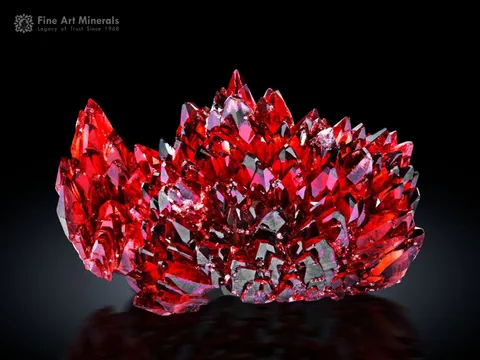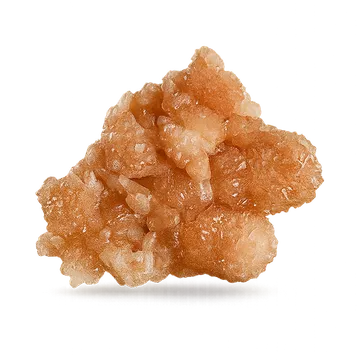
Olmiite - orange-pink radial clusters from N'Chwaning II, the type locality manganese silicate prized for color, architecture, and cabinet-worthy specimens.
Key facts
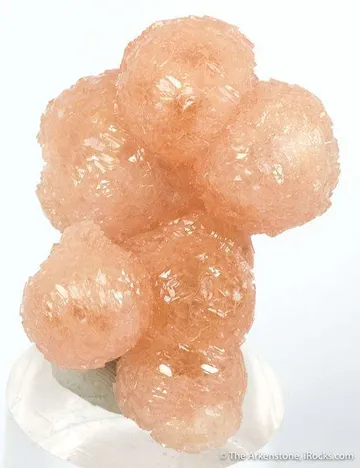
Olmiite from N'Chwaning II is one of the great modern surprises of the Kalahari Manganese Field: a rare silicate that is not merely a microscope mineral, but an attractive collector species in cabinet-worthy aggregates. The best pieces show rounded, radial clusters built from countless glittering orthorhombic crystal tips, in colors that range from cream and beige through salmon, peach, rose-brown, cinnamon, and deep orange-pink. Under strong light the finest balls can take on a warm internal glow, a quality that makes N'Chwaning II olmiite immediately recognizable across a room.

Photo: Wikimedia Commons
Its importance is not only aesthetic. N'Chwaning II is the type locality for olmiite, CaMnSiO3(OH), the manganese-dominant analogue of poldervaartite. Many specimens now accepted as olmiite entered collections under the older name “poldervaartite,” and the relabeling of that material is one of the more consequential nomenclatural corrections in recent specimen mineralogy. The two species are too close visually for confident hand-specimen separation; the decisive distinction is chemical and structural, especially the dominance of Mn over Ca at the relevant crystallographic site.
The setting is equally distinctive. N'Chwaning II lies in the Black Rock area of South Africa’s Kalahari Manganese Field, the world’s largest land-based manganese deposit and one of the most productive rare-mineral provinces on Earth. The field’s fame rests on hydrothermally altered manganese ores that produced an extraordinary suite of calcium-manganese silicates, borates, sulfates, oxides, and carbonates. Olmiite belongs to that altered, specimen-rich world: it occurs with minerals such as calcite, bultfonteinite, oyelite, celestine, sturmanite-group material, hematite, xonotlite, quartz, and other Kalahari specialties.
Collectors prize N'Chwaning II olmiite for three things above all: color, architecture, and condition. A good specimen should show clean, lustrous radial aggregates rather than dull crusts; the best examples combine saturated peach-to-rose color with sharp sparkling terminations and strong contrast against dark manganese ore, white calcite, or pale fibrous associated minerals. Large spherical aggregates several centimeters across are especially desirable, as are plates with multiple undamaged balls and well-balanced composition.
Search for specimens: View all olmiite specimens from N'Chwaning II Mine, South Africa
N'Chwaning II Mine is part of the N'Chwaning mine complex in the Black Rock area, roughly 75 km northwest of Kuruman in the Northern Cape. The operation belongs to Assmang’s manganese ore division and is grouped with N'Chwaning and Gloria under the broader Black Rock mining operations. N'Chwaning II was commissioned in 1981 and is an underground mechanized manganese mine; modern descriptions of the operation cite mechanized bord-and-pillar mining and a N'Chwaning 2 shaft depth of about 421 m.
Geologically, the mine sits in the Kalahari Manganese Field, where manganese ore is hosted in Paleoproterozoic rocks of the Hotazel Formation of the Transvaal Supergroup. The district contains sedimentary manganese layers interbedded with banded iron formation and carbonate rocks, later modified by deformation, faulting, hydrothermal alteration, and supergene processes. The original manganese beds account for the bulk ore resource, but the collector minerals for which the field is famous are closely tied to later alteration and enrichment events. N'Chwaning II’s specimen pockets are part of that altered manganese-ore environment rather than simple sedimentary ore.
The mine’s collecting history is exceptional. N'Chwaning II produced major specimen finds of rhodochrosite, hausmannite, manganite, ettringite-group minerals, bultfonteinite, oyelite, xonotlite, gaudefroyite, and other species, but olmiite has a special place because it became the type locality species that rewrote labels in collections worldwide. Material found in the early 2000s was marketed as poldervaartite, following the earlier Wessels Mine type species; later analytical work showed the N'Chwaning II material to be the Mn-dominant species olmiite.
Access is not comparable to a public collecting locality. N'Chwaning II is an active industrial underground manganese mine, and specimens reach the market through mine-permitted recovery, dealer networks, and older collection dispersals. The underground environment is severe: hot, humid, mechanically active, and controlled by professional safety procedures. Collectors should treat any “self-collected” claim from N'Chwaning II with caution unless supported by credible provenance.
The most notable olmiite production periods for collectors are the early 2000s finds, later recognized as olmiite, and the attractive Fall 2008 material that produced glassy, gemmy, rose-brown to tan radial aggregates. Marketed pieces from these finds range from thumbnails and miniatures to small-cabinet plates; the best-known examples show balls or hemispheres of olmiite on dark manganese ore or with calcite and pale calcium silicates.
N'Chwaning II olmiite is best known for radial spherical to hemispherical aggregates, “wheat-sheaf” bundles, bow-tie groupings, botryoidal-looking balls made of crystal sprays, and less commonly blockier or plate-like crystal groupings. Individual crystals are usually small, but the aggregate architecture can be bold: balls several millimeters across are common on collector specimens, while excellent pieces may carry aggregates of 1 cm or more; exceptional balls and hemispheres can reach several centimeters across.
Color is one of the locality’s signatures. The type description emphasizes pale to intense reddish pink material, but collector specimens broaden the palette: beige, cream, grayish pink, salmon, peach, rose-brown, cinnamon-brown, tan, amber, and orange-pink all occur. Some aggregates show darker cores and paler, nearly colorless outer zones. The most commercial-looking pieces are not necessarily the reddest; a large, sparkling, complete peach or cinnamon ball can be more desirable than a smaller redder aggregate if the luster and composition are superior.
Luster is typically vitreous on individual crystal faces, and this is crucial to the appeal of fine specimens. A good olmiite ball should sparkle from many tiny terminations, not read as a dull rounded crust. Translucency varies: some aggregates look waxy or creamy, while others are distinctly glassy and gemmy under strong light. Short-wave ultraviolet response has been reported as deep red fluorescence, especially in the lighter material, but fluorescence should be treated as an added feature rather than a primary identification tool.
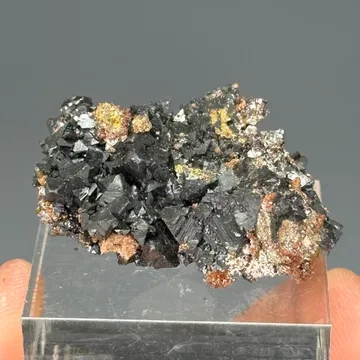
Common associated minerals at N'Chwaning II include calcite, bultfonteinite, oyelite, celestine, hematite, sturmanite-group material, xonotlite, quartz, goethite, manganite, gageite, pectolite, baryte, galena, hausmannite, hydroxyapophyllite-(K), siderite, natrolite, and rare combinations with andradite or pyrite. For collectors, the most attractive combinations are often olmiite on dark manganese ore, olmiite with white to colorless calcite, olmiite with delicate bultfonteinite needles, and olmiite with oyelite or xonotlite providing pale textural contrast.
Quality is judged by the completeness of the balls, the sparkle of the crystal terminations, the saturation and warmth of color, and whether the aggregates stand freely enough to show their radial form. Plates with multiple undamaged clusters can be very satisfying, but crowding matters: a few well-positioned, sharply exposed balls may be better than a busy plate of bruised or contacted domes. The finest pieces have a sense of architecture—rounded clusters projecting cleanly from the matrix, good color contrast, and minimal damage to the high points.
The central authenticity issue for N'Chwaning II olmiite is not a common treatment or artificial enhancement problem; it is nomenclature. Much N'Chwaning II material was originally sold as poldervaartite before analytical work established olmiite as the Mn-dominant analogue. Because olmiite and poldervaartite cannot be reliably separated by appearance alone, old labels reading “poldervaartite” from N'Chwaning II should be viewed skeptically unless backed by analysis. For most collector purposes, unanalysed N'Chwaning II “poldervaartite” is more plausibly olmiite.
Condition problems are common and should be evaluated closely. The spherical aggregates are made of many small crystal tips, so high points can be rubbed, flattened, or contacted without looking obviously broken at first glance. Edge contacts on plates are frequent, and some specimens show incomplete balls where the aggregate was attached to pocket wall or matrix. Examine luster under a strong light: fresh crystal tips flash; abraded surfaces look matte or sugary. Calcite-associated specimens add another fragility concern, as the calcite can be bruised, cleaved, or etched-looking.
Rarity is nuanced. Olmiite is rare as a species, and N'Chwaning II is the defining locality, but specimens are not unobtainable because early 2000s and later finds placed a meaningful number of pieces into the collector market. Ordinary miniatures and small plates appear regularly, especially from older stocks and dealer recirculation. Fine color, large intact balls, strong aesthetics, unusual associations, and old find provenance are much scarcer.
Current market availability remains active but uneven. Recent dealer listings show modest miniatures in the low hundreds or below, good miniature to small-cabinet pieces in the several-hundred-dollar range, and better or more sculptural examples reaching four figures. Exceptional size alone is not enough: damaged large hemispheres are less compelling than smaller complete, glassy balls with strong color. For serious acquisitions, ask for exact locality, old label history if available, and whether the specimen was ever analytically checked if it carries a legacy poldervaartite attribution.
The olmiite story at N'Chwaning II begins as a classic mineralogical misidentification, but on an unusually large stage. Poldervaartite had been described from the nearby Wessels Mine in 1993, and when attractive radial Ca-Mn silicate aggregates appeared from N'Chwaning II in the early 2000s, they were introduced to collectors under that name. The material was too good to ignore: milky to flesh-colored radial balls on dark ore, bow-tie sprays, and later, transparent amber, peach-pink, and orange spheres that could reach 3 to 4 cm across. Dealers and collectors treated them as spectacular examples of a rare species.
The difficulty was that the name had outrun the analysis. The N'Chwaning II specimens had not been chemically tested in the way their beauty deserved. Renato Pagano noticed that many N'Chwaning II “poldervaartites” looked quite different from Wessels material, and preliminary chemistry showed unusually high manganese. In 2006 and 2007, researchers at the University of Florence examined 25 N'Chwaning II specimens covering the range of habits, aggregates, and colors. Even dark cores and nearly colorless rims were checked. The result was not a minor variety but a new species: olmiite, named for Filippo Olmi.
The relabeling did not end with the type description. In August 2008, a Mindat discussion opened the question publicly: how many online “poldervaartite” photos should be changed to olmiite? Anatoly Kasatkin reported that more than 15 specimens from N'Chwaning II and Wessels, representing different habits and colors, had been analyzed and all proved to be Mn-dominant olmiite rather than Ca-dominant poldervaartite. His practical conclusion was blunt: visual examination cannot distinguish the two. That is why old labels still matter, but lab work matters more.
There is a memorable coda involving Bill Pinch’s collection. Kasatkin later described visiting Pinch and being allowed to remove a tiny fragment from an extraordinary miniature labeled “poldervaartite” from Wessels. It looked unlike the hundreds of “poldervaartites” he had already seen and tested: the crystals were prismatic, nearly colorless, and transparent. Back in Moscow, microprobe analyses and infrared spectra showed the result collectors had been waiting for—essentially pure poldervaartite. In other words, true poldervaartite did exist as beautiful crystals, but the event only emphasized how much N'Chwaning II “poldervaartite” in collections had to be reconsidered as olmiite.
A separate field account from N'Chwaning II gives a visceral sense of why specimens from this mine carry such provenance weight. A visiting collector described entering the mine in 2007 beneath the headgear, wearing an uncomfortable lamp and loose overall, gripping the bar of the mine vehicle as it passed a braking test before heading underground. The mine was described as a city below the Kalahari, with engineering stations, safe rooms, vehicle bays, rest areas, sidings, geologists, engineers, miners, and electricians all moving through the same industrial ecosystem. At the face, after a second check for rock stability, cavities in hard manganese ore appeared in the underground light. The heat and humidity were punishing; even the rock felt warm to the touch. Specimens were packed in old cloth and plastic containers before being brought to surface, where daylight revealed colors the mine lamps had flattened. That is the environment behind the clean olmiite balls collectors casually turn under a case light.