Nakhlak Mine, Iran — desert lead locality famed for cerussite with snowflake twins, orange wulfenite accents, and chromium-rich mimetite; historic mining roots.
Key facts
Nakhlak is one of the great desert lead localities of central Iran: an ancient, still-active Pb-(Ag) mine in the Anarak District of Nain County, Isfahan Province, roughly 55 km northeast of Anarak on the margin of the Central Desert. For collectors, its importance rests on a deceptively simple ore system. The primary ore is galena-rich, hosted in Upper Cretaceous carbonate rocks, with barite, calcite and quartz in steep fracture- and fault-controlled veins. Above that, oxidation made the specimens: cerussite in open, reticulated, sixling “snowflake” twins; small but sharp orange to red-orange wulfenite accents; and, in a later celebrated find, vivid chromium-rich mimetite outlining cerussite blades like a painted edge.
Nakhlak’s best specimens do not look like ordinary lead-mine gossan pieces. They are architectural. Fine cerussites can be loose, all-around lattices of lustrous white, colorless, or faint smoky blades, sometimes with tiny orange wulfenite tabs perched in the recesses. The most distinctive mimetite pieces are not massive yellow-green crusts, but delicate orange-red microcrystals tracing the rims of tabular cerussite twins from the 200 m level, giving the crystal groups a rare combination of geometry and color. Good Nakhlak pieces are judged less by sheer crystal size than by sharpness, completeness of the reticulated form, openness, luster, and the presence of attractive wulfenite or mimetite without damage.
Regional View
Country View
The mine also has unusual historical weight. Mining at Nakhlak is tied to Sassanid-period workings, and possibly to late Parthian activity; old adits, historical shafts, smelting remains and tools around the complex keep the locality in the conversation not only as a specimen source, but as one of Iran’s long-lived lead-silver mining centers. Modern mining began in the 1930s with German and Austrian technical involvement, and later industrial development made Nakhlak important in Iran’s twentieth-century lead industry, including early flotation production of lead concentrate.

Photo: Ivar Leidus / Wikimedia Commons
Search for specimens: View all specimens from Nakhlak Mine, Iran
Nakhlak is a carbonate-hosted Pb-(Ag) deposit in the Yazd-Anarak metallogenic belt of central Iran. The mine sits in the Anarak District, within a structurally complicated region where older Triassic successions, Cimmerian deformation, and later Cretaceous carbonate cover all matter to the present ore setting. The collectible ore is not a granitic pegmatite or a skarn-style suite; it is the oxidized expression of a low-temperature, galena-barite lead system in dolomitized carbonate rocks. Geological studies describe the deposit as an epigenetic, stratabound, vein-type Pb-(Ag) system with strong affinities to lead-rich Mississippi Valley-type mineralization.
The ore occurs mainly in the lower part of the Upper Cretaceous Sadar carbonate sequence, where dolomites and dolomitized sandy limestones are cut by steep east-west-trending veins and vein clusters. These veins are described as quartz-calcite-barite structures carrying massive galena. Reported vein thickness ranges from narrow mineralized seams of about 0.25 m to very large zones up to roughly 25 m, with individual bodies extending hundreds of meters along strike and down dip. Reserve figures reported in the geological literature describe about 7 million tonnes of ore averaging roughly 8.33% Pb, 0.38% Zn and 72 ppm Ag; galena concentrate analyses show that silver, antimony, copper, arsenic and zinc are meaningful trace components of the ore system.
The primary mineralogy is strikingly simple for such a famous collector locality. Galena and barite dominate the primary ore, with minor sphalerite, tennantite-tetrahedrite, pyrite and chalcopyrite reported as inclusions or subordinate phases. The spectacular collectible suite belongs mainly to the oxidized zone: cerussite is abundant and forms the iconic reticulated twins; anglesite and plattnerite occur as secondary lead phases; wulfenite adds molybdate color; and mimetite appears in the arsenate-rich supergene assemblage. Some of the best specimen descriptions place the finest cerussite and chromium-rich mimetite material at or near the 180–200 m levels, especially the well-known Vein 5 / 200 m material and the January 2015 chromium-rich mimetite-on-cerussite find.
Nakhlak is also important in Iranian mining history. Ancient mining has been traced to the Sassanid period, and possibly earlier, based on material from old adits and nearby historical ruins such as the Qaleh-Bozorg fortress. Around the Gombad and Shaft No. 1 workings, old mining features have been reported to reach about 80 m depth, with preserved evidence including smelters and mining tools such as picks, hammers, wooden shoes and lamps. Modern mine development began in the mid-1930s, when German and Austrian engineers and geologists worked in cooperation with Iranian mining interests. In the twentieth century Nakhlak also became a technical landmark: lead concentrate production by flotation was first practiced there in 1957, and a small lead smelter operated before being shut down in 1974 because of its uneconomic scale.
The mine remains an industrial operation rather than an open collecting area. Recent industry sources list Nakhlak as a lead and zinc plant associated with Iran Minerals Production and Supply Company, under the Iranian Mines and Mining Industries Development and Renovation Organization framework, with modern crushing and flotation-development projects reported in the 2021–2023 period. That status matters to collectors: material in the market normally comes through miners, dealers, old stocks, or previously distributed specimen lots, not from casual recreational collecting. Any visit would require permission from the land and mineral-rights holders and awareness of active underground-mine hazards.
Specimen availability has come in pulses. Western collectors first encountered distinctive Nakhlak reticulated cerussites in the 1970s, then again in more substantial supplies around the early 2000s, including material collected in 2000 and January 2001 from Vein 5 at the 200 m level. Further old stock and fresh releases appeared through specialist dealers in the 2010s. The 2015 material added a new visual signature: chromium-rich mimetite microcrystals in vivid orange-red outlining lamellar and tabular cerussite twins. Fine matrix pieces are much scarcer than loose reticulated cerussite clusters, and fully crystallized, undamaged floaters with open “snowflake” architecture are the standard by which the locality is judged.
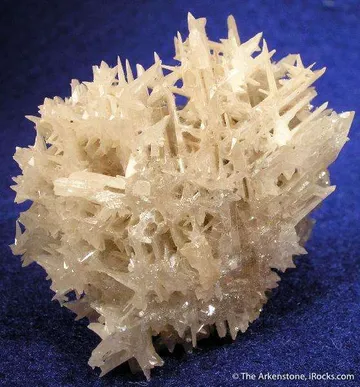
Cerussite is Nakhlak’s signature mineral and the species that put the mine into the front rank of modern lead-carbonate localities. The classic habit is reticulated, cyclically twinned cerussite in sixling “snowflake” lattices: lamellar to tabular blades intersecting in open, geometric frameworks, usually white, colorless, or faint smoky, and typically highly lustrous. Documented specimens range from thumbnails around 2–4 cm to small-cabinet pieces over 5 cm, with exceptional all-cerussite aggregates reported to more than 10 cm; individual blades on common pieces are often millimetric to roughly 1.5 cm, though larger crystal groups occur. The best-known production includes Vein 5 / 200 m level material collected around 2000–2001, plus later releases from about the 180–200 m levels. Associates may include galena, barite, wulfenite, anglesite, plattnerite and, in the 2015 material, chromium-rich mimetite. Top Nakhlak cerussites are open, sharp, complete and three-dimensional, with no obvious glued junctions, no flattened back, and enough luster to make the white lattice sparkle rather than read as chalky or bruised.
Nakhlak mimetite is most admired not as large freestanding crystals, but as a brilliantly colored arsenate accent on cerussite. The most distinctive specimens from the January 2015 find at about the 200 m level show very fine, sharp, elongated to prismatic microcrystals of vivid orange-red chromium-rich mimetite outlining lamellar and tabular cyclic twins of cerussite. Cabinet aesthetics are possible because the cerussite provides the architecture: reported specimens from dealer and museum-style photo records commonly fall in the 4–8 cm range, with main cerussite crystal groups several centimeters across, while the mimetite forms the bright edging. Shortwave fluorescence has been noted on some of these pieces. The best examples show an even, clean orange-red border on sharp cerussite without muddy coatings, crushed microcrystals, or confusion with the brighter botryoidal mimetite specimens from nearby Anarak localities such as Chah Mileh.
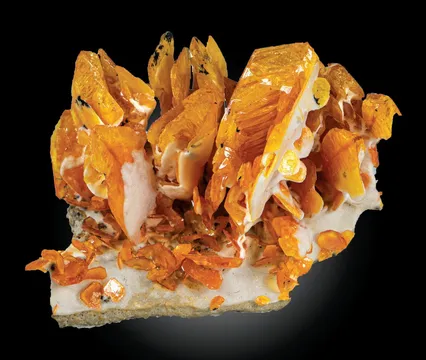
Nakhlak wulfenite is generally a vivid accent mineral rather than the large-plate centerpiece seen at some classic Arizona or Mexican localities. It occurs as small tabular to bladed crystals, commonly orange to red-orange, perched on or among cerussite blades; documented crystals on Nakhlak specimens are often only a few millimeters across, with a 4–5 mm tabular crystal on cerussite being typical of the better illustrated material. The strongest pieces are combination specimens: reticulated white or smoky cerussite carrying sharp, bright wulfenite tabs in balanced positions, where the color contrast is immediate and the wulfenite is not merely a microscopic afterthought. Ordinary pieces have sparse, damaged, or poorly placed wulfenite; good ones make the wulfenite part of the composition while still preserving the open cerussite architecture that defines the locality.
Other documented Nakhlak minerals include galena, barite, anglesite, plattnerite, hemimorphite, acanthite, sphalerite, pyrite, chalcopyrite, and tennantite-tetrahedrite-group minerals. Nakhlak is not chiefly a type-locality mine; its reputation comes from the quality and style of its oxidized lead minerals rather than from a long list of species first described there. The notable rarities for collectors are therefore contextual: chromium-rich mimetite on cerussite, uncommon high-quality anglesite on galena matrix, plattnerite as part of the secondary lead assemblage, and silver-bearing sulfide chemistry tied to the galena-dominant ore.
Nakhlak specimens should be bought with the same care one gives to Tsumeb or Touissit reticulated cerussite, and in some cases more. The best forms are delicate lattices of brittle, dense PbCO3; a piece can look airy and light but still carry enough mass to break if mishandled. Check blade edges, projecting spearpoints, twin junctions, and any contact points where the cluster meets matrix. Small chips and peripheral losses are common; they are not fatal on modest specimens, but they sharply affect value on high-end “snowflake” pieces where completeness is the entire point.
Repairs are the main authenticity concern. There is no widely documented Nakhlak-specific fake industry comparable to some reconstructed gem-crystal localities, but reticulated cerussite is exactly the kind of specimen that can be repaired or reattached without obvious disclosure. Inspect under 10x–20x magnification for glue in the junctions, unnatural glossy films, misaligned blade edges, or dust trapped in adhesive. Longwave UV can sometimes reveal modern epoxy, though fluorescence behavior of the minerals themselves means UV is a clue rather than proof.
Mislabelling within the Anarak District is a real practical issue. Chah Mileh, Chah Kharboze, Gowd, Chah Khouni and Nakhlak have all supplied colorful Pb secondary minerals, and older dealer labels may use variant spellings such as Nakhlak, Nahlak, Madan-e Nakhlak, Ma'dan-e-Nahlak, Esfahan or Isfahan. Bright orange botryoidal mimetite and fiery red wulfenite from nearby Anarak mines have sometimes circulated in discussions alongside Nakhlak material, so serious buyers should prefer labels that specify the exact mine and, when possible, the level or vein. “Nakhlak, Anarak” is better than “Iran”; “Vein 5, 200 m level, Nakhlak” is better still.
For cerussite, fluorescence is a useful bonus but not a locality guarantee. Some Nakhlak cerussite and mimetite-on-cerussite specimens have been reported as minor or shortwave fluorescent, but daylight aesthetics remain more important: luster, sharpness, open structure, lack of bruising, and all-around display. Keep specimens away from acids and aggressive cleaning methods; cerussite can be damaged by chemical treatment, and gossan or carbonate matrix can be altered. Because these are lead and, in the case of mimetite, arsenate-bearing specimens, handle sensibly: do not lick or soak them, wash hands after handling, and keep dust or broken fragments away from children and pets.
Market availability is intermittent. Small loose cerussite lattices still appear from older 2000–2001 and later lots, and some are affordable relative to their beauty. Fine matrix specimens, large complete snowflakes, pieces with balanced wulfenite, and chromium-rich mimetite-on-cerussite specimens are much more selective purchases. Provenance adds real value here: a recognized dealer label, an old collection label, a publication reference, a photographed specimen record, or a specific level attribution can separate a strong Nakhlak specimen from a merely attractive Iranian cerussite.
The oldest story at Nakhlak is not a romantic collector’s tale, but a mining one. In the desert northeast of Anarak, the lead workings are part of a landscape where archaeology and ore extraction overlap. Historical shafts near Gombad and Shaft No. 1 reportedly reach about 80 m, and old smelting sites and tools have been preserved around the workings: picks, hammers, wooden shoes and lamps, the simple equipment of generations who followed galena before the mine became a modern industrial complex. The nearby Qaleh-Bozorg fortress belongs to the same historical atmosphere. For a collector holding a glassy cerussite snowflake, that background matters: the specimen came not from a short-lived novelty pocket, but from a place where lead ore had human meaning long before mineral collecting existed.
One of the most vivid glimpses into the mine comes from a 1977 locality photograph note describing a place underground where a visitor could look upward into a cleft in the ceiling “lined as far as your light could see” with small sharp cerussite crystals. That single image explains why Nakhlak’s cerussite feels so different from ordinary oxidation-zone rubble. The finest specimens are not just isolated crystals; they are fragments of an underground architecture, a carbonate-hosted lead vein whose open spaces gave cerussite room to twin, cross, repeat and lace itself into lattices.
When the modern collector market began to recognize Nakhlak, the material arrived in waves. Distinctive snowflake-white reticulated cerussite first appeared in the 1970s, then the locality quieted. Around 2000–2002, more specimens reached Western shows, many labeled from Vein 5 at the 200 m level and some collected in January 2001. Collectors immediately compared the reticulations to Tsumeb, not because the two localities are geologically the same, but because both produced cerussite with that rare combination of precision, luster and sculptural openness. Later dealer notes describe old stock resurfacing after being packed away for years, a pattern that fits Nakhlak well: there has rarely been a continuous flood of specimens, only episodes.
The January 2015 chromium-rich mimetite find added a new chapter. Instead of asking collectors to admire yet another white cerussite lattice, it gave the cerussite a vivid border: orange-red mimetite microcrystals tracing the edges of lamellar and tabular cyclic twins. The result looked almost designed, as if someone had taken the classic Nakhlak snowflake and drawn along its margins with a fine mineral brush. Analyses showed the mimetite to be chromium-rich, and several specimens from this group were photographed, sold through major dealers, and later referenced in specimen literature. It is one of the few modern finds from the mine that can be recognized across a room by style alone.