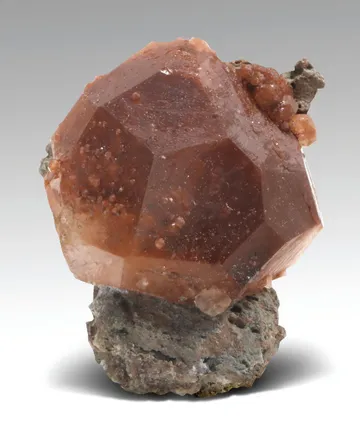
Qalat Payeen, Iran - a modern locality famed for zunyite crystals: red-brown tetrahedra set in a hematite-rich matrix from a Hormuz salt-dome near Bandar Abbas.
Key facts
Qalat Payeen is one of the great modern localities for zunyite, not because it is an old metal mine or a sprawling specimen-producing district, but because a small, exposed salt-dome system near Bandar Abbas yielded sharp, red-brown tetrahedra of a species that had long been represented in most collections by tiny, pale, or massive material. The locality is the Qalat Payeen Salt Dome, also recorded in the literature and specimen trade as Qalat-e Payeen, Qalat-e Bala, Qalat-e Balat, or Qalat-e Balal, in Bandar Abbas County, Hormozgan Province, southern Iran. It lies close to the Persian Gulf coast, about 24 km northwest of the harbor city of Bandar Abbas, within the broader Hormuz salt-diapir province of the southeastern Zagros.
Geologically, Qalat Payeen is a salt-plug locality of the Hormuz Complex: a diapiric body in which evaporites have carried, disrupted, and exposed altered volcanic, volcaniclastic, sedimentary, carbonate, and locally metamorphic material. The dome is described as a highly deformed, concentrically structured plug roughly 4 km across. Its specimen-producing rocks are not simple bedded ore but a violently rearranged mixture of light-colored rhyolite to rhyodacite, tuffs, ignimbrite, hematitic alteration zones, shales and siltstones, carbonate beds, gypsum and halite-bearing evaporites, and fractured green metamorphic rocks. That mix matters to collectors because it created the chemical environment in which aluminum-rich, fluorine- and chlorine-bearing zunyite crystallized with hematite.
The best Qalat Payeen pieces have an immediately recognizable look: lustrous tetrahedral zunyite crystals, often bevelled by small cube faces, in reddish brown to dark brown tones, rising from or partly embedded in a metallic, black to steel-gray hematite-rich matrix. Many crystals are enlivened by lamellar or scaly hematite inclusions, giving them a peppered or internally plated appearance rather than the glassy pale look familiar from older zunyite occurrences. Good crystals are sharp, complete, and architectural; ordinary pieces tend to be darker, more included, less isolated, or bruised along the high points of the tetrahedra.
Regional View
Country View
Collectors first began seeing the Iranian salt-dome zunyites as a serious world occurrence in the late 2010s, with Qalat Payeen material appearing on the international market around the 2018 Munich show and then in more substantial, better documented lots dated January 2019, July 2019, and May 2022. In a short span the locality moved from novelty status to mineralogical classic status: not because zunyite was new, but because the size, form, color, and hematite-rich character of the crystals were so far beyond the routine standard for the species.
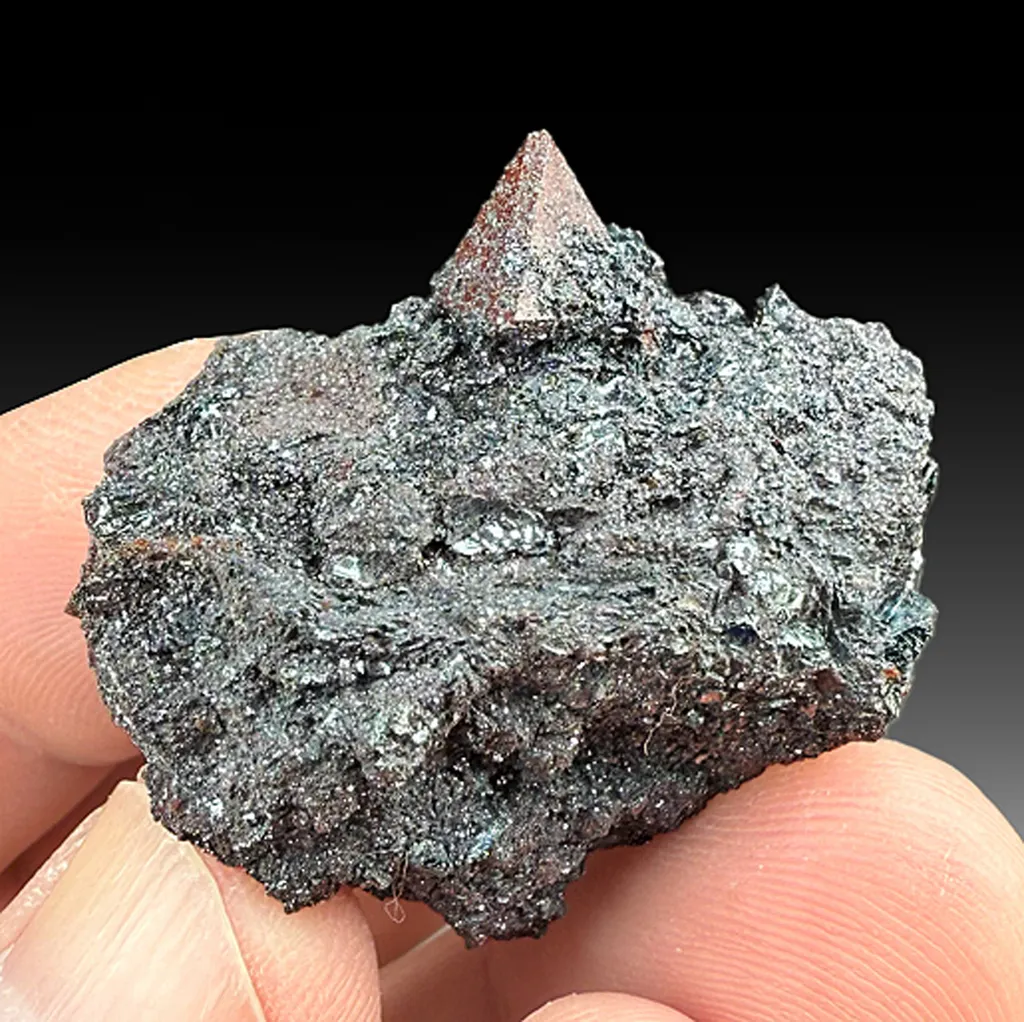
Photo: EarthWonders
Search for specimens: View all specimens from Qalat Payeen, Iran
The locality is best understood as a salt-diapir mineral occurrence rather than a conventional lode mine. Qalat Payeen belongs to the Hormuz salt-dome province of southern Iran, where evaporitic rocks have risen diapirically through the Zagros fold-and-thrust belt, entraining blocks and slices of volcanic, volcaniclastic, sedimentary, carbonate, and metamorphic rocks. Published locality descriptions place the dome near the village of Qalat-e Payeen, about 24 km northwest of Bandar Abbas, at approximately 27° 17' 49" N, 56° 3' 55" E. The plug is described as highly deformed and concentrically structured, about 4 km in diameter, and built of numerous hills of pale whitish, yellowish, pink, and greenish rhyolite to rhyodacite, with porphyritic textures, tuffs, ignimbrite, and strongly altered fracture zones.
The specimen mineralization is tied to those altered and fractured rocks. Qalat Payeen’s documented suite includes zunyite, hematite, fluorapatite, fluorite, gypsum, halite, and pyrite, with limonite after pyrite reported as cubes and pyritohedra. The host assemblage also includes green metamorphic rocks cut by epidotized and hematitized fractures, purple to brown shale and siltstone locally interbedded with sandstone, and beds of limestone, dolomitic limestone, and dolostone. A 2025 mineralogical study of red euhedral zunyite from Qalat-e Payeen reported optical zoning corresponding to bands of hematite inclusions; the same work noted quartz and phosphate inclusions in the zunyite and a matrix containing gypsum, calcite, and rutile.
There is no named, historic metal mine at Qalat Payeen behind the specimen story. Published records list salt as the exploitable commodity, while the collector material comes from exposed altered zones of the salt dome rather than from a formal underground mine with stopes, levels, or named veins. In the collector trade, the important production period begins with material that reached the Munich mineral market in 2018, followed by documented specimens from January 2019 and a particularly well represented July 2019 find. Later examples dated May 2022 show that the occurrence was not a one-time curiosity, though fine pieces remain much scarcer than the flood of common minerals from large commercial mines.
For modern collectors outside Iran, practical access is through the specimen market. Qalat Payeen is not a public fee-collecting locality with published visitor rules, and serious self-collecting would require local knowledge, permission, and safe field logistics in a hot, remote salt-dome environment. Specimens offered by reputable dealers generally appear as thumbnails and miniatures: isolated zunyite crystals perched on hematite-rich matrix, loose floater crystals, small clusters, or matrix pieces with one dominant crystal. The most desirable pockets produced lustrous, sharply bounded tetrahedra with cube bevels and visible hematite inclusions, commonly on metallic hematite-rich matrix; lesser pieces are incomplete, excessively embedded, heavily abraded, or visually confused by dark alteration.
Qalat Payeen zunyite is the mineral that put the locality on the collector map: reddish brown to dark brown, commonly hematite-included tetrahedral crystals, often with cube-face bevels and unusually smooth, sharply defined faces for the species. Documented specimens range from small thumbnail floaters of about 1 cm to matrix miniatures with crystals around 1.4–2.0 cm, with the broader Iranian salt-dome material recognized for producing exceptionally large and well-shaped zunyite compared with older classic occurrences. The typical association is hematite—both as lamellar or scaly inclusions within the zunyite and as a dark, metallic crystalline matrix—while studied material also shows inclusion and matrix relationships involving gypsum, quartz, phosphate material, calcite, and rutile. The best Qalat Payeen zunyites are isolated, aerial, lustrous tetrahedra with crisp corners, attractive reddish color, visible hematite texture, and minimal edge bruising; ordinary pieces tend to be squat, dark, fractured, too deeply embedded in matrix, or dulled by alteration.
At Qalat Payeen, hematite is important less as a standalone cabinet species and more as the visual and genetic companion that defines the zunyite specimens. It occurs as dark metallic crystalline matrix, scaly or lamellar inclusions in zunyite, and hematitic alteration in fractured volcanic and metamorphic rocks. Dealer and publication records repeatedly emphasize lamellar, scaly, or bright hematite inclusions as a distinguishing feature of Qalat Payeen crystals, giving the zunyite its reddish brown to dark brown tone and a speckled internal sheen. Good hematite-associated pieces show contrast: a sharp red-brown zunyite standing above a black to steel-gray hematite-rich base, or a crystal clean enough for its tetrahedral geometry to remain dominant while hematite inclusions add character; less attractive examples are visually overwhelmed by massive dark matrix or have hematite-rich surfaces that obscure the zunyite form.
Beyond zunyite and hematite, the documented Qalat Payeen suite is compact but geologically telling. Fluorapatite and fluorite reflect the fluorine-rich chemistry expected in altered volcanic and evaporitic settings, while gypsum and halite represent the active salt-dome environment itself. Pyrite is recorded from the locality, and limonite after pyrite occurs as cubes and pyritohedra, adding a pseudomorphic note to the assemblage. The 2025 analytical work on Qalat-e Payeen zunyite adds important micro-mineralogical context by recording quartz and phosphate inclusions in the zunyite and gypsum, calcite, and rutile in the matrix of studied specimens. No type-locality mineral currently defines Qalat Payeen; its significance rests instead on making an already rare species into a world-class display mineral.
The main authenticity issue with Qalat Payeen is not a well-documented fakery industry, but precision of locality and identification. Labels vary—Qalat Payeen, Qalat-e Payeen, Qalat-e Bala, Qalat-e Balat, and sometimes simply Bandar Abbas or Hormozgan—so older or abbreviated labels should be preserved, not “corrected” beyond recognition. The locality also sits within a broader Iranian salt-dome zunyite province that includes Hormuz Island and Larak Island, so serious collectors should distinguish Qalat Payeen material from other Hormuz Complex occurrences whenever possible.
Identification is usually supported by form and association, but the finest market specimens deserve more than a casual visual call. Qalat Payeen zunyite should show cubic-system tetrahedral habit, commonly bevelled by cube faces, reddish to dark brown color, vitreous luster where fresh, and hematite inclusions or hematite-rich matrix. Because the crystal form is striking, it can tempt overconfident identifications; analytical confirmation by Raman spectroscopy, X-ray diffraction, or well documented provenance is valuable for expensive pieces. Mindat locality data specifically notes XRD and XRF confirmation for zunyite from Qalat Payeen, and recent research used EMP, SEM, Raman spectroscopy, and single-crystal X-ray diffraction on Qalat-e Payeen material.
Condition matters greatly. Zunyite is hard enough to survive handling better than many alteration minerals, but the Qalat Payeen crystals are brittle, geometrically exposed, and often perched on friable hematite-rich matrix. Check the apex and tetrahedral edges under magnification; small chips there have an outsize visual effect. Also inspect the contact between zunyite and matrix, especially on dramatic “aerial” examples, because the visual appeal depends on the crystal rising cleanly and naturally from the base. Matrix pieces can shed hematitic grains, so they are best stored in fitted boxes and handled over a tray.
Fluorescence should be treated as an accessory observation, not an authentication test. Zunyite as a species may fluoresce red under shortwave ultraviolet light, but hematite-rich inclusions, opacity, coatings, and matrix effects can reduce or complicate the response. A non-fluorescent Qalat Payeen crystal is not automatically suspect, and a fluorescent response alone does not prove locality or species.
Market availability is intermittent. Since the Munich 2018 debut and the 2019–2022 finds, Qalat Payeen zunyites have appeared regularly enough that collectors can compare examples, but the supply of truly fine pieces is limited. Thumbnails with single sharp crystals are the commonest desirable format; miniatures with a well-positioned crystal on hematite-rich matrix are more competitive; large, undamaged, lustrous, isolated crystals with strong form and provenance are genuinely scarce. For a serious collection, an ideal Qalat Payeen specimen should have a recorded find date or dealer trail, a clean tetrahedral crystal, visible hematite character, and a label that preserves the original Iranian locality spelling.
The Qalat Payeen story entered the collector world quickly. In 2018, zunyite from Iran appeared at Munich as a novelty: not the tiny, pale accessory crystals familiar from older localities, but red-brown tetrahedra with real presence. Soon afterward, better documented pieces began circulating with find dates of January 2019 and July 2019, and the language around them changed. Dealer descriptions no longer treated the crystals as curiosities; they described a “modern find” that had already become a mineralogical classic.
One July 2019 specimen shows why. The piece later listed by Fabre Minerals as MD93AL3 measured 3.9 × 2.7 × 2 cm, with a main zunyite crystal 2 × 1.6 cm—large enough that the tetrahedral geometry reads across a room rather than only under a loupe. Its faces were described as very well defined and smooth, the color between reddish and dark brown, and the crystal packed with lamellar hematite inclusions. That specimen was later photographed as a reference for zunyite in Lapis, number 05/2020, page 9, helping fix the look of Qalat Payeen zunyite in the minds of European collectors.
The locality also produced specimens that were almost sculptural in pose. A May 2022 example obtained at Sainte-Marie-aux-Mines was described as an isolated, aerial zunyite crystal on matrix, 4.1 × 2.9 × 1.4 cm overall, with a 1.4 × 1.4 cm main crystal. The specimen was not merely another thumbnail from a rare species; it had the proportions collectors want from a display mineral—one strong crystal lifted away from the matrix, good luster, reddish to dark brown color, and lamellar hematite inclusions that tied it unmistakably to the Iranian salt-dome material.