Iran, a national-scale mineral province with Neyshabur turquoise, Nakhlak cerussite, rare iranite and talmessite, and multiple localities prized by collectors.
Key facts
Iran matters to collectors because it is not a single-locality story. It is a mineral province at national scale: an arid, tectonically complicated belt between Arabia and Eurasia where old lead-silver workings, porphyry copper systems, volcanic arcs, salt diapirs, zeolitized basalts, gold-arsenic deposits, and ancient turquoise mines all contribute specimens with strongly recognizable “Iranian” character. The country’s best-known collectible minerals are not only the famous blue Neyshabur turquoise, but also snowflake-reticulated cerussite from Nakhlak, red-orange wulfenite from the Anarak district, grass-green demantoid from Belqeys Mountain, rare chromates and arsenates such as iranite and talmessite from central Iranian lead deposits, sulfosalt microminerals from Barika and Zarshouran, and sharp recent analcime on barite from Mount Kahovan in Semnan Province.
Geologically, the collector is looking at a country stitched from major structural belts: the Zagros fold-thrust system, the Sanandaj-Sirjan zone, the Central Iranian blocks, the Alborz, and the long Urumieh-Dokhtar magmatic arc. Those names are not academic decoration; they explain why Iran can produce such different specimens within one national boundary. Porphyry copper systems and related oxidized assemblages give molybdate, arsenate, and carbonate minerals; carbonate-hosted and vein-style lead-zinc deposits give cerussite, anglesite, wulfenite, mimetite, and vanadinite; volcanic and subvolcanic rocks provide turquoise and zeolites; and the Persian Gulf salt diapirs have yielded startling, highly sculptural zunyite crystals.
The historical significance is exceptional. Neyshabur turquoise has been mined and traded for more than a millennium and sits at the heart of the phrase “Persian turquoise.” Nakhlak is one of the great old lead mines of the Anarak region, with ancient underground workings and modern specimen fame. The Barika and Zarshouran gold districts, meanwhile, are modern mineralogical laboratories: places where opaque, microscopic grains have become new IMA species and where Iran’s specimen reputation intersects with research mineralogy.
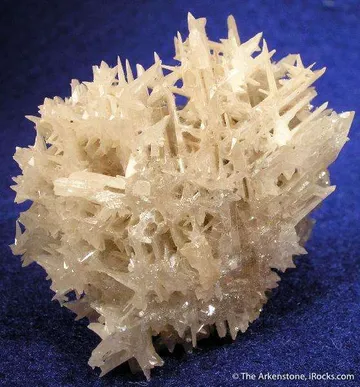
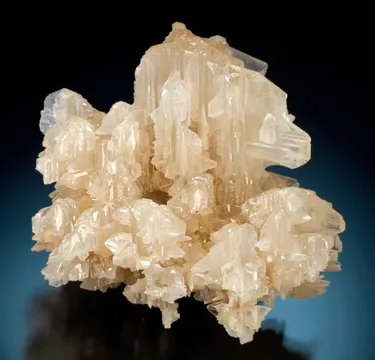
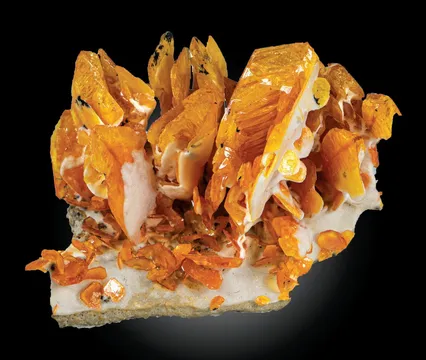
At their best, Iranian specimens are visually direct and memorable. Nakhlak cerussite forms white to cream reticulated lattices that look spun or frozen in mid-air. Chah Karboze wulfenite is small but fierce, with sharp red-orange plates on pale matrix. Belqeys demantoid appears as vivid green dodecahedral and trapezohedral garnets on gray host rock. Mount Kahovan analcime is sharper and more sculptural than many collectors expect from a country not traditionally placed beside India, Nova Scotia, or the Deccan basalts in zeolite collecting. The finest pieces have the quality collectors value most: a locality look that can be recognized across a room.
Regional View
Country View

Search for specimens: View all specimens from Iran
For specimen purposes, “Iran” should be read as a national collecting field made of several distinct deposit types rather than as one mine district. The most productive modern specimen sources fall into five broad settings: carbonate-hosted lead-zinc and lead-silver deposits of central Iran, oxidized copper and polymetallic systems, volcanic and subvolcanic turquoise deposits, zeolite-bearing basaltic volcanic fields, and salt-diapir assemblages along the Persian Gulf. The country’s tectonic position along the Alpine-Himalayan system is the underlying reason for that variety.
The Anarak district in Isfahan Province is the essential starting point for classic Iranian specimen collecting. Its lead-bearing deposits include the Nakhlak mine, Chah Khouni, Talmessi, Chah Milleh, Chah Karboze, and related workings. Nakhlak is a carbonate-hosted lead deposit whose ore bodies occur in dolomite and dolomitized sandy limestone as steep quartz-calcite-barite veins and vein clusters dominated by galena. The oxidized zone is where the collector’s specimens come from: cerussite in snowflake, reticulated, jackstraw, and twinned forms; wulfenite; mimetite; vanadinite; anglesite; malachite; and other secondary lead-copper minerals. Nakhlak’s reticulated cerussites are the country’s most instantly recognizable cabinet specimens, especially when the lattice is open, white, complete, and free of bruising.
Chah Karboze, also spelled in several ways on labels, is another Anarak-district name to know. Its wulfenite is generally much smaller than the best cabinet wulfenites from Arizona, Mexico, or China, but the best Iranian examples have a saturated red-orange color and bright luster that make even thumbnails desirable. Ahmad Abbas in Yazd Province has produced a very different wulfenite style: butterscotch to yellow-orange tabular crystals with white calcite, typically larger and more plate-like than the fiery Chah Karboze pieces. Chah Milleh is important for mimetite and vanadinite, including orange botryoidal mimetite and associated wulfenite; it is also the source of the unusual dark, spiky willemite pseudomorphs after descloizite that reached the specimen market in recent years.
Neyshabur in Razavi Khorasan Province belongs to another world entirely: a turquoise deposit in volcanic, subvolcanic, and hydrothermal breccia units at Raish Mountain. The area lies at the eastern end of the Quchan-Sabzevar magmatic arc, where volcanic rocks such as trachyte, andesite, and trachyandesite are cut by subvolcanic intrusions including monzosyenite, monzodiorite, quartz monzosyenite porphyry, and monzodiorite porphyry. The mine’s primary minerals include pyrite, magnetite, specularite, chalcopyrite, and bornite, while turquoise belongs to the secondary assemblage with chalcocite, hematite, covellite, and goethite. The important modern tunnels are Main, Dom, and Zahk, and the best rough is sorted by color, porosity, shape, toughness, and whether it occurs as clean nuggets, slabs, veins in host rock, chalky porous material, or chips.
Neyshabur’s production is strongly tied to mining method. Turquoise veins are irregular, commonly thin, and selectively followed by underground stoping. Fine veins are often only 1 to 2 cm thick, though upper Zahk has produced veins reported up to 4 cm. The mine is not merely a relic; a 2020 field report described three active tunnels, more than 200 workers, average production near four tons of rough turquoise per month, and annual production around 40 to 42 tons, with more than 70 percent of production then coming from Zahk. For collectors of natural turquoise in matrix, the key distinction is not the romance of the word “Persian” but the specific mine, color, compactness, and treatment history.
North-central Iran has added a more recent and very different collectible: analcime from Mount Kahovan near Moalleman in Semnan Province. The occurrence is described from a volcanic field and produces trapezohedral analcime crystals on basaltic matrix and, in later finds, on white barite. Associated species include calcite, epidote, and celadonite, with hematite or iron-oxide inclusions or staining contributing salmon, orange, or reddish tones to some crystals. The find began entering the Western show circuit in the late 2010s and continued to appear through later dealer updates, making it one of the country’s best modern zeolite contributions.
The Belqeys Mountain demantoid occurrence near Takab in West Azerbaijan Province belongs to metamorphic and ophiolitic terrain rather than to the central Iranian lead-zinc suite. Its best specimens show bright green andradite var. demantoid crystals on gray matrix, often with dodecahedral and trapezohedral forms and individual crystals reportedly reaching about 1.5 cm in high-quality examples. The finest pieces are true-green rather than yellowish, lustrous, and well isolated on matrix; many ordinary examples are crowded, dark, or only weakly translucent.
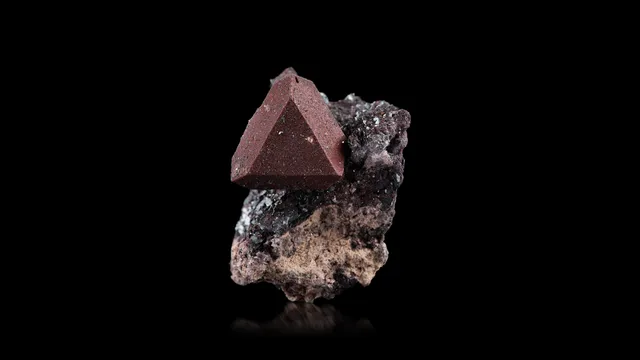
The Persian Gulf salt diapirs, especially in Hormozgan Province, are another distinctive Iranian setting. Zunyite from Qalat-e-Bala, Qalat-e-Payeen, Hormuz Island, and related salt-dome localities can occur as tetrahedral crystals and twins, brown to rust-red, sometimes with hematite peppering. The form is so sharp and geometric that good loose zunyites can look machined at first glance, which is precisely why they became notable specimens rather than just mineralogical curiosities. These diapirs have also produced anhydrite, gypsum, hematite, magnetite, sulfur, baryte, fluorite, calcite, dolomite, fluorapatite, pyrite, and related evaporite-associated minerals.
Modern Iranian collecting access is uneven. Some material comes from active industrial mines, some from historic underground workings, and some from remote or geologically sensitive districts. Many occurrences are not legal or safe casual-collecting destinations. Serious collectors should treat Iranian specimens as acquisition pieces rather than travel targets unless they have local permission, current safety information, and explicit legal access. Because labels from Iran have often been simplified for export as merely “Iran,” “Anarak,” “Hamadan,” “Takab,” or “Neyshabur,” a precise old label or dealer documentation naming the actual mine can add real scientific and market value.
Iranian analcime of collector interest is chiefly the modern Mount Kahovan material from Semnan Province: sharp, lustrous trapezohedra from a volcanic-field setting, first noted on the Western market from a December 2016 discovery and subsequently seen at Tucson, Munich, and European dealer updates. Crystals range from small thumbnails to miniature and small-cabinet plates; documented examples include individual specimens around 3 cm and later barite plates to about 9.5 cm. The crystals may be pure white, colorless and transparent, salmon-orange, or reddish from fine hematite and iron-oxide inclusions or staining, and associations include white barite, calcite, epidote, celadonite, and basaltic matrix. The best pieces show isolated, undamaged trapezohedra with glassy luster, strong contrast against white barite or dark matrix, and enough transparency or warm hematitic color to avoid the chalky look of ordinary zeolite crusts from the occurrence.
Beyond analcime, Iran is unusually rich in documented rarities and type-locality species. Iranite, a saffron-yellow lead-copper chromate, was named for the country and has its type-locality history tied to the Anarak district, with later discussion over whether Sebarz or Chah Khouni represents the true source of the type material. Talmessite was named for the Talmessi mine. Barika in West Azerbaijan Province has yielded a suite of rare Ag-Pb-Sb-As sulfosalts including barikaite, ferdowsiite, arsenquatrandorite, sardashtite, hayyanite, and lopatkaite, while Zarshouran near Takab is the type locality for the brilliant orange-red arsenic-mercury-lead sulfosalt daliranite. For cabinet collectors, the more visible Iranian rarities include demantoid from Belqeys Mountain, red-orange Chah Karboze wulfenite, butterscotch Ahmad Abbas wulfenite, Nakhlak reticulated cerussite, Chah Milleh mimetite and vanadinite, zunyite from Hormozgan salt diapirs, and natural Neyshabur turquoise in blue, greenish blue, spiderweb, and host-rock forms.
The first rule with Iranian specimens is label discipline. “Iran” alone is not enough for a serious collection. A Nakhlak cerussite, Chah Karboze wulfenite, Ahmad Abbas wulfenite, Belqeys Mountain demantoid, Mount Kahovan analcime, Neyshabur turquoise, and Hormozgan zunyite are not interchangeable national labels; they are different deposit types with different histories and diagnostic appearances. Specimens sold simply as “Anarak” deserve special scrutiny because several productive mines in the Anarak district have yielded superficially similar secondary lead minerals.
Nakhlak cerussite is fragile. The reticulated “snowflake” pieces are often loose or perched on minimal matrix, and the most desirable specimens have open lattices that are exactly the parts most vulnerable to compression, vibration, and careless wrapping. Examine them under side lighting for repaired breaks, missing lattice tips, and areas where white bruising has dulled the glassy adamantine luster. A complete miniature with a clean reticulated structure is preferable to a larger piece with crushed internal bridges.
Wulfenite from Chah Karboze is usually small, so scale matters. Dramatic photographs can make a 1.5 cm specimen look like a small cabinet piece. The premium is on intense red-orange color, sharp tabular form, luster, and undamaged edges. Ahmad Abbas wulfenite should not be confused with Chah Karboze: its butterscotch color, larger plates, and calcite “snowfall” association are a different look and locality. Old or vague “Iran wulfenite” labels should be updated only when the crystal style and provenance justify it.
Mount Kahovan analcime is a modern-market material, and the best pieces remain affordable compared with classic zeolite localities, but the finest examples are much less common than ordinary crusts. Watch for broken trapezohedron corners, dull iron staining that obscures crystal faces, and massive-looking aggregates with little separation. Reddish color alone is not enough; form and luster carry the value.
Turquoise is the most treatment-sensitive Iranian mineral in trade. The Neyshabur mine sells rough in natural form, but treatments are commonly applied later in lapidary workshops, especially to porous or chalky material. Stabilization, color enhancement, dyed substitutes, reconstituted turquoise, dyed howlite, dyed magnesite, and vague “Persian turquoise” marketing all require caution. Fine natural Neyshabur material is compact, takes a good polish, and may occur as clean nuggets, slabs, or attractive veins in host rock; lower-grade chalky turquoise may require stabilization to survive cutting. Even untreated turquoise is not inert: oils, perfume, sweat, heat, sunlight, and household chemicals can alter color over time.
Iranian demantoid from Belqeys Mountain is mostly a specimen-garnet market rather than a major faceted-stone market. The desirable pieces show vivid grass-green crystals with strong luster and clean placement on matrix. Be careful with claims based on “horsetail” inclusions: such inclusions can occur in demantoid from serpentinite-related settings outside Russia, so they should never be used as proof of Russian origin. Conversely, an Iranian locality claim should rest on matrix, crystal habit, label history, and trustworthy provenance.
Zunyite from Iranian salt diapirs can look unnaturally perfect, especially as loose tetrahedral floaters. The sharp geometry is real, but collectors should inspect for chips on edges, artificial oiling or coating, and matrix added for presentation. Many are loose crystals by nature; a floater is not automatically suspect. Good labels should distinguish Qalat-e-Bala, Qalat-e-Payeen, Hormuz Island, Larak Island, or other specific salt-diapir localities when known.
Iranian rare-species specimens such as iranite, daliranite, barikaite, ferdowsiite, arsenquatrandorite, hayyanite, and sardashtite should be treated as analytical minerals. Many are microscopic, opaque, or visually ambiguous, and some occur in complex intergrowths where visual identification is inadequate. For serious species collectors, polished sections, analytical reports, museum provenance, or publication-linked material are far more meaningful than an attractive hand label.
At Neyshabur, the story of turquoise is still underground, not just in museum cases. The mine lies at Raish Mountain, near the village of Ma’adan, where turquoise veins have been chased for centuries through short tunnels, vertical shafts, adits, stopes, and galleries. The old method was brutally direct: when a vein appeared at the surface and looked worth following, miners pursued it into the rock. Narrow vertical shafts widened into horizontal galleries where the turquoise lay, and the old workings had to contend with darkness, poor ventilation, and the ever-present risk of collapse. Some of those older openings still stand; others have fallen in.
The modern mine is still a maze. A 2020 field visit described three principal active tunnels: Main, Dom, and Zahk. The Main tunnel alone extends more than 2 km, with Chah Abdar reached by a shaft descending 80 m underground to the lowest level, where groundwater leaks into the workings. The Dom tunnel, 70 m above Main, was described as the most difficult to navigate; even after repeated instructions to follow the lights to active stopes, its paths could cause “serious confusion.” Zahk, whose entrance sits nearly 100 m above Main, was divided into upper and lower workings, with upper Zahk cut into the mountain through 15 levels and more than 60 m of vertical extent. In practical specimen terms, that geography matters: upper Zahk held some of the thickest turquoise veins reported in the mine.
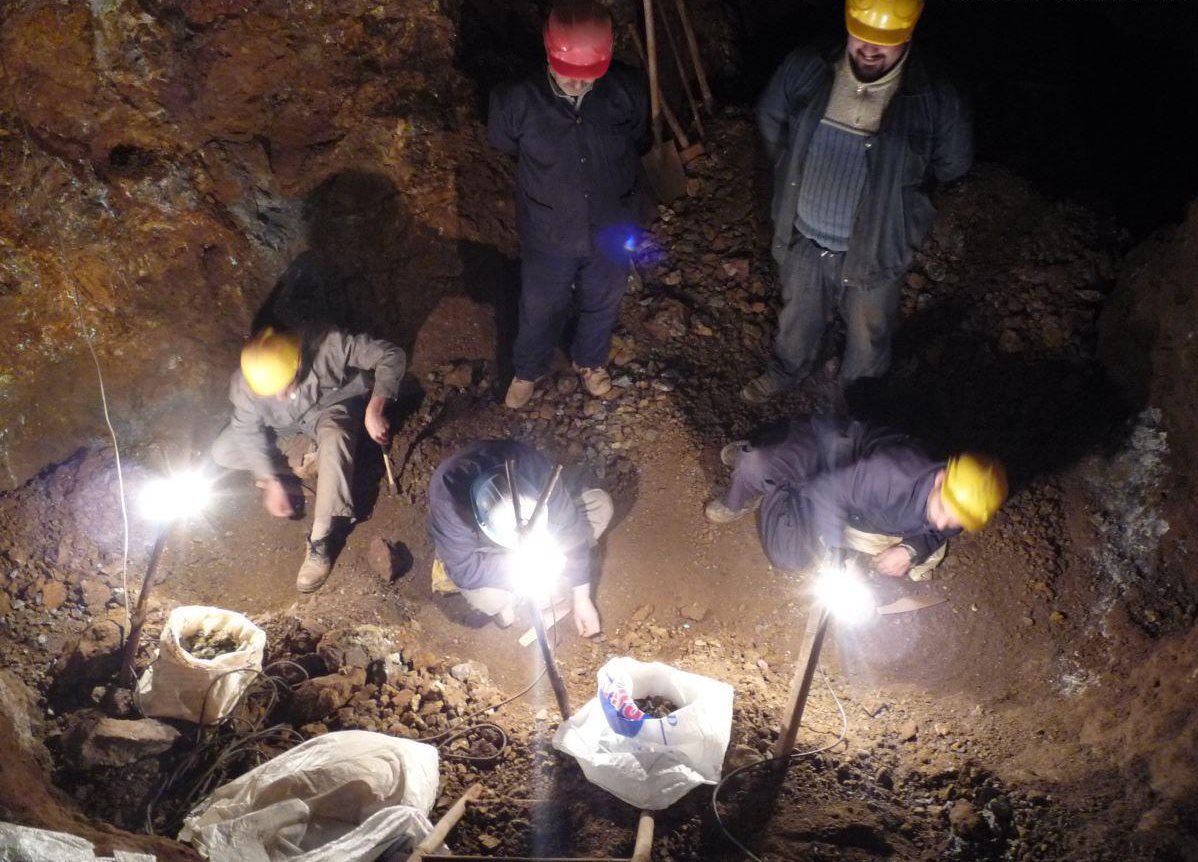
The sorting is still intimate and physical. Miners work in groups of three to five, supervised at the stope, sorting and cobbing the turquoise underground before it ever reaches the market. The rough is divided by color, quality, vein thickness, shape, and toughness, then bagged for the storeroom. When enough has accumulated, the cooperative holds auctions in the mine yard three or four times a year. Bags of rough are brought out, a base price is assigned, and lapidaries and traders from Mashhad, Neyshabur, and Esfahan bid for them. This is a long way from the romantic image of a single blue stone plucked from ancient Persia; it is a working mine economy, with more than 200 workers and dozens of tons of rough moving through a local network of cutters and merchants.
One of the most evocative details from Neyshabur is linguistic. The Main tunnel includes Sabz, Persian for “green,” and Chah Abdar, “water well.” The turquoise itself follows those names: some areas produce greener vein material, others more blue. The mine’s local grading vocabulary includes “nim rang,” meaning “half color,” for material less saturated than the first grade. For a collector, those words are a reminder that Persian turquoise is not a single color chip on a jewelry chart. It is a geological and cultural range: vivid blue, greenish blue, pale blue, green, white, spiderweb veins, chips for inlay, and natural compact pieces that need no treatment at all.
The discovery of daliranite has the flavor of a modern mineralogical detective story. At the Zarshouran arsenic-gold deposit near Takab, Farahnaz Daliran noticed conspicuously orange-red material during fieldwork connected with research on epithermal gold mineralization. The mineral was initially confused with ludlockite, a reasonable mistake by appearance, but later analytical work showed that the fibers represented a new species. The crystals are not cabinet trophies; type material is described as matted nests of acicular, flexible fibers up to only 200 μm long and less than a few μm wide. Yet the color was vivid enough in the field to draw attention, and the result was an IMA-approved species named in Daliran’s honor.
Iran’s modern specimen market has had its own small dramas. Nakhlak reticulated cerussite had appeared in the 1970s, then largely faded from Western availability before German prospectors brought abundant supplies to shows in the early 2000s. Further waves appeared in 2012–2013 and again through later European dealer updates. The pattern is now familiar for Iranian minerals: a locality long known geologically or historically suddenly becomes a specimen locality when the right pocket, the right local collector, and the right export path meet. Mount Kahovan analcime followed a similar modern arc, first discovered in December 2016, seen in small numbers at the 2017 Tucson Show, and later appearing in enough quantity for collectors to recognize the locality style.
The zunyite story is stranger still. From salt diapirs along the Persian Gulf coast came brown to rust-red tetrahedra, many loose, sharp, and edge-beveled, as if they had been cut by a machine. Reports described them as “floating” in salt domes, with some crystals peppered by black hematite. One dealer later claimed a 5.2 cm twin from Qalat-e-Payeen as the largest known euhedral zunyite crystal from Iran or anywhere else. Whether or not one ever owns such a giant, the Iranian zunyites changed how many collectors think of the species: not as a rare, dull accessory mineral hidden in rock, but as a sculptural object with its own stage presence.
Pierre Bariand and Paulette Herpin, “Une nouvelle espèce minérale: l’iranite, chromate hydraté de plomb,” Bulletin de Minéralogie, 86(2), 133–135, 1963. Original description of iranite, named for Iran, with the type-locality history tied to the Anarak district. (mindat.org)
“Iranite,” Mindat mineral entry. Useful for the modern formula Pb10Cu(CrO4)6(SiO4)2(OH)2, mineral data, and the note that Bariand and Poullen later suggested Chah Khouni rather than Sebarz may be the true source of the type material. (mindat.org)
“Iranite,” Smithsonian National Museum of Natural History Collections Search Center. A museum record for iranite material in a major institutional collection. (collections.si.edu)
Pierre Bariand and Paulette Herpin, “Un arséniate de calcium et de magnésium, isomorphe de la β rosélite,” Bulletin de la Société française de Minéralogie et de Cristallographie, 83, 118–121, 1960. Original work on talmessite, named for the Talmessi mine in the Anarak district. (en.wikipedia.org)
W. H. Paar, A. Pring, Y. Moëlo, C. J. Stanley, H. Putz, D. Topa, A. C. Roberts, and R. S. W. Braithwaite, “Daliranite, PbHgAs2S6, a new sulphosalt from the Zarshouran Au-As deposit, Takab region, Iran,” Mineralogical Magazine, 73(5), 871–881, 2009. The original daliranite description; later structural work revised the formula to PbHgAs2S5. (mindat.org)
Karlsruhe Institute of Technology, “Daliranite – KIT Researcher Discovers a New Mineral,” 2009. Short institutional account of Farahnaz Daliran’s discovery of the orange-red mineral at Zarshouran. (kit.edu)
Dan Topa, Emil Makovicky, Hubert Putz, Gerhard Zagler, and Hossein-Ali Tajeddin, “Barikaite, Pb10Ag3(Sb8As11)Σ19S40, a new member of the sartorite homologous series,” Mineralogical Magazine, 77(7), 3039–3046, 2013. Description of barikaite from the Barika gold deposit in West Azerbaijan Province. (citeseerx.ist.psu.edu)
Emil Makovicky, Dan Topa, and Hossein-Ali Tajeddin, “Ferdowsiite: A new mineral from the Barika ore deposit, Iran,” The Canadian Mineralogist, 51, 727–734, 2013. Description of ferdowsiite and its complex replacement relationships with arsenquatrandorite, guettardite, smithite, and tetrahedrite-tennantite. (rruff.info)
CNMNC Newsletter No. 16, Mineralogical Magazine, 77(6), 2695–2709, 2013. Includes arsenquatrandorite from the Barika gold deposit among new minerals approved in 2013. (rruff.info)
Barika ore deposit, Mindat locality entry. Valuable summary of the Barika assemblage, including arsenquatrandorite, barikaite, ferdowsiite, lopatkaite, sardashtite, and hayyanite. (mindat.org)
Wendell E. Wilson, “The Nakhlak Mine, Anarak District, Esfahan Province, Iran,” The Mineralogical Record, vol. 54, no. 3, 2023. Major modern specimen-mineralogy treatment of Nakhlak. (lggmclub.org)
Vachik Hairapetian, Tim Welting, and Herwig Pelckmans, “Wulfenites from Central Iran: A Review and Some New Observations,” Rocks & Minerals, 90(5), 426, 2015. A focused review of Iranian wulfenite occurrences and specimen styles. (openurl.ebsco.com)
Vachik Hairapetian, Herwig Pelckmans, Tim Welting, Alireza Sarami, and Pourya Hosseini, “New Finds of Mimetite and Vanadinite from Central Iran,” Rocks & Minerals, 91(5), 402–413, 2016. Important article on Chah Milleh and related central Iranian arsenate-vanadate specimen finds. (tandfonline.com)
Vachik Hairapetian, Herwig Pelckmans, and Hossein Basirat, “Zunyite Crystals in Salt Diapirs from Southern Iran,” Rocks & Minerals, 95(2), 118–127, 2020. The key publication on Iranian zunyite from Persian Gulf salt diapirs. (tandfonline.com)
Bahareh Shirdam, Andy H. Shen, Mingxing Yang, Zahra Mokhtari, and Hamed Fazliani, “Persian Turquoise: The Ancient Treasure of Neyshabur,” Gems & Gemology, Fall 2021. The best modern field report on Neyshabur turquoise geology, mining, sorting, production, treatments, and market structure. (gia.edu)
Mansour Ghorbani, The Economic Geology of Iran: Mineral Deposits and Natural Resources, Springer, 2013. Broad English-language reference on Iran’s mineral deposits and metallogenic framework. (link.springer.com)
Wenrich-style market documentation in The Mineralogical Record “What’s New in the Mineral World” online reports, especially reports covering Nakhlak cerussite, Chah Karboze wulfenite, Mount Kahovan analcime, Belqeys demantoid, and Hormozgan zunyite. These are especially useful for tracing when Iranian specimen lots entered Western shows and dealer inventories. (cdn.mineralogicalrecord.com)
Persian Turquoise: The Ancient Treasure of Neyshabur — GIA — Essential field-based account of Neyshabur geology, tunnels, mining, sorting, treatments, and production.
Nakhlak Mine — Mindat — Locality data for the classic Anarak lead deposit and its cerussite-rich oxidized assemblage.
Mount Kahovan analcime specimen record — Mindat minID — Useful example of the modern Mount Kahovan analcime association with calcite, epidote, celadonite, and basaltic matrix.
Belqeys Mountain demantoid — Mindat locality entry — Photo-rich reference for the Takab demantoid occurrence.
Barika ore deposit — Mindat — Detailed mineral list for the Barika sulfosalt locality, including several Iranian type-locality species.
Zareh Shuran Mine — Mindat — Locality reference for Zarshouran/Zareh Shuran, type locality for daliranite.
Iranite — Mindat — Mineral entry for Iran’s namesake chromate species and its Anarak district type-locality discussion.
Daliranite — Mindat — Mineral entry summarizing daliranite’s type locality, color, formula revision, and type material.
Zunyite Crystals in Salt Diapirs from Southern Iran — Rocks & Minerals — Key article on the Persian Gulf salt-diapir zunyite discoveries.
New Finds of Mimetite and Vanadinite from Central Iran — Rocks & Minerals — Focused publication on central Iranian mimetite and vanadinite specimen finds.
The Economic Geology of Iran — Springer — Broad reference for Iran’s mineral deposits and metallogenic setting.
Cerussite from Nakhlak Mine — Wikimedia Commons — High-resolution open-license photograph of a classic Nakhlak cerussite specimen.
Neyshabur turquoise mine sorting photograph — Wikimedia Commons — Open-license underground image of turquoise-bearing material being hand sorted.