A collector's guide to Anarak District, Iran: its geology, mining history and notable minerals, illustrated with the 35 specimens documented from this locality on EarthWonders.
Key facts
Anarak District is one of Iran’s great collector localities not because it is a single mine, but because a tight desert mining district northeast of Nain gathers several very different mineralizing systems into one name. For the specimen collector, the district is best known for oxidized lead deposits that produced reticulated cerussite, orange to red-orange mimetite, brilliant wulfenite, descloizite, and the remarkable Chah Milleh pseudomorphs in which descloizite crystal forms are preserved by later willemite and carbonate-arsenate overgrowths. For the economic geologist, the district also includes the Nakhlak carbonate-hosted Pb-Ag deposit, sediment-hosted Pb-Zn bodies in the Yazd-Anarak metallogenic belt, and the older Cu-Ni-Co-As-U assemblages of Talmessi and Meskani, whose arsenide-rich mineralization has been compared with classic “five-element” deposits.
Regional View
Country View
The district sits on the southern fringe of the Dasht-e Kavir, in an austere landscape where ancient lode workings, abandoned adits, modern exploration, and small desert settlements all overlap. Its mineralogy reflects that structural complexity. The Nakhlak deposit is a galena-barite system in faulted Upper Cretaceous carbonate rocks, with supergene cerussite, anglesite, plattnerite, wulfenite, and mimetite developed from lead ore. Chah Milleh is a more irregular Pb-Zn-Cu deposit in older schists and marbles, noted for solution cavities and a late secondary assemblage rich in calcite, cerussite, mimetite, wulfenite, willemite, and descloizite. Talmessi and Meskani, by contrast, are collector names from a different world: copper, nickel, cobalt, arsenic, uranium, and secondary arsenates such as talmessite and seelite.
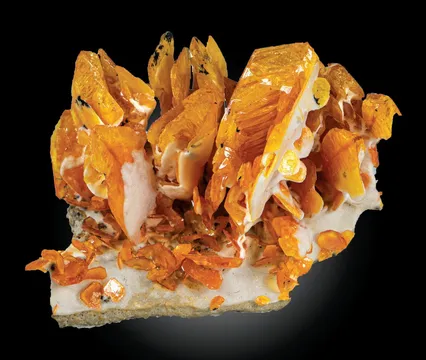
The best Anarak specimens have a look unlike any other Iranian material. Nakhlak cerussite is often a white to water-clear lacework of thin, tabular to lamellar twins, sometimes as complete floaters and sometimes edged by vivid orange-red mimetite microcrystals. Chah Milleh pieces can be sculptural: branching, herringbone, or “Christmas tree” forms inherited from descloizite, replaced or coated by pale to glittering willemite and dusted with orange mimetite, wulfenite, minium, calcite, and cerussite. The finest Chah Kharboze wulfenites are small but incandescent, with red to red-orange blades on pale matrix.

Photo: Ivar Leidus, Wikimedia Commons
Search for specimens: View all specimens from Anarak District, Iran
Anarak District is a political and mining district in Nain County, Isfahan Province, with the town of Anarak as its center and Chupanan Rural District forming its rural component. In collector usage, “Anarak” usually refers to a group of mines and prospects scattered across the desert around Anarak and Nakhlak: Nakhlak, Chah Milleh, Chah Kharboze, Chah Khouni, Kali Kafi, Gowd, Sebarz, Talmessi, Meskani, and related occurrences. Labels may use Esfahan or Isfahan, Nain or Na’in, and older specimens may simply say “Anarak, Persia” or “Nakhlak, Iran.”
The district lies within a structurally busy part of central Iran, near the intersection of the Great Kavir-Doruneh fault system and the Urumieh-Dokhtar magmatic belt, and within the broader Yazd-Anarak metallogenic belt. That position helps explain why the district is not mineralogically uniform. Its lead-zinc systems include carbonate-hosted, structurally controlled deposits whose features are comparable to Mississippi Valley-type mineralization; its copper-nickel-cobalt deposits include arsenide-rich ores associated with Eocene volcanic rocks, ultrabasic rocks, and later fault reactivation; and its chromate-bearing Pb-Cu-Zn occurrences yielded classic rarities such as iranite.
Nakhlak, roughly northeast of Anarak, is the most important lead mine in the district and one of the best-known Iranian specimen localities. The ore body is hosted mainly in the lower part of Late Cretaceous carbonate rocks, especially faulted and fractured Sadar carbonates. Geological studies describe steeply dipping, east-west-trending, stratabound epigenetic veins controlled by fractures and faults. The primary ore is dominated by galena and barite, with minor sphalerite, tennantite-tetrahedrite, pyrite, and chalcopyrite. The collector minerals that made Nakhlak famous are largely supergene: cerussite, anglesite, plattnerite, wulfenite, mimetite, and related lead phases produced by oxidation of the galena-barite ore.
Published reserve and grade figures for Nakhlak describe a deposit containing about 7 million tonnes of galena-barite ore averaging 8.33% Pb, 0.38% Zn, and 72 ppm Ag. Fluid-inclusion work indicates low-temperature basinal brines, and sulfur isotope data have been interpreted as consistent with sulfate ultimately tied to Permian-Triassic evaporitic sources. The result, in specimen terms, is a lead-rich oxidized zone capable of producing superb cerussite twins and unusual chromian mimetite rims on cerussite.
Chah Milleh, also spelled Chah Mileh or Tchah-Mille, is a separate Pb-Zn-Cu mine near the village of Chah Milleh. It is reported at about 1500 meters elevation and was abandoned in 1959. The ore deposit is described as extensive but irregular, hosted in Upper Proterozoic schists and marbles. The mineralization is lenticular, reaching reported dimensions up to about 20 meters long and 3 meters thick, and lies along a crushed contact zone between marble and schist cemented by coarse-crystalline calcite. Five adits were used during its main working period in the 1950s; one extended about 200 meters into Milleh Mountain and gave access to large solution cavities described in the literature as geodes.
Those cavities are the key to the best Chah Milleh specimens. The locality’s species list is not large by Talmessi standards, but it is intensely collector-relevant: calcite, aragonite, baryte, galena, sphalerite, chalcopyrite, chalcocite, cerussite, mimetite, wulfenite, descloizite, willemite, hemimorphite, hydrozincite, leadhillite, linarite, malachite, chrysocolla, cuprite, minium, plattnerite, and quartz are all documented. The 2015-era specimen finds of willemite after descloizite, commonly with mimetite and cerussite, are among the most distinctive modern Iranian mineral discoveries.
Chahmileh, in modern geological literature, is a sediment-hosted Pb-Zn deposit about 30 kilometers northeast of Anarak and about 12 kilometers south of Nakhlak. It is hosted in Middle Triassic dolomitic marble of the Chah Gorbeh Complex and controlled mainly by NW-trending faults. Three mineralized zones are described there: Kuh-e Mileh, Seilacho, and Mazra-e Deraz. The largest, Kuh-e Mileh, has been reported with an approximate reserve of 1 million tonnes at 2.15% Pb + Zn. Its primary ore assemblage is simple—galena, sphalerite, minor chalcopyrite and pyrite, with quartz, dolomite, calcite, and baryte—but weathering produced cerussite, hemimorphite, mimetite, wulfenite, smithsonite, malachite, iron oxyhydroxides, and associated secondary minerals.
Chah Kharboze is another small but important collector locality, especially for red wulfenite. The locality’s history has been traced back to mining activity in the Sassanid period, and its modern specimen reputation rests on small, intensely colored, lustrous wulfenite crystals, usually only millimeters across but sometimes covering attractive thumbnail to miniature matrices. It also yields cerussite, calcite, aragonite, galena, hemimorphite, mimetite, and pyromorphite. Labels can vary considerably: Chah Kharboze, Chah Karbuzeh, Tchah-Kharboze, Shah Kharbuzeh, and related transliterations all appear in the market.
Talmessi and Meskani, west of Anarak, represent the district’s Cu-Ni-Co-As-U side. Native copper is reported to have been mined at Talmessi since ancient times. Nickel and cobalt were discovered there in 1930, and uranium mineralization was discovered in the 1950s. Modern studies separate the mineralization into an earlier copper sulfide stage related to Eocene volcanism and a later nickel-copper arsenide stage with nickeline as a principal mineral, accompanied by chalcocite, pyrite, and a complex secondary arsenate assemblage. Talmessi and Meskani were the two main deposits in the area to have produced copper, nickel, and cobalt together; mining ceased in 1960, and later work included re-evaluation and uranium-related exploration.
Production records and summaries show how serious the Talmessi workings once were. Large-scale mining was recorded between 1937 and 1940; 1939 production included about 1500 tonnes of ore grading 4.5% copper and about 1000 tonnes of ore containing roughly 10% or more nickel, with cobalt consistently present in lower concentrations. Native copper blocks weighing up to about half a tonne were reported. A French company, Cofimines, re-evaluated the deposit in 1970-1971 and estimated remaining reserves to 100 meters depth at about 450,000 tonnes with combined Cu, Ni, and Co grades of 1-2%.
Collecting access in the district is not comparable to a public fee-dig locality. Some workings are abandoned, some are industrial or under government and company control, and some are remote desert sites where legal access, safety, and local permission are decisive. Specimens reaching collectors today generally come through Iranian collectors, older European material, and international dealers rather than casual tourist collecting. For serious collectors, provenance matters: a label specifying Nakhlak 180 m or 200 m levels, Chah Milleh 2015 pseudomorph material, Chah Kharboze red wulfenite, Sebarz iranite, or Talmessi type-locality arsenates carries more information than a broad “Anarak” label.
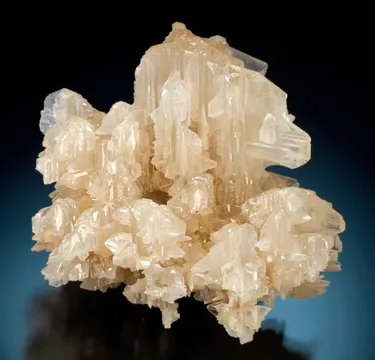
Cerussite is the signature display mineral of Nakhlak and the most widely recognized Anarak specimen species. The classic habit is a reticulated, branching, or lattice-like aggregate of cyclic twins, commonly with thin lamellar to tabular crystals that are sharp, lustrous, transparent to white, and surprisingly sculptural for a lead carbonate. Fine specimens are usually small cabinet or miniature size, but the visual weight comes from three-dimensional architecture: complete floaters, undamaged terminations, open lacework rather than massive intergrowth, and enough transparency or snowy white contrast to show the twinning clearly. Documented dealer and publication records place notable pieces from Nakhlak levels around 180 m and 200 m; some 2015 material is especially striking where orange-red chromium-rich mimetite microcrystals outline the edges of cerussite twins. Chah Milleh also produces cerussite, often as a later generation on willemite-after-descloizite pseudomorphs with mimetite, calcite, minium, and wulfenite, but the archetypal Anarak cerussite is the fragile Nakhlak reticulated floater.
Mimetite from Anarak District occurs in several distinct specimen styles, and careful locality attribution matters. From Chah Milleh, collector reports and published show notes describe orange to reddish orange balls, coatings, and small barrel-shaped to prismatic crystals, commonly on or around willemite after descloizite and sometimes associated with wulfenite, cerussite, calcite, and minium. From Nakhlak, the most distinctive modern material is chromium-rich mimetite forming very thin, sharp, vivid orange-red microcrystals along cyclic-twinned cerussite; these have been analyzed and are repeatedly noted as a rare chromium-bearing variety. Good Anarak mimetite is not usually about large individual crystals, but about color, brightness, and placement: the best pieces use orange mimetite as a precise edge or sparkle against white cerussite, pale willemite, or calcite, while ordinary pieces are duller, more massive, or visually lost in mixed oxidation crust.
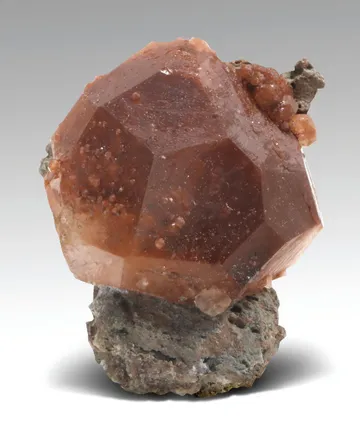
Descloizite is most important at Anarak as the original architecture behind Chah Milleh’s famous pseudomorphs. Specimens preserve stacked, herringbone, arborescent, flattened, or spiky descloizite growths, but many of the best collector pieces are now willemite after descloizite, sometimes also partly altered or overgrown by cerussite and mimetite. Reported Chah Milleh examples include cabinet-sized pieces with individual pseudomorphed descloizite forms several centimeters across; a premium example is sharp, aerial, complete, and recognizable as descloizite in habit even when the surface chemistry has changed. Associated orange mimetite, wulfenite, red minium, calcite, hemimorphite, or late cerussite greatly improves the best pieces, but only when these species enhance rather than obscure the pseudomorphic structure.
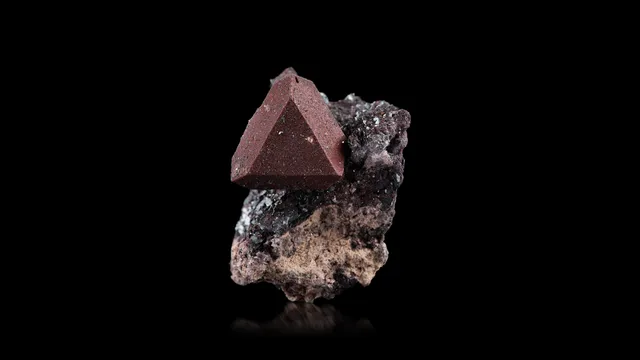
Beyond cerussite, mimetite, and descloizite, Anarak District is a locality of real mineralogical breadth. Mindat lists more than one hundred valid minerals for the district, including wulfenite, galena, anglesite, plattnerite, pyromorphite, vanadinite, phosgenite, hemimorphite, smithsonite, willemite, linarite, leadhillite, caledonite, malachite, chrysocolla, cuprite, minium, cinnabar, baryte, calcite, aragonite, quartz, sphalerite, chalcopyrite, chalcocite, acanthite, native silver, and native copper. Its type-locality importance is concentrated in three species: iranite from the Sebarz mine, talmessite from the Talmessi mine, and seelite from Talmessi, the last shared with Rabejac in France. Talmessi also contributes a complex suite of nickel-cobalt-copper arsenides and secondary arsenates, including nickeline, rammelsbergite, safflorite, skutterudite, annabergite, erythrite-series material, pharmacolite, picropharmacolite, roselite, tyrolite, zeunerite, uranospinite, uranophane, uraninite, and related uranium-bearing phases.
The main authenticity issue for Anarak specimens is not widespread artificial enhancement, but locality precision. “Anarak” can mean Nakhlak, Chah Milleh, Chah Kharboze, Chah Khouni, Gowd, Sebarz, Talmessi, or another district occurrence, and the specimen style can change drastically from mine to mine. Mimetite has been particularly vulnerable to loose attribution: show and dealer reports have noted material called Nakhlak that appears in other contexts as Chah Milleh, and both mines lie within the same district. Labels should be preserved exactly, including spellings, level information, dates, and former-owner notes.
The most common condition problem is breakage. Nakhlak cerussite is dense as a mineral but delicate as a structure: reticulated crystals snap easily, and small repairs or missing tips can be hard to see in a white lattice. Examine the ends of tabular twins under magnification, and look for fresh, flat, overly bright breaks. Chah Milleh pseudomorphs can be more robust in mass but are still prone to bruised branch tips, rubbed mimetite, and broken wulfenite plates. Red-orange Chah Kharboze wulfenite is typically tiny and should be judged under magnification; edge damage is common, and color alone should not carry the specimen if the crystals are scattered or incomplete.
Fluorescence is a useful but limited supporting observation. Some Nakhlak cerussite and cerussite-mimetite specimens are reported as weakly or minor fluorescent under shortwave ultraviolet light, and willemite-bearing Chah Milleh pseudomorphs may show the expected yellow-green response. Fluorescence should not be treated as proof of locality, because it varies by species and generation and because similar responses occur in many lead-zinc districts worldwide.
Handling deserves unusual care because several Anarak species contain lead, arsenic, chromium, uranium, or nickel. Cerussite, mimetite, descloizite, wulfenite, iranite, talmessite-associated arsenates, and uranium minerals from Talmessi are display specimens, not materials for acid testing, grinding, or children’s handling. Wash hands after handling, keep friable powders contained, and store radioactive uranium-bearing material from Talmessi with ordinary radioactive-mineral precautions: distance, ventilation, labeling, and avoidance of prolonged close storage near occupied spaces.
On the market, Nakhlak cerussite appears intermittently and is available in a wide range from small damaged examples to choice miniatures and small cabinet floaters. The best reticulated floaters, especially with mimetite edging or documented 180-200 m level provenance, are much scarcer than the locality name suggests. Chah Milleh willemite-after-descloizite material was a short-lived modern find and good, complete, three-dimensional examples with bright mimetite are not common. Chah Kharboze wulfenite remains famous, but most examples are thumbnails or small miniatures; a piece with both size and uncompromised red luster is a premium specimen.
In Anarak, the mining story begins before modern geology gives it names. Copper mining in the district is thought to reach back to pre-Islamic times, and older workings followed the lode directly into the hillsides. The most evocative remnants are the wind catchers, or badgirs, built to ventilate the shafts. In most mineral districts, early mining leaves dumps, pits, and vague tradition; at Anarak it left a recognizable desert technology, the same architectural idea used to breathe air through buildings, adapted to keep underground workings alive.
Talmessi is the district’s heavy-metal chapter in every sense. Native copper had been mined there long before the discovery of nickel and cobalt in 1930, and by the late 1930s the workings were no longer merely old desert prospects. Records describe large-scale mining from 1937 to 1940. In 1939 alone, production included about 1500 tonnes of ore grading 4.5% copper and roughly 1000 tonnes of ore containing 10% or more nickel, with cobalt persistently present in smaller amounts. The most memorable detail is physical rather than statistical: blocks of native copper weighing up to half a tonne were found. For a collector accustomed to thumbnail copper wires or cabinet plates, that figure re-scales the mine completely.
Chah Milleh’s story is underground and cavernous. During its 1950s working period, five adits penetrated the mountain, one extending about 200 meters into Milleh Mountain. Those workings opened large solution pockets, the “geodes” described in older accounts, in a crushed contact zone between marble and schist sealed by coarse calcite. Decades later, that same geological architecture explains why the mine could produce such improbable specimens: not just crystals on a wall, but branching descloizite forms later transformed into willemite, then dusted with mimetite, wulfenite, cerussite, calcite, and minium. The best pieces look less like ordinary oxidized ore and more like a mineralized memory of a vanished crystal forest.
The Chah Kharboze wulfenites carry a different kind of field story. The crystals are famous today as bright red to red-orange collector specimens, but historical notes record local women employed in the mine to collect wulfenite crystals from the walls and bag them for shipment as lead ore. Modern collectors prize single millimeter-scale red plates; in the working mine, those same crystals were ore material. That tension between beauty and utility runs through Anarak: the specimens that now sit in acrylic bases and Perky boxes were once sorted, bagged, or ignored in the practical rhythm of mining.
Nakhlak’s collector fame arrived in waves. The distinctive snowflake-white, reticulated cerussites appeared on the international market in the 1970s, then the supply quieted. In the early 2000s, German prospectors brought more Nakhlak cerussites to Western shows, and another wave followed in 2012-2013. By 2015-2016, specimens with specific level data—180 m and 200 m—were being described in detail by European dealers, and the 200 m chromium-rich mimetite-on-cerussite pieces added a new chapter: not merely white lead-carbonate lace, but white cyclic twins outlined in vivid orange-red arsenate microcrystals.