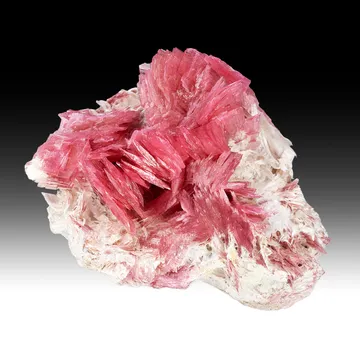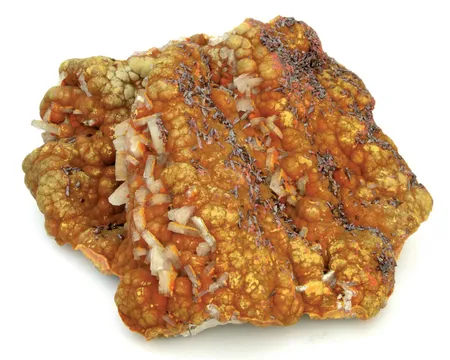
Mundo Nuevo Mine, Peru – a premier high-Andean tungsten locality famed for lustrous hübnerite, luminous augelite, and quartz pockets for collectors.
Key facts
Mundo Nuevo is one of the great Peruvian specimen localities of the modern collecting era: a high-Andean tungsten vein system whose best pieces combine the steel-black mass and weight of hübnerite or tetrahedrite with bright, glassy quartz, and, in its most celebrated pockets, luminous apple-green augelite. The mine belongs to the historic Mundo Nuevo–Tamboras–Pasto Bueno tungsten province of northern Peru, a belt of intrusive-related W-Mo-Cu mineralization in the Western Cordillera. Its collector identity is unusually sharp: not a broad “Peru” label, not merely “Pasto Bueno,” but a distinct La Libertad locality in which quartz veins produced world-class hübnerite, some of the most beautiful augelite known, brown scheelite coated by yellow stolzite, and rare sulfosalts that have become serious reference material.
The deposit is best understood as a high-altitude vein system tied to felsic Miocene intrusive activity. In the broader district model, near-vertical quartz veins cut sedimentary country rocks around quartz-monzonite intrusions, with tungsten as hübnerite-ferberite and scheelite, followed or accompanied by pyrite, tetrahedrite-tennantite-group sulfosalts, chalcopyrite, sphalerite, galena, fluorite, carbonates, and late oxidation products. That geological history matters to collectors because it produced open-space vugs rather than just ore: cavities lined with colorless quartz points, metallic tungstates and sulfosalts perched cleanly enough to be display specimens, and late phosphate pockets where augelite stands out like green glass against snow-white quartz.
Regional View
Country View
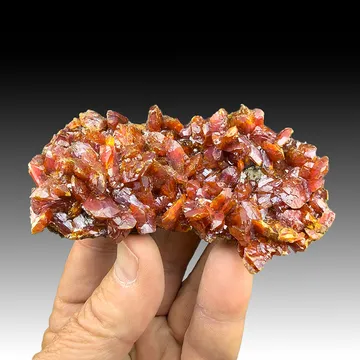
The look of fine Mundo Nuevo material is distinctive. Hübnerite tends to form lustrous, black to deep wine-red tabular or prismatic crystals, sometimes translucent red on thin edges or under strong light, set among jackstraw sprays of transparent quartz. Augelite is the locality’s showpiece phosphate: sharp, wedge-like to tabular crystals, commonly doubly terminated, in pale to vivid apple-green colors on quartz. Tetrahedrite-group and tennantite-group specimens are darker, heavier and more architectural, with tetrahedral to modified tetrahedral metallic crystals rising from quartz and pyrite. Scheelite pieces, especially those with lemon-yellow stolzite dusting, are fewer and instantly recognizable under shortwave ultraviolet light.

Photo: Wikimedia Commons

Photo: Wikimedia Commons
Search for specimens: View all specimens from Mundo Nuevo Mine, Peru
Mundo Nuevo Mine is in the Mundo Nuevo mining area near Huamachuco, Sánchez Carrión Province, La Libertad, northern Peru. Older specimen labels often place it in “Pasto Bueno District, Pallasca Province, Ancash,” and many classic pieces entered collections under that wording; the modern political placement used by Mindat and most current dealers is Huamachuco, Sánchez Carrión Province, La Libertad. The distinction is not a trivial paperwork issue for locality-conscious collectors: it reflects the long-standing habit of treating Mundo Nuevo with Pasto Bueno geologically and economically, while recognizing it as a separate locality under present administrative boundaries.
The mine lies very high in the Andes, commonly cited around 4600–4800 m elevation for the Mundo Nuevo mining area. At these elevations, the specimen story is inseparable from tungsten mining. The regional metallogenic setting is the upper Miocene intrusive-related W-Mo-Cu belt of the north-central Western Cordillera, where mineralization is controlled by granitoids of the Cordillera Blanca system and by major NW-SE to N-S structures. The larger district includes vein systems with quartz, hübnerite-ferberite, grey copper sulfosalts, pyrite, base-metal sulfides and late fluorite-carbonate assemblages; Mundo Nuevo fits that pattern but is prized because some of its veins opened into specimen-quality pockets.
The ore bodies are chiefly quartz veins and vugs rather than massive, collector-unfriendly ore alone. In the broader Pasto Bueno model, Landis and Rye described tungsten-base-metal mineralization in near-vertical quartz veins around a 9.5 Ma quartz monzonite stock emplaced in Jurassic-Cretaceous shale and quartzite. Their paragenetic model places molybdenite-pyrite nearer the intrusive center, then wolframite with tetrahedrite, chalcopyrite and pyrite, followed by galena-sphalerite-tennantite and later fluorite-carbonate mineralization. Mundo Nuevo has produced specimens reflecting much of that sequence: black hübnerite in quartz, tetrahedrite-tennantite-group sulfosalts with pyrite, scheelite with stolzite, fluorite-bearing associations, and late alteration minerals such as hydrotungstite and stolzite.
Mining history in the region reaches back to the early twentieth-century tungsten boom. Published historical accounts record the creation of Compañía Minera Mundo Nuevo in 1913, with its office in the province then described as Santiago de Chuco, and the formation in 1916 of Sociedad Minera Tamboras by Fermín Málaga Santolalla and partners to exploit the Tamboras and Mundo Nuevo deposits. After World War I, tungsten prices fell sharply, forcing many Peruvian tungsten operators to suspend work or abandon plants and claims; the Tamboras-Mundo Nuevo area nevertheless remained a named reference point in Peruvian tungsten literature.
For collectors, the most important production episodes are later pocket finds rather than the early industrial tonnage. A well-known 1984 find from the Victoria Mine area produced small, bright hübnerite-quartz pieces with sharp wine-red to black crystals and water-clear quartz. In 2005–2006 the Ortega brothers operated the high Ortega adit in the Mundo Nuevo mining area, from which augelite crystals up to about 5 cm were reported. In 2012, abundant, high-quality augelite from the Tamboras/Mundo Nuevo area appeared prominently on the European market and was treated as a significant new wave of material. Around 2014–2015, collectors saw additional augelite, scheelite-stolzite-quartz, and tetrahedrite-tennantite material, including pieces from small pockets that were quickly exhausted. The 2015–2016 period also brought the rare lautite-on-tennantite material from the El Gallito/La Gringa workings into the international show circuit.
Collecting access today should be treated as mine access, not casual field collecting. The locality consists of underground workings and concessions at high altitude, with unstable adits, private or concessionary mineral rights, and potentially hazardous mine conditions. Specimen recovery has been episodic, sometimes effectively a specimen-mining project rather than continuous ore production. Material now reaching the market is a mixture of older collection pieces, dealer stock from the 2000s and 2010s, and occasional later resales; significant new pockets should not be assumed available without current, direct confirmation from legal operators or land and mineral-rights holders.
Quartz is the stage on which most of Mundo Nuevo’s best specimens perform: colorless to milky, often transparent, in tapered prisms, dense jackstraw sprays, doubly terminated crystals and occasional Japan-law twins. The best quartz specimens from the mine are not merely “matrix” but sculptural clusters in their own right, with clear points carrying black hübnerite, apple-green augelite, brown scheelite, pyrite, tetrahedrite-tennantite-group sulfosalts, fluorite or sphalerite. Reported specimen descriptions include cabinet clusters of lustrous doubly terminated crystals, individual quartz crystals in the 1–3 cm range on rich clusters, and Japan-law twins recorded from the locality in the Mineralogical Record index; the finest examples are clean, undamaged, glassy and three-dimensional, while ordinary pieces tend to be bruised at the terminations, heavily contacted on the back, or crowded by opaque quartz that obscures the associated minerals.
Mundo Nuevo augelite is the locality’s most eye-catching rarity: sharp, lustrous, translucent to transparent crystals in pale green, apple-green and vivid green hues, typically perched on clear quartz from the Tamboras and Ortega parts of the mining area. The crystals are commonly tabular to wedge-shaped, with well-defined faces and edges, and many of the most admired pieces show isolated green crystals rising from a spray of quartz rather than embedded in massive matrix. Published and dealer records note augelite crystals from about 0.9–2.5 cm on many specimens, larger examples from the Ortega adit, and exceptional crystals reported up to about 5 cm; the 2012 Tamboras/Mundo Nuevo material was notable for both relative abundance and quality, while rarer combinations include augelite with hübnerite and quartz, augelite on quartz with a small Japan-law twin, and topaz casts related to earlier augelite crystals. The best pieces have saturated color, transparency, complete terminations and an open quartz setting; mediocre examples lose much of the magic when the augelite is pale, contacted, buried or dull.
Hübnerite from Mundo Nuevo is classic Peruvian tungsten material: lustrous black to deep wine-red prismatic or tabular crystals, often sharply terminated and set among colorless quartz points. The finest specimens can show red translucency along edges or in thin areas under strong lighting, a feature that separates true high-quality hübnerite from merely black, opaque wolframite-group ore. Crystal sizes documented in the specimen trade commonly fall around 2–4 cm, with notable examples including a 2.5 cm doubly terminated crystal in transparent quartz, a 3.4 cm prismatic group with Japan-law twinned quartz, a 4.2 cm tabular crystal from Labor Jacky, and large cabinet pieces with crystals reported around 6.5 cm; the 1984 Victoria-area find is remembered for sharp, bright hübnerite on water-clear quartz. Good Mundo Nuevo hübnerites are judged on clean terminations, bright luster, red internal glow, strong contrast with quartz and freedom from edge chipping, because many specimens have bruised or incomplete side crystals.
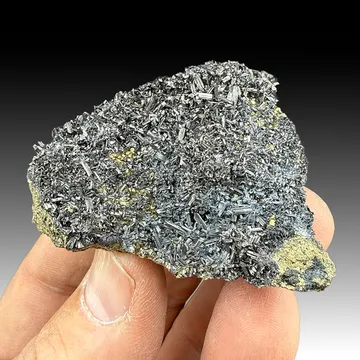
Collector labels from Mundo Nuevo often say “tetrahedrite,” but the locality is chemically more complicated than a visual label can express: many grey-copper specimens belong to the tetrahedrite-tennantite group, and analyzed Peruvian material includes tennantite-(Zn) from Mundo Nuevo. In hand specimen, the classic look is dark grey-black to steel-black metallic tetrahedral or modified tetrahedral crystals on clear quartz and sparkling pyrite, commonly with hübnerite and sometimes sphalerite or lautite in the association. Published specimen records describe sharp crystals around 1.2 cm, larger modified tetrahedra up to about 3.8 cm on edge, and Mineralogical Record index entries for Mundo Nuevo crystals up to several centimeters with pyrite and hübnerite; the best pieces are crisp, lustrous, undamaged, and elevated on quartz-pyrite matrix rather than half-buried in sulfide ore. Serious collectors should value analyzed or locality-referenced pieces especially highly, because tetrahedrite-group and tennantite-group members cannot be reliably separated by sight.
Mundo Nuevo scheelite is less abundant than quartz, hübnerite or augelite in collections, but the best examples are memorable: brown, dipyramidal to pseudooctahedral crystals on quartz, often with a powdery lemon-yellow coating of stolzite. The 2015 material introduced at Tucson and handled by several dealers became especially recognizable because the scheelite crystals sit among clear quartz points and can be dusted almost entirely with bright yellow stolzite; some descriptions also note doubly terminated quartz with red hübnerite inclusions in the same specimens. Scheelite pieces from Mundo Nuevo are typically miniatures to small cabinet specimens, with individual crystals commonly around 1–2 cm, and the species is notable for strong shortwave ultraviolet fluorescence when the scheelite is not hidden by heavy alteration. The best specimens have exposed, well-formed scheelite crystals, attractive yellow stolzite coverage, clean quartz and minimal abrasion; lesser examples look melted, rounded, powdery or crowded, and can be difficult to appreciate without UV.
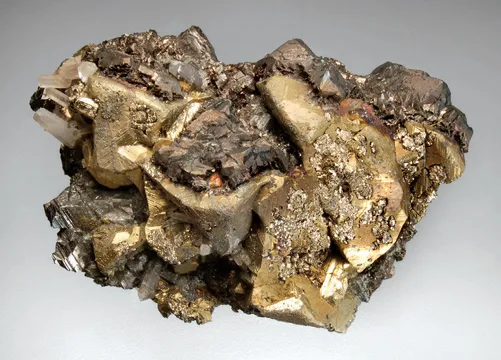
Pyrite at Mundo Nuevo is both a specimen species and an important matrix mineral, forming golden metallic surfaces and crystals beneath or beside tetrahedrite-tennantite-group sulfosalts, hübnerite, quartz and rare lautite. The Mineralogical Record index records striated pyrite cubes from Mundo Nuevo up to about 7 cm and 5 cm cubes with fine hübnerite crystals, while modern specimen records more commonly show pyrite as sparkling crystallized matrix supporting black sulfosalts and clear quartz. Good pieces have bright, untarnished pyrite with sharp cube or pyritohedral faces and strong contrast against quartz or dark tungstates; ordinary examples are massive, oxidized, hidden on the back of the specimen, or damaged along cube edges. Because pyrite is abundant in many Peruvian mines, Mundo Nuevo pyrite earns collector interest chiefly when it is well crystallized and part of a distinct Mundo Nuevo association rather than as an isolated golden cube.
Beyond the headline species, Mundo Nuevo is a serious locality for rare sulfosalts and tungsten alteration minerals. Lautite from the El Gallito/La Gringa area is the standout rarity: grey metallic, sometimes purple-pink, as rosettes or flattened crystals on tennantite-tennantite-group crystals with quartz and pyrite, confirmed by EPMA and SEM-EDS in documented material and introduced to collectors as a Tucson 2016 novelty. Tennantite-(Zn) has been analytically reported from Mundo Nuevo in a broader study of Peruvian tetrahedrite-group minerals, helping explain why many older “tetrahedrite” labels deserve caution. Heteromorphite has been documented on pyrite and confirmed by analysis, and the locality list also includes bournonite, jamesonite, sphalerite, galena, chalcopyrite, fluorite, muscovite, topaz, crandallite, hydrotungstite, stolzite, scorodite, siderite and native sulphur. Topaz-related casts after augelite and hydrotungstite or tungstite-like yellow crusts after tungsten minerals are especially worth a second look under magnification.
The first authenticity issue with Mundo Nuevo is not outright fakery but labelling. Older labels reading “Mundo Nuevo, Pasto Bueno District, Pallasca Province, Ancash” are common and can be historically understandable; modern locality usage places the mine at Mundo Nuevo, Huamachuco, Sánchez Carrión Province, La Libertad. A specimen should not be rejected solely because it carries an older Pasto Bueno/Ancash label, but the dealer or collection history should be checked carefully. Conversely, vague labels such as “Pasto Bueno, Peru” can hide several distinct mines and should be refined when possible, especially for high-value augelite, hübnerite and sulfosalt pieces.
A second concern is species-level naming. “Tetrahedrite” from Mundo Nuevo is often a field or trade name for visually similar tetrahedrite-tennantite-group minerals, and analyzed material from the locality includes tennantite-(Zn). Unless a specimen has analytical support, “tetrahedrite subgroup” or “tetrahedrite-tennantite group” is often more responsible than a precise end-member label. Likewise, dark wolframite-group crystals may be labelled hübnerite by locality tradition, but unusual pieces can require analysis to distinguish hübnerite from ferberite-rich material. This matters because a bright, red-translucent hübnerite crystal carries different collector value than an undifferentiated black wolframite-group crystal.
Condition is a major value driver. Mundo Nuevo quartz is often a forest of exposed points, so chipped terminations, bent-looking broken sprays, and contacted backs are common. Hübnerite edges can show small dings that disappear from the display side but matter under magnification. Augelite has a perfect-to-good cleavage and brittle edges, making clean corners and complete terminations especially important; the best green crystals should be inspected for contact marks that mimic natural growth features. Tetrahedrite-tennantite crystals should be checked for edge chips and dull pitted faces, while scheelite-stolzite specimens require care because the yellow stolzite coating may be powdery and easily abraded.
Treatments and constructed specimens are not widely documented for Mundo Nuevo in the way they are for some gem-mineral localities, but the contrast between green augelite and white quartz is so striking that damaged, glued or repaired pieces deserve careful inspection. Look for unnatural glue shine in quartz junctions, mismatched dust in cracks, suspiciously isolated crystals sitting on fresh-looking contacts, or matrix breaks that do not line up. Provenance from reputable dealers, old collection labels, and published or photographed specimens adds real value.
Fluorescence is relevant chiefly for scheelite. Good scheelite should show strong shortwave UV response, but a stolzite coating, dirt, or heavy iron staining can mute the effect. Stolzite itself should be handled gently. Hydrotungstite and tungstite-like alteration crusts are also delicate and may dehydrate or powder with careless storage. Pyrite-bearing specimens should be kept dry and stable; while widespread pyrite disease is not a hallmark warning for Mundo Nuevo material, any pyrite from a sulfide-rich vein deserves low-humidity storage and periodic inspection.
Market availability is mixed. Quartz, hübnerite-quartz and augelite-quartz specimens appear regularly enough that collectors can be selective, but fine examples from the best pockets are not common. The finest augelite, sharp hübnerite with clear quartz, large tetrahedrite-tennantite-group crystals, and analyzed lautite or tennantite pieces are much scarcer than the number of “Mundo Nuevo” labels in the market might suggest. As of the mid-2020s, resales from older collections and dealer inventories remain the main source of good pieces; truly new, major pockets should be regarded as exceptional events rather than expected supply.
For years, one of the liveliest stories around Mundo Nuevo was not about a single crystal pocket but about the address on the label. Classic specimens circulated as “Mundo Nuevo, Pasto Bueno District, Pallasca Province, Ancash,” a wording that made geological sense to many collectors because the tungsten veins had long been treated with the Pasto Bueno camp. Then, as Peruvian boundaries and concession data were clarified by modern surveying, the locality was corrected to Huamachuco, Sánchez Carrión Province, La Libertad. Carles Millan preserved a pointed explanation from Spanish dealer and mine-owner Luis Miguel Fernández Burillo: before GPS, concessions and even provinces in Peru were delimited referentially by mountains, rivers and valleys; satellite GPS finally made reliable boundaries possible. The practical collector’s translation is simple: old labels tell the history of how the specimens moved, while modern labels tell where the mine belongs today.
The augelite story has the glamour of a sudden star arriving late to a classic stage. Mundo Nuevo had already been famous for hübnerite, but the green augelite-on-quartz pockets from the Tamboras and Ortega areas made specialists look again. A published Wikimedia/Mindat description of one Carles Millan specimen records several green augelite crystals on quartz, the largest doubly terminated and 25 mm long, on a 61 × 61 × 51 mm specimen weighing 115 g. The piece was tied to a recent Tamboras-area find and carried the Mineralogical Record comment that the Mundo Nuevo augelites were probably among the world’s finest for the species. The visual reason is obvious even before the labels are read: green, glassy phosphate crystals rising from a thicket of white, clear quartz, an association that looks more Alpine than Andean until the tungsten-suite label brings it back to Peru.
The 2012 European-show appearance of Mundo Nuevo augelite gave collectors one of those rare moments when a locality moved from specialist knowledge to show-floor excitement. Fabre Minerals described some of the Tamboras/Mundo Nuevo material as a Munich 2012 novelty—not because augelite had never appeared before, but because the quantity, individual crystal quality and vivid apple-green color were suddenly strong enough to define a find. One recorded specimen measured 7 × 5.2 × 3.5 cm with an 1.8 × 1.5 cm main augelite crystal, associated with doubly terminated hübnerite and clear quartz. Another, from 2014, paired sharp green augelite with fine quartz, including a tiny, sharply formed Japan-law twin perched on the main augelite crystal. For a species that usually lives in the margins of phosphate collections, Mundo Nuevo made augelite a centerpiece mineral.
The small scheelite-stolzite pocket of 2015 has a more field-collector feel: not a flood, but a handful of odd, memorable pieces that one had to catch at the right time. Khyber Minerals’ account of the material describes seeing a small group at Tucson 2015, hoping to find more in Peru, and finally returning with a modest suite from a small find. The charm was not perfection. Some early examples looked “melted,” but the better pieces had brown scheelite octahedra or stacked crystals nestled in quartz and coated in powdery yellow-green stolzite. Under shortwave UV, the scheelite adds the hidden theatrical element: a tungsten specimen that changes personality when the lights go down.
Mundo Nuevo’s rare-sulfosalt chapter arrived with even more surprise. At the 2016 Munich show, Jaroslav Hyršl displayed crystallized lautite on tennantite from Mundo Nuevo, a copper arsenic sulfide that is usually encountered as massive material. Trinity Minerals’ show report called it only the second find ever of crystallized lautite. The specimens from El Gallito/La Gringa turned the locality’s dark sulfide assemblage into a rarity story: grey metallic flattened crystals and rosettes on tennantite-group crystals, with quartz and pyrite, later supported by analytical work. For collectors who had thought of Mundo Nuevo mainly as hübnerite and green augelite, the lautite find showed that the mine still had obscure mineralogical surprises hidden in its veins.
The mine also carries a rougher modern history. Dealer and collector notes on the locality record that larger-scale operations were disrupted in the early 1990s, with key parts of the site reportedly blown up by Shining Path guerrillas, after which the workings were abandoned for years before later specimen-recovery projects resumed. That episode helps explain the irregular rhythm of Mundo Nuevo specimens in the market: older tungsten mining, long gaps, small recovery efforts, sudden pockets, and then silence again. It is a locality best understood not as a steady pipeline but as a series of brief windows into a very high, difficult, mineralogically rich vein system.