Mount Gunson, Australia — essential copper locality in South Australia, yielding deep green atacamite, green gypsum, and notable wittichenite crystals.
Key facts
Mount Gunson is one of the essential South Australian copper localities for collectors: a sediment-hosted copper district on the Stuart Shelf beside Pernatty Lagoon, where old oxide workings, open-cut sulfide mines, evaporitic lagoon chemistry, and a once-in-a-generation sulfosalt pocket have all contributed very different kinds of specimens. Its best-known collector minerals are deep green atacamite, unusually colored green gypsum from the lagoon environment, and, above all, large sharp crystals of wittichenite from the Cattle Grid pit—material that transformed an otherwise obscure copper-bismuth sulfosalt into one of the great Australian mineral surprises.
Geologically, Mount Gunson is a copper-silver-cobalt-zinc-lead district developed around the Pernatty Upwarp, where Neoproterozoic strata lap onto older red-bed sandstones of the Pandurra Formation. Much of the mineralization is stratabound at the disconformable contact at the base of the Whyalla Sandstone, with Cattle Grid Breccia—an ancient periglacial breccia formed on the silicified top of the Pandurra Formation—serving as a principal ore host. For a collector, that geological architecture matters because it created both the primary sulfide suite and the oxidized chloride-carbonate assemblage: chalcocite, bornite, chalcopyrite, djurleite, digenite, carrollite, sphalerite, galena, pyrite, marcasite, bismuth minerals and wittichenite below; atacamite, malachite, chrysocolla, azurite, cuprite, covellite films, iron oxides and manganese oxides above.
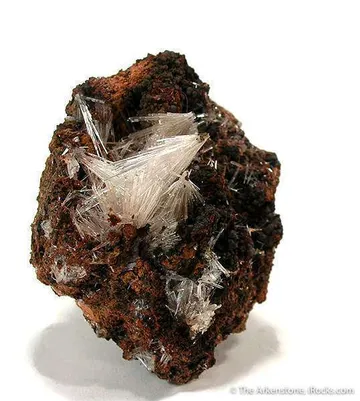
The visual character of Mount Gunson specimens is unusually varied. Classic atacamite pieces are dark, saturated green crusts and sprays on gossanous, malachitic or clay-coated matrix; the finest examples show glittering bladed crystals rather than dull massive coatings. Wittichenite, by contrast, is a metallic collector’s mineral: steel-grey to bronze-black, tabular to complex orthorhombic crystals with bright reflective faces, often showing contact points where crystals were once loosely attached to sulfide crusts. The green gypsum specimens from Pernatty Lagoon are another category entirely—delicate, pale lime to mint-green selenitic crystals and crusts, their color tied to the copper-rich environment around the mines.
Regional View
Country View
Mount Gunson’s reputation rests on a rare combination: it is both a historically important copper producer and a specimen locality whose best pieces are instantly recognizable. The district includes the Main Open Cut, West Lagoon, East Lagoon, Cattle Grid, MG14, House, Gunyah, Gunyot and related prospects, with Cattle Grid by far the dominant sulfide orebody. Collectors should treat “Mount Gunson” labels with care, because specimens may have come from different pits and sublocalities, and those distinctions matter most for wittichenite, atacamite associations and lagoon gypsum.


Search for specimens: View all specimens from Mount Gunson, Australia
Mount Gunson lies in the Pernatty Lagoon district of South Australia, on the Stuart Shelf west of Lake Torrens and southeast of Woomera. The mineral district is named for Mount Gunson, a small hill near the mines, but specimen labels often use broader terms such as Mount Gunson Mines, Pernatty Lagoon, Cattle Grid, Cattlegrid, Main Open Cut, West Lagoon or East Lagoon. These are not interchangeable in a mineralogical sense. Cattle Grid is the key sulfide and wittichenite locality; East and West Lagoon are closely tied to stratabound copper mineralization beneath or near the salt-lake environment; the Main Open Cut represents the older Mount Gunson oxide workings and later open-cut production.
The deposit type is sediment-hosted copper, with copper-silver-cobalt-zinc-lead mineralization controlled by stratigraphy, permeability and redox boundaries. The important contact is the disconformity between the older Pandurra Formation—reddish-brown, fluviatile, locally silicified sandstone and quartzite—and the overlying Marinoan Whyalla Sandstone. At Cattle Grid and nearby deposits, the top of the Pandurra Formation was silicified, frost-shattered and brecciated during Marinoan periglacial conditions, producing the Cattle Grid Breccia. This breccia, averaging several metres thick in the Cattle Grid orebody, provided open space, fractures and permeability for sulfide deposition.
The ore system is not a simple vein deposit. At Cattle Grid, copper sulfides occur in a tabular breccia body, in fractures, vugs and bedding-plane openings, and locally as cement in porous Whyalla Sandstone. The principal copper sulfides recorded from the orebody include chalcocite, bornite and chalcopyrite, with digenite, djurleite, carrollite, sphalerite, galena, marcasite, pyrite, native bismuth and wittichenite among the wider sulfide and sulfosalt assemblage. At the Main Open Cut, the oxidized zone above the modern water table is especially important for collectors, because atacamite is abundant there, with subordinate malachite and traces of chrysocolla and azurite. In East Lagoon, mineralization was concealed beneath the bed of Pernatty Lagoon and formed a 2–3 m thick stratabound zone at the Pandurra–Whyalla Sandstone contact; djurleite was recorded as the predominant copper mineral there, with digenite and chalcocite in a complexly zoned deposit.
Copper was discovered at Mount Gunson in 1875, probably in the area now known as the Main Open Cut. Early mining was intermittent and small-scale, and production from 1937 to 1943 sent about 32,000 tonnes of ore to the Port Pirie smelters. A major modern exploration phase in the 1960s and early 1970s changed the scale of the district: several million tonnes of ore were outlined, the Mount Gunson Mines operation worked ore from 1969 to 1971, and the Cattle Grid deposit was discovered in the early 1970s. Production from Cattle Grid began in August 1974, after drilling, geochemistry and geophysics proved a major sandstone copper orebody several kilometres west of the original Pernatty Lagoon workings.
Cattle Grid became the great mining centre of the district. Published figures record 7.2 Mt of ore from Cattle Grid during 1974–1986 at a recovered grade of about 1.7% Cu and 8.3 g/t Ag, with head grade to the concentrator near 2.0% Cu. Other summaries give total district production of roughly 8.4 Mt averaging about 1.7% Cu. The Main Open Cut later produced about 830,000 tonnes at 1.6% Cu during 1984–1990, and East Lagoon produced 212,350 tonnes at 0.79% Cu and 10 g/t Ag. The metallurgical product was a copper concentrate in the sulfide era, while later operations and remnant materials involved heap leaching and cement copper from oxidized stockpiles and mine materials.
Today the historic Mount Gunson mine leases are not a casual collecting ground. The mining area and related leases have been held and operated by A & MJ Musolino since 2000, and government records list the Mount Gunson and Cattlegrid deposits as seasonal rather than abandoned free-collecting sites. Surrounding and nearby sediment-hosted copper-cobalt resources form part of the modern Elizabeth Creek project advanced by Coda Minerals, which is separate from casual specimen access and has been in advanced exploration and project-development planning. Serious collectors should assume that access requires explicit permission from the leaseholder and, where relevant, pastoral and regulatory compliance. Old pits, tailings, soft ground, saline flats and post-mining water bodies are not safe or open field-collecting environments.
The notable specimen finds were not evenly distributed through mining. The most famous mineral pocket was the early-1980s wittichenite occurrence at Cattle Grid, where large metallic crystals were first taken for chalcocite and only much later recognized as wittichenite. Atacamite specimens came from the oxidized copper environment, especially Cattle Grid and the wider Mount Gunson mine area, with associations including malachite, goethite, quartz, dickite, fluorite, chrysocolla, wulfenite and chalcocite recorded in specimen data. Gypsum specimens are tied to the Pernatty Lagoon setting rather than the primary orebody: pale green selenitic crystals and crusts formed in the saline, copper-influenced lagoon environment and are valued for color and delicacy rather than for large individual crystals.
Atacamite is the signature oxidized copper species of Mount Gunson, occurring as dark forest-green to emerald-green bladed crystals, sparkly crusts, nodules and locally rich coatings on malachite, gossan, quartz, clay minerals and iron-oxide matrix; SARIG records atacamite as an abundant oxidized ore mineral in the Mount Gunson deposit, and specimen records from the district show associations with malachite, quartz, goethite, dickite, fluorite, wulfenite, chrysocolla and chalcocite. Good Mount Gunson atacamite is judged by saturation of color, luster, recognizable bladed or prismatic crystal form and contrast against pale or rusty matrix; ordinary pieces are more massive, dull or powdery. Cabinet pieces exist, including old classic plates over 10 cm across, but individual crystals are usually small, and pieces with sharp, isolated prisms or malachite pseudomorphs after atacamite are much more unusual than the common green crusts.
Mount Gunson’s wittichenite is one of Australia’s great rarity stories: the Cattle Grid pit produced lustrous metallic crystals of Cu3BiS3 far larger and sharper than the microcrystalline material typical of most world localities, with tabular to complex orthorhombic habits, flattened forms, prism faces, terminal faces, striations parallel to the c axis, dark bronze to black surfaces and local purple, blue or brassy iridescence from surface alteration. Specimens from the find are usually loose crystals or crystals with remnant sulfide crust contact points, and many were originally sold as chalcocite before analytical work clarified their identity; XRD- and EDS-confirmed specimens are therefore especially desirable. Fine examples are typically thumbnail to miniature size, commonly around 1–2 cm, with the celebrated largest crystals exceeding 3 cm and reported to about 44 mm; value rises steeply with complete terminations, bright faces, minimal contact damage, visible orthorhombic form and secure Cattle Grid provenance.
Gypsum from the Mount Gunson–Pernatty Lagoon area is collected chiefly as pale green to lime-green selenite, forming fragile needles, blades, plates, crusts and densely crystallized transparent aggregates in the saline lagoon environment influenced by copper-bearing mine waters and copper-rich materials. Museum and dealer examples document specimens from small cabinet size to about 15 x 12 cm, with individual crystals commonly small and delicate; the best pieces have an even mint-green color, bright transparency, undamaged crystal tips and an open, grass-like or sparkling drusy surface. Because gypsum is soft, water-sensitive and easily bruised, many specimens look dusty, abraded or clay-coated; careful dry handling and stable storage are part of the appeal and the challenge of owning good Mount Gunson green gypsum.
Other documented Mount Gunson minerals include chalcocite, bornite, chalcopyrite, digenite, djurleite, covellite, pyrite, marcasite, sphalerite, galena, carrollite, bismuthinite, native bismuth, aikinite, emplectite, anilite, fluorite, barite, calcite, dolomite, quartz, dickite, alunite, jarosite, hematite, goethite, manganese oxides, pyrolusite and psilomelane, with azurite, chrysocolla, cuprite, malachite and tenorite in the oxidized suite. No IMA type-locality mineral is central to Mount Gunson’s fame, but the district is mineralogically important because it produced exceptional crystals of wittichenite—a species named from Germany but represented at Mount Gunson by the large collector-grade crystals that most collectors associate with the mineral today.
Mount Gunson specimens demand unusually close attention to labels. “Mount Gunson” may mean Main Open Cut, Cattle Grid, East Lagoon, West Lagoon, Pernatty Lagoon or the broader mining district, and the difference matters. A wittichenite without a Cattle Grid provenance is less meaningful; green gypsum should be treated as Pernatty Lagoon material unless a more precise source is documented; atacamite labels should not automatically be assumed to indicate the same pocket, pit or association.
The most important authentication issue is wittichenite versus chalcocite. The famous Cattle Grid wittichenites were long mistaken for chalcocite, and some older labels still preserve that history. Because both species can be dark metallic copper sulfides/sulfosalts in hand specimen, serious wittichenite should ideally have modern analytical confirmation or a reliable chain of provenance from known Cattle Grid material. Bright tabular form, high specific gravity, bronze-black to iridescent surfaces and complex orthorhombic faces are encouraging, but they are not substitutes for XRD, EDS or trusted expert documentation.
Atacamite also has identification traps. Some green Mount Gunson pieces have been questioned as brochantite, but informed locality discussion has emphasized that malachite is a much more likely associated green mineral and that brochantite is not securely established as a Mount Gunson orebody species. Malachite pseudomorphs after atacamite are known, and those can confuse the visual story: a jackstraw cluster may preserve atacamite-like form while being partly or wholly malachite. The best practice is to describe visible associations conservatively unless the specimen has been analyzed.
Condition is central to value. Atacamite blades can be brittle and may shed from friable gossan or clay-rich matrix; avoid ultrasonic cleaning, soaking and aggressive brushing. Green gypsum is even more vulnerable: gypsum has perfect cleavage, low hardness and partial solubility in water, so specimens should be kept dry, dusted only with the gentlest air or soft brush, and protected from pressure in storage. Wittichenite is comparatively robust as a metallic species, but the Cattle Grid crystals commonly have natural contact points from their original attachment to sulfide crusts; distinguish these from fresh breaks, and inspect terminations and high points under magnification.
Market availability is uneven. Atacamite remains the most obtainable Mount Gunson collectible, though truly aesthetic, lustrous, old-time pieces are much scarcer than routine green crusts. Green gypsum appears periodically and is generally more affordable, but undamaged, evenly colored examples are harder to find than the abundance of loose or battered lagoon material might suggest. Large, confirmed wittichenite crystals from Cattle Grid are genuinely rare; the best examples are now mostly in private and institutional collections, and when they surface they command prices appropriate to a world-class occurrence for a rare sulfosalt.
The most repeated Mount Gunson story begins in the Cattle Grid pit in the early 1980s, not with a professor leaning over a microscope but with mine workers noticing flashes of light. The metallic crystals that caught the eye were bright enough to be collected as excellent chalcocite. That seemed reasonable at the time: Cattle Grid was a copper mine, chalcocite was abundant in the district, and the crystals were dark, lustrous and sulfide-looking. Years later, one of the specimens was analyzed and the verdict changed the history of the find: the crystals were wittichenite. Suddenly, what had been good “chalcocite” became the world’s finest large-crystal occurrence of a rare copper-bismuth sulfosalt.
The afterlife of that misidentification is part of the locality’s charm. A fine Cattle Grid wittichenite in the Australian Museum, once displayed as chalcocite, was later recognized as suspect and removed for closer study. Measurements of its crystal faces, specific gravity and morphology supported the wittichenite identification. That specimen, catalogued as D47210, measures 21 x 14 x 8 mm and is made of at least two similarly oriented crystals, dark bronze with iridescent reflections. For collectors, it is a useful reminder that labels are historical documents, not final truths; Mount Gunson is a locality where the old label may tell you what people thought they had, while the crystal tells a better story.
The largest and brightest wittichenites have acquired almost legendary status. The best-known crystal, a loose 3.6 cm specimen with a wealth of reflective faces, has been nicknamed the “disco ball.” Mineralogical Record commentary has noted that only about thirty Cattle Grid wittichenite crystals of 2 cm or more are thought to be in major private and institutional collections. When several appeared on the market in the mid-2010s, prices reflected both beauty and scarcity: one 3.5 cm crystal was offered at $6,000, while a 3.6 cm cluster was offered at $21,000. That is an extraordinary trajectory for a mineral species that, at most localities, is nearly invisible without magnification.
Cattle Grid also preserves a much older story, written in frozen ground rather than in mine ledgers. The orebody sits in and beneath a breccia interpreted as a fossil periglacial block field, formed when the upper Pandurra Formation was silicified and then shattered in place under Marinoan glacial conditions. Studies of the Cattle Grid Breccia describe sand-wedge polygons, frost-heave structures, tepee-like forms, reverse faults and frost-heaved quartzite blocks lifted as much as 3 m above the base of the Whyalla Sandstone. The temperature estimates are startling: mean annual air temperature probably no higher than 0°C, and under the harsher sand-wedge conditions perhaps down to -20°C or lower, with strongly seasonal monthly extremes. The same open pit that yielded copper ore and wittichenite crystals also exposed a deep-time cold-climate surface from a world hundreds of millions of years old.