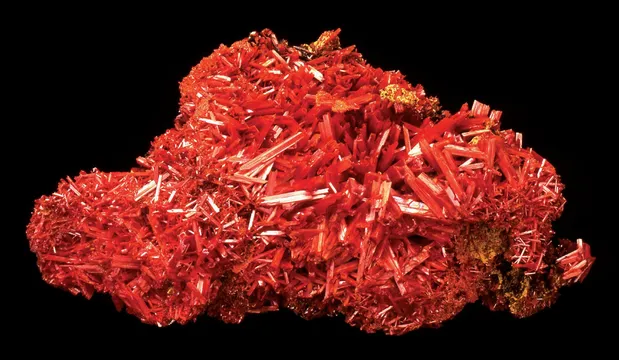
Flinders Ranges, Australia — copper frontier locality famed for azurite and malachite in mines, plus rare scholzite from Reaphook Hill, prized by collectors.
Key facts
The Flinders Ranges are not a single mine but a long, mineralogically varied province of folded Neoproterozoic to Cambrian sedimentary rocks in South Australia, lifted into ridges, diapirs, gorges and desert valleys. For collectors, the name usually calls up two quite different specimen traditions. One is the old copper belt of Blinman, Sliding Rock, Nuccaleena, Yudnamutana and smaller workings, where blue azurite and green malachite marked oxidized copper ore in dolomite and breccia. The other is the much rarer zinc-phosphate suite of Reaphook Hill on Martins Well Station, a small zinc- and phosphorus-rich occurrence that became one of the classic world sources for sharp, acicular scholzite.
The best Flinders Ranges specimens have an unmistakable dry-country look: white to glassy needles of scholzite bursting from reddish-brown iron and manganese oxide cavities; black cryptomelane and chalcophanite making a dramatic background; orange-brown parahopeite, pale collinsite, and micaceous metaswitzerite tucked into vugs. In the copper mines, the aesthetic is more rugged and historic—azurite as royal-blue crusts or small crystals with malachite on pale dolomite, red-brown goethite, cuprite and carbonate-stained mine rock. Fine cabinet pieces are much scarcer than the mining history might suggest, which is why well-localized old specimens from the Flinders carry more weight than generic “South Australia” labels.
Regional View
Country View
Historically, the ranges mattered first as a copper frontier. Blinman became the largest and longest-running copper mine in the Flinders Ranges, and its ore was important enough to justify smelters, shafts, stopes, camel and bullock transport, and a mining township in country where water and freight could decide whether a mine lived or failed. Mineralogically, however, the locality gained a second life in the twentieth century when Reaphook Hill yielded a suite of rare secondary phosphates, including scholzite in collector-quality sprays and the type-locality minerals hillite and reaphookhillite.

Photo: Wikimedia Commons
Search for specimens: View all specimens from Flinders Ranges, Australia
The Flinders Ranges occupy part of the Adelaide Superbasin/Adelaide Geosyncline, with thick successions of Neoproterozoic and Cambrian sedimentary rocks later folded, faulted and uplifted. Collector localities are commonly controlled by this structure: diapiric breccias, carbonate blocks, faults, thrusts and weathered near-surface zones created the small but mineralogically rich deposits for which the region is known. The important collecting environments are not igneous pegmatites or alpine veins; they are oxidized copper deposits, carbonate-hosted zinc-lead-silicate deposits, and unusual supergene phosphate concentrations developed in sedimentary and brecciated rocks.
Reaphook Hill, on Martins Well Station, is the key rare-phosphate locality for specimen collectors. It is a zinc- and phosphorus-rich deposit in late Proterozoic to Cambrian sedimentary rocks and diapiric breccia near Reaphook Hill. The important mineralization occurs in near-surface gossanous material and voids, where groundwater concentrated manganese, iron, zinc and phosphorus. The classic assemblage includes scholzite, tarbuttite, parahopeite, collinsite, phosphophyllite, hopeite, hemimorphite, cryptomelane, chalcophanite, pyrolusite, manganite, goethite and hematite, with later recognition of hillite and reaphookhillite. Reaphook Hill was mined for a short period in the 1970s by mineral dealer Chris Johnson specifically for specimens, chiefly scholzite, rather than as a large ore producer.
Blinman represents the historic copper side of the Flinders. The copper orebody lay in a north-south structural zone on the eastern margin of the Blinman Diapir, in a dolomitic “mine sequence” within diapiric breccia. Near the surface, the oxidized zone was dominated by cuprite and malachite, with azurite present among the secondary copper minerals; below the water table, the ore passed into primary sulphides including chalcopyrite, bornite and chalcocite. The Blinman workings exploited a steep orebody that originally cropped out over roughly 60 metres and reached about 150 metres in length at depth. Mining ultimately removed about 200,000 tonnes of ore for around 10,000 tonnes of copper metal, making Blinman the largest producer and longest-running copper mine in the Flinders Ranges.
The mining history around Blinman is unusually well recorded. Robert Blinman, a shepherd, discovered the copper outcrop in 1859. The Yudnamutana Mining Company purchased the leases and began work in September 1862 under Captain Thomas Anthony. Early work quarried the outcrop and sank shafts along the orebody. Because cartage to Port Augusta was expensive, smelting works were built in 1863 below the manager’s residence and eventually included four reverberatory furnaces. By 1870 the workings had reached the 91-metre level, where water and sulphide ore were encountered. Later campaigns followed the arrival of the railway at Parachilna, and a final major phase under the Tasmanian Copper Company in the early 1900s used a water-jacketed blast furnace producing copper matte. The mine closed when falling copper prices and dwindling payable ore overcame the enterprise.
Other Flinders copper mines add context to azurite and malachite labels from the region. Nuccaleena, on Moolooloo Station, was one of the early northern copper ventures, with substantial stone ruins still standing. Sliding Rock, east of Beltana, was discovered in 1870 and supported the township of Cadnia before water problems overwhelmed the mine in the late 1870s. Yudnamutana and the Arkaroola-Mount Painter district are part of the northern Flinders mining story as well, though specimens from those areas should be kept distinct from Blinman and Reaphook Hill labels.
The Beltana deposit at Puttapa is a separate but important zinc locality in the Flinders Ranges. It is a structurally controlled, carbonate-hosted willemite deposit in Lower Cambrian limestone, associated with hematite-rich hydrothermal dolomitisation. The ore is notable for its lack of sulphides and for supergene arsenate and vanadate minerals including adamite, austinite, mimetite, tsumcorite, descloizite and the recently described type-locality mineral puttapaite. Unlike Reaphook Hill, Beltana was a significant modern zinc mine, producing high-grade zinc ore and stockpiled product through intermittent operations.
Collecting access today must be treated conservatively. Many Flinders localities are on pastoral leases, private land, active or retained mining tenements, historic reserves, conservation parks, national parks, or areas of Aboriginal and scientific significance. Fossicking is not permitted in South Australian national parks, conservation parks or forest reserves without proper authorization, and access to mining leases, claims and private mines requires permission from the holder. Blinman is managed as a heritage site with underground tours and walking trails, not as an open collecting ground. Reaphook Hill specimens now seen on the market are overwhelmingly old collection pieces, material from past specimen mining, or carefully documented traded specimens rather than fresh casual finds.
Scholzite is the signature collector mineral of Reaphook Hill and the species that gives the Flinders Ranges its rare-phosphate reputation. Here it occurs as colourless to white, glassy, acicular crystals in protected cavities, commonly in divergent sprays, rosettes and “Roman sword” clusters on reddish-brown iron and manganese oxide matrix; individual crystals in classic specimens commonly reach around 1 cm, with some documented cabinet pieces showing crystals to about 2 cm in larger aggregates. Its most characteristic associations are cryptomelane, chalcophanite, parahopeite, tarbuttite, collinsite, metaswitzerite and phosphophyllite. The finest Reaphook Hill scholzites have sharp, lustrous, translucent needles standing proud in undamaged vugs against dark matrix; ordinary examples are more matted, sugary, iron-stained or rubbed, and many require magnification to appreciate.
Azurite from the Flinders Ranges is tied chiefly to the oxidized zones of the old copper mines rather than to the Reaphook Hill phosphate suite. At Blinman it belongs with malachite, cuprite, goethite, dolomite, calcite, barite and the deeper copper sulphides chalcopyrite, bornite and chalcocite; at Sliding Rock and other historic copper workings it appears in the same weathered-copper setting. Flinders azurite is usually valued for locality and history more than for large freestanding crystals: good pieces show vivid deep-blue crusts, small lustrous crystal groups or blue-green azurite-malachite contrasts on pale dolomite or iron-stained mine rock, while lesser specimens are simply thin coatings, powdery stains or mixed blue-green smears with little crystallization.
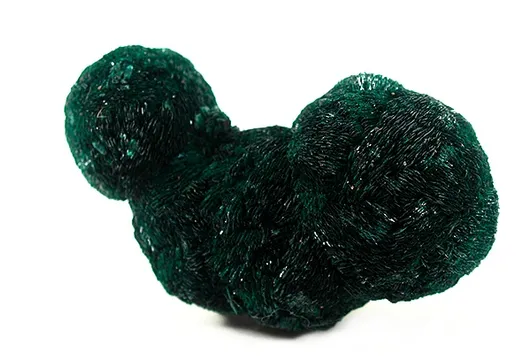
Malachite is the most familiar Flinders copper mineral and was a major visible component of the oxidized ore at Blinman, where the upper 90–110 metres of the deposit was dominated by cuprite and malachite above the primary sulphide zone. It occurs as green coatings, crusts, veinlets, aggregates and local pseudomorphic or replacement textures in dolomitic copper ore, commonly with azurite, cuprite, goethite, calcite, dolomite and barite. The best collector pieces from the region combine strong saturated green colour, clear copper-mine provenance, and attractive contrast with blue azurite or reddish cuprite-bearing matrix; common examples are abundant as historical mine-rock fragments but are often massive, earthy or abraded.
Beyond those three species, the Flinders Ranges are unusually rich in locality-sensitive minerals. Reaphook Hill is the type locality for hillite, Ca2Zn(PO4)2·2H2O, and reaphookhillite, MgZn2(PO4)2·4H2O; it also carries notable tarbuttite, parahopeite, collinsite, phosphophyllite, hopeite, hemimorphite, chalcophanite, cryptomelane, manganite, pyrolusite, rockbridgeite, metaswitzerite and plimerite. Beltana at Puttapa is the type locality for puttapaite, Pb2Mn2ZnCr4O2(AsO4)4(OH)6·12H2O, and is famous to specialists for willemite, smithsonite, hedyphane, mimetite, adamite, austinite, tsumcorite and descloizite. In the northern Flinders and Mount Painter-Arkaroola region, uranium minerals add another specialized thread, including historically important schoepite-group and related species from the Radium Ridge and Mount Painter workings.
Precise locality matters more in the Flinders Ranges than the regional name. “Flinders Ranges, South Australia” may refer to Reaphook Hill scholzite, Blinman copper minerals, Beltana willemite-suite specimens, Arkaroola uranium minerals, or one of many smaller mines. Serious collectors should insist on mine-level provenance whenever possible, especially for rare phosphates and type-locality species.
Reaphook Hill material is particularly vulnerable to mislabelling. Old labels may use “switzerite” for material now better regarded as metaswitzerite in many Reaphook specimens. “Zincian collinsite” appears in older literature and collection labels; part of that story led to the later recognition of hillite, but not every pale phosphate crust is hillite. “Psilomelane” is another old-style label that should be treated as a field term for black manganese oxides unless analytically confirmed. Parascholzite has been reported tentatively in tiny white tubular crystals intergrown with scholzite, but visual identifications of these microscopic phosphates should be regarded cautiously.
Condition is a central issue for Reaphook Hill scholzite. The crystals are slender, brittle and commonly perched in cavities where a single rub can reduce a top specimen to a fuzzy white patch. Look for intact terminations, undisturbed sprays, minimal iron smearing, and a matrix that protects the crystals rather than exposing them on a high point. Old specimens may carry dust in vugs; aggressive cleaning is risky because the associated phosphate assemblage can include soft, hydrated and microcrystalline minerals. Handle by the matrix, avoid soaking unless the species are known and stable, and keep specimens dry and away from repeated temperature swings.
For azurite and malachite, the main concern is generic or romanticized labelling. Many Australian copper specimens are simply sold as “South Australia,” and Burra, Kapunda, Moonta and other famous copper districts can be confused with Flinders material. Blinman pieces should ideally have old mine, township, or collection documentation. Azurite may alter to malachite over time, especially in less stable earthy material; strong blue, sharp microcrystals are preferable to powdery stains. Malachite coatings from old mine dumps are common-looking unless the specimen has good aesthetics or clear historical association.
Market availability is uneven. Blinman malachite and mixed copper ore can appear occasionally, but high-quality crystallized azurite-malachite from the Flinders Ranges is not abundant. Reaphook Hill scholzite is the marquee material and is genuinely limited: fine examples tend to come from older collections, specialist Australian mineral dealers, and occasional deaccessions. Beltana willemite-suite specimens are more available than Reaphook phosphates in some Australian circles, but rare arsenates, vanadates and puttapaite-level micro material are specialist pieces that often require analytical confirmation.
Robert Blinman’s discovery has the texture of an outback mineral legend because it begins not with a prospector, but with a shepherd. In December 1859, while employed on H.C. Swan’s Angorichina station, Blinman noticed a large copper outcrop on a hill about thirty metres above a creek. He was known as “Peg Leg,” and the story preserved at Blinman has him inheriting a favourite sitting rock from Paul Hayward, then breaking off a piece and recognizing good copper. He had to risk wages he could scarcely spare to secure the ground: the application was approved on 9 February 1860, surveyed on 10 May 1860, and the lease was issued on 1 January 1861 in the names of Robert Blinman, Alfred Frost, Joe Mole and Henry Alford. The first year’s rent was £80, shared between men who were not wealthy. Within a year, Wheal Blinman had become desirable enough that the leaseholders sold it to the Yudnamutana Copper Mining Company.
The mine grew quickly because the outcrop was real. By the end of 1862, five shafts had been sunk, the main shaft was down to about eighteen metres, and more than 600 tons of ore had been recovered. Four hundred tons of that ore were estimated to yield about 40 percent copper. But the Flinders punished mines that could not move their ore. Before smelting works existed at Blinman, copper had to be carted over hard country to Port Augusta, first by a punishing route via Wilpena and Arkaba, later by way of Brachina Gorge. By 1863 more than 4,000 tons of ore had accumulated at the mine, not because it could not be mined, but because moving ore instead of metal was too wasteful. The company built furnaces in the valley below the manager’s house, eventually operating four reverberatory furnaces.
The human setting was as vivid as the geology. In 1864, surveyor Thomas Evans laid out 162 allotments for a town about three kilometres from the workings, far enough to escape some of the machinery, dust and commotion. Contemporary descriptions make the place almost tactile: crushers, boilers, winding gear and pumps; bullock drivers shouting; horse, donkey, camel and bullock teams grinding tracks into powder; dust settling through tents and houses and hanging in still air for hours. Yet Blinman endured. In 1869, superintendent R.A. Fiveash employed more than 200 men at the mine, and when woodcutters, carters, ore dressers and other workers were counted, nearly 700 men were tied to the company’s operation. Smelting used wood rather than coal because bringing Newcastle coal through Port Augusta was too expensive; some of the wood came from as far away as Melrose.
Nuccaleena, another northern Flinders copper venture, had its own improbable moments. The Great Northern Copper Mining Company sent the ship New Margaret from Gravesend on 19 January 1860 carrying 10,000 ore bags, 160 barrels of gunpowder and a large quantity of mining implements for its northern mines. By June, William Finke and sixteen miners had raised about 100 tons of copper ore from a well-defined lode expected to yield 30 percent copper. In October 1860 Captain J.B. Pascoe cut the lode again, and one sample assayed 51 percent copper. Those numbers fed a fever of claims across the northern ranges: more than 4,000 claims in 1860, about 1,800 in 1861, and more than 5,000 applications in 1862, most of which never matured into serious mining leases.
The Nuccaleena camp tried to be more than a remote hole in the hills. In September 1861, John McDouall Stuart passed through on his way to Moolooloo and was welcomed by the miners’ band. Reports spoke of a township where mechanics and miners lived, a chapel bell sounding on the Sabbath, and music during the week ending with “God save the Queen.” A Miners’ Institute was proposed by about forty assembled miners, with hopes for lectures, books and “literary recreation” in country that had only just been occupied by a mining company. Four months later, on 18 December 1861, the building was completed and opened. The optimism did not save the mine, but it left one of the most memorable social snapshots of Flinders mining: music, books, gunpowder, copper bags and Cornish managers in a desert valley.
At Reaphook Hill, the story is quieter but more important to mineral collectors. The deposit was not a great mining camp with furnaces and hotels; it was a small, scientifically peculiar zinc-phosphate occurrence. In the 1970s Chris Johnson worked it for specimens, and the reward was not tonnage but cavities lined with delicate scholzite. Researchers soon recognized that the Reaphook Hill material was not just attractive—it was chemically unusual. Hill and Milnes documented tarbuttite, parahopeite, scholzite and zincian collinsite from near-surface gossans; later work turned the same tiny world into type-locality mineralogy, with hillite and reaphookhillite joining the list. That progression—from a small gossanous mass on a pastoral station to a reference locality for rare hydrated zinc phosphates—is the reason Reaphook Hill still matters every time a sharp scholzite spray appears from an old collection.