Morro Velho Mine, Brazil — Nova Lima locality famed for siderite, dolomite, pyrrhotite, cubanite, quartz, and scheelite; prized by collectors for its carbonate…
Key facts
Morro Velho is one of the great names in Brazilian mineral collecting: a deep, long-lived gold mine at Nova Lima, Minas Gerais, in the northern Quadrilátero Ferrífero, where an Archean orogenic gold system cut through carbonaceous phyllite, quartz-carbonate rock, dolomite-rich “lapa seca,” and sulfide-rich ore. Its collector reputation is not built mainly on native gold, though gold is the historical reason the mine existed. It rests on a distinctive suite of elegant carbonate-sulfide specimens: lustrous greenish to amber siderite, white to colorless dolomite rhombs, brassy pyrrhotite plates, tabular cubanite, glassy quartz, orange scheelite, and occasional pink fluorapatite and albite. The finest cabinet pieces from Morro Velho have a look unlike ordinary gold-mine material: airy plates of flattened carbonate crystals glittering with metallic bronze and brass, sometimes with quartz spears or orange scheelite set into the same miniature geological stage.
Historically, Morro Velho is hard to overstate. Gold was worked in the Nova Lima area in the colonial period, and the mine became a showpiece of nineteenth- and twentieth-century deep mining under the St. John d’el Rey Mining Company and its successors. By the twentieth century it had descended to extraordinary depths, with Mina Grande reaching level 27 at about 2,453 m. For collectors, that depth matters because the classic specimens are not casual surface vug material; they are products of a major underground hydrothermal system, recovered during working years when miners, local collectors, and Brazilian specialists such as Álvaro Lúcio preserved specimens from ore cavities and carbonate-quartz veins.
Regional View
Country View
The mine’s aesthetic signature is contrast: pale dolomite against darker siderite, metallic pyrrhotite and cubanite against glassy quartz, and occasional warm orange scheelite against carbonate matrix. Morro Velho specimens tend to be judged as associations, not isolated species. A modest crystal can become important when it shows the full local paragenesis cleanly; conversely, large but bruised carbonate plates with dulled sulfides are commoner and less desirable.

Photo: Wikimedia Commons

Photo: Wikimedia Commons
Search for specimens: View all specimens from Morro Velho mine, Brazil
Morro Velho lies at Nova Lima, Minas Gerais, south-southeast of Belo Horizonte, in the Quadrilátero Ferrífero, one of Brazil’s most important Precambrian mining provinces. The deposit is hosted near the base of the Archean Rio das Velhas greenstone belt, within the Nova Lima Group. In the mine area the important rocks include carbonaceous phyllite, felsic to intermediate volcaniclastic intercalations, dolomitic horizons, and the celebrated lapa seca, a grey quartz-carbonate rock whose name is inseparable from Morro Velho geology. Modern interpretations classify Morro Velho as an orogenic gold deposit, formed in a structurally controlled, metamorphosed, hydrothermally altered greenstone-belt setting.
The ore was developed in two principal underground sectors, Mina Velha and Mina Grande, which worked the same broader mineralized system at different levels and through different access. The high-grade massive sulfide bodies occur near the base of grey carbonatic lapa seca, while disseminated mineralization and quartz veins are associated with micaceous lapa seca. The principal ore-sulfide assemblage is pyrrhotite-rich, with arsenopyrite and pyrite as major companions and chalcopyrite as a minor but important copper sulfide. Trace and accessory sulfides include cubanite, sphalerite, galena, bornite, ullmannite, stibnite, and tetrahedrite-group minerals, with scheelite and wolframite reported as minor or rare tungsten minerals. For collectors, that ore chemistry explains why Morro Velho pieces are often visually dominated by pyrrhotite and carbonate rather than by showy native gold.
The gangue and pocket assemblage is the heart of the locality’s specimen fame. Siderite occurs as flattened, stepped, greenish-yellow to amber-brown rhombs and discs. Dolomite forms sharp white, colorless, grey, or tan rhombs, commonly as the matrix that supports cubanite and pyrrhotite. Quartz ranges from ordinary vein quartz to glassy, transparent crystals, including desirable doubly terminated examples. Cubanite appears as small brassy plates, blades, prisms, or acicular crystals, historically described under the name chalmersite. Scheelite is far rarer but highly prized when it forms sharp orange to red-orange dipyramids on carbonate, mica, quartz, or sulfide-rich matrix.
Mining began in the colonial gold period, with early work on alluvial gold and near-surface lodes. Industrialized underground mining is tied to the St. John d’el Rey Mining Company, which acquired and developed the mine in the nineteenth century. The mine’s history includes repeated technical triumphs and disasters: a major fire and collapse in 1867, a severe collapse in 1886, and later deep-shaft redevelopment. By 1929 the lower Mina Grande workings had reached level 27, roughly 2,453 m below surface, placing Morro Velho among the most extraordinary deep gold mines of its era. Brazilian ownership followed in 1960 with Mineração Morro Velho S.A.; Anglo American later acquired a major participation, and AngloGold became the controlling successor before the AngloGold Ashanti era. Mina Grande was closed in the 1990s, and Mina Velha ceased operation in 2003 or 2004, depending on whether one follows corporate closure milestones or geological summaries of final operation.
Specimen production is best associated with the working decades when underground cavities and vein openings were available to miners. The most recognizable collector pieces came to the market in the 1950s, 1960s, and 1970s, a period repeatedly represented by old Brazilian, dealer, and collection labels. Álvaro Lúcio’s collecting and writing are especially important: he acquired Morro Velho material directly in the mining community and helped document the mine’s mineralogy. Old labels from Brazilian collections, Baskin & Sons, Scott Williams, Robert Whitmore, Jack Halpern, Michael Jactat, Rich Kosnar, and similar sources can add real historical interest when they accompany undamaged, characteristic specimens.
Collecting access today should be regarded as closed. Morro Velho was a major industrial underground gold mine, not a recreational collecting site, and the old workings and surface complex are controlled, hazardous, and historically sensitive. The former mining landscape in Nova Lima includes heritage features, memory-center material, industrial ruins, environmental works, and areas tied to AngloGold Ashanti’s modern presence. Collectors should expect specimens to come from old collections, historic dealer stock, or recycled estate material, not from contemporary field collecting.
Pyrrhotite is the visual and geological anchor of many Morro Velho specimens: it is the dominant sulfide in much of the ore and, in collector pieces, appears as bronze to brassy metallic plates, pseudohexagonal tabs, flattened blades, and smaller lustrous crystals scattered over dolomite, siderite, and quartz. The best pieces show sharp, well-separated pyrrhotite crystals with fresh metallic luster and minimal tarnish, ideally perched on white or colorless dolomite or contrasting with greenish-yellow siderite; ordinary examples are dull, massive, oxidized, or so densely crusted that the crystal form is lost. Classic plates from the 1960s–1970s often show pyrrhotite together with cubanite, and the distinction matters: the larger, sharper hexagonal plates are commonly pyrrhotite, while smaller irregular brassy blades or acicular forms may be cubanite.
Morro Velho siderite is one of the locality’s most collectible species, famous for lustrous flattened rhombs, stepped-growth discs, and arborescent clusters in olive-brown, greenish-golden, honey, amber, and darker brown tones. Crystals commonly range from small sparkling groups to pieces with individual rhombs around 1–2.5 cm, with exceptional matrix specimens displaying larger, well-positioned plates associated with dolomite, quartz, pyrrhotite, and cubanite. The finest siderites here have translucency, crisp stepped faces, a warm greenish-yellow cast, and balanced association; lower-grade pieces are bruised along the rhomb edges, overly iron-stained, or lack the metallic sulfide accents that make Morro Velho combinations instantly recognizable.
Dolomite from Morro Velho is not merely a gangue mineral; it is a major part of the locality’s specimen identity, forming sharp simple rhombs, flattened rhombs, and lustrous colorless, white, light grey, or tan plates that act as the preferred stage for pyrrhotite, cubanite, siderite, quartz, and scheelite. Good crystals range from small drusy carpets to sharp rhombs several centimeters across, and some classic pieces show pyrrhotite blades partly included in or perched on the dolomite. A top Morro Velho dolomite specimen has glassy luster, clean pale color, minimal bruising, and attractive metallic contrast; a merely average one is chalky, limonite-stained, or overgrown so heavily with sulfide that the rhombohedral form becomes secondary.
Quartz is common in the Morro Velho system but uncommon as a truly fine display species, which is why sharp, transparent crystals and doubly terminated examples from the mine are more desirable than the word “quartz” might suggest. It occurs with siderite, dolomite, pyrrhotite, cubanite, fluorapatite, albite, and scheelite, and classic association pieces may carry glassy crystals from small points to several centimeters long, including documented cabinet specimens with transparent crystals around 1.5–6 cm. The best quartz pieces are valued for clarity, complete terminations, and integration with the carbonate-sulfide assemblage; ordinary Morro Velho quartz is milky vein material, broken, coated, or subordinate enough that it serves only as matrix.
Cubanite is one of Morro Velho’s signature rarities and one of the most historically interesting species from the mine, because the old name chalmersite was introduced for material from Morro Velho before later work established its identity with cubanite, CuFe2S3. Collector specimens show small brassy to bronze tabular crystals, plates, blades, prisms, and acicular crystals on dolomite, siderite, quartz, and pyrrhotite; individual crystals are often only millimetric, though their placement can make a miniature exceptional. The finest pieces are not judged by cubanite size alone but by freshness, abundance, and contrast—bright brassy tabs scattered over glassy dolomite or greenish siderite are much better than tarnished, confused sulfide crusts where cubanite and pyrrhotite cannot be separated visually.
Scheelite is scarce but highly prized from Morro Velho, occurring as yellow-orange, orange, red-orange, to deep orange tetragonal dipyramids in the same carbonate-sulfide-quartz environment that produced the classic siderite and dolomite specimens. Reported and photographed pieces include sharp orange crystals on dolomite with pyrrhotite, on quartz, and in rare combinations with apatite or cubanite; documented crystal sizes range from bright microcrystals to significant crystals around 1–2.6 cm, with older accounts and collector references pointing to exceptional larger examples. The best Morro Velho scheelites have saturated warm color, recognizable dipyramidal form, translucency, and matrix contrast, while lesser pieces are contacted, partly hidden, or represented only by tiny orange grains among sulfides.
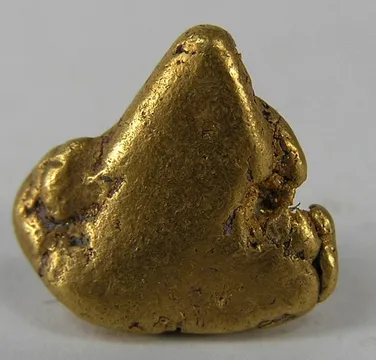
Gold is the reason Morro Velho became a world-class mine, but crystallized native gold specimens from the locality are far scarcer on the collector market than siderite, dolomite, pyrrhotite, or cubanite combinations. Much of the gold in the ore was fine-grained, invisible or difficult to see, occurring in sulfide-bearing lapa seca and quartz-carbonate systems rather than as abundant showy wires or leaves; collectible examples tend to be small nuggets, blebs, or gold in quartz, sometimes with a rounded, buttery luster rather than dramatic crystallization. The most desirable Morro Velho gold specimens are those with old provenance and natural context—gold visibly associated with quartz or ore matrix—because loose nuggets without strong documentation can be difficult to separate confidently from other Brazilian gold localities.
Other documented minerals from Morro Velho include arsenopyrite, pyrite, chalcopyrite, sphalerite, galena, bornite, ullmannite, stibnite, marcasite, tetrahedrite-group minerals, magnetite, hematite, fluorite, albite including andesine, muscovite including fuchsite, apatite and fluorapatite, magnesite, calcite, ankerite, monazite-group minerals, scheelite, wolframite, gypsum var. selenite, and rare or trace ore minerals reported from the gold system. The most important historical mineralogical name is chalmersite, described from Morro Velho material and named for superintendent George Chalmers; it is now treated as cubanite, so Morro Velho is better viewed as a classic historical source for the chalmersite/cubanite problem rather than as the type locality of a currently accepted separate species.
Morro Velho specimens are most often misjudged through association errors. Pyrrhotite, cubanite, chalcopyrite, and tarnished sulfides can be confused on small specimens, and at least some older or dealer-labeled pieces have been noted as having pyrrhotite mislabeled as hematite. Cubanite is especially prone to overcalling: true cubanite on classic Morro Velho pieces is commonly small, brassy, tabular, bladed, prismatic, or acicular, while larger sharp hexagonal metallic plates are often pyrrhotite. Labels that simply say “cubanite” on a sulfide-rich carbonate specimen should be read critically unless the habit and context support it.
Condition is central. The flattened siderite and dolomite rhombs chip at edges, and many old plates have minor contact marks from mining, trimming, or decades of storage. Pyrrhotite and cubanite surfaces can tarnish, lose brightness, or develop bronze-brown oxidation; avoid washing sulfide-rich specimens aggressively, and keep them dry, stable, and away from humid display cases. If a piece carries marcasite or unstable altered sulfides, isolate it from high-value specimens and monitor for sulfate efflorescence or acidic odor.
Scheelite from Morro Velho should be checked under shortwave ultraviolet light, where scheelite typically fluoresces strongly; fluorescence is a useful supporting observation but not a substitute for identification, especially on complex, old matrix pieces. Siderite and dolomite should not be acid-tested on display surfaces, as even weak acid can etch carbonates or dull luster. Gold specimens require the strongest provenance discipline: because many Brazilian gold localities produce loose nuggets and quartz-gold fragments, Morro Velho gold without an old label, collection history, or matrix context should be valued conservatively.
Market availability is best described as intermittent. Siderite, dolomite, pyrrhotite, quartz, and cubanite combinations appear periodically from old collections, with the most desirable pieces tracing to the 1950s–1970s specimen-producing years. Scheelite is much less common, and strong orange crystals on matrix attract specialized competition. Native gold from Morro Velho is scarcer still as a well-documented specimen category, despite the mine’s enormous bullion production. The ideal Morro Velho acquisition is a balanced old-time association piece with clean carbonates, bright sulfides, and a credible historical label.
The human history of Morro Velho begins long before specimen labels. In the eighteenth century, miners followed alluvial gold through the streams and hills around what became Nova Lima, searching for the mother lodes that fed the gravels. The exposed Morro Velho lode cropped out across the Cardoso stream north of town and plunged eastward at about forty-five degrees in a quartz-ankerite-dolomite body. Unlike many Brazilian gold deposits that diminished quickly with depth, this one kept going down. That geological fact shaped a town: cottages for British staff on one side of the ridge, the older Brazilian center on the other, and an underground workplace that became the central force in Nova Lima’s identity.
The St. John d’el Rey Mining Company’s name is itself a small colonial translation. When British directors formed the company in 1830, they anglicized São João d’El Rei into “St. John d’el Rey.” In Brazil the enterprise became known in everyday speech as the Companhia do Morro Velho. By the nineteenth century it was an English industrial enclave in inland Minas Gerais, with Cornish mining knowledge, British managers, Brazilian workers, and enslaved labor bound into the same deepening mine. At the height of the British era, the company employed thousands in a community of tens of thousands; Morro Velho was not just a mine beside Nova Lima, but the engine around which the town’s economy and social geography turned.
On the night of November 21, 1867, fire broke out underground. The old timberwork that held the workings open burned, and the mine collapsed. One account records the deaths of 21 enslaved workers and one English miner. The destruction was so severe that the mine required years of capital, reconstruction, and new shaft work before full production returned. For a collector holding a bright siderite or cubanite specimen today, it is worth remembering that these elegant crystals come from a mine where the passage from old timbered stopes to modern deep mining was paid for in repeated catastrophe.
The next great collapse came on November 10, 1886. Local memory preserves the event with a strange, sharp image: Sebastião, a worker, refused to go down after seeing a small woman at the top of Morro do Cruzeiro screaming for miners not to enter. Others reportedly saw the apparition and went down anyway. Later that day, a huge block fell from the roof of a tunnel, dragging machinery and wooden supports with it. Some miners were buried or trapped; others, nearer the surface, were rescued. Newspapers gave conflicting accounts of the dead, and the most widely circulated official version gave 10 deaths, but local memory held that the toll was greater. The collapse blocked the only entrance, and the company’s London board considered closing the operation. Instead, the disaster became the hinge on which the modern deep mine turned: new vertical ducts and shafts were driven through the Mingú slope, ventilation and cooling were improved, and Morro Velho resumed the downward pursuit of its ore.
There is another, quieter story behind many collector specimens: the role of miners and local buyers in saving mineral pieces from a working gold mine. Álvaro Lúcio, one of Brazil’s important mineral collectors, was active in the region when Morro Velho was in production. Workers collected specimens in cavities of the auriferous quartz veins and sold them in Nova Lima; Lúcio acquired material there on weekends and built a collection representing the mine’s paragenesis. His specimens included Morro Velho scheelite, and his coauthored 1973 article with Richard V. Gaines helped fix the mine in the literature of collector mineralogy. Without that local traffic between underground workers, Nova Lima buyers, and serious mineralogists, many of the best carbonate-sulfide specimens would likely have been crushed, milled, or forgotten.
Morro Velho also entered the visual record through travel and art. Marianne North painted the old gold works from a veranda in 1873, looking across a tropical mining landscape of hills, buildings, rail or tram structures, vegetation, animals, and exposed earth. The painting is not a mineral specimen, but it captures something a specimen cannot: Morro Velho as a nineteenth-century industrial landscape embedded in the green terrain of Minas Gerais. Richard Burton, another English visitor, wrote about the mine in the same broad era and praised the British enterprise, even while later historians noted how such accounts often minimized the danger and violence built into the underground system.
The twentieth century brought further depth and scale. By 1929, Mina Grande had reached level 27 and about 2,453 m depth. In mid-century descriptions, ore moved through underground haulage, hoisting, crushing, milling, concentration, cyanidation, and smelting into gold bars. A 1950s account described daily production around 10 kg of gold and annual treatment on the order of hundreds of thousands of tonnes of ore. Those numbers explain both the mine’s fame and the paradox of its specimens: Morro Velho was a bullion machine, yet the collector pieces are often delicate, small survivals from the margins of production—crystals that escaped the mill because someone underground recognized beauty in the ore.
Richard V. Gaines and Álvaro Lúcio, “The Minerals of the Morro Velho Gold Mine, Brazil,” The Mineralogical Record, 4(5), 224–229, 1973. A foundational collector-mineralogy article on Morro Velho’s specimen suite and paragenesis. Source reference: Government of Canada bibliography entry
D. S. Vial, E. DeWitt, L. M. Lobato and C. H. Thorman, “The geology of the Morro Velho gold deposit in the Archean Rio das Velhas greenstone belt, Quadrilátero Ferrífero, Brazil,” Ore Geology Reviews, 32(3–4), 511–542, 2007. The key modern geological paper on the deposit, its lapa seca host rocks, ore styles, and orogenic-gold interpretation. USGS Publications Warehouse
C. M. Noce, L. M. Lobato, D. S. Vial and coauthors, “U–Pb SHRIMP monazite ages of the giant Morro Velho and Cuiabá gold deposits, Rio das Velhas greenstone belt, Quadrilátero Ferrífero, Minas Gerais, Brazil,” Ore Geology Reviews, 32, 582–608, 2007. Important geochronological work tying hydrothermal monazite ages to the Morro Velho-Cuiabá gold systems. ScienceDirect topic listing via EarthWonders reference context
E. Hussak, “Ueber Chalmersit, ein neues Sulfid der Kupferglanzgruppe von der Goldmine Morro Velho in Minas Geraes, Brasilien,” Zentralblatt für Mineralogie, Geologie und Paläontologie, 3, 69–72, 1902. Original work on “chalmersite,” the historic Morro Velho sulfide later recognized as cubanite. Mindat reference record
E. Hussak, “Nota sobre a chalmersita, mineral do grupo da chalcosina encontrado na Mina do Morro Velho,” Annaes da Escola de Minas de Ouro Preto, 6, 91–97, 1903. Portuguese-language note on chalmersite from Morro Velho. Mindat reference record
Daniel Atencio, Type Mineralogy of Brazil, a book in progress, 2018. Includes a useful historical discussion of chalmersite, its Morro Velho occurrence, its naming for George Chalmers, and its later identity with cubanite. University of São Paulo repository PDF
J. V. N. Dorr II and colleagues, Geology and Mineral Resources of Parts of Minas Gerais, Brazil, U.S. Geological Survey Professional Paper 341-A. Includes older regional and ore-deposit observations on Morro Velho, including gold associated with sulfides in quartz-ankerite-dolomite rock. USGS Professional Paper 341-A
D. H. Eakin, British Enterprise in Brazil: The St. John d’el Rey Mining Company and the Morro Velho Gold Mine, 1830–1960, Duke University Press, 1989. The major English-language historical study of the company, mine, and Nova Lima community. Publisher preview PDF
Mindat — Morro Velho mine, Nova Lima, Minas Gerais, Brazil — The central online mineral-locality database entry, with species list, coordinates, photographs, and locality references.
Mindat — Dolomite from Morro Velho mine — Useful for the locality’s world-class dolomite status, habit notes, and photo-based associations.
USGS Publications Warehouse — Vial et al. 2007 — Authoritative abstract and citation for the main modern geological paper on the deposit.
Serviço Geológico do Brasil Geossit — Mina de Morro Velho — Portuguese-language geosite profile with geology, mining history, ownership, production notes, and bibliography.
Wikimedia Commons — Minerals of the Morro Velho Mine — Open image category with specimen photographs of siderite, dolomite, pyrrhotite, cubanite, quartz, scheelite, apatite, and gold.
Wikimedia Commons — Morro Velho Mine — Broader visual material for the mine, including historical imagery.
SciELO Brasil — “A gente está no centro deles”: mineração e produção de desastres — A modern historical and social analysis of mining disasters, memory, and neighborhood impacts at Morro Velho and Mingú.
Texas Archival Resources Online — Saint John d’El Rey Mining Company Records — Archival finding aid for company records tied to Morro Velho’s British-enterprise period.
AngloGold Ashanti Brasil — Linha do Tempo — Corporate timeline with Morro Velho milestones, including Mina Grande deactivation and the transition to AngloGold.
Agência Brasil archive — Closure of Mina Velha — Contemporary Brazilian news report on the 2003 closure of Mina Velha.
Mineral Auctions — Quartz, Siderite, Dolomite, Fluorapatite, Albite, Pyrrhotite and Cubanite — A well-described old-collection association specimen illustrating the classic Morro Velho suite.
Mineral Auctions — Pyrrhotite & Cubanite on Dolomite — Helpful market description of large classic dolomite-sulfide combination material.
Fabre Minerals — Scheelite search results including Morro Velho — Dealer archive showing Morro Velho scheelite styles, dates, and sizes.