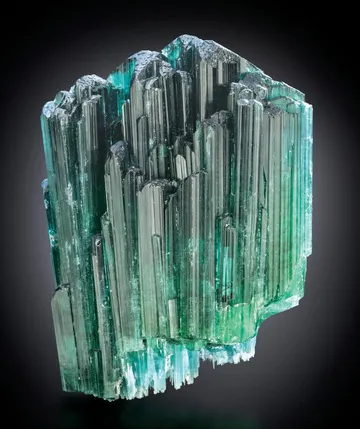
Morro da Mina, Brazil — a historic manganese locality in Minas Gerais, renowned for gemmy red rhodonite crystals and a suite of Mn minerals prized by collector…
Key facts
Morro da Mina is one of the great manganese localities of the Iron Quadrangle region of Minas Gerais, and for collectors it occupies a special place: an old, industrial ore mine that unexpectedly became a modern classic for brilliant red rhodonite. The mine lies at Conselheiro Lafaiete, formerly Queluz de Minas, in a belt of metamorphosed manganese-rich chemical sediments. The protore is not a simple oxide seam but a complex silico-carbonate manganese rock—traditionally discussed as queluzite and gondite—dominated by manganese carbonates and silicates, then overprinted by deformation, shearing, granitic intrusions, weathering, and local hydrothermal remobilization. That history produced an assemblage unusually rich in Mn minerals: rhodochrosite, rhodonite, tephroite, spessartine, alabandite, pyroxmangite, cummingtonite, clino-suenoite, pyrolusite, cryptomelane, and other manganese oxides and silicates.
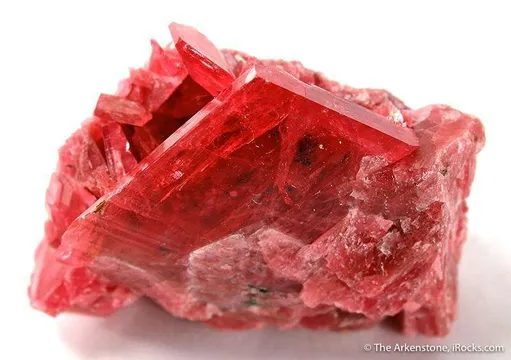
For more than a century Morro da Mina mattered as ore. Its early oxidized manganese ore was high grade, easy to quarry, and tied directly to rail shipment and export. Later, after the supergene oxide ore was largely depleted, mining turned to the harder silico-carbonate ore. For the mineral collector, however, the mine’s fame rests on a much narrower and more beautiful accident of geology: vugs and seams in massive rhodonite-pyroxmangite rock that yielded translucent to gemmy crystals with an intense cherry-red to raspberry-red color. The finest specimens are not merely pink manganese silicate; they are sharp, glassy, saturated red rhodonite crystals, commonly striated, sometimes twinned or intergrown, and at their best perched on pale matrix or associated with white to tan fibrous amphibole. This combination gives Morro da Mina pieces a look unlike the older Broken Hill rhodonites, the Japanese pyroxmangites, or the opaque ornamental rhodonites familiar from lapidary material.
Regional View
Country View
The best Morro da Mina rhodonites have a remarkably “alive” color: red in hand light, glowing crimson on the edges, and often transparent enough that internal needles and veils can be seen without magnification. Many crystals show flat bladed or blocky forms, with strong face luster and fine parallel striation. Matrix examples are scarcer and more desirable than loose crystal fragments, especially when the red crystals contrast with white quartz, pale carbonate, tan cummingtonite, or dark manganese-oxide coatings.
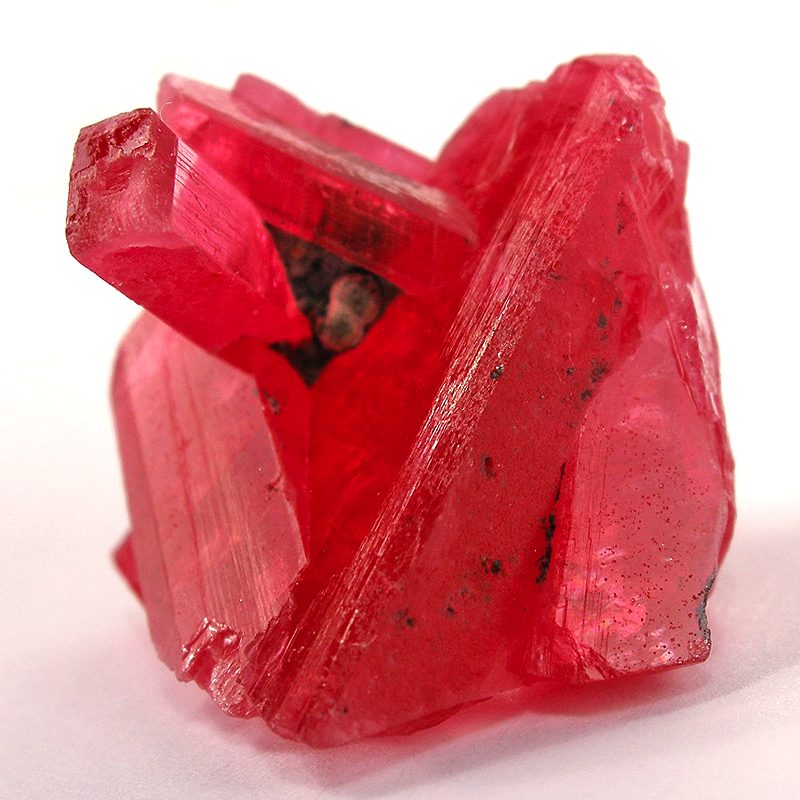
Photo: Rob Lavinsky, iRocks.com / Wikimedia Commons
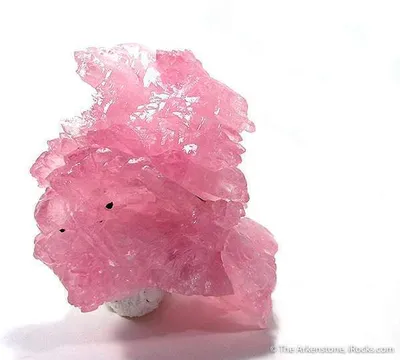
Rhodochrosite is a quieter Morro da Mina prize. It is a major ore mineral microscopically and petrographically, but attractive cabinet specimens are scarce. The notable collector pieces are typically salmon-pink to peach-pink, rounded, botryoidal, or puffy aggregates on pale matrix rather than the transparent scalenohedral crystals associated with Colorado, South Africa, or Peru. Their importance lies in rarity, locality character, and the association with the same manganese system that produced the celebrated rhodonites.

Photo: Rob Lavinsky, iRocks.com / Wikimedia Commons
Search for specimens: View all specimens from Morro da Mina mine, Brazil
Morro da Mina is an open-pit manganese mine on the north side of Conselheiro Lafaiete, Minas Gerais, in the southern part of Brazil’s classic Iron Quadrangle mining province. The locality is historically tied to the old name Queluz de Minas, and the deposit gave its name to the “Queluz” or Morro da Mina type of Brazilian manganese deposit: manganese oxide ore produced by weathering of a deeper manganese silicate-carbonate-sulfide protore. In modern mine geology, the ore occurs within a deformed package of metavolcanic and metasedimentary rocks assigned in local studies to the Rio das Velhas Supergroup, with amphibolite, graphitic biotite schist, biotite-feldspar-quartz schist, phyllite, and granitoid bodies around and within the mineralized zone.
The deposit is fundamentally a metamorphosed manganese sedimentary system. The primary silico-carbonate ore is a compact, gray-brown, hard rock made largely of rhodochrosite, spessartine, rhodonite, tephroite, and related manganese silicates and sulfides, with graphite, amphiboles, mica, quartz, sulfides, and oxide phases. Geological descriptions of the pit emphasize rhythmic compositional banding, strong NW-SE structural trends, steep dips, shear zones, boudinage, tight to isoclinal folding, and faulted or sigmoidal ore bodies. One geotechnical description gives an apparent ore-body thickness around 100 m in the principal body, with additional individual bodies following shear zones. A later academic summary gives the manganese-rich layer an average thickness around 20 m, but with extreme variation—exactly the sort of structural irregularity a collector sees translated at hand-specimen scale as disrupted bands, lensy seams, amphibole sprays, oxide skins, and pockets rather than simple stratiform plates.
The older mine exploited supergene manganese oxide ore. That oxidized ore contained pyrolusite, psilomelane-type barium manganese oxides, cryptomelane, and manganite, and it was richer in manganese than the silico-carbonate ore beneath it. By the late twentieth century the high-grade oxide ore was essentially exhausted, and operations adapted to mining the silico-carbonate ore. This transition is important for collectors: the spectacular rhodonite and rhodochrosite specimens belong to the deeper, less weathered, more mineralogically complex manganese protore, not to the black oxide ore that originally made the mine famous as an industrial property.
Mining began in the 1890s. Historical accounts place the discovery or recognition of the manganese oxide deposit in 1894 and the first export shipment in 1902, after construction of a short rail branch linking the mine to the Central do Brasil railway. In the first years of the twentieth century, ore went mainly to export markets, particularly the United States and Europe. During the world-war years Morro da Mina was a strategic manganese source. Later ownership passed through a series of companies, including U.S. Steel interests through Companhia Meridional de Mineração, then Brazilian ferroalloy interests, and eventually Vale. Vale became sole owner in 1999 and incorporated the mine into Rio Doce Manganês in 2004. Vale completed the sale of the Morro da Mina manganese mine and associated ferroalloy assets to the VDL Group in January 2022; the operation is now associated with Nexus Ligas / Nexus Manganês, with the Conselheiro Lafaiete ore feeding ferroalloy plants at Barbacena and Ouro Preto.
Specimen production has been episodic and small compared with industrial mining. Rhodonite specimens entered the international market in several waves, with a notable 1998 appearance recorded on dealer labels, material collected or photographed around 2002, and later development work in 2005–2006 specifically aimed at recovering specimen-quality rhodonite. The scientifically described gemmy rhodonite material was associated with calcite-filled vugs in massive rhodonite-pyroxmangite rock, and some crystals contain fine cummingtonite needles. Good specimens were never a normal mine product; they came from rare open spaces and seams in a mine worked for bulk manganese ore. That explains the collector market today: small singles and miniatures appear with some regularity, but clean matrix pieces, large gemmy crystals, undamaged clusters, and old-label examples from the early finds are far scarcer.
Collecting access today should be regarded as closed unless arranged through the operating company. Morro da Mina is an active industrial manganese operation, with pit-wall stability, blasting, haulage, plant areas, and controlled mine access. Nearly all specimens reaching collectors have come through miners, mine-approved recovery, dealers, or older collections rather than casual field collecting. Labels may vary—Morro da Mina, Conselheiro Lafaiete, Queluz de Minas, Lafaiete, or simply Minas Gerais—but serious specimens should retain the mine name, especially because Brazilian rhodonite, pyroxmangite, and manganese silicate material from other districts can be visually confusing.
Morro da Mina rhodonite is the locality’s signature collector mineral: translucent to gemmy, vivid cherry-red to raspberry-red crystals from vugs and seams in massive rhodonite-pyroxmangite manganese silicate rock. The best crystals are sharp, glassy, striated, and commonly bladed to blocky; thumbnail and miniature clusters around 2–6 cm are the most familiar, while individual crystals in the 2–4 cm range are exceptional when complete and on matrix. Associations include quartz or chalcedony, rhodochrosite, spessartine, cummingtonite and clino-suenoite, calcite, pyrite, chalcopyrite, and dark manganese oxides. Some gemmy crystals contain curved, randomly oriented cummingtonite needles, a distinctive internal feature documented in gemological and mineralogical studies of the Brazilian material. The finest Morro da Mina pieces separate themselves by saturated pure red color, transparency at the edges or through the crystal, crisp undamaged terminations, strong face luster, and matrix contrast; ordinary pieces tend to be massive, cleaved, contacted, internally clouded, or isolated fragments lacking the sculptural geometry that made the locality famous.
Morro da Mina rhodochrosite is scientifically abundant in the ore but genuinely scarce as attractive specimens. In collector pieces it tends to occur as salmon-pink, peach-pink, to warm orange-pink rounded aggregates, puffy coatings, botryoidal masses, or compact carbonate-rich pieces on pale matrix, with quartz and rhodonite as the most commonly documented visual associates. Cabinet specimens are unusual; an often illustrated example measured 11.8 x 8.4 x 6.3 cm and weighed 450 g, already described as large for the locality. Good examples are valued less for crystal perfection than for strong color, freshness, aesthetic rounded form, and clear Morro da Mina provenance. Because rhodochrosite here is part of the silico-carbonate manganese protore, many massive or dull pieces are ore samples rather than display specimens; the desirable ones are the few that preserve a bright, clean, sculptural carbonate surface without heavy bruising, oxidation, or chalky alteration.
Beyond rhodonite and rhodochrosite, Morro da Mina has a deep manganese-mineral assemblage. Documented species include spessartine, tephroite, pyroxmangite, alabandite, bementite, cummingtonite, clino-suenoite, actinolite, fluorapatite including manganese-bearing fluorapatite, kutnohorite, manganosite, lithiophorite, neotocite, nsutite, pyrolusite, cryptomelane, todorokite, pyrite, pyrrhotite, chalcopyrite, bornite, covellite, siegenite, molybdenite, quartz, chalcedony, graphite, talc, mica-group and chlorite-group minerals. The mine is not best known as a type locality; its importance is instead as a reference locality for a complex metamorphosed manganese system and as the source of analytically studied Ca-Mg-Fe-rich rhodonite. One modern wrinkle is vittinkiite, the Mn-dominant rhodonite-group mineral: Morro da Mina is not its type locality, but analytical work has shown that some Ca-poor “rhodonite-like” material from the mine belongs in that part of the rhodonite-group spectrum, a reminder that red Mn pyroxenoids from this locality cannot always be assigned confidently by eye alone.
The main authenticity issue at Morro da Mina is not widespread fabrication but misidentification and overconfident labeling. Rhodonite, pyroxmangite, and vittinkiite are closely related Mn pyroxenoids, and massive or partly crystalline pieces can be visually indistinguishable without analytical work. Red, bladed crystals from the classic pockets are legitimately sold as rhodonite when supported by provenance and morphology, but massive pink material, old “rhodonite/pyroxmangite” labels, and Ca-poor crystals deserve caution. Fine pieces with old labels from recognized dealers or collections are preferable, especially if the label specifies Morro da Mina mine rather than only “Brazil” or “Minas Gerais.”
Condition is critical. Rhodonite has excellent cleavage and many Morro da Mina crystals came from tight vugs in hard manganese silicate rock, so contacts, cleaved backs, bruised terminations, and edge nicks are common. A specimen can still be excellent with a contacted back if the display face is pristine, but prices change sharply when front terminations are chipped or when the main crystal has a cleave through the face. The best pieces have intact “peaks,” clean red color, no obvious glued repairs, and little black oxide staining on the display faces. Matrix pieces should be inspected for trimming scars and for whether the crystals are actually attached to natural matrix rather than mounted fragments.
Gemmy rhodonite from Morro da Mina is tempting lapidary material, but the same qualities that make it beautiful also make it fragile. Faceted stones may show cracks, needle-like inclusions, and in some cases clarity enhancement; gem reports have documented transparent rhodonite with fracture-filling residue and gas bubbles. For mineral specimens, oiling or resin enhancement is not commonly advertised and should be treated as a disclosure issue if suspected. The material is generally not radioactive and is not known as a fluorescent showpiece; reported gem material may be inert to both long-wave and short-wave ultraviolet light. Avoid ultrasonic cleaning, acids, heat, and prolonged soaking. Rhodochrosite should be handled even more gently because of its lower hardness and acid sensitivity.
Market availability is steady but selective. Small rhodonite crystals, thumbnails, and repaired or contacted examples appear periodically, including from older dealer stocks and collection dispersals. Choice matrix miniatures and small cabinets with saturated gem-red, sharply terminated crystals are much scarcer and can bring strong prices, especially if they show white amphibole or pale matrix contrast. Rhodochrosite from the mine is much less available than rhodonite as a display specimen; any attractive, well-provenanced example is a legitimate locality rarity. Older pyrolusite and manganese ore specimens exist, but they appeal to a different audience and are rarely the reason collectors pursue Morro da Mina today.
In 1907, José Veríssimo described Morro da Mina less as a mine than as a geological astonishment. He struggled with the word “mine” because there were no romantic underground workings to descend into, no hidden vein being chased by candlelight. The thing was out in the open. His unforgettable phrase was “Todo o morro é mina”—the whole hill is mine. Workers attacked the red-dark earth and black-streaked ore with hoes and picks, quarrying the mountain itself in stepped benches. The old town of Queluz de Minas lay about 5 km away; the Rio de Janeiro connection came by the Central do Brasil railway, with a 7 km branch to the mine. The summit stood at 1114 m above sea level, and the rail contour around the deposit averaged about 1050 m.
The early operation was built around motion. Each bench had Decauville track for small ore cars, except the lowest level, where the Central do Brasil cars could be loaded directly. Ore from the upper workings ran through chutes into standard-gauge railcars. Veríssimo admired the loading system: a rail wagon of about 40,000 kg could be filled in six to eight minutes, and the system was organized for 1,000 tonnes per day. Around 150 workers—Brazilian and Italian—were employed at the mine in 1907, and shipments averaged about 50% metallic manganese. The reserve estimate he recorded was immense for the day: five million tonnes available in the first 100 vertical meters, with another comparable probable reserve above the valley floor.
Celso Oliveira Magalhães Gomes, who joined Morro da Mina in 1959 and later gave a long oral-history interview, preserved a different kind of memory: the mine as an institution passing from foreign strategic asset to Brazilian industrial property. He recalled that the name Morro da Mina predated manganese mining and may have come from an old tunnel dug in search of gold, perhaps in the eighteenth century, when prospectors were still imagining Ouro Preto-style veins in the surrounding hills. In his telling, the real manganese story accelerated when investors organized rail access and the first special train of ore left on 12 November 1902 for Rio de Janeiro, feeding an export lot of more than 5,000 tonnes bound for England. The Rio docks were not yet complete, so the ore had to be transferred to barges and carried out to the ship at anchor.
The First World War turned Morro da Mina into a strategic source. Celso remembered the squeeze on other manganese suppliers—Turkey, Russia, India—and the surge of ore from Minas Gerais to Allied industry. U.S. Steel sent missions during the war years, first in 1916 and then more decisively in 1919, evaluating several manganese properties before judging Morro da Mina to have the greatest potential despite risks from freight and taxes. The purchase that followed made the mine part of a larger steelmaking geography, and Celso remembered an American magazine treating it as U.S. Steel’s first offshore property below the equator.
By the 1970s, Morro da Mina was no longer simply the easy oxide hill of Veríssimo’s account. The operation had to reinvent itself around protore—the silico-carbonate manganese rock that earlier generations might have considered less attractive. Celso described the rebirth in industrial terms: long-range planning, carbonates being calcined, and tall vertical furnaces about 23 m high. He also explained why the carbonate-rich ore had value in ferroalloy practice: it carried not only manganese but also calcium and magnesium, reducing the amount of flux that had to be bought and added separately. That detail is one of the charming connections between ore geology and mineral collecting at Morro da Mina. The same chemically complicated stone that made the furnace charge interesting also carried the rhodochrosite, rhodonite, spessartine, tephroite, and amphibole assemblage that collectors now prize.
One of Celso’s best business anecdotes concerns the 1978 sale from U.S. Steel’s Companhia Meridional to Companhia Paulista de Ferro-Ligas. The buyer, Joaquim Salles Leite, arrived prepared to pay 10 million dollars; the asking price was 5 million, essentially the book value. The deal was accepted immediately. Celso remembered the lunch at Morro da Mina on 28 January 1978 and, later, the formal handover in Rio de Janeiro, where he was placed in the odd position of delivering the company on behalf of Meridional and receiving it on behalf of Paulista. He described checking motors and equipment with one hand giving and the other receiving—a neat human image of a mine changing worlds without stopping work.